Arts & Entertainment
Quotidian explores obscure Chekhov with ‘Lady With the Little Dog’
Charming production depicts Russian romance
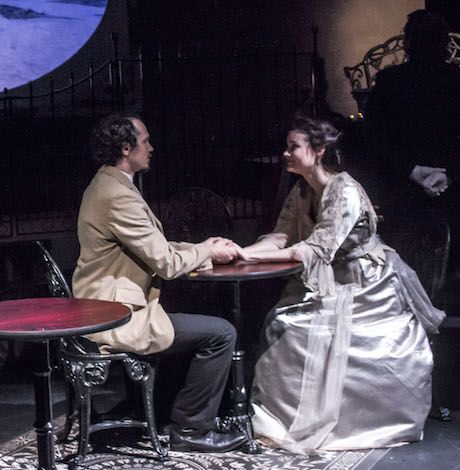
Ian Blackwell Rogers as Guroy and Chelsea Mayo as Anna in ‘The Lady With the Little Dog.’ (Photo by St. John Blondell)
‘The Lady with the Little Dog’
Through Aug. 7
Quotidian Theatre Company
4508 Walsh Street in Bethesda, Md. 20815
$30 (discounts for seniors and students)
301-816-1023
Russian writer Anton Chekhov is known foremost as a dramatist.
His quartet of classics “The Seagull,” “Uncle Vanya,” “Three Sisters” and “The Cherry Orchard” — all ensemble pieces noted for their focus on character and mood rather than plot — are among theater’s most-produced and adored plays. But Chekhov was also a masterful and prolific writer of short fiction. His melancholy romantic tale “Lady with the Dog” (1899) ranks among his best and is now tailored for the stage at Quotidian Theatre Company in Bethesda.
Lovingly adapted as “The Lady with the Little Dog” and staged by Quotidian co-founder Stephanie Mumford, the hour-long play is an imaginative take on the original work. Fortyish banker Dmitry Gurov (Ian Blackwell Rogers) is sliding into middle age. Long bored with his wife and uninterested in family life, he’s had many affairs and expects to have many more. Vacationing alone in Yalta, the fashionable Russian seaside resort, Gurov is charmed by Anna Sergeyevna (Chelsea Mayo), a much younger woman, also alone, who’s in Yalta ostensibly to correct ill health, but is in fact enjoying a temporary escape from dull provincial life where she is unhappily but faithfully married to a government flunky.
Gurov is aware of their age difference: he notes his graying hair and increasingly plain looks and that Anna is not long out of school, but he remains undaunted. The confident philanderer is certain he will have her. As they become acquainted, Gurov says, “I own two houses in Moscow but I no longer sing.” In that short sentence, Gurov imparts the essence of his secure but joyless existence. That will soon change, however. What starts out as a flirtation grows into a passion and then something more.
As director and costume and set designer, Mumford deftly captures the atmosphere of Chekhov and late 19th century bourgeois Russia. Her crowded set includes the compartments that make up Gurov’s life. Stage left is Gurov’s Moscow home complete with three cardboard cutout children. On stage right is the hotel room where he and Anna secretly meet. Bridging those two worlds are Vernet’s coffee pavilion and the seaside promenade — public spaces where the lovers first met.
Mumford further adds to the mood with projections of paintings depicting the natural glories of Yalta, and live classical Russian music played beautifully by pianist Zach Roberts and violinist Christine Kharazian. Roberts doubles as Anna’s ambitious husband and Kharazian brings humor to the role of Gurov’s bespectacled wife, a solemn, self-described intellectual.
Mayo is compelling as guilt-ridden but determined Anna. Rogers gives a nuanced performance as restrained Gurov whose occasional wild eyes reveals his inner turmoil. David Dubov narrates the action as Chekhov, and plays various waiters and friends of Gurov.
Like ambiguity filled real life, “Little Dog” ends on an uncertain note. “And it seemed that, just a little more and the solution would be found, and then a new, beautiful life would begin; and it was clear to both of them that the end was still far, far off, and that the most complicated and difficult part was just beginning.”
Nothing is tied up neatly with a bow. That’s the way Chekhov liked it.


Movies
The queer appeal of ‘The Devil Wears Prada’
Tying the feminist and LGBTQ rights movements together on screen

“Would we have fashion without gay people? Forgive me, would we have anything?”
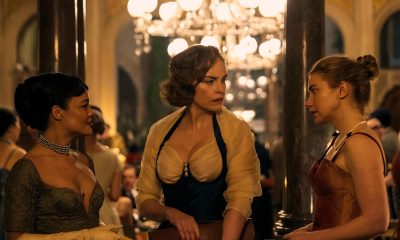
Those words, spoken by Miranda Priestley herself (actually by Meryl Streep, the 76-year-old acting icon who played her), may well sum up why “The Devil Wears Prada” has been a touchstone for queer audiences for two decades now.
Streep, who returns to big screens this weekend in the sequel to director David Frankel’s beloved 2006 classic (succinctly titled “The Devil Wears Prada 2”), expressed this nugget of allyship in a recent interview with Out magazine, promoting the new film’s upcoming release. It would be hard, as a member of the queer community, to disagree with her assessment. The world of fashion has always been inextricably linked with queer culture, and the whims of taste that drive it are so frequently shaped by queer men – and women, too – who have adopted it as a means of expressing their sense of identity from the very first time they thumbed through a copy of Vogue.
At the same time, the notion that “Prada” has been claimed by the community as “canon” simply because of the stereotypical idea that “gay people love fashion” feels like a lazy generalization. After all, fashion is about discernment – about knowing, if you will, whether a sweater is simply blue or if it is cerulean, and, importantly, understanding why it matters – and just because something ticks off a few basic boxes, that doesn’t mean it qualifies as “haute couture.”
So yes, the setting of the “Devil Wears Prada” universe in what might be called “ground zero” of the fashion industry plays a part in piquing queer interest, but to assume our obsession with it is explained as simply as that is, frankly, insulting. The fashion angle catches our interest, but it’s the story – and, more to the point, the central characters (all of which return in the sequel) – that reels us in.
First, there’s the ostensible heroine, Anne Hathaway’s Andrea (or rather, Andy) Sachs, who falls into the world of fashion almost by accident. She’s a recent college grad who wants to be a journalist, to write for a publication that operates on a less-superficial level than Runway magazine, but fate (for lack of a better word) places her in the job that “a million girls” would kill to have – assistant to Streep’s Miranda Priestly (based on Vogue editor Anna Wintour), who can determine an entire season’s fashion trends merely by pursing her lips. She’s idealistic, and dismissive of fashion in the overall scheme of human existence; she’s also stuck with a truly terrible boyfriend (Nate, played by Adrian Grenier) and trying to live up to the self-imposed expectations and ideals that have been foisted upon her since birth.
It’s clear from the start that none of this “fits” her particularly well. More significantly, the natural grace with which she blossoms, from “sad girl” fashion-victim to the epitome of effortless style, tells us that she was meant to be exactly where she is, all along.
Then, of course, there is Nigel (Stanley Tucci), the ever-loyal art director and “Gay Best Friend” that’s always there to provide just the right saving touch for both Miranda and Andy, helping to boost the former while gifting the latter with his own insight, “tough love,” and impeccable taste. Never mind that he’s a queer character played by a straight actor – Tucci avoids stereotype and performative flamboyance by simply playing it with pure, universally relatable authenticity – or that he ends up, at the end of the original film, betrayed by his goddess yet deferring his own dream to double down on his commitment to hers. Anyone who has ever been a gay man in the orbit of a remarkable woman knows exactly how he feels. Of course, they also probably know the precarious life of being a queer person in the workplace – something that carries its own set of compromises, disappointments, and determinations to go above-and-beyond just to make oneself invaluable to the powers that be.
Which brings us to Emily (Emily Blunt), the cutthroat “first assistant” who does her level best to keep Andy in her place, who goes to extremes (“I’m just one stomach flu away from my goal weight”) to be the “favorite” no matter how much cruelty she has to unleash on those who threaten her status. Some see her as merely an obstacle in the way of Andy’s rise to success, an antagonist whose efforts to embody the “no mercy” persona of an ascendent girl boss only expose her own mediocrity. But for many, she’s just another victim doomed to fail and fall while watching others rise to the top. Queer, straight, or in-between, who among us hasn’t been there?
Finally, of course, there is Streep’s Miranda Priestley, the presumed “devil” of the title and the epitome of mercilessly autocratic authority, who has earned her status and her power by embracing the toxic modus operandiof a misogynistic hierarchy in order to conquer it. Yes, she’s more than just a little horrible, a strict gatekeeper who hones in on perceived weaknesses with all the vicious premeditation of a hawk with its eyes on a luckless rabbit, and it would be easy to despise her if she weren’t so damn fabulous. But thanks to the incomparable Oscar-nominated performance from Streep – along with the glimpses we are afforded into her “real” life along the way – she is not just aspirational, but iconic. Stoic, imperturbable, always three steps ahead and never affording an inch of slack for any perceived shortcoming, there’s an undeniable excellence about her that inspires us to see beyond the obvious dysfunction of the “work ethic” she represents; and sure, there’s enough emotionally detached enthusiasm in her torment/training of Andy to fuel countless volumes of erotic lesbian fan-fiction (Google “MirAndy,” if you dare), but when we eventually recognize that she might just be the ultimate “fashion victim” of them all, it doesn’t just cut us to the core – it strikes a chord that should be universally recognizable to anyone who has had to make their own “deal with the devil” in order to claim agency in their own lives. In this way, “The Devil Wears Prada” comes closer than probably any mainstream film to tying the feminist and queer rights movements together in common cause.
In any case, each character, in their way, can easily be tied to a facet of queer identity – and indeed, to the identity of anyone who must work twice (or more) as hard as a straight white Christian male to succeed. We can see ourselves reflected in all of them – and whether we aspire to be Miranda (I mean, who wouldn’t?), identify with Andy, recognize our worst traits in Emily, or empathize with Nigel and his deferential suffering, there’s something in “The Devil Wears Prada” that resonates with everyone.
Now let’s see if the sequel can say the same.

Lesbifriends Travel will host “Queer Night Out: DC Power FC Game” on Wednesday May 6 at 7 p.m. at Audi Field.
This will be a fun night out as DC Power FC takes the field at Audi Field, kicking off with a happy hour meetup in Navy Yard before the group walks to the stadium together. Lesbifriends and Travel group will be seated together in the stands, making it easy to connect, cheer, and enjoy the game with people who just feel like your people.
More details are available on Eventbrite.
Friday, May 1
Go Gay DC will host “First Friday LGBTQ+ Community Social” at 7 p.m. at Silver Diner Ballston. This is a chance to relax, make new friends, and enjoy happy hour specials at this classic retro venue. Attendance is free and more details are available on Eventbrite.
“Illusions The Drag Queen Show Washington, D.C.” will be at 7 p.m. at 2323 18th St., N.W. Come see this amazing D.C. drag show and laugh all night long while being amazed by the stellar performances in tribute to some of your old-time favorite classics as well as the latest pop favorites. Come see the likes of Madonna, Cher, Tina Turner, Whitney Houston, Joan Rivers, Phyllis Diller, Beyoncé, Pink, and many more. Tickets are $12.97 and are available on Eventbrite.
Saturday, May 2
Go Gay DC will host “LGBTQ+ Community Brunch” at 11:00a.m. at Freddie’s Beach Bar & Restaurant. This fun weekly event brings the DMV area LGBTQ+ community, including allies, together for delicious food and conversation. Attendance is free and more details are available on Eventbrite.
Drag Queen Sip and Paint Washington DC will be at 4 p.m. at Town Tavern DC. This event combines the joy of painting with the lively energy of a drag queen, offering an hour and a half of fun, creativity, and entertainment. Participants paint a canvas while enjoying cocktails, all under the guidance of a glamorous drag queen host. Tickets are $47.19 and are available on Eventbrite.
Monday, May 4
“Center Aging: Monday Coffee Klatch” will be at 10 a.m. on Zoom. This is a social hour for older LGBTQ+ adults. Guests are encouraged to bring a beverage of choice. For more information, contact Adam ([email protected]).
Tuesday, May 5
Universal Pride Meeting will be at 7 p.m. on Zoom. This group seeks to support, educate, empower, and create change for people with disabilities. For more details, email [email protected].
Wednesday, May 6
Job Club will be at 6 p.m. on Zoom upon request. This is a weekly job support program to help job entrants and seekers, including the long-term unemployed, improve self-confidence, motivation, resilience and productivity for effective job searches and networking — allowing participants to move away from being merely “applicants” toward being “candidates.” For more information, email [email protected] or visit thedccenter.org/careers.
Center Aging Women’s Social and Discussion Group will be at 6 p.m. on Zoom. This group is a place where older LGBTQ+ women can meet and socialize with one another. There will be discussion, activities, and a chance for guests to share what they want future events to include. For more information, email [email protected].
Thursday, May 7
The DC Center’s Fresh Produce Program will be held all day at the DC Center for the LGBT Community. People will be informed on Wednesday at 5 p.m. if they are picked to receive a produce box. No proof of residency or income is required. For more information, email [email protected] or call 202-682-2245.
Virtual Yoga Class will be at 7 p.m. on Zoom. This free weekly class is a combination of yoga, breath work and meditation that allows LGBTQ+ community members to continue their healing journey with somatic and mindfulness practices. For more details, visit the DC Center’s website.

Tennessee’s trans data bill a frightening omen

The queer appeal of ‘The Devil Wears Prada’

Lesbifriends Travel to host queer night out

Republicans attach five anti-LGBTQ riders to State Department funding bill

Calendar: May 1-7

House Republicans push nationwide ‘Don’t Say Gay’ bill

European Parliament backs EU-wide conversion therapy ban

LGBTQ people are leaving Orthodox Judaism behind

Rep. Sarah McBride reflects on first year in Congress amid political backlash

Democracy Forward files FOIA request for State Department bathroom policy records
-

 Federal Government4 days ago
House Republicans push nationwide ‘Don’t Say Gay’ bill
-
European Union2 days ago
European Parliament backs EU-wide conversion therapy ban
-
News4 days ago
LGBTQ people are leaving Orthodox Judaism behind
-
Delaware3 days ago
Rep. Sarah McBride reflects on first year in Congress amid political backlash