Local
D.C. Council candidate no longer opposes gay marriage law
Harry Thomas resignation triggers Ward 5 special election
An outspoken advocate for placing D.C.’s same-sex marriage law on the ballot in a voter referendum in 2010 says he no longer holds that view and will express “respect” for the law as a candidate for the City Council in a special election this spring.
Civic activist Delano Hunter has announced plans to run for the Ward 5 Council seat that became vacant last week when incumbent Harry Thomas, a Democrat, resigned after pleading guilty to federal theft and tax evasion charges.
“I do not seek to overturn the Marriage Equality Act when elected,” Hunter told the Blade in a statement released on Tuesday.
“I will, however, continue to establish working relationships within the LGBT community to focus on issues that affect the quality of life for all residents of the District of Columbia,” he said.
Hunter unsuccessfully challenged Thomas in the September 2010 Democratic primary. He received the backing of anti-gay groups that opposed the same-sex marriage law. The D.C. Council approved the law in December 2009.
At the time, Hunter joined gay marriage opponents in calling for a voter referendum to overturn the law. The city’s election board ruled that the law could not be subjected to a referendum, saying doing so would violate the city’s Human Rights Act, which bans discrimination based on sexual orientation.
The D.C. Superior Court, the D.C. Court of Appeals and the U.S. Supreme Court upheld the election board’s ruling following a series of appeals by gay marriage opponents who challenged the election board’s decision.
In an exclusive Jan. 10 interview with the Blade, Hunter said that while groups opposed to same-sex marriage endorsed his candidacy in the 2010 Democratic primary, he focused his campaign on other issues, such as unemployment, crime and the high rate of HIV infection among residents of his ward.
Thomas, who supported the marriage law and opposed subjecting it to a referendum, defeated Hunter by a margin of 61 percent to 19 percent in the September 2010 primary.
Hunter said he now considers the marriage law a “settled issue” and has no intention of raising it as an issue in a special election to fill Thomas’s seat that is expected to take place in May.
“My stance is that I respect the Marriage Equality Act,” he told the Blade. “It gives individuals the right to marry whom they chose. But also it gives our religious institutions the right to ordain marriage according to their beliefs. So that is something that I’m in agreement with. It is settled. It is a moot point.”
Hunter said he did not take a position in 2010 and has no position now on whether the D.C. Council should or should not have passed the same-sex marriage law.
“My position was that residents should have the right to vote on this issue,” he said. “That was something that was approved by residents of our ward within a [Washington Post] straw poll…So for me, I said, OK, if folks want the right to discuss this through this method, we should do so.”
Hunter added, “Obviously, it was approved by the Council and the courts said it was not something that can be voted upon. And those are our elected representatives. They passed the law. It’s done.”
Thomas announced his resignation less than a day after federal authorities charged him with felony theft for allegedly embezzling more than $350,000 in government funds and filing false income tax returns with the IRS.
He pleaded guilty on Jan. 6 to one count of theft concerning city programs receiving federal funds and one count of filing a false tax return.
“I am resigning my position as a member of the Council effective immediately,” Thomas said in a statement released Jan. 5. “I made some very serious mistakes and exhibited inadequate and flawed judgment. I take full responsibility for my actions. I am truly sorry.”
Among those calling for Thomas’s resignation last fall, when news surfaced that he was about to be charged with an embezzlement related offense, were Robert Turner, president of the D.C. Log Cabin Republicans, a gay group; and Robert Kabel, the gay chair of the D.C. Republican Party.
Most gay Democratic activists who supported Thomas before news surfaced about his legal problems, including the Gertrude Stein Democratic Club, the city’s largest LGBT political group, did not join others in calling for his resignation.
Thomas drew praise from LGBT activists in 2009 when he voted for the city’s same-sex marriage law over strong objections from many of his Ward 5 constituents, who oppose same-sex marriage.
A large number of the ward’s residents are conservative African Americans who support civil rights related legislation but oppose same-sex marriage on religious grounds. Clergy from black churches in the ward testified against the marriage bill during a contentious City Council hearing prior to the Council’s vote to approve the bill in December 2009.
The anti-gay National Organization for Marriage and other national groups opposed to same-sex marriage contributed tens of thousands of dollars for direct mail, robocalls, and racially divisive fliers attacking Thomas during his re-election campaign in 2010, according to Right Wing Watch, a project of People for the American Way, an LGBT-supportive organization.
Right Wing Watch said some of the same anti-gay groups supported Delano Hunter’s race against Thomas but didn’t contribute large amounts of money directly to his campaign. NOM sent a mailer supportive of Hunter to residents of Ward 5 in 2010.
LGBT activists were quick to point out that the attack campaign against Thomas had little effect since he won re-election by a large margin.
Gay Republican Tim Day, a member of Log Cabin Republicans, ran against Thomas in the general election in November 2010 but lost by a lopsided margin in a ward that is overwhelmingly Democratic. Day hasn’t said whether he will run for the seat in the special election this year.
Other Democrats are expected to run in the special election for Thomas’s seat. LGBT advocates and gay residents of the ward will likely appeal to Council member Vincent Orange (D-At-Large), who formerly held the Ward 5 seat, to back a candidate supportive of LGBT equality and same-sex marriage. Orange remains a popular figure in the Ward.
He opposed same-sex marriage at the time he held his Ward 5 seat and when he ran unsuccessfully for mayor in 2006. But Orange changed his position shortly before he ran for the at-large Council seat in a special election, saying he now strongly supports civil marriage for gay and lesbian couples.
The Stein Club, which plans to endorse a Democratic candidate in the special election, issued a statement last week saying its members’ thoughts were with Thomas’s family and the residents of Ward 5.
“While we are saddened that someone who many in our community supported and had high hopes for fell short of our collective ethical expectations for public officials, our primary concern is with the residents and youth of Ward 5,” the Stein Club statement says. “We plan to stay engaged in the process to ensure that the next Ward 5 councilmember is both a strong supporter of gay, lesbian, bisexual, and transgender rights and a person who holds himself or herself up to the highest ethical standards.”


Virginia
Fellow lawmakers praise Adam Ebbin after Va. Senate farewell address
Gay state senator to take job in Spanberger administration
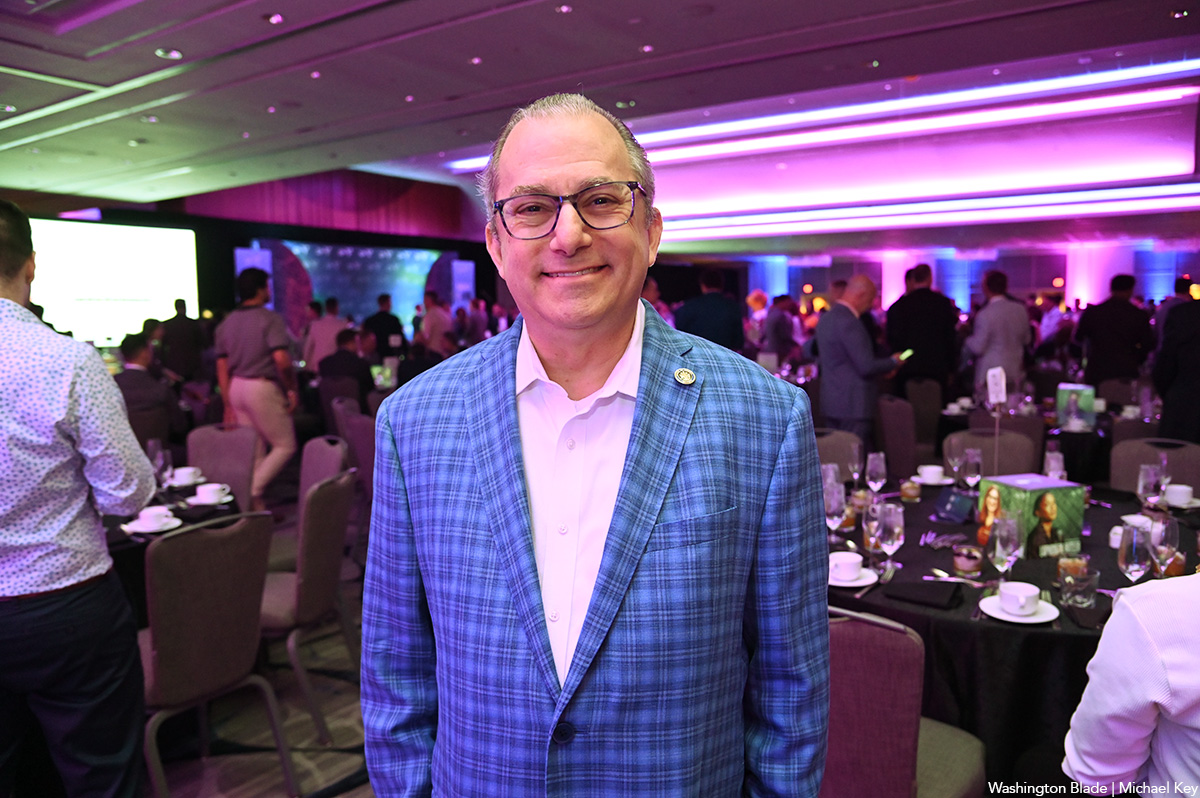
Gay Virginia state Sen. Adam Ebbin (D-Alexandria) delivered his farewell address on Feb. 16 in the Senate chamber in Richmond following his decision to resign from his role as a lawmaker to take a position as senior advisor to Democratic Gov. Abigail Spanberger.
Ebbin, whose resignation was to take effect Feb. 18, received a standing ovation from his fellow senators. Several of them spoke after Ebbin’s address to praise him for his service in the Virginia Senate from 2012 to 2026.
Ebbin first won election to the Virginia House of Delegates in 2003 as the first openly gay member of the General Assembly. He served in the House of Delegates from 2004 to 2012 before winning election to the Senate in 2011.
His Senate district includes Alexandria and parts of Arlington and Fairfax Counties.
“Serving in this body has been the greatest honor of my life,” Ebbin said in his farewell address. “Representing Northern Virginia in the General Assembly — my adopted home since 1989 — has been a responsibility I never took lightly,” he said.
“We are a 406-year-old institution,” he told his fellow lawmakers. “But, when I arrived, I had the distinct honor of being a ‘first’ in the General Assembly,” he said. “Being an openly gay elected official 22 years ago didn’t earn you book deals or talk show appearances — just a seat in a deep minority across the hall.”
Ebbin added, “Still, being out was a fact that felt both deeply personal and unavoidably public. I was proud, but I was also very aware that simply being here carried a responsibility larger than myself.”
Ebbin has been credited with playing a lead role in advocating for LGBTQ rights in the General Assembly as well as speaking out against anti-LGBTQ proposals that have surfaced during his tenure in the legislature.
In his speech he also pointed to other issues he has championed as a lawmaker; including strengthening education programs, expanding access to healthcare, safeguarding the environment, and legislation to help “stand up for working people.”
Among the LGBTQ rights legislation he pushed and mentioned in his speech was the Virginia Values Act of 2020, which bans discrimination based on sexual orientation and gender identity, among other categories.
“I’m particularly proud of our work ensuring Virginia modernized state law to protect LGBT people from discrimination in their daily lives, including in employment, housing, and public accommodations,” he said in his speech. “The Virginia Values Act of 2020 — my proudest achievement — established new protections for all Virginians,” he said.
“This law, the first of its kind in the South, passed with strong bipartisan support,” he stated. “And now — this November — after 20 years, Virginians will finally be able to vote on the Marriage Equality Amendment, which will protect the ability to marry who you love. It’s time for our state constitution to accurately reflect the law of the land.”
He was referring to a proposed state constitutional amendment approved by the General Assembly, but which must now go before voters in a referendum, to repeal a constitutional amendment approved by the legislators and voters in 2006 that bans same-sex marriage.
The U.S. Supreme Court’s Obergefell ruling legalizing same-sex marriage nationwide voided the Virginia same-sex marriage ban. But Ebbin and LGBTQ rights advocates have called on the General Assembly to take action to repeal the amendment in case the Supreme Court changes its ruling on the issue.
In his new job in the Spanberger administration Ebbin will become a senior advisor at the Virginia Cannabis Control Authority, which regulates policies regarding marijuana possession and distribution.
Ebbin was among the lead sponsors of legislation in 2020 to decriminalize possession of marijuana and of current pending legislation calling for legalizing possession.
“When I first entered the General Assembly, I saw too many lives upended by a simple marijuana charge — jobs lost, futures delayed, families hurt,” he said in his speech. “And for far too long, that harm was baked into our laws. That is no longer the case. The times have changed and so have our laws.”
Ebbin said he was also proud to have played some role in the changes in Virginia that now enable LGBTQ Virginians to serve in all levels of the state government “openly, authentically, and unapologetically.”
“I swore to myself that I wouldn’t leave until there was at least one more lesbian or gay General Assembly member,” Ebbin said in his speech. “But when I leave, I’m proud to say we will have an 8-member LGBTQ caucus.”
And he added, “And if anyone on the other side of the aisle wants to come out, you will be more than welcome — we’re still waiting on that first openly gay Republican.”
District of Columbia
Deon Jones speaks about D.C. Department of Corrections bias lawsuit settlement
Gay former corrections officer says harassment, discrimination began in 1993
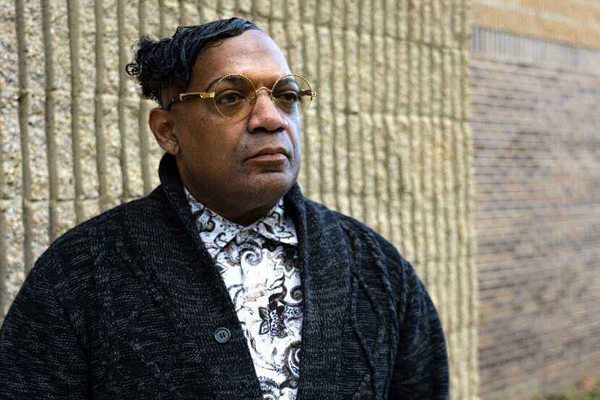
Deon Jones says he is pleased with the outcome of his anti-gay bias lawsuit against the D.C. Department of Corrections that ended after five years on Feb. 5 with the D.C. government paying him $500,000 in a settlement payment.
The lawsuit, filed on his behalf by the American Civil Liberties Union of D.C. and the international law firm WilmerHale, charged that Jones, a Department of Corrections sergeant, had been subjected to years of discrimination, retaliation, and a hostile work environment because of his identity as a gay man in clear violation of the D.C. Human Rights Act.
A statement released by the ACLU at the time the settlement was announced says Jones, “faced years of verbal abuse and harassment, from co-workers and incarcerated people alike, including anti-gay slurs, threats, and degrading treatment.”
The statement adds, “The prolonged mistreatment took a severe toll on Jones’s mental health, and he experienced depression, post-traumatic-stress disorder, and 15 anxiety attacks in 2021 alone.:
Jones said the harassment and mistreatment he encountered began in 1993, one year after he first began work at the Department of Corrections and continued for more than 25 years under six D.C. mayors, including current Mayor Muriel Bowser, who he says did not respond to his repeated pleas for help.
Each of those mayors, including Bowser, have been outspoken supporters of the LGBTQ community, but Jones says they did not intervene to change what he calls the homophobic “culture” at the Department of Corrections.
The Department of Corrections, through the Office of the D.C. Attorney General, which represents city agencies against lawsuits, and the mayor’s office, have so far declined to comment on the lawsuit and the half million-dollar settlement the city offered to Jones, who accepted it.
Among other things, the settlement agreement states that Jones would be required to resign from his job at the Department of Corrections. It also declares that “neither the parties’ agreement nor the District government’s offer to settle the case shall in any way be construed as an admission by the District that it or any of its current or former employees, acted wrongfully with respect to plaintiff or any other person, or that plaintiff has any rights.”
Scott Michelman, the D.C. ACLU’s legal director said that type of disclaimer is typical for parties that agree to settle a lawsuit like this. He said the city’s action to pay Jones a half million-dollar settlement “speaks louder than words.”
With that as a backdrop, Jones reflected on the settlement and what he says was his tumultuous 30-year career as an employee at the D.C. Department of Corrections in a Feb. 9 interview with the Washington Blade.
He and Michelman pointed out that Jones was placed on paid administrative leave in April 2022, one year after his lawsuit was filed. Among his upcoming plans, Jones told the Blade, is to publish a podcast that, among other things, will highlight the hardship he faced at the Department of Corrections and advocate for LGBTQ rights.
BLADE: What are your thoughts on this lawsuit settlement which appears very much in your favor?
JONES: That’s great. I’m happy. I’m glad to resign. It’s been a long time coming. It was the worst time it’s ever been. And I have advocated for the community for many, many years. And not only standing up for my rights but for the rights for others in the LGBTQ community.
And I’m just tired now. And my podcast will start soon. And I will continue to advocate for the community.
BLADE: Can you tell a little about that and when it will begin?
JONES: Once in April, once everything is closed my podcast will be starting. And that’s Deon’s Chronicle and Reveal. Yes, my own podcast.
BLADE: Since we have reported your attorney saying you have been on administrative leave since March of 2022, some in the community might be interested in what you have been doing since that time. Did you get another job or were you just waiting for this case to be resolved?
JONES: I was waiting for this to be resolved. I couldn’t work. That would violate policy and procedures of the D.C. government. So, I could not get another job or anything else.
BLADE: You have said under administrative leave you were still getting paid. You were still able to live off of that?
JONES: Yes, I was able to. Yes, sir. I used to do a lot of overtime. As a zone lieutenant for many years, I have supervised over 250 officers. I’ve also supervised over 25,000 inmates in my 30 years.
BLADE: How many years have you been working for the Department of Corrections?
JONES: It’s 30 years all together. I started down at the Lorton facility. Six facilities — I’ve worked for past directors, deputy directors, internal affairs. I’ve done it all.
BLADE: Do you have any plans now other than doing the podcast?
JONES: Well, to just do my podcast and also to write my book and my memoir inside of the house of pain, the house of shame — what I’ve been through. When I start my podcast off it will be stories — Part 1 through Part 4. And I will go back to the Lorton days all the way up to now. When it first started was sexual harassment and discrimination back down at Lorton. And I mean this has just been the worst time around.
BLADE: So, did you first start your work at the Lorton Prison?
JONES: Yes, I was at the central facility, which was the program institution.
MICHELMAN: Just for context. You may remember this, but the Lorton facility was where D.C. incarcerated people were held. So, that was part of the D.C. Department of Corrections.
BLADE: Yes, and that was located in Lorton, Va., is that right?
JONES: Right.
BLADE: Didn’t that close and is the main incarceration facility is now in D.C. itself?
JONES: Yes. And that closed in 2001.
BLADE: I see. And is the main D.C. jail now at a site near the RFK Stadium site?
JONES: Yes, sir. And next-door is the correctional treatment facility as well.
BLADE: So, are you saying the harassment and other mistreatment against you began back when you were working at the Lorton facility?
JONES: At the Lorton central facility. And they used to flash me too. When I say flash me like the residents, the inmates were flashing. And they [the employees] were flashing.
BLADE: What do you mean by flashing?
JONES: They take their penis out and everything else. I mean the sexual harassment was terrible. And I came out then down there. And I continued to advocate for myself and to advocate for other people who I was told were being picked on as well.
BLADE: As best you can recall, where and what year did that happen?
JONES: That was back in 1993 in April of 1993.
BLADE: The mayor’s office has declined to comment on the settlement and payment the city is giving you. Yet they have always said they have a strong policy of nondiscrimination protections for LGBTQ people in D.C. government agencies. But do you think that was not carried out at the Department of Corrections?
JONES: That’s a blatant reason why — I had 13 anxiety attacks. It was so blatant. Can you imagine? On the airwaves or the walkie-talkies — everybody had a walkie talkie — the captains and the majors and everything. And you transmit it to the command center or something like that. When you finish someone gets on the air and calls you a sissy or a fag.
They received so many complaints, and I also sent the mayor so many emails and begging for help. And they ignored it. They didn’t address any complaints at all. So, that’s bull.
BLADE: But now after you filed your lawsuit and you received this settlement do you think there will be changes there to protect the rights of other LGBTQ employees?
JONES: I hope so, because I have been defending community rights. For many years I have been advocating for different things and different services. And I’ve seen the treatment. There are a lot of mistreatments towards the community over there. And I have taken a stance for a lot of people in the community and protecting their constitutional rights as well as mine.
BLADE: What advice might you have for what the Department of Corrections should do to correct the situation that led to your lawsuit?
JONES: Well, what my advice for the department is they need to go back over their training. And they need to enforce rules against any acts of discrimination, retaliation, or sexual harassment. They need to enforce that. They’re not enforcing that at all. They’re not doing it at all. And this time it was worse than ever, then I’ve ever seen it. That you would get on the walkie talkie and someone would call you a fag or a sissy or whatever else or do evil things and everything. They are not enforcing what they are preaching. They are not enforcing that.
BLADE: Is there any kind of concluding comment you may want to make?
JONES: Well, I hope that this litigation will be a wakeup call for the department. And also, that it will give someone else the motivation to stand up for their rights. I was blessed to have the ACLU and WilmerHale to protect my constitutional rights. So, I am just really happy. So, I’m hoping that others will stand up for their rights. Because a lot of people in the community that worked there, they were actually afraid. And I had some people who actually quit because of the pressure.
Baltimore
‘Heated Rivalry’ fandom exposes LGBTQ divide in Baltimore
Hit show raises questions about identity, cultural representation

By JOHN-JOHN WILLIAMS IV | “Heated Rivalry,” the surprise gay hockey romance that has captivated global audiences and become a cultural phenomenon, has inspired sold-out parties celebrating the characters from the steamy series, including in Baltimore.
For some, love of the show has exposed the loss of a once-vibrant gay nightlife in Charm City and splintered its LGBTQ community. It also brings up layered questions about identity, cultural representation, and the limits of identity politics.
In Baltimore, the majority of the parties also appear to be missing a key ingredient that has been a part of the show’s success: gay men at the helm. Last month, women hosted a dance party at Ottobar, a straight establishment.
The rest of this article can be read on the Baltimore Banner’s website.

EXCLUSIVE: Markey says transgender rights fight is ‘next frontier’

LGBTQ activists mourn the Rev. Jesse Jackson

Trump falsely links trans people to terrorism

Fellow lawmakers praise Adam Ebbin after Va. Senate farewell address

LGBTQ groups question US health agreements with African countries

FOIA lawsuit filed against State Department for PEPFAR records

Trans sports bans rooted in eugenics

Pride flag raised at Stonewall after National Park Service took it down

Trans students not included in new India University Grants Commission equity rules

Calendar: February 13-19
-

 State Department5 days ago
FOIA lawsuit filed against State Department for PEPFAR records
-
Opinions5 days ago
Trans sports bans rooted in eugenics
-
New York5 days ago
Pride flag raised at Stonewall after National Park Service took it down
-
India5 days ago
Trans students not included in new India University Grants Commission equity rules