Commentary
Are you sure you know how to use a condom?
Tips for practicing safer sex this Valentine’s Day

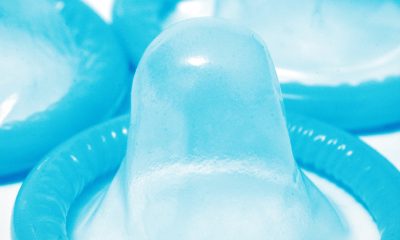
(Photo by Inga via Wikimedia Commons)
By JUSTIN GOFORTH
February is National Condom Month. Appropriate for the same month as Valentine’s Day when all that talk of love can make one amorous.
But, when the mood strikes, are you taking precautions to protect yourself? Based on reports from here in D.C. and around the nation, many people aren’t.
More than three decades into the HIV/AIDS epidemic, we’re still telling people about the importance of condoms. Even with recent advancements in HIV prevention, there are still STDs that can change your life.
Watched the news lately? A drug-resistant strain of gonorrhea has just been found in North America. And untreated gonorrhea could have some really nasty effects on your body.
Condoms aren’t a 100 percent guarantee against STDs and won’t protect against everything. But using them correctly and consistently will dramatically reduce your chances of catching an infection.
Most condom failures are due to user mistakes, including damaging the condom when opening it or – and we’re not kidding here – putting it on wrong. You may think that using a condom is simple. But many people still don’t understand how to use them properly.
So how do you use a condom correctly? Let’s take this step by step:
• Use a new condom for each sex act. Recycling is not good here.
• Use only latex or polyurethane condoms. Lambskin condoms do not protect against HIV.
• Open the package carefully.
• Put on the condom after erection but before insertion. For someone who’s uncut, pull the foreskin back before you put the condom on.
• Pinch the tip to leave a little bit of room. Even if there isn’t a “reservoir end,” squeeze the tip.
• Hold the tip and unroll the condom all the way down.
• Once they’ve…finished…hold the condom close to the base of the penis and pull out.
• Throw it away immediately.
If you feel a condom break during sex, stop, pull out immediately and use a new one. Most condom breakage is due to lack of lubrication, so lube it up.
Now, a few other points you need to remember:
• Only use water-based or silicone lubricant. Anything else will damage the latex and could cause the condom to break. Leave the flavored lubricants to make oral sex yummier, as they are not made for intercourse.
• Condoms have a shelf life — they aren’t Twinkies. Check the expiration date on the package and throw out expired condoms.
• Don’t carry condoms in your back pocket or wallet. Prolonged exposure to body heat and moisture can weaken them. Use a shirt pocket or protective case.
If you use condoms consistently and correctly, you can greatly reduce your risk of catching many STDs, including HIV, gonorrhea and chlamydia.
Condoms are less effective against STDs like herpes, syphilis or human papillomavirus, which are spread by skin-to-skin contact instead of through body fluids. But, if the condom covers the infected area or site of possible exposure, it can sometimes reduce the risk of infection.
If you want to reduce your risk of STDs, condoms should be just one tool in your toolkit, including:
• Talk with your partner(s) about your sexual history and HIV/STD status.
• Frequent HIV/STD testing if you have more than one partner.
• Reducing the number of sexual partners you may have.
• Checking each other for signs and symptoms of STDs before sex.
• Exploring other sexual interests besides penetrative sex.
• Learning about Post Exposure and Pre-Exposure Prophylaxis (PEP and PrEP), which use medications to stop HIV infection if exposed.
Whitman-Walker can help you with everything here: access to condoms, education about proper use, and free STD testing. We’re here to help and to make sure that you live a long, happy and healthy life.
Justin Goforth is director of medical adherence for Whitman-Walker Health. Reach him via whitman-walker.org.



Commentary
Asian American and LGBTQ: A Heritage of Pride
May is Asian American, Native Hawaiian and Pacific Islander Heritage Month
Asian Americans and Pacific Islanders (APIs) are the nation’s fastest growing racial minority group by 2040, one in 10 Americans will be of Asian ancestry. And, while many Americans think that anti-Asian hate and racism towards Asian Americans has disappeared, the community disagrees.
The Asian American Foundation which found that Asian Americans are continually subjected to hate, violence, and discrimination, baldly reveals that disparity.
- 33 percent of Americans think hate towards Asian Americans has increased in the past year, compared to 61 percent of Asian Americans themselves.
- In the past year, 32 percent of Asian Americans across the country reported being called a racial slur; 29 percent said they were verbally harassed or verbally abused.
- Southeast Asian Americans report even higher incidences of being subject to racial slurs (40 percent), verbal harassment or abuse (38 percent), and threats of physical assault (22 percent).
- Many Asian Americans live in a state of fear and anxiety with 41 percent of Asian American/ Native Hawaiian/Pacific Islander (AANHPI) believing they will likely be the victims of a physical attack due to their race, ethnicity, or religion. These numbers are disturbing.
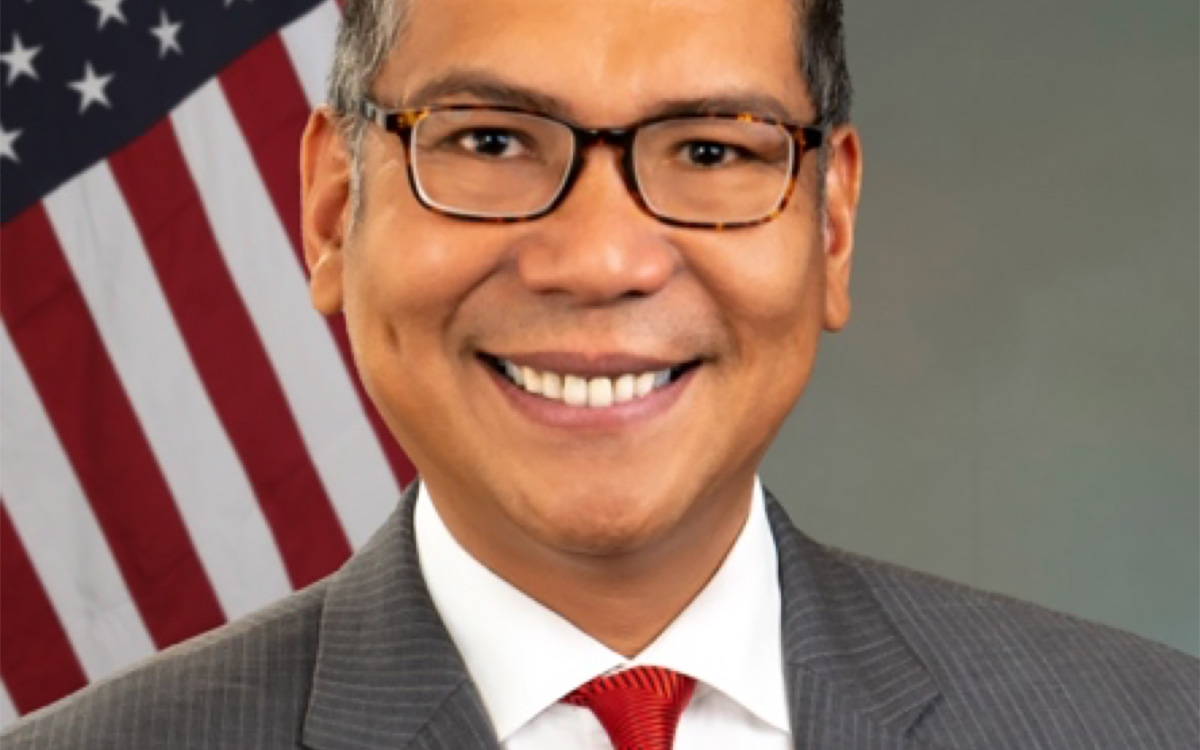
I serve as the only Asian American Pacific Islander member on the U.S. Commission on Civil Rights. And, I am the first and only queer AAPI on the U.S. commission. I am deeply honored to both serve my country and represent my Asian Americans and Pacific Islander community.
Last year, the commission investigated the Federal Response to Anti-Asian Racism in the United States. With congressional authorization, the report documented the experiences of AANHPIs in the U.S. since the dubbing of COVID-19 as the “China Virus” infecting people with the “Kung Flu” by government leadership. Words matter, as this report shows.
This report has a deep personal connection for me. I am the survivor of a hate crime of 25 years ago for being gay, and the victim of a hate crime for being Asian 25 months ago
The Stop AAPI Hate Coalition reported that bias incidents against individuals who are Asian and lesbian, gay, bisexual, transgender or queer (LGBTQ) were most prominent between 2019 and 2022, highlighting the intersectional nature of these incidents. For example, two transgender Asian women stated:
“I was with my new boyfriend at a restaurant. When we walked in the server started calling me names … a b—h, ch—k, tra—i.e. … He said I have a big fat p—s, and told me to go back to China. Then my boyfriend proceeded to walk in the restaurant and when I took a step forward, the server hit me, so I left.”
“Left a restaurant with friends in the Asian district of town. A man began to follow me calling out ‘Hey you f—got c—k!’ and ‘Come here you virus!’ I began to walk fast towards a crowd until he stopped following me.”
To address these and other equally appalling experiences, I helped shepherd the bipartisan Commission on Civil Rights recommendations to the president, Congress, and the nation that:
- Prosecutors and law enforcement should vigorously investigate and prosecute hate crimes and harassment against Asian Americans, as well as Asian Americans who are LGBTQ.
- First responders should be trained to understand what exactly constitutes a hate crime in their jurisdiction, including the protections of LGBTQ people.
- Federal, state, and local law enforcement and victim services should identify deficiencies in their programs for individuals with limited English proficiency.
Greater language access will make an enormous impact for the Asian American community as one in five Asian individuals speak a language other than English at home. A third (34 percent) is limited English proficient. The most frequently spoken languages are Chinese, Korean, Vietnamese, Tagalog, Thai, Khmer, Bengali, Gujarati, Hindi, and Punjabi.
For me, this report comes full circle. Since 1988, I’ve lobbied for passage of LGBTQ-inclusive federal and state laws to prevent hate crimes. Since 2001, I’ve supported South Asian and Muslim victims of post 9/11 violence. In response to the shootings at the Pulse nightclub in Orlando, Fla, in 2016; Atlanta Spa in Georgia in 2021; and Club Q in Colorado Springs, Colo., in 2022, I‘ve trained over 3,000 lawyers, law students, and community leaders on hate crimes law.
And yet, our work is not yet done.
May is Asian Pacific American Heritage Month. June is LGBTQ Pride Month. Despite these challenges, we are resilient. Let us join together in celebrating our Heritage of Pride
Glenn D. Magpantay, Esq., is a long-time civil rights attorney, professor of law and Asian American Studies, and LGBTQ rights activist. Glenn is a founder and former Executive Director of the National Queer Asian Pacific Islander Alliance (NQAPIA). He is principal at Magpantay & Associates: A nonprofit consulting and legal services firm. In 2023, the U.S. Senate (majority) appointed Glenn to the U.S. Commission on Civil Rights to advise Congress and the White House on the enforcement of civil rights laws and development of national civil rights policy.
Commentary
Journalists are not the enemy
Wednesday marks five years since Blade reporter detained in Cuba
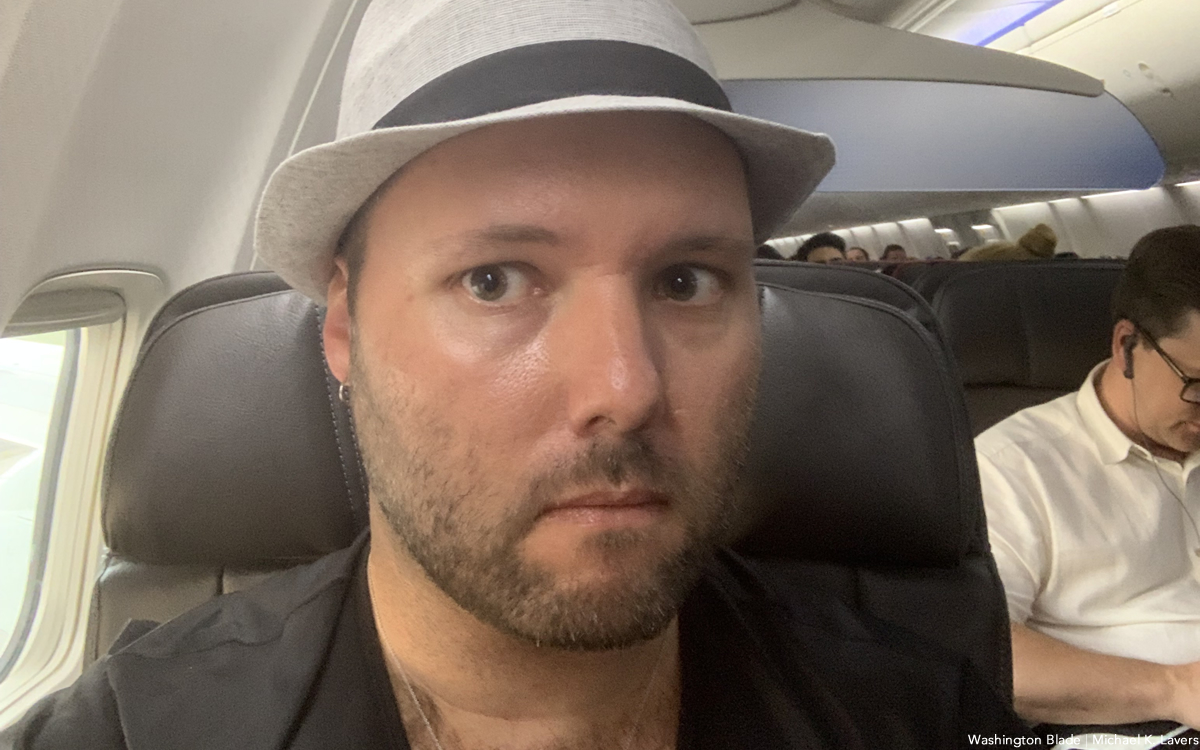
Wednesday marked five years since the Cuban government detained me at Havana’s José Marti International Airport.
I had tried to enter the country in order to continue the Washington Blade’s coverage of LGBTQ and intersex Cubans. I found myself instead unable to leave the customs hall until an airport employee escorted me onto an American Airlines flight back to Miami.
This unfortunate encounter with the Cuban regime made national news. The State Department also noted it in its 2020 human rights report.
Press freedom and a journalist’s ability to do their job without persecution have always been important to me. They became even more personal to me on May 8, 2019, when the Cuban government for whatever reason decided not to allow me into the country.
‘A free press matters now more than ever’
Journalists in the U.S. and around the world on May 3 marked World Press Freedom Day.
Reporters without Borders in its 2024 World Press Freedom Index notes that in Cuba “arrests, arbitrary detentions, threats of imprisonment, persecution and harassment, illegal raids on homes, confiscation, and destruction of equipment — all this awaits journalists who do not toe the Cuban Communist Party line.”
“The authorities also control foreign journalists’ coverage by granting accreditation selectively, and by expelling those considered ‘too negative’ about the government,” adds Reporters without Borders.
Cuba is certainly not the only country in which journalists face persecution or even death while doing their jobs.
• Reporters without Borders notes “more than 100 Palestinian reporters have been killed by the Israel Defense Forces, including at least 22 in the course of their work” in the Gaza Strip since Hamas launched its surprise attack against Israel on Oct. 7, 2023. Media groups have also criticized the Israeli government’s decision earlier this month to close Al Jazeera’s offices in the country.
• Wall Street Journal reporter Evan Gershkovich, Washington Post contributor and Russian opposition figure Vladimir Kara-Murza and Radio Free Europe/Radio Liberty’s Alsu Kurmasheva remain in Russian custody. Austin Tice, a freelance journalist who contributes to the Post, was kidnapped in Syria in August 2012.
• Reporters without Borders indicates nearly 150 journalists have been murdered in Mexico since 2000, and 28 others have disappeared.

Secretary of State Antony Blinken in his World Press Freedom Day notes more journalists were killed in 2023 “than in any year in recent memory.”
“Authoritarian governments and non-state actors continue to use disinformation and propaganda to undermine social discourse and impede journalists’ efforts to inform the public, hold governments accountable, and bring the truth to light,” he said. “Governments that fear truthful reporting have proved willing to target individual journalists, including through the misuse of commercial spyware and other surveillance technologies.”
U.S. Agency for International Development Administrator Samantha Power, who is a former journalist, in her World Press Freedom Day statement noted journalists “are more essential than ever to safeguarding democratic values.”
“From those employed by international media organizations to those working for local newspapers, courageous journalists all over the world help shine a light on corruption, encourage civic engagement, and hold governments accountable,” she said.
President Joe Biden echoed these points when he spoke at the White House Correspondents’ Association Dinner here in D.C. on April. 27.
“There are some who call you the ‘enemy of the people,'” he said. “That’s wrong, and it’s dangerous. You literally risk your lives doing your job.”
I wrote in last year’s World Press Freedom Day op-ed that the “rhetoric — ‘fake news’ and journalists are the ‘enemy of the people’ — that the previous president and his followers continue to use in order to advance an agenda based on transphobia, homophobia, misogyny, islamophobia, and white supremacy has placed American journalists at increased risk.” I also wrote the “current reality in which we media professionals are working should not be the case in a country that has enshrined a free press in its constitution.”
“A free press matters now more than ever,” I concluded.
That sentiment is even more important today.
Commentary
A reporter’s observations on the Brazilian, U.S. elections
Polls in both countries proved inaccurate
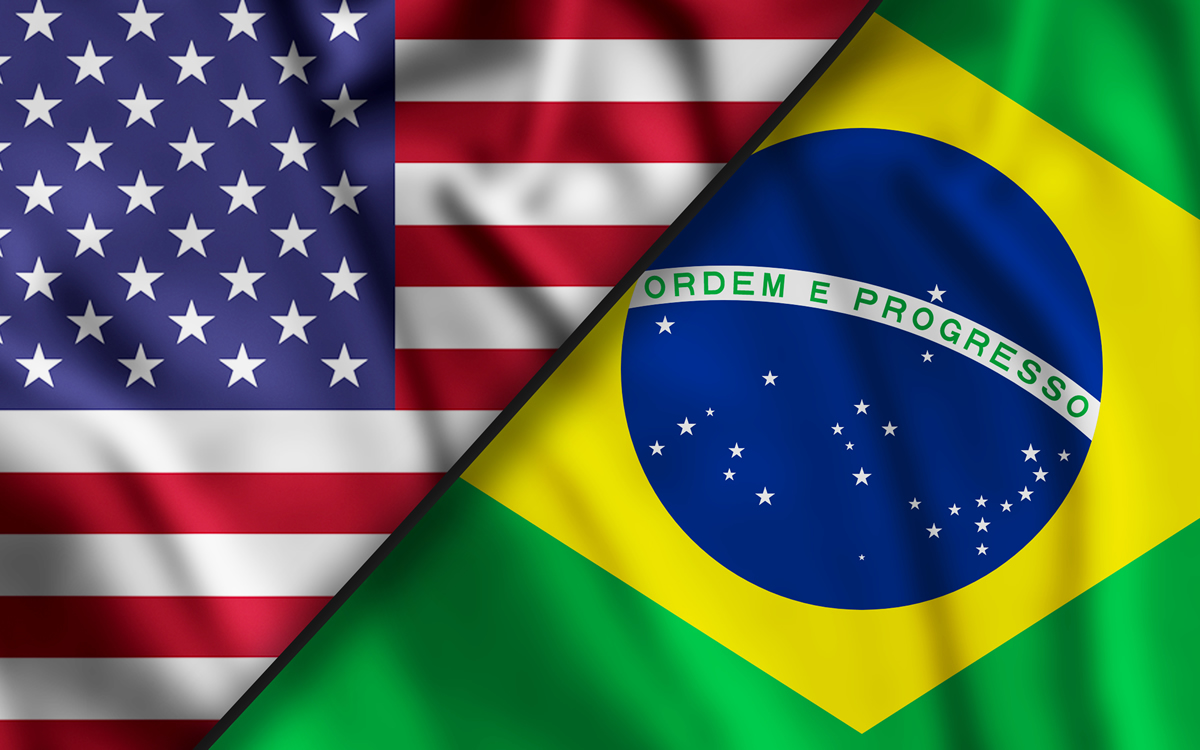
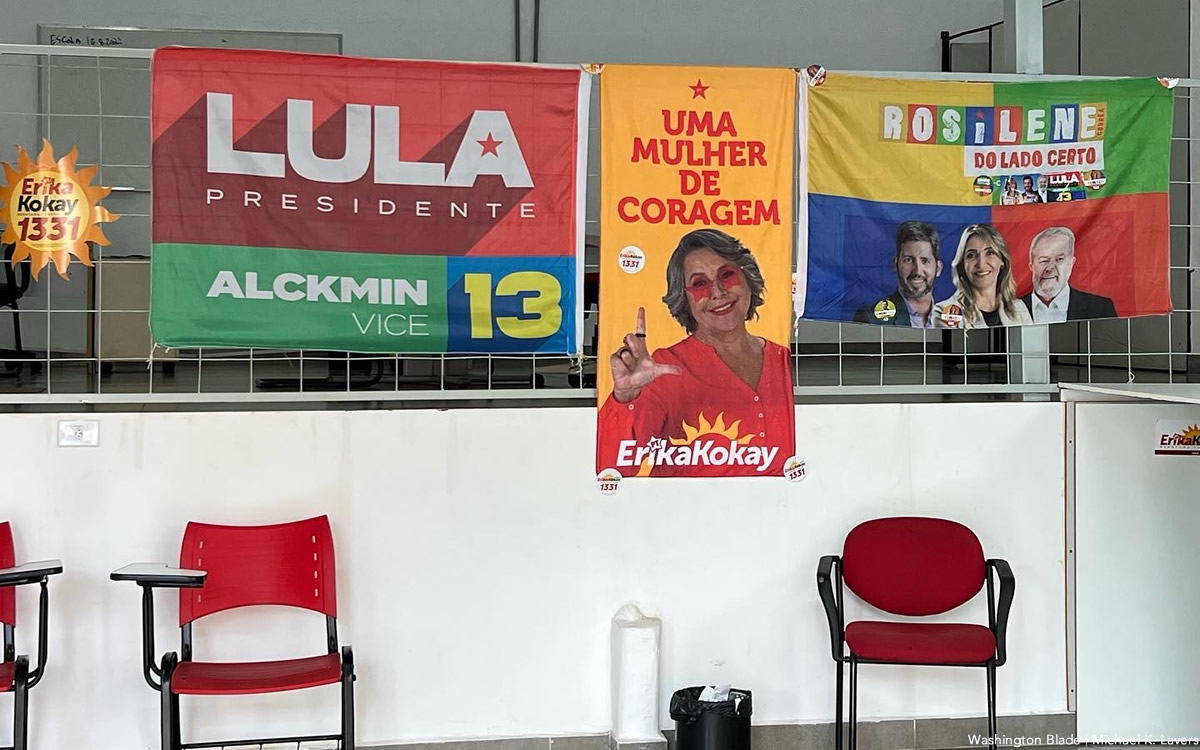
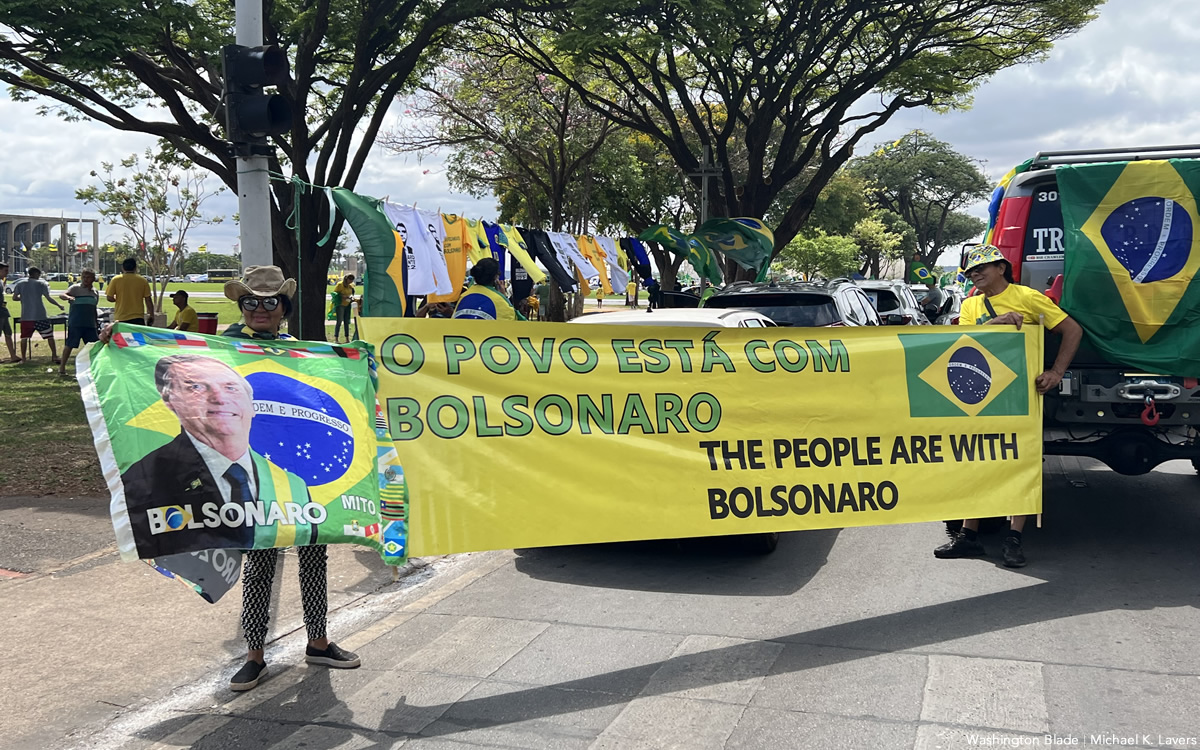
BRASÍLIA, Brazil / STEVENSVILLE, Md. — I was sitting in my hotel room in Brasília, the Brazilian capital, at 5 p.m. on Oct. 2 when the polls closed. The area around my hotel was quiet as the Supreme Electoral Tribunal began to post the election results on their website. Brazilian television stations continued their live coverage of the election that largely focused on whether former President Luiz Inácio Lula da Silva would defeat incumbent President Jair Bolsonaro. I was nibbling on KIND Dark Chocolate Whole Grain Clusters that I had bought at Dulles two days earlier before I flew to Brazil and sipping a glass of Brahma beer that I had poured for myself while refreshing the Supreme Electoral Tribunal’s website and listening to the reporters talk about the results. I was nervous because Bolsonaro was ahead.
I left my room at around 7 p.m. to get some dinner at a nearby mall. I ordered sushi from a restaurant in the food court. Bolsonaro was still ahead of Da Silva when I returned to my room at around 7:45 p.m., but the margin between the two men had narrowed. Da Silva soon took the lead, but it soon became clear that he and Bolsonaro would face each other in a runoff because neither of them had received at least 50 percent of the vote.
Da Silva defeated Bolsonaro in the second round of the presidential election that took place on Oct. 30. The U.S. midterm elections took place nine days later.
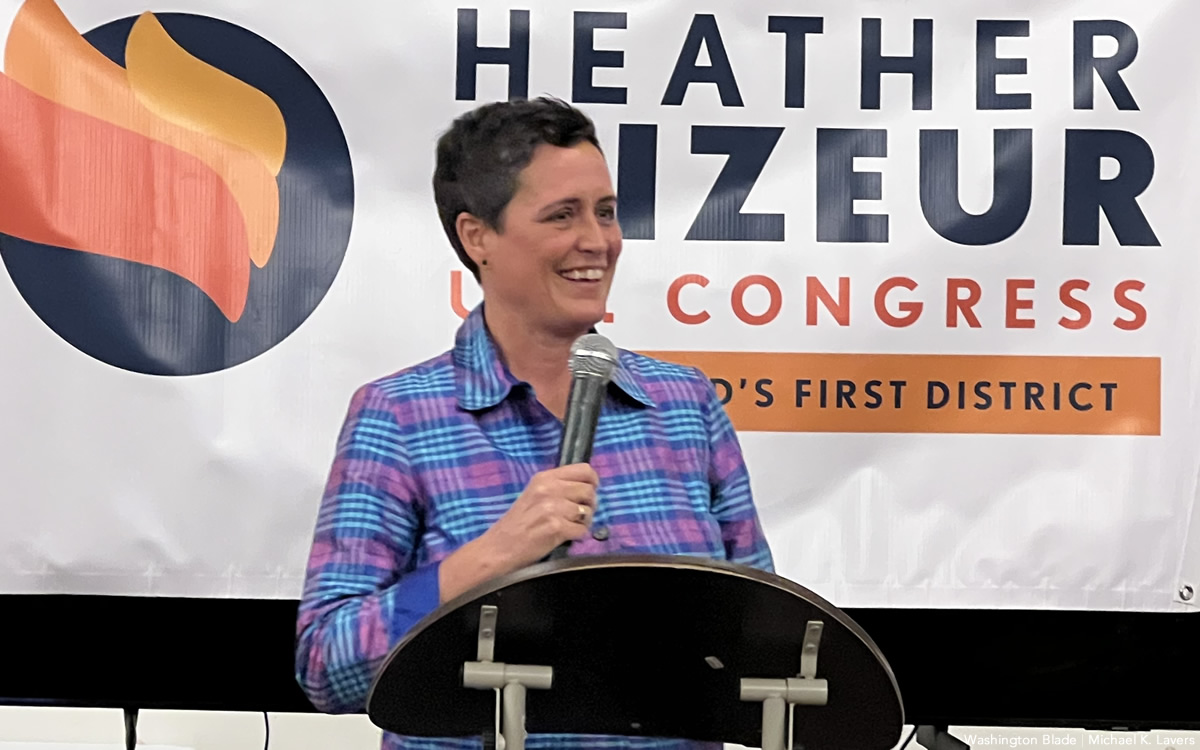
I arrived at Heather Mizeur’s election night party at the Kent Island Resort in Stevensville, Md., shortly before polls in Maryland closed at 8 p.m. Mizeur less than three hours later told her supporters that her bid to unseat Republican Congressman Andy Harris had come up short. The so-called red wave that so many pundits and polls predicted would elect Republicans across the country also failed to materialize.
Each country is different and the way they conduct their elections is difficult. I cannot, however, help but compare the Brazilian election and the U.S. midterms. Here are a few observations from a reporter who covered them both.
• Polls ahead of the first round of Brazil’s presidential election predicted Da Silva would defeat Bolsonaro in the first round. Polls and pundits ahead of the U.S. midterms, as previously noted, predicted Republicans would defeat Democrats across the country. Both scenarios did not happen.
• Bolsonaro ahead of Brazil’s presidential election sought to discredit the country’s electoral system. Bolsonaro did not concede to Da Silva after he lost. Former President Donald Trump continues to insist he won the 2020 presidential election. Trump also instigated the deadly Jan. 6 insurrection that took place as lawmakers were beginning to certify the Electoral College results.
• Cláudio Nascimento, president of Grupo Arco-Íris de Cidadania LGBT, an LGBTQ and intersex rights group in Rio de Janeiro, on Oct. 9 told me during an interview at his office that Bolsonaro would “destroy democracy”in Brazil if he were reelected. Mizeur in July described Harris as a “traitor to our nation” after the Jan. 6 committee disclosed he attended a meeting with Trump that focused on how he could remain in office after he lost to now President Joe Biden.
• Voters in São Paulo and Belo Horizonte on Oct. 2 elected two transgender women — Erika Hilton and Duda Salabert respectively — to the Brazilian Congress. Openly gay Rio Grande do Sul Gov. Eduardo Leite on Oct. 30 won re-election when he defeated former Bolsonaro Chief-of-Staff Onyx Lorenzoni in a runoff. LGBTQ Victory Fund President Annise Parker in a Nov. 10 statement noted 436 openly LGBTQ candidates across the country won their races. (One of them, openly gay New Hampshire Congressman Chris Pappas, who represents my mother, defeated Republican Karoline Leavitt in the state’s 1st Congressional District by a 54-46 percent margin.)
Brazil and the U.S. are different countries, but they both have democracies that must be defended. Brazilians and Americans did just that through their votes.
2 former NBA players launch cheap anti-trans stunt to exploit WNBA rules

Same-sex couples challenges India income tax law

HISTORIC: Susan Stewart elected Rehoboth’s first out mayor

Todd Blanche’s record on LGBTQ issues comes under scrutiny as he takes over DOJ

Don’t miss summer productions at Clear Space in Rehoboth Beach

Perez Hilton’s live breakdown reveals social media mental health crisis

HRC files class action over federal ban on gender-affirming care coverage

Dutch PM: More needs to be done to defend trans rights

HRC condemns DoE removal of LGBTQ bullying data from federal survey

New book chronicles gay man’s life in hippie commune
-

 The White House5 days ago
HRC files class action over federal ban on gender-affirming care coverage
-
Celebrity News5 days ago
Perez Hilton’s live breakdown reveals social media mental health crisis
-
Netherlands5 days ago
Dutch PM: More needs to be done to defend trans rights
-
National5 days ago
HRC condemns DoE removal of LGBTQ bullying data from federal survey