News
European LGBT rights advocates gather in Croatia
Uzra Zeya of U.S. State Department addressed ILGA-Europe conference participants
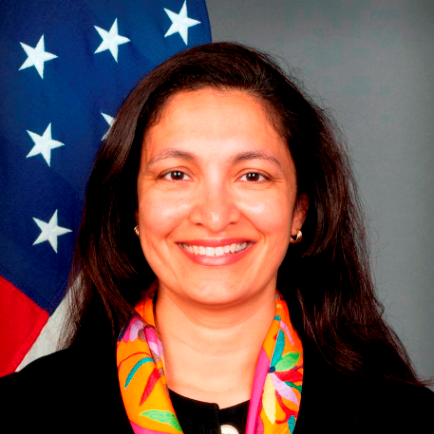
Uzra Zeya (Photo courtesy of the State Department)
Croatian President Ivo Jospović on Thursday welcomed those who attended the gathering in Zagreb, the country’s capital, in a video message.
“I take this opportunity to congratulate you on your courage and perseverance in the struggle for your right to be different, your right to be public and visible,” Jospović said.
Uzra Zeya, acting assistant secretary of the Bureau of Democracy, Human Rights and Labor at the U.S. State Department joined European Union Special Representative for Human Rights Stavros Lambrinidis, Portuguese LGBT rights advocate Miguel Vale de Almeida and other officials who spoke during the conference. Denis Dison of the Gay and Lesbian Victory Fund, Russian LGBT rights advocates Igor Kochetkov and Polina Andrianova, Neil Grungras of the Organization for Refugee Asylum and Migration and Hilde Vossen of the European Bisexual Network are among the activists who attended the gathering.
“The exchange of experiences and policy development is highly beneficial to us in Europe, as the European societies as well as the national laws differ widely across the continent,” Søren Laursen of LGBT Denmark, a Danish advocacy group, told the Washington Blade. “The activists fighting the course need to understand the differences and learn the different political realities to be able to formulate policies. An ILGA-Europe conference is a big sharing experience.”
The ILGA-Europe conference took place less roughly five months after same-sex couples began to marry in France.
Gays and lesbians can also legally tie the knot in Portugal, Spain, Iceland, the Netherlands, Belgium, Norway, Sweden and Denmark.
Same-sex couples will be able to legally marry in England and Wales in the spring, while Scottish lawmakers have begun to debate their own gay marriage measure. Irish voters next year will consider a proposed constitutional amendment that would extend marriage rights to same-sex couples in the country.
Maltese parliamentarians earlier this month began to debate a measure that would allow gays and lesbians to enter into civil unions. A Croatian parliamentary commission on Thursday approved a December referendum on whether to amend the country’s constitution to ban same-sex marriage.
The upper house of the Dutch Parliament later this fall is expected to vote on a measure that would allow trans people to petition a judge to change their gender on their birth certificates, passports and other official documents without undergoing sterilization and sex-reassignment surgery.
Activists continue to combat homophobia, transphobia
Anti-LGBT discrimination and violence in Europe remains a serious concern in spite of these legislative advances.
Nearly half of the respondents who took part in a survey the European Union Agency for Human Rights conducted in E.U. countries in 2012 said they experienced anti-gay discrimination or harassment. A quarter of respondents said they experienced violence or were threatened during the past year — this figure increases to 35 percent among trans people who took part in the survey.
The annual ILGA-Europe conference took place less than a week after police in Montenegro clashed with protesters who sought to disrupt a Pride march in Podgorica, the country’s capital.
Hundreds of Serbian LGBT rights advocates late last month criticized their government’s decision to ban a Pride march in Belgrade because of what officials described as the threat of violence from anti-gay extremists.
The European Union and the governments of the Netherlands and other member countries have also repeatedly criticized Russia over its LGBT rights record that includes a law that bans gay propaganda to minors.
“Laws that validate discrimination, as we have seen in Russia, can lead to an increase in violence and harassment,” Zeya said during her speech at the ILGA-Europe conference. “This is particularly true when authorities don’t act to protect all of their citizens and when they fail to investigate and prosecute crimes committed by or against particular groups.”
Jospović did not specifically reference Russia in his remarks, but he did stress human rights “imply the right of every human being to achieve his or her potential in that which he or she is.”
“This includes the right to freely express one’s sexual orientation and gender identity without the threat of anyone being humiliated, insulted and subjugated to violence as a result or to be excluded from social and public life,” the Croatian president said.
Saša Gavrić, executive director of the Sarajevo Open Centre, an LGBT rights group in the Bosnian capital, co-presented a workshop on responding to hate crimes in the country.
“We believe [in] high level events, like this one,” Gavrić told the Blade. “The grassroots work like our work in Sarajevo will together contribute to achieving full equality of LGBT persons in Europe.”
Members of Famiglie Arcobaleno, an Italian group that advocates on behalf of LGBT parents and those who want to have children, also presented at the ILGA-Europe conference.
Luca Possenti of the Famiglie Arcobaleno Board of Directors noted to the Blade his organization continues to work with schools and other institutions to recognize same-sex couples and their families, even though gays and lesbians remain unable to marry or adopt children in Italy. He stressed working with teachers in particular to become more LGBT-friendly is “fundamental throughout Europe” because prejudice, homophobia and transphobia remain pervasive in many European countries.
Transgender Europe, a continent-wide trans advocacy organization with more than 70 affiliates in 35 countries, also participated in the conference.
The group notes 71 anti-trans murders have been reported in Europe over the last five years. Two dozen European countries still require trans people to become sterilized before they can legally change their gender.
“The ILGA-Europe conference is one of the regular opportunities to meet, work and network in one place with many relevant stakeholders in the field of LGBTI work,” Transgender Europe Secretary Alecs Recher told the Blade. “ILGA-Europe strengthens trans representation in this meeting space and supports greater cohesion of the joint struggle for human rights on grounds of sexual orientation and gender identity.”



Minnesota
Flanagan beats Craig in Minn. Senate primary after winning key LGBTQ endorsements
The race highlights a growing ideological shift within the Democratic Party, as Democrats increasingly seek a more robust pushback against Trump.
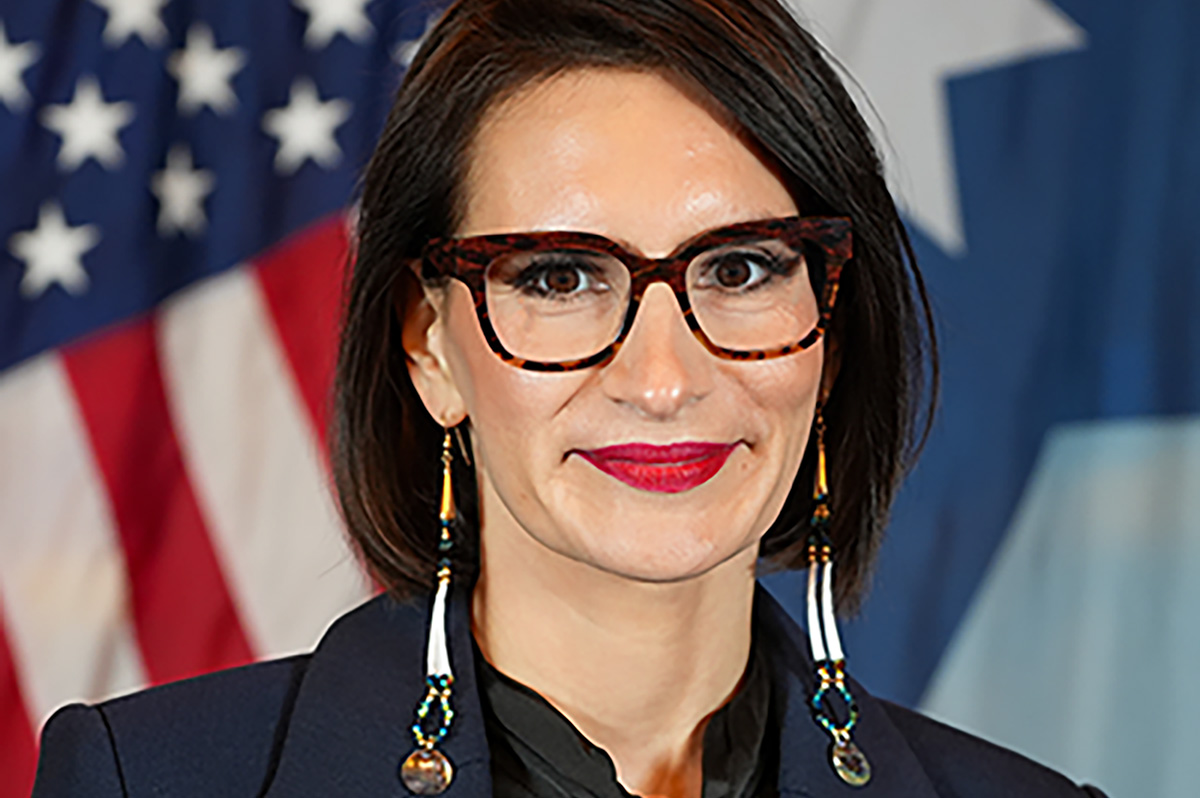
Lt. Gov. Peggy Flanagan won the Democratic primary for the Senate in Minnesota, as progressive Democrats continue to clinch nominations across the country.
On Tuesday night, NBC News called the race for Flanagan, who received 59.0% of the state’s Democratic primary vote, while her opponent, Rep. Angie Craig, received 39.4%. Flanagan ran against Craig for retiring Sen. Tina Smith’s seat.
Smith, along with Sens. Bernie Sanders, I-Vt., and Elizabeth Warren, D-Mass., endorsed Flanagan, while House Minority Leader Hakeem Jeffries, D-N.Y., and former House Speaker Nancy Pelosi, D-Calif., backed Craig.
Flanagan also received the endorsement of the Christopher Street Project, a transgender rights organization that has been at the center of efforts to counter the Republican Party’s push against transgender rights. The group chose Flanagan over Craig in part because Craig has not co-sponsored the Trans Bill of Rights, legislation that has been introduced multiple times in Congress and seeks to establish federal protections for transgender Americans.
The endorsement underscored a key difference between the two Democrats on LGBTQ issues. While Craig is the first openly lesbian mother in Congress, the Christopher Street Project said LGBTQ identity alone is not enough without a strong commitment to transgender rights as they are increasingly debated in legislative offices around the country.
In 2022, the Human Rights Campaign, the largest LGBTQ advocacy organization in the U.S., endorsed Flanagan’s re-election campaign for lieutenant governor alongside Tim Walz, calling the duo “Champions of Equality.”
Flanagan called the race an expensive fight of the “many versus the money,” Flanagan told NBC News’ “Meet the Press Now.” Craig and her allies combined to spend nearly $20 million on the airwaves, while Flanagan and her allies spent $4.7 million, according to AdImpact and NBC.
“I’m running to make sure that people can afford the lives they want to live,” Flanagan said. “I want to get big money out of our politics, and I want to fight for things like ‘Medicare for All’ so that people aren’t just paying for health insurance but actually have access to health care.”
Flanagan criticized Craig, who is in her fourth term, for not standing up enough to President Donald Trump’s administration, a characterization Craig disputed. Craig flipped a competitive House seat in the Twin Cities metro area and had argued that she was the best candidate to win in November.
Craig faced criticism for voting for the Laken Riley Act, an immigration detention measure that Trump signed into law shortly after he started his second term in January 2025. Craig said she later regretted that vote.
Flanagan has been vocal about her stance on abolishing U.S. Immigration and Customs Enforcement. In a recent Minnesota Public Radio debate she said that ICE “has to be ripped apart.” Flanagan said she does support immigration enforcement to ensure secure borders.
Immigration and ICE debates are especially pertinent in the Twin Cities, as ICE agents fatally shot two U.S. citizens, Renee Good and Alex Pretti, in Minneapolis during an enforcement crackdown at the behest of President Trump.
Despite the contested race, Craig made it clear that Democrats are committed to unifying.
“We have an existential crisis in our nation with Trump and Republicans, and so I would be right by the lieutenant governor’s side asking my supporters to support her,” Craig said. “The most important thing in this election is that we beat Republicans. That’s what matters.”
On the Republican side, former NFL sideline reporter Michele Tafoya won the Senate primary. Considered an outsider to the Republican Party structure, she did not win the state GOP’s endorsement at the May convention, where delegates instead backed retired Navy SEAL Adam Schwarze.
She has run her campaign on a slew of issues Republicans have deemed worthy — including transgender sports participation, corruption, and minimizing illegal immigrants in the area.
This recent pattern of moderate and centrist Democrats raising huge funds — in many instances backed by major PACs — only to lose to more progressive and less experienced candidates is growing as more people grow disillusioned with the Democratic Party’s inability to push back against Trump and Republicans. A similar outcome happened in Michigan’s Democratic primary last week when progressive physician Abdul El-Sayed won over incumbent U.S. Rep. Haley Stevens (D-Mich.).
Democratic Gov. Tim Walz, who decided not to run for re-election, stayed neutral in the Senate primary but his wife, Gwen, backed Craig over Flanagan, the governor’s ticketmate.
The Senate seat will be determined in the election on Tuesday, November 3, later this year.
District of Columbia
Gay ANC commissioner sues D.C. over police ‘failure’ to pay reward money
Lawsuit says information led to conviction in murder, armed robbery cases

Gay D.C. Advisory Neighborhood Commissioner Tom Donohue on Aug. 11 filed a lawsuit in D.C. Superior Court charging that D.C. police acted improperly and violated a local law by not paying him $30,000 in reward money for his role in helping police identify and arrest — and obtain the subsequent conviction — of one man charged with murder and another man charged with armed robbery in separate cases.
Although the lawsuit alleges improper action by D.C. police in carrying out the city’s Crime Solvers reward program, it names as defendants the District of Columbia and the Office of the Attorney General for D.C., which, among other things, defends the city against lawsuits.
Donohue, who is a member of the city’s ANC Rainbow Caucus consisting of LGBTQ elected ANC members, held a news conference outside the D.C. Superior Court building on Aug. 11 to talk about the lawsuit before entering the courthouse to officially file it.
The lawsuit states that Donohue “provided key video evidence that led to the arrest and conviction” of a man initially charged with first degree murder for allegedly running over a bicyclist with his car after the two got into an argument.
The lawsuit states that police had offered a $25,000 reward for information leading to the arrest and conviction of the defendant in that case, but police “arbitrarily slashed the payment to $5,000 without prior notice or policy justification.”
Court records show that D.C. resident Eric Beasley was charged with first degree murder for killing David Farewell, 45, by hitting him with his car on Sept. 4, 2020, on the 2100 block of Young Street, S.E. The records show the evidence for the case was based in large part on video camera footage of the incident obtained by police. Donohoe has said he provided that video camera evidence.
The records show that during Beasley’s October 2023 trial a jury was unable to reach the required unanimous verdict, and the judge declared a mistrial.
According to the records, Beasley later agreed to an offer by prosecutors to plead guilty to a lesser charge of involuntary manslaughter and was sentenced in September 2024 to eight years in prison, a development that angered the victim’s family members who called it a “slap on the wrist,” according to a Fox 5 News report.
Donohue’s lawsuit says the second case in which he provided police with pivotal information involved a series of armed robberies known as the Fairlawn Serial Armed Robbery Spree that occurred in the Fairlawn neighborhood in Southeast D.C. in 2023 near where Donohue lives.
The lawsuit says evidence consisting of video surveillance footage provided by Donohue to police enabled police to determine they initially wrongfully arrested an 18-year-old male for the robberies. “Using Plaintiff’s security video, MPD identified, arrested, and convicted the actual robber, David Crocker, who was sentenced to 18 years in federal prison,” the lawsuit states.
It says one of the detectives investigating the case recommended a $10,000 reward for Donohue’s help in the case based on the police Crime Solvers reward program. The detective’s recommendation was approved by then-Assistant D.C. Police Chief Kyle Ramey on Aug. 4, 2025, according to the lawsuit.
But it adds, “Nevertheless, MPD improperly withheld payment.”
When contacted by the Washington Blade for comment on Donohue’s lawsuit allegations, a D.C. police spokesperson said “MPD does not comment on pending or ongoing litigation.”
Gabriel Shoglow-Rubenstein, who serves as press secretary for the D.C. Office of the Attorney General, which will be defending the city against the Donohue lawsuit, said he would look into obtaining a possible comment but said the office has a similar longstanding policy of not commenting on pending litigation.
“This action arises from the District of Columbia Metropolitan Police Department’s arbitrary, bad-faith, and legally unsupportable failure to honor its public reward promises and administrative obligations to Plaintiff,” the lawsuit states.
It says the MPD violated the city’s Freedom of Information Act or FOIA law by not responding to Donohue’s request for information and documents related to the decision not to pay him the full reward money.
“MPD’s reduction of Plaintiff’s homicide reward from $25,000 to $5,000, and its withholding of his approved $10,00 robbery reward, were undertaken completely devoid of written standards, making such decisions inherently arbitrary, capricious, and an abuse of administrative discretion,” it says.
It calls for Donohue to be awarded $30,000 in compensatory damages consisting of the $20,000 “unpaid balance” for the homicide case reward and $10,000 for the robbery case reward. It also calls for reimbursement for “reasonable” litigation costs and attorney’s fees. Donohue told the Washington Blade that at this time he is representing himself without an attorney.
Donohue told the Blade that the refusal by D.C. police to pay him the full reward money also limited his plans to donate some of that money to the family of murder victim David Farewell to help pay for a burial stone. He said that due to the family’s limited resources Farewell is buried in an unmarked grave
Delaware
New LGBTQ visitor center slated for Wilmington, Del.
The Collective to feature gift shop, queer museum, more

During Pride month this year, the Delaware Sexuality and Gender Collective (DSGC) announced plans for The Collective, which will become Delaware’s first LGBTQIA+ visitor center and Wilmington’s first dedicated LGBTQIA+ space in nearly 40 years.
“We’ve been talking about the concept of a brick-and-mortar space for a long time,” said Noah Duckett, co-founder of DSGC.
A licensed clinical social worker, Duckett co-founded DSGC with his mother, Julissa Coriano, in 2018. DSGC is an independent nonprofit organization that provides vital clinical and educational support, social programming and direct-need support to the LGBTQIA+ community.
Some of the programs DSGC offers include a free clothing closet for the trans community, meal support for people recovering from gender-affirming surgery, connections to pro bono legal services, a biannual Pride Market featuring over 100 LGBTQIA+-owned small businesses, and more.
“Our vision for The Collective is a place where our community can come to learn, create, work and be inspired,” said Coriano.
The Collective will feature a visitor center and gift shop highlighting LGBTQIA+-owned businesses in Delaware.
“I think that this is something that’s going to benefit our community so much,” said Duckett.
Some of the LGBTQIA+-owned businesses that DSGC has already partnered with include Stress Induced Art Attack, Moonbeam Art Collaborative, Voce Coffee, Groovy Gemini Co., Scout Cafe, Macaron Social and Huxley and Hiro.
“Specifically in Wilmington, we haven’t had an LGBTQIA+-dedicated space in almost 40 years,” said Duckett.
The Griffin Community Center, which operated from 1986 to 1990, was Delaware’s first LGBTQ+ community center. The Griffin was founded by Ivo Dominguez Jr. and James C. Welch and provided a range of community services during the height of the HIV/AIDS crisis, including AIDS hotlines, organizational offices and meeting space. The center ultimately closed because of a lack of financial support.
Duckett said DSGC hopes The Collective will carry on The Griffin’s legacy while building a sustainable space for the LGBTQIA+ community.
“I think now more than ever, there’s more and more spaces closing their doors. More and more spaces are losing funding, seeing reduced funding and reduced access, especially LGBTQ+ organizations and communities,” said Duckett.
The Collective will also feature Delaware’s first LGBTQ+ history museum, curated by LGBTQ+ historian Carolanne Deal.
“We don’t have any permanent displays in the state about Delaware’s queer history, and we want people to be able to access that history any day of the year, not just during Pride Month,” said Deal.
With a master’s degree in art history for museum professionals, Deal has more than seven years of experience in curatorial work and hands-on collections care.
“It’s mainly going to be a graphic display with photographs, articles and accessible text that draws people in and creates a story for the community,” said Deal.
Although the museum will not initially have an object collection, Deal said she hopes to add physical archival pieces in the future.
“Delaware has been at the forefront of a lot of queer civil rights, and it’ll be really amazing to have that enshrined in a permanent display that’s not only up for Pride Month,” said Deal.
Duckett said DSGC is currently raising funds with the goal of beginning construction this summer and opening by the end of the year.
Duckett told the Blade that fundraising efforts have reached just under $29,000 and that the organization is awaiting several major donations from community partner organizations.
However, he said DSGC continues to be denied many grants tied to federal or state funding because of restrictions on those funds being used for LGBTQ+-serving organizations.
“Private and corporate donations are absolutely vital,” said Duckett.
Anyone interested in supporting the construction and renovation of The Collective can donate online or contact [email protected] for more information.ose funds being used for LGBTQ-serving organizations.
“Private and corporate donations are absolutely vital,” said Duckett.
Anyone interested in supporting the construction of The Collective can donate online or contact [email protected] for more information.

Flanagan beats Craig in Minn. Senate primary after winning key LGBTQ endorsements

Gay ANC commissioner sues D.C. over police ‘failure’ to pay reward money

New LGBTQ visitor center slated for Wilmington, Del.

Jason DePuy on coping with homophobia in ‘Big Brother’ house