News
Pelosi envisions path for House passage of ENDA
Democratic leader looks to VAWA as way to move LGBT anti-bias bill
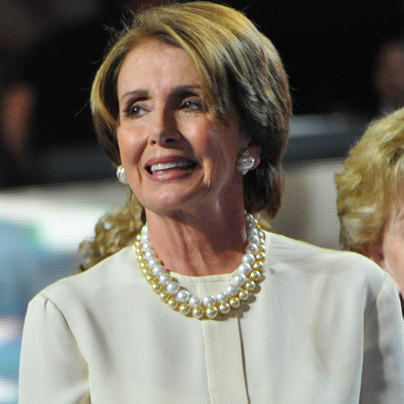
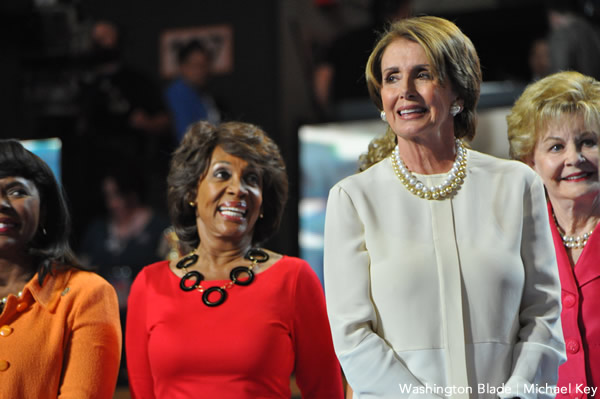
House Minority Leader Nancy Pelosi said she hopes ENDA could pass the House in a way similar to VAWA (Washington Blade file photo by Michael Key).
During her routine news conference on Wednesday, Pelosi said she’s hoping for a situation on ENDA similar to what happened when the House passed reauthorization of the Violence Against Women Act earlier this year.
“We made it too hot to handle in the public,” Pelosi said. “It had to come to the floor. Even so, a majority of the Republicans voted against the Violence Against Women Act. But nonetheless, it came to the floor. I hope we could have a similar situation with this.”
Asked to clarify whether VAWA reauthorization could be a model for House passage of ENDA, Pelosi called for expedited movement of the legislation in her chamber.
“Well, I would think it would be “once burned, twice learned,” and that they would, shall we say, save some time by taking it right to our committee and to the floor,” Pelosi said. “It’s really important. Our country – ending discrimination is what we are all about as Americans, and we should not have discrimination in the workplace because of gender identity.”
In February, the House, amid public pressure, passed the Senate measure to reauthorize VAWA, which contained protections for LGBT victims of domestic violence. It was the first and only time a bill with LGBT-specific language passed under the leadership of House Speaker John Boehner (R-Ohio).
House Republican leadership initially brought to the floor its own version of the bill without LGBT protections, but didn’t have enough votes in its own caucus to pass the measure. Afterward, House leaders brought to the floor the Senate version of the bill, which was approved unanimously by the House Democratic caucus along with 87 Republicans.
Pelosi said Wednesday the situation could be similar for ENDA after noting the significant cultural change on LGBT issues since 2007, when a gay-only version of ENDA was introduced on the House floor. The Democratic leader attributed this change to “the community’s” efforts.
“So I would hope that the public attitude, which I attribute to the community’s activism, outside mobilization, and just family awareness and respect for people to end discrimination, increases its prospects for now,” Pelosi said. “And, it will be interesting to see if in the Republican Party they want to see a continuation of discrimination in the workplace for people because of their gender identity.”
Notably, throughout her remarks, Pelosi twice explicitly mentioned the bill’s protections in employment based on gender identity, and never once mentioned sexual orientation. That’s significant because the House under her leadership moved forward a bill in 2007 that included protections based on sexual orientation, but omitted language for transgender people.
Small progress has been made on ENDA quietly in the House amid considerable attention about whether the bill will have enough votes to pass in the Senate.
In this week alone, the legislation has gained at least two new Republican co-sponsors following the initial news that ENDA would soon come to a floor vote in the Senate. According to “Thomas,” the website for the Library of Congress, Rep. Jon Runyan (R-N.J.) signed on as a co-sponsor on Monday.
Joining him on Wednesday were six additional co-sponsors. Among them are Raul Ruiz (D-Calif.), Nydia Velazquez (D-N.Y.), G.K. Butterfield (D-N.C.), Corrine Brown (D-Fla.) and William Owens (D-N.Y.).
Rep. Chris Gibson (R-N.Y.) on Wednesday also signed on as a co-sponsor to ENDA. He’s facing a challenge next year to his congressional seat from Sean Eldridge, a gay Democratic activist who’s married to Facebook co-founder and New Republic owner Chris Hughes.
Gregory Angelo, executive director of the National Log Cabin Republicans, called Gibson’s co-sponsorship of ENDA “welcome news indeed.”
“Cynics will say that this is all politics and precipitated by Sean Eldridge’s carpetbagging candidacy, but I know that this was a decision Congressman Gibson didn’t make lightly,” Angelo said. “A great deal of contemplation and consultation with Log Cabin Republicans and others in the GOP who know support for ENDA is prevalent and growing put Congressman Gibson on the right side of history here.”
Counting these new co-sponsors and chief sponsor of ENDA gay Rep. Jared Polis (D-Colo.), the legislation has a total of 194 supporters. That’s still 24 votes shy of the 218 votes necessary to pass ENDA in the House.
Tico Almeida, president of Freedom to Work, said he agrees with Pelosi that VAWA advocates ran an impressive campaign and that method could be applied to ENDA.
“Freedom to Work and other LGBT organizations with strong Republican connections should meet with Republican House leaders to urge them to drop the Hastert Rule as they did with LGBT-inclusive VAWA and allow a vote,” Almeida said. “Our Republican Legislative Director has already started on an impressive number of Republican House meetings.”
But Almeida said a VAWA-like strategy is one of three possible approaches to passing ENDA in the House. Others, as he’s previously already articulated, include a discharge petition, as proposed by McCain-Feingold author Trevor Potter, and attaching ENDA in the Senate to a larger bill for the House to pass.
“We should try all of the above strategies in the next year before the election,” Almeida said. “It’s not a choice. We should push on multiple fronts. We can only win if we’re willing to try.”
Drew Hammill, a Pelosi spokesperson, wouldn’t rule out any option as a possibility for passing ENDA in the House despite Republican control.
“As with any measure that passes the Senate and already enjoys bipartisan support in the House, all options remain on the table,” Hammill said.
A partial transcript of the exchange between Pelosi and reporters follows:
Reporter: Madam Leader, Leader Reid in the other body mentioned in the next couple of weeks he is going to try to bring up ENDA. I know this passed in the House in 2007. I think there were 10 Republicans who are still in the House who voted for it. Why do you think there would be any chance if it moved to this body – they think they might be within striking distance of 60 next door – why would they have any ability to move it here when they can’t even pass a farm bill? Why would they be interested in trying to move ENDA in this body in this political circumstance?
Leader Pelosi: Well, I believe a lot has changed since 2007 on this subject. We have seen – as we know, in 2010, we repealed the Don’t Ask, Don’t Tell policy in the military. The Supreme Court has overturned the so-called euphemistically named Defense of Marriage Act. Thank God they overturned that and its name. And just generally, the public awareness and acceptance of ending discrimination in any way.
Some people think ENDA is ending discrimination in the workplace. Isn’t that a given in our country? Apparently not. And that’s why we have to pass the bill.
So I would hope that the public attitude, which I attribute to the community’s activism, outside mobilization, and just family awareness and respect for people to end discrimination, increases its prospects for now. And, it will be interesting to see if in the Republican Party they want to see a continuation of discrimination in the workplace for people because of their gender identity.
We had a problem with the Violence Against Women Act. They didn’t want to bring that to the floor. We made it too hot to handle in the public. It had to come to the floor. Even so, a majority of the Republicans voted against the Violence Against Women Act. But nonetheless, it came to the floor. I hope we could have a similar situation with this.
Reporter: Do you think you could use the model that was used for VAWA to make this ENDA bill “too hot to handle,” as you put it?
Pelosi: Well, I would think it would be “once burned, twice learned,” and that they would, shall we say, save some time by taking it right to our committee and to the floor. It’s really important. Our country – ending discrimination is what we are all about as Americans, and we should not have discrimination in the workplace because of gender identity.
UPDATE: This article has been updated to reflect the additional ENDA co-sponsors in the House that signed on Tuesday.



District of Columbia
D.C. police arrest man for burglary at gay bar Spark Social House
Suspect ID’d from images captured by Spark Social House security cameras

D.C. police on Feb. 18 arrested a 63-year-old man “of no fixed address” for allegedly stealing cash from the registers at the gay bar Spark Social House after unlawfully entering the bar at 2009 14th St., N.W., around 12:04 a.m. after it had closed for business, according to a police incident report.
“Later that day officers canvassing for the suspect located him nearby,” a separate police statement says. “63-year-old Tony Jones of no fixed address was arrested and charged with Burglary II,” the statement says.
The police incident report states that the bar’s owner, Nick Tsusaki, told police investigators that the bar’s security cameras captured the image of a man who has frequently visited the bar and was believed to be homeless.
“Once inside, the defendant was observed via the establishment’s security cameras opening the cash register, removing U.S. currency, and placing the currency into the left front pocket of his jacket,” the report says.
Tsusaki told the Washington Blade that he and Spark’s employees have allowed Jones to enter the bar many times since it opened last year to use the bathroom in a gesture of compassion knowing he was homeless. Tsusaki said he is not aware of Jones ever having purchased anything during his visits.
According to Tsusaki, Spark closed for business at around 10:30 p.m. on the night of the incident at which time an employee did not properly lock the front entrance door. He said no employees or customers were present when the security cameras show Jones entering Spark through the front door around 12:04 a.m.
Tsusaki said the security camera images show Jones had been inside Spark for about three hours on the night of the burglary and show him taking cash out of two cash registers. He took a total of $300, Tsusaki said.
When Tsusaki and Spark employees arrived at the bar later in the day and discovered the cash was missing from the registers they immediately called police, Tsusaki told the Blade. Knowing that Jones often hung out along the 2000 block of 14th Street where Spark is located, Tsusaki said he went outside to look for him and saw him across the street and pointed Jones out to police, who then placed him under arrest.
A police arrest affidavit filed in court states that at the time they arrested him police found the stolen cash inside the pocket of the jacket Jones was wearing. It says after taking him into police custody officers found a powdered substance in a Ziploc bag also in Jones’s possession that tested positive for cocaine, resulting in him being charged with cocaine possession in addition to the burglary charge.
D.C. Superior Court records show a judge ordered Jones held in preventive detention at a Feb. 19 presentment hearing. The judge then scheduled a preliminary hearing for the case on Feb. 20, the outcome of which couldn’t immediately be obtained.
District of Columbia
Judge rescinds order against activist in Capital Pride lawsuit
Darren Pasha accused of stalking organization staff, board members, volunteers
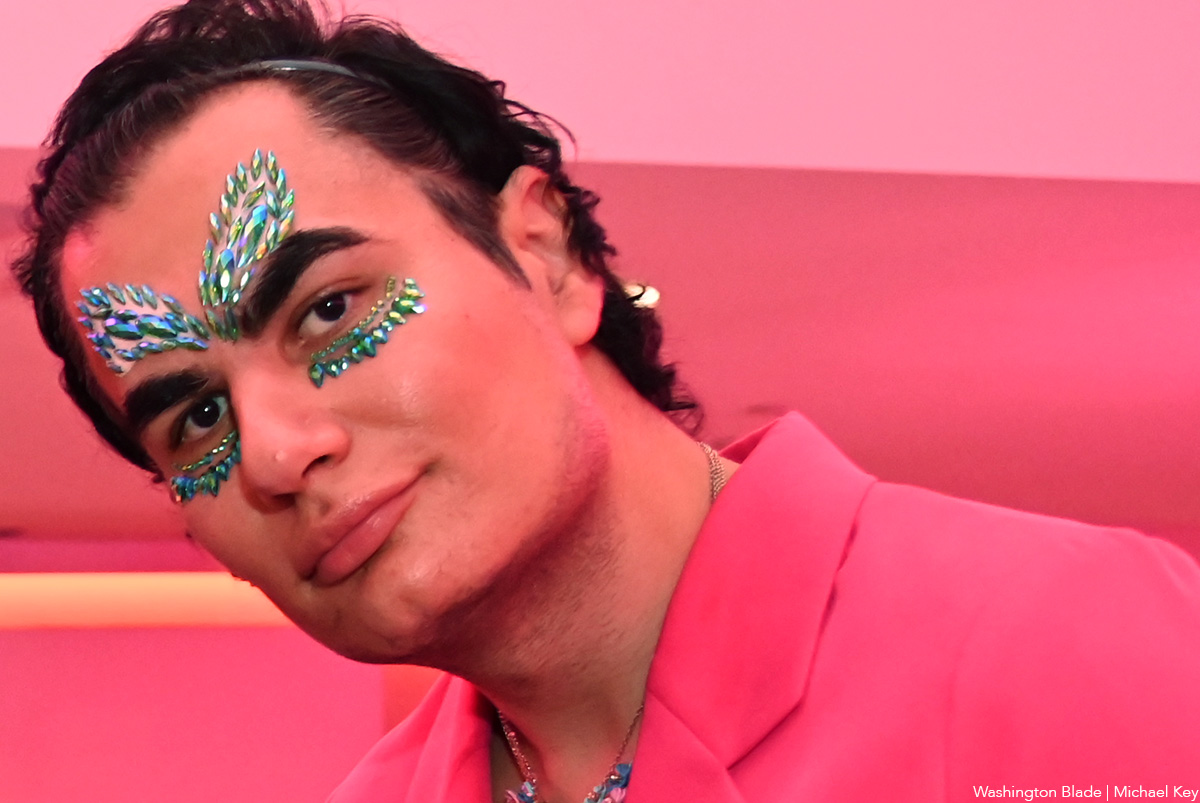
A D.C. Superior Court judge on Feb.18 agreed to rescind his earlier ruling declaring local gay activist Darren Pasha in default for failing to attend a virtual court hearing regarding an anti-stalking lawsuit brought against him by the Capital Pride Alliance, the group that organizes D.C.’s annual Pride events.
The Capital Pride lawsuit, initially filed on Oct. 27, 2025, accuses Pasha of engaging in a year-long “course of conduct” of “harassment, intimidation, threats, manipulation, and coercive behavior” targeting Capital Pride staff, board members, and volunteers.
In his own court filings without retaining an attorney, Pasha has strongly denied the stalking related allegations against him, saying “no credible or admissible evidence has been provided” to show he engaged in any wrongdoing.
Judge Robert D. Okum nevertheless on Feb. 6 approved a temporary stay-away order requiring Pasha to stay at least 100 feet away from Capital Pride’s staff, volunteers, and board members until the time of a follow-up court hearing scheduled for April 17. He reduced the stay-away distance from 200 yards as requested by Capital Pride.
In his two-page order issued on Feb. 18, Okun stated that Pasha explained that he was involved in a scooter accident in which he was injured and his phone was damaged, preventing him from joining the Feb. 6 court hearing.
“Therefore, the court finds there is a good cause for vacating the default,” Okun states in his order.
At the time he initially approved the default order at the Feb. 6 hearing that Pasha didn’t attend, Okun scheduled an April 17 ex parte proof hearing in which Capital Pride could have requested a ruling in its favor seeking a permanent anti-stalking order against Pasha.
In his Feb. 18 ruling rescinding the default order Okun changed the April 17 ex parte proof hearing to an initial scheduling conference hearing in which a decision on the outcome of the case is not likely to happen.
In addition, he agreed to consider Pasha’s call for a jury trial and gave Capital Pride 14 days to contest that request. The Capital Pride lawsuit initially called for a non-jury trial by judge.
One request by Pasha that Okum denied was a call for him to order Capital Pride to stop its staff or volunteers from posting information about the lawsuit on social media. Pasha has said the D.C.-based online blog called DC Homos, which Pasha claims is operated by someone associated with Capital Pride, has been posting articles portraying him in a negative light and subjecting him to highly negative publicity.
“The defendant has not set forth a sufficient basis for the court to restrict the plaintiff’s social media postings, and the court therefore will deny the defendant’s request in his social media praecipe,” Okun states in his order.
A praecipe is a formal written document requesting action by a court.
Pasha called the order a positive development in his favor. He said he plans to file another motion with more information about what he calls the unfair and defamatory reports about him related to the lawsuit by DC Homos, with a call for the judge to reverse his decision not to order Capital Pride to stop social media postings about the lawsuit.
Pasha points to a video interview on the LGBTQ Team Rayceen broadcast, a link to which he sent to the Washington Blade, in which DC Homos operator Jose Romero acknowledged his association with Capital Pride Alliance.
Capital Pride Executive Director Ryan Bos didn’t immediately respond to a message from the Blade asking whether Romero was a volunteer or employee with Capital Pride.
Pasha also said he believes the latest order has the effect of rescinding the temporary stay away order against him approved by Okun in his earlier ruling, even though Okun makes no mention of the stay away order in his latest ruling. Capital Pride attorney Nick Harrison told the Blade the stay away order “remains in full force and effect.”
Harrison said Capital Pride has no further comment on the lawsuit.
District of Columbia
Trans activists arrested outside HHS headquarters in D.C.
Protesters demonstrated directive against gender-affirming care
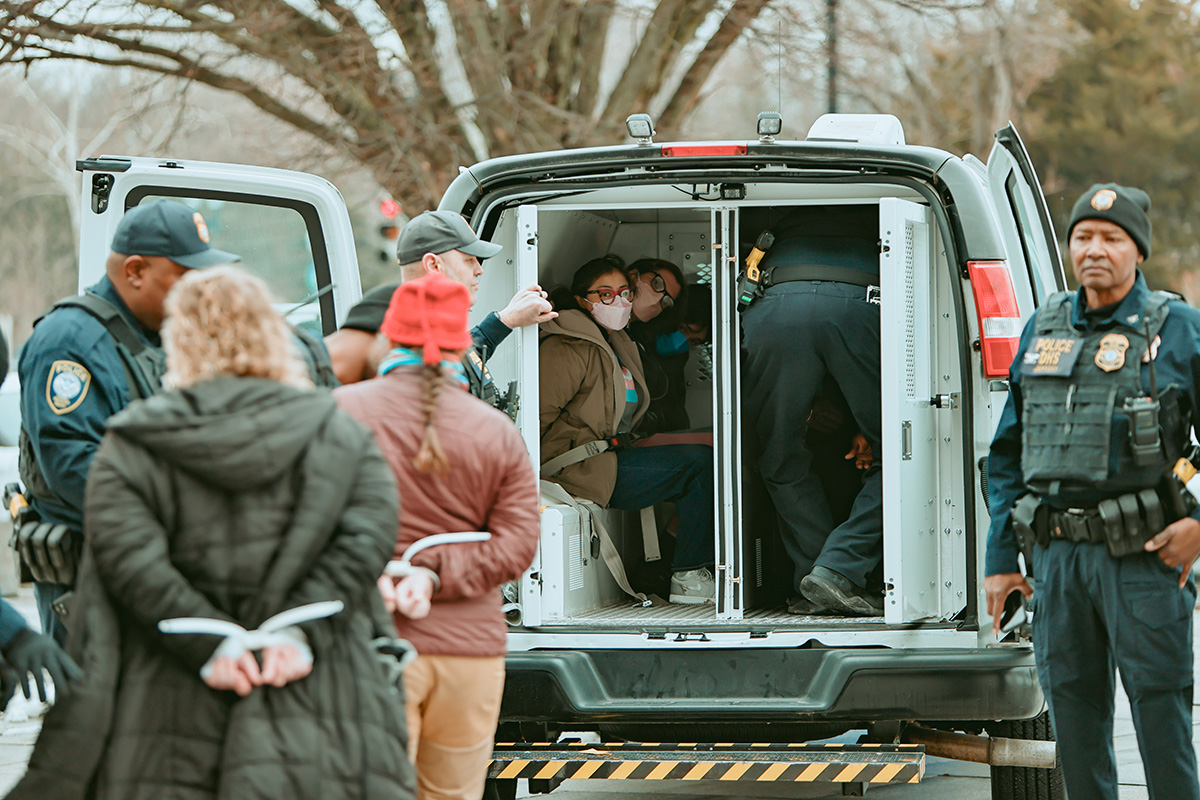
Authorities on Tuesday arrested 24 activists outside the U.S. Department of Health and Human Services headquarters in D.C.
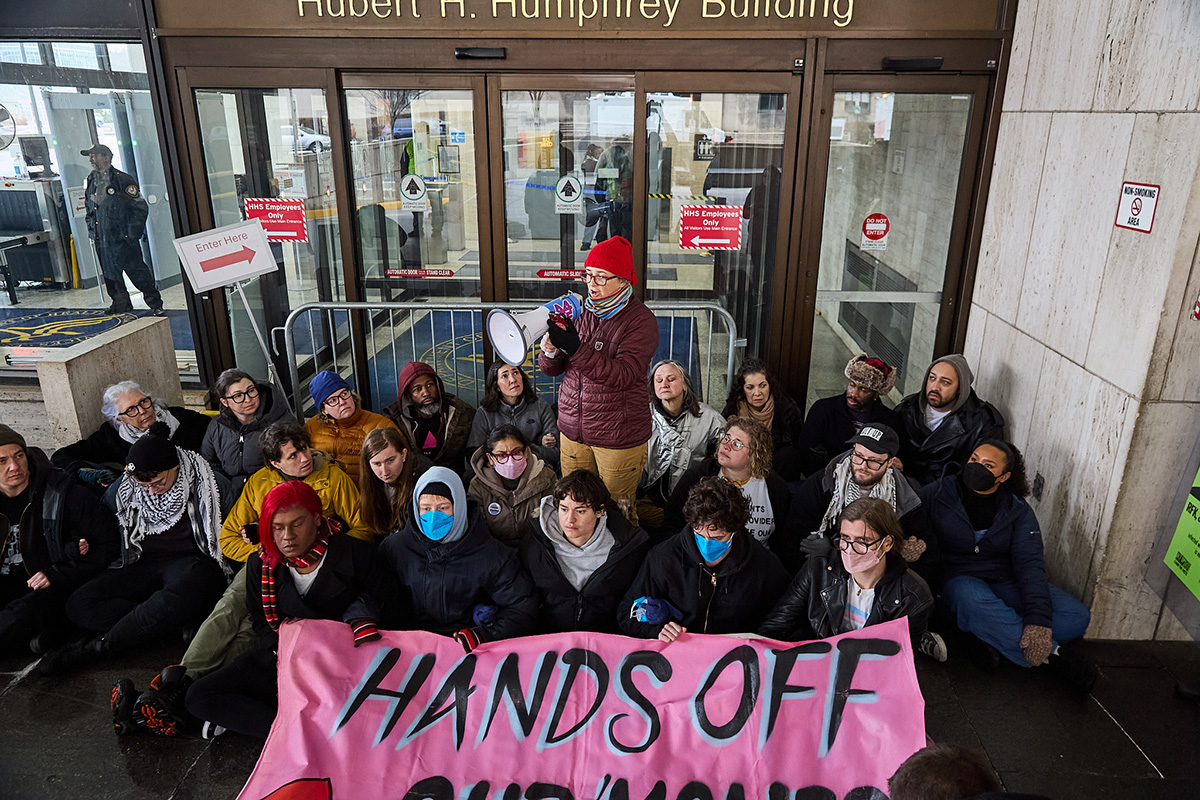
The Gender Liberation Movement, a national organization that uses direct action, media engagement, and policy advocacy to defend bodily autonomy and self-determination, organized the protest in which more than 50 activists participated. Organizers said the action was a response to changes in federal policy mandated by Executive Order 14187, titled “Protecting Children from Chemical and Surgical Mutilation.”
The order directs federal agencies and programs to work toward “significantly limiting youth access to gender-affirming care nationwide,” according to KFF, a nonpartisan, nonprofit organization that provides independent, fact-based information on national health issues. The executive order also includes claims about gender-affirming care and transgender youth that critics have described as misinformation.
Members of ACT UP NY and ACT UP Pittsburgh also participated in the demonstration, which took place on the final day of the public comment period for proposed federal rules that would restrict access to gender-affirming care.
Demonstrators blocked the building’s main entrance, holding a banner reading “HANDS OFF OUR ‘MONES,” while chanting, “HHS—RFK—TRANS YOUTH ARE NO DEBATE” and “NO HATE—NO FEAR—TRANS YOUTH ARE WELCOME HERE.”
“We want trans youth and their loving families to know that we see them, we cherish them, and we won’t let these attacks go on without a fight,” said GLM co-founder Raquel Willis. “We also want all Americans to understand that Trump, RFK, and their HHS won’t stop at trying to block care for trans youth — they’re coming for trans adults, for those who need treatment from insulin to SSRIs, and all those already failed by a broken health insurance system.”
“It is shameful and intentional that this administration is pitting communities against one another by weaponizing Medicaid funding to strip care from trans youth. This has nothing to do with protecting health and everything to do with political distraction,” added GLM co-founder Eliel Cruz. “They are targeting young people to deflect from their failure to deliver for working families across the country. Instead of restricting care, we should be expanding it. Healthcare is a human right, and it must be accessible to every person — without cost or exception.”
Despite HHS’s efforts to restrict gender-affirming care for trans youth, major medical associations — including the American Medical Association, the American Academy of Pediatrics, and the Endocrine Society — continue to regard such care as evidence-based treatment. Gender-affirming care can include psychotherapy, social support, and, when clinically appropriate, puberty blockers and hormone therapy.
The protest comes amid broader shifts in access to care nationwide.
NYU Langone Health recently announced it will stop providing transition-related medical care to minors and will no longer accept new patients into its Transgender Youth Health Program following President Donald Trump’s January 2025 executive order targeting trans healthcare.

PHOTOS: Cupid’s Undie Run

Sweat DC expands to Shaw

D.C. police arrest man for burglary at gay bar Spark Social House

Going for gold: Ford Bronco Sport vs. Toyota RAV4

How do we honor Renee Good, Alex Pretti?

LGBTQ groups question US health agreements with African countries

Trump falsely links trans people to terrorism

Fellow lawmakers praise Adam Ebbin after Va. Senate farewell address

LGBTQ activists mourn the Rev. Jesse Jackson