News
Obama announces initiative to develop HIV cure
President allocates $100 million for NIH research against disease
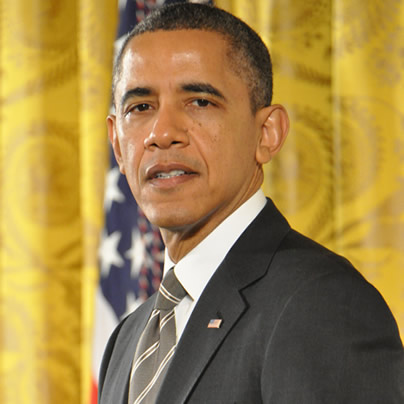
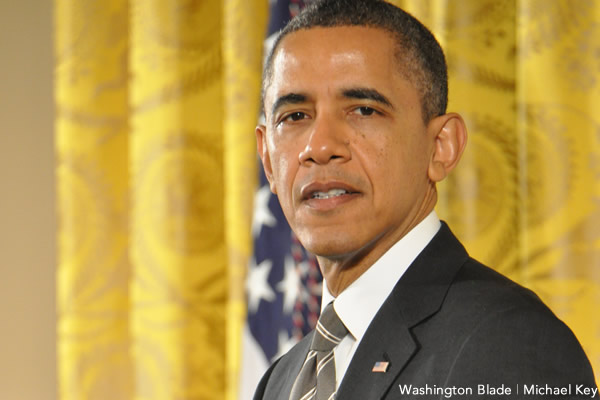
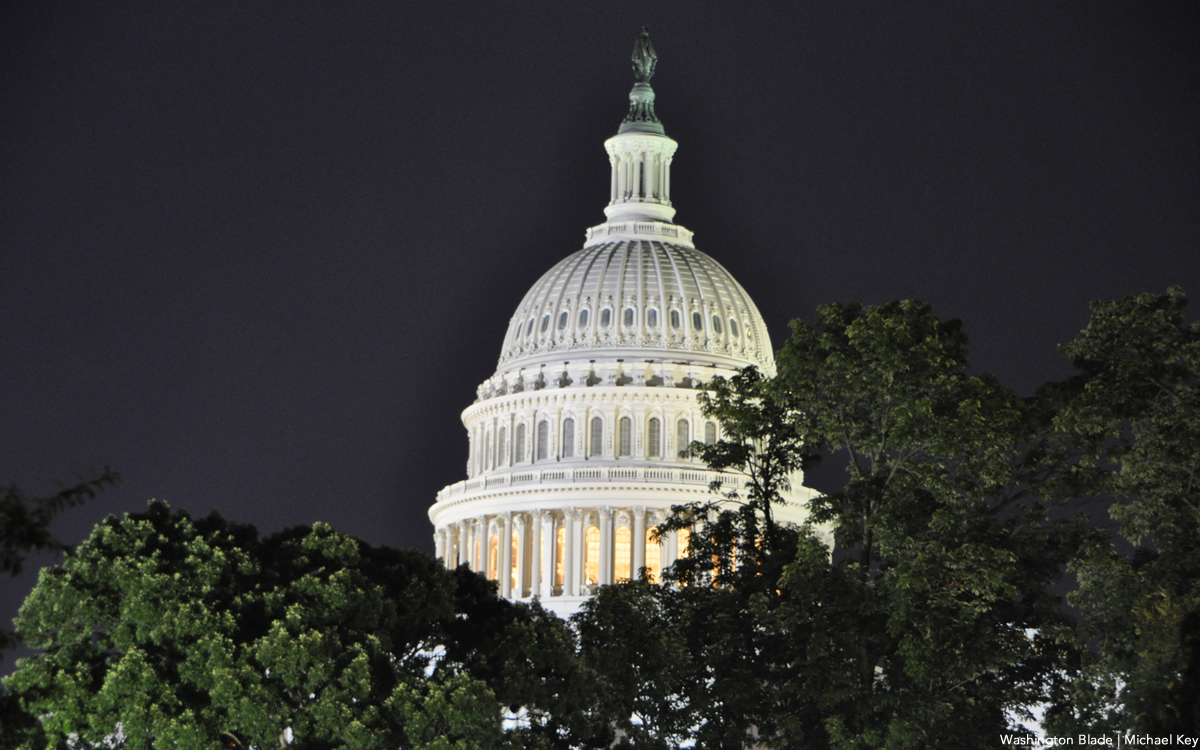
President Obama announced $100 million in funding for NIH to develop an HIV cure (Washington Blade file photo by Michael Key).
President Obama announced on Monday he’s redirecting $100 million at the National Institutes of Health for a new initiative to develop a cure for HIV as part of his vision for an “AIDS-free generation.”
Obama made the announcement when speaking before a group of HIV/AIDS advocates at a White House event observing World AIDS Day in the South Court Auditorium of the Eisenhower Executive Office Building.
“The United States should be at the forefront of new discoveries in how to put HIV into long-term remission without requiting live-long therapies, or better yet, eliminate it completely,” Obama said.
In a fact sheet published after the event, the White House clarified the $100 million would be distributed over the course of three years and would catalyze further research for new therapies to improve outcomes for people with HIV.
Rowena Johnston, amfAR’s vice president and director of research, said in a statement after the event the administration’s efforts to find a cure for HIV would build off previous successes in the past year.
“This year, we saw a series of breakthroughs in HIV cure research that have brought us more clarity than we’ve ever had on the precise steps and tools needed to finally end AIDS,” Johnston said. “We cannot achieve the President’s goal of an AIDS-free generation without continued investment in the research necessary to ultimately help us find a cure for this disease.”
The event was part of the rollout for a new White House report on confronting HIV/AIDS, titled “Improving Outcomes: Accelerating Progress Along the HIV Care Continuum.” The report describes the state of the epidemic, makes recommendations going forward and highlights local successes as well as public-private partnerships.
In his remarks, Obama said significant progress has made in confronting HIV/AIDS since Congress first allocated funds to fight the disease in 1983, but certain communities continue to be affected more than others, including LGBT people and the D.C. area.
“Here in the United States, we need to keep focusing on investments to communities that are still being hit hardest, including gay and bisexual men, African-Americans and Latinos,” Obama said. “We need to keep up the fight in our cities — including Washington, D.C., which in recent years has reduced diagnosed infections by nearly half.”
As Assistant to the President on Domestic Policy Cecilia Munoz pointed out at the start of the event, the Centers for Disease Control has reported gay and bisexual men account for two-thirds of all new HIV infections in the United States.
Obama said after his remarks were over, he would sign into law the PEPFAR Stewardship and Oversight Act of 2013, which reauthorizes and extends funds under the Bush-era President’s Emergency Plan for AIDS Relief to confront HIV/AIDS overseas.
The PEPFAR program, Obama said, has exceeded goals set two years ago to help 6 million people across the globe receive treatment for HIV/AIDS by the end of 2013. As it stands, Obama said the program has helped 6.7 million people receive treatment.
As part of the related effort to maintain the Global Fund to Fight AIDS, Tuberculosis & Malaria, Obama said the United States will contribute $1 for every $2 pledged by other donors over the next three years, up to $5 billion total.
“Don’t leave our money on the table,” Obama said. “It’s been inspiring to see the countries most affected by this disease vastly increase their own contributions to this fight — in some cases, providing more than donor countries do. And that ought to inspire all of us to give more, to do more, so we can save more lives.”
Other accomplishments Obama touted was an end to waiting lists for drugs under the AIDS Drug Assistance Program. Two years after the Department of Health & Human Services announced that Obama directed $35 million to end the wait lists for federal drugs for HIV/AIDS, Obama said wait lists have since been eliminated.
“At one time, the needs was so great that over 9,000 people were on the wait list,” Obama said. “We vowed to get those numbers down, and I’m proud to announce that, as of last week, we have cleared that wait list. We are down to zero.”
Other initiatives Obama mentioned included old accomplishments, such as the lifting of the HIV travel ban, and new efforts, including the signing of the HIV Organ Policy Equity Act, or HOPE Act, which enables HIV-positive people to donate organs to others with the disease.
Additionally, Obama said early next year the United States will host a meeting with worldwide partners — including governments, the Global Fund, U.N.-AIDS, and civil society — to “sit around one table and develop joint HIV prevention and treatment goals for the countries where we and the Global Fund do business.”
“We’ll hold each other accountable, and we’ll continue to work to turn the tide of this epidemic together,” Obama said.
Carl Schmid, deputy director of the AIDS Institute and attendee at the event, praised Obama for the new initiatives, but said more work is necessary, particularly to address the HIV/AIDS infection rate among gay men.
“We are not making progress when it comes to gay men and more must be done,” Schmid said. “We hope that the Administration along with the states and community based organizations follow the Strategy and, as was discussed at the White House today, follow the science and the epidemic, and for the US, that means a greater focus needs to be on gay men.”
A number of high-profile members of the Obama administration were present at the event, including Secretary of State John Kerry, Secretary of Health & Human Services Kathleen Sebelius, Senior Advisor to the President Valerie Jarrett, Director of the Office of National AIDS Policy Grant Colfax, Assistant to the President on Domestic Policy Cecilia Munoz and Microsoft co-founder and philanthropist Bill Gates.
In remarks that followed Obama’s, Kerry compared the international alliances that have formed to confront HIV/AIDS to similar alliances that have effected change at a global level.
“We are the nation that faced down the Soviet Union with the force of our ideals and our alliances, and without resorting to the force of arms,” Kerry said. “Now, no exaggeration, in our own time, in this generation, in our fight against AIDS – yes, in a different way, but no less important – we are able to engage in an initiative that can help define our nation and the global spirit.”
Jarrett maintained the administration is committed to confronting HIV/AIDS both at home and abroad because successful efforts overseas requires attention to the epidemic within U.S. borders.
“HIV remains a priority for the administration, and for the president, both here and abroad,” Jarrett said. “We’re committed to PEPFAR and the Global Fund, and to ongoing implementation of the National HIV/AIDS Strategy because the global response also requires a sustained national response to the epidemic right here at home.”
Also present at the event was HIV/AIDS advocate Rep. Barbara Lee (D-Calif.). In an apparent ad-lib from his remarks when he mentioned he would soon sign legislation to continue funding for PEPFAR, Obama recognized excitement from Lee as she applauded and said, “Count on the legislator to applaud legislation.”
After the event, Lee told the Washington Blade she was proud of Obama’s efforts in confronting HIV/AIDS and looks forward to his continued leadership to create a world without the disease.
“I think everything that this administration is doing is leading us to that, and fighting for an AIDS-free generation, and that’s the next step,” Lee said.
Obama concluded his remarks by articulating his vision for an “AIDS-free generation” in which all people can protect themselves from infection and all people with the disease have access to treatment.
“That’s the world I want for my daughters,” Obama said. “That’s the world that all of us want for our families. And if we stay focused, if we keep fighting, and if we honor the memory of those that we’ve lost, if we summon the same courage that they displayed, by insisting on whatever it takes, however long it takes, I believe we’re going to win this fight.”





Turkey
More than 150 people detained outside Istanbul courthouse
Protesters gathered after raids targeted Turkey’s LGBTQ community

Turkish authorities on Tuesday detained more than 150 people who gathered outside an Istanbul courthouse to protest raids that targeted the country’s LGBTQ community.
CNN reported the protesters had planned to speak with reporters outside the city’s Caglayan courthouse, but authorities prevented them from doing so.
Turkish authorities over the weekend detained dozens of people in Istanbul and in other cities during raids that were part of the government’s “My Family is Safe” campaign.
A statement from a group of Turkish advocacy groups the Washington Blade received on Tuesday notes “at least 112 people have been detained in connection with the operations.” The organizations said 43 of those taken into custody are “LGBTI+ rights defenders,” and “at least” 62 of those detained “have been arrested, while judicial proceedings remain ongoing in Istanbul.”
“Among those arrested, at least 16 are LGBTI+ activists or individuals connected to LGBTI+ associations, including founders and members of association bodies,” reads the statement. “Per press statements by the prosecutor’s offices, dissolution cases will also be launched against associations.”
“The majority of those arrested are trans women who are charged with prostitution-related offences,” it adds. “While authorities have framed the operations as part of investigations into alleged crimes such as obscenity, prostitution and child exploitation, human rights defenders and civil society organizations have raised serious concerns regarding the use of criminal law mechanisms and public morality narratives to target legitimate LGBTI+ rights activities. Civil society views the ‘My Family is Safe’ narrative as a smokescreen to distract the public from deep economic crises and actual domestic violence, weaponizing moral panic to scapegoat LGBTI+ rights defenders, who have long been targeted by the government.”
The raids have sparked outrage among LGBTQ activists in Europe and elsewhere around the world.
The Congressional Equality Caucus and U.S. Rep. Carlos Giménez (R-Fla.) are among those who have publicly condemned them in the U.S. The Council for Global Equality on Friday is scheduled to hold a rally in support of Turkey’s LGBTQ community in front of the Turkish Embassy in Northwest D.C.
Delaware
Gay man sues Delaware AG for not prosecuting partner in domestic violence case
Also accuses Univ. of Delaware of failing to discipline Ph.D. student named as attacker
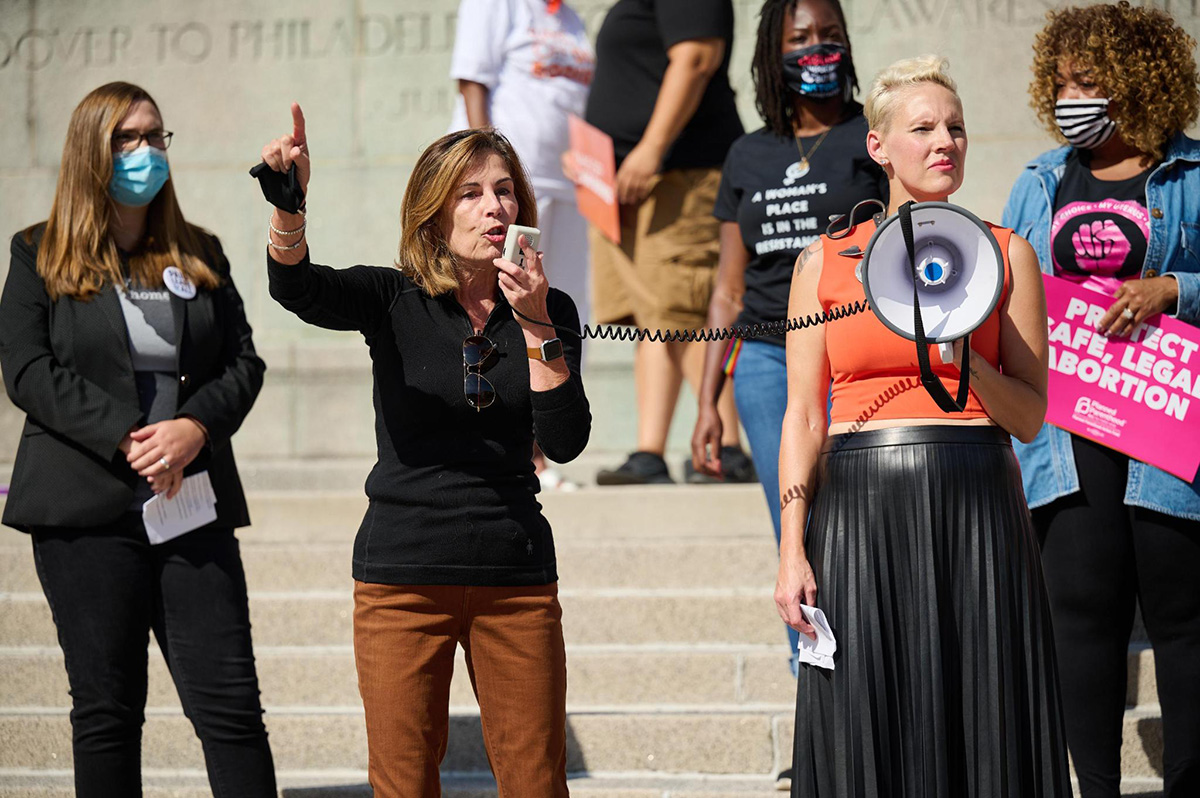
Tymothy ‘Ty’ Moyer, a gay former resident of Wilmington, Del., earlier this year filed a lawsuit in federal court charging Delaware Attorney General Kathleen ‘Kathy’ Jennings, one of her deputies, and a state-employed victims advocate with conspiring to deny him “equal protection” under the law because he is African American by declining to prosecute his then domestic partner after the partner’s arrest on Feb. 3, 2024, for assaulting and seriously injuring him, causing a “permanent traumatic brain injury.”
The lawsuit also names as defendants the University of Delaware and one of its officials for allegedly failing to sufficiently discipline Michael Uzu, Moyer’s former partner and alleged attacker, who at the time was a graduate student seeking a Ph.D. in chemistry.
According to the lawsuit, following his arrest on an assault charge, the university conducted an investigation of Uzu and found he violated the university’s policy of student conduct by engaging in domestic violence, but issued a deferred suspension until December 2025, allowing him to continue his studies. Moyer has said the university acted improperly by not expelling Uzu from its Ph.D. program because of the seriousness of the assault.
The lawsuit identifies Uzu, 33, as a citizen of Nigeria with a U.S. student visa. Uzu identifies himself on his LinkedIn page as a chemist who was conducting research for the Delaware-based chemical company Chemours while studying advanced chemistry at the University of Delaware. His LinkedIn page says he received his Ph.D. in 2026.
Moyer, 30, who identifies himself in his lawsuit as African American and a lifelong U.S. citizen, provided the Washington Blade with a statement describing the details of his allegations against Uzu.
“On the late evening of February 2 through the morning of the 3rd, in 2024, I ended the relationship and asked Michel ‘Mike’ Uzu to leave my apartment in Wilmington, Delaware,” his statement says. “I was ending the relationship after months of escalating mistreatment,” the statement says, adding that Uzu refused to leave his apartment and started a confrontation.
“Uzu attacked me,” the statement continues. “He struck me repeatedly with his fists, with my own cell phone, and with a titanium lacrosse stick that he picked up from inside the apartment and used to strike me on the head. I suffered severe facial trauma, swelling, bodily bruising, and required surgical staples to close the lacerations on the top of my skull.”
The statement adds, “During the assault, Uzu told me he would kill me if I told anyone. Outside the apartment building, Uzu picked up a large rock and positioned himself to strike me with it before a bystander intervened.” It says Moyer was then transported to the emergency room of a nearby hospital.
Moyer’s lawsuit says Uzu was arrested by Wilmington police, indicted by a grand jury, and arraigned on felony and misdemeanor assault charges.
In response to an email request from the Blade for comment, Uzu emailed a statement on Sept. 15 denying all of Moyer’s allegations, saying it was he who told Moyer he wanted to end their relationship and it was Moyer who assaulted him.
“He would get drunk and use drugs and pick up fights with me and apologize when he became normal,” Uzu says in his statement. “So, I packed up my things and decided to depart from him,” he said, adding, “The night preceding the day I was moving out he attacked me while I was sleeping, kicked me in the stomach and injured me in my arms, jaw and neck while I was sleeping, that turned into a fight as I was defending myself.”
He said he called the police and before the police arrived Moyer “self-inflicted injury on himself and framed it on me.”
Moyer couldn’t immediately be reached for a response to Uzu’s allegations. But his friend, journalist Scott Davis, who has followed the case and examined the police report and court documents, said none of Uzu’s allegations could be confirmed by police, who arrived on the scene and prepared a report. Among other things, Davis said the investigation conducted by the University of Delaware found Uzu never provided any documentation that he was injured.
Davis said Moyer, who is about 5 feet 7 inches tall and weighs about 160 pounds compared to Uzu, who is over six feet tall and weighed over 200 pounds, was the one found to be suffering serious injuries, with no injuries reported for Uzu.
Moyer’s earlier statement to the Blade says that In September 2024, on the day of his birthday, the lead prosecutor in the case, Deputy Attorney General Claudia Debonte, called him to inform him she was dropping the case. The lawsuit states that the reason given for dropping the case was insufficient evidence based on Uzu’s claim that he acted in self-defense.
“The University’s hearing officer explicitly rejected Uzu’s self-defense claims as ‘inconsistent and unreliable’ and found that Uzu’s account contained ‘multiple irreconcilable inconsistencies’ and ‘material omissions,’” Moyer’s lawsuit states.
Moyer’s lawsuit says the university’s investigative findings and the police report at the time Uzu was arrested, along with a partial video Moyer took with his phone showing Uzu attacking him with the lacrosse stick, clearly provide sufficient evidence for a full prosecution.
Moyer has said the assault left him with permanent brain damage that impaired his vision, forcing him to resign from his career as a financial compliance associate with the BlackRock asset management company.
In response to a request by the Blade for comment on why the Delaware Attorney General’s office, with the approval of Attorney General Jennings, declined to prosecute Uzu for assault, Matt Marshall, a spokesperson for Jennings, sent the Blade a statement.
“While I can’t characterize specific evidence or statements made to police, the State’s analysis included, but was not limited to, the investigation’s finding that the Defendant had a credible claim of self-defense,” according to Marshall’s statement.
“This kind of dynamic is fairly common in domestic violence cases, no less so in same-sex cases,” he said. “A case being unviable at trial does not mean a victim has not been harmed, that we don’t believe them, or even necessarily that a Defendant is innocent,” Marshall’s statement says. “It only means that criminal guilt could not be proven at trial.”
Among other things, he noted that prosecutors must be able to convince a jury that a defendant is guilty beyond a reasonable doubt. In this case, he said, his office did not believe they could overcome “every reasonable doubt, which would include a Defendant’s argument that they acted in self-defense.”
Jennings, a Democrat, who easily won her primary race for re-election to a third four-year term on Tuesday, has a longstanding record of support on LGBTQ rights and progressive causes. She was challenged by two opponents in the Sept. 15, 2026, Delaware Democratic primary. One of the opponents, civil rights attorney Dwayne Bensing, is gay and would have become the nation’s first openly gay state attorney general had he prevailed in the race.
In response to a request from the Blade for comment on Moyer’s lawsuit allegations, Bensing said in a statement that when the Attorney General’s office declines to prosecute a case where an arrest was made it should maintain the public trust by being “transparent” about its decision-making process.
“As Attorney General, I will commit to reviewing how domestic partner violence cases are handled across the state to ensure that prosecutorial decisions are made consistently, transparently, and free from administrative oversight failures,” he said.
Moyer’s lawsuit, which was filed in the U.S. District Court for the District of Delaware on April 16, 2026, calls for a jury trial and requests that the court issue a judgment against each of the defendants, “jointly and severally” finding that they “conspired to deprive Plaintiff of the equal protection of the laws in violation of 42 U.S. Code 1985 (3).”
It calls for compensatory damages and punitive damages against each defendant “in an amount to be determined at trial, including damages for lost wages, medical expenses, legal fees, emotional distress, and pain and suffering.”
Moyer said he is currently representing himself without an attorney.
In an Aug. 28, 2026, “Report and Recommendation,” Magistrate Judge Laura D. Hatcher, who was presiding over the lawsuit case, issued a recommendation that the case be dismissed without prejudice on grounds that Moyer’s complaint “fails to state a claim upon which relief can be granted” based on existing federal law.
Hatcher also recommended that Moyer be “granted leave to amend his complaint within thirty (30) days of the District Court’s adoption of this Report and Recommendation.”
Moyer told the Blade District Judge Gregory B. Williams accepted the recommendation and granted him permission to amend and revise his complaint.
“An amended complaint addressing the Court’s guidance will be filed within the timeframe the Court has provided,” Moyer said. “The Court identified areas where the complaint needed further development, and that development is underway,” he said.
Moyer’s friend, journalist and commentator Davis, said he has conducted research into domestic violence cases in Delaware and reported in articles and commentaries that Delaware is one of the states with the highest rates of domestic violence cases that are not prosecuted.
“In fiscal year 2024, Delaware law enforcement made 5,064 domestic violence arrests,” Davis wrote in a November 2025 commentary entitled, “Was Ty Moyer Too Black and Gay for Delaware AG Kathy Jennings to Prosecute His Attacker?” He added, “Yet Jennings’ office prosecuted only 1,184 cases – a mere 23 percent,” Davis wrote, adding that, “More than three-quarters of domestic violence perpetrators faced no prosecution despite being arrested.”
Davis told the Blade that Jennings’s decision not to prosecute Uzu has raised concerns that she based that decision on political bias. He points out that Jennings has publicly aligned herself with national immigration advocacy efforts, including joining lawsuits against the Trump administration’s immigration policies and its funding freezes against universities, including the University of Delaware.
Davis said Uzu’s academic ties to the University of Delaware and the chemical company Chemours, which Davis says is “politically influential” with its headquarters in Wilmington, has led some to believe that Jennings’s refusal to prosecute Uzu was politically motivated, aimed at preserving her image as a defender of immigrants rather than pursuing justice for a domestic violence victim.
Jennings’s supporters dispute those claims, saying she bases her decisions on whom to prosecute on the available evidence.
As if all that were not enough, Davis said he contacted the U.S. Department of Homeland Security in September 2025 to find out if their strict policy of investigating and deporting immigrants found to have violated U.S. laws, including engaging in violent behavior, might apply to Michael Uzu, who was charged with assault and is in the U.S. on a visa status. Davis said the DHS did not respond to his inquiry.
Virginia
Virginia Anti-Violence Project struggles to fill federal funding gaps
Group has lost 54 percent of funding since 2020
A loss of federal funding has threatened to adversely impact the Virginia Anti-Violence Project’s work in the state.
The group’s mission is to assist LGBTQ and BIPOC (Black, Indigenous and people of color) victims of domestic, sexual, interpersonal, and state violence with direct support, education, and advocacy. The VAVP seeks to build a future where LGBTQ and BIPOC individuals can live freely without a sense for worry about violence.
“Virginia Anti-Violence Project helps to close the distance between services existing and LGBTQIA+ survivors actually being able to reach safety, stable housing, and support that they can trust,” VAVP Executive Director Ebony Clark told the Washington Blade on Tuesday. “Our mission is to provide direct services and advocacy to LGBTQ+ survivors across Virginia.”
Clark said obtaining state and federal funds has become increasingly difficult.
“One of the reasons that we can talk about is politics and how you know queer diverse, queer communities are targets when it comes to politics, and so that may be a reason why the funding is decreasing in in very niche areas, but overall, state funding, federal funding has been lost or significantly reduced when it comes to culturally specific marginalized populations,” Clark said. “The bigger picture is that funding that was purposed for diversity, equity, inclusion, marginalized populations, or you know culturally competent programming, those funds have been strategically reduced or eliminated on state and federal levels overall.”
Even more so with the current Trump-Vance administration.
Data shows federal funding for one “major federal victim-services funding stream in” Virginia has dropped 54 percent over the last six years: from $25.1 million in fiscal year 2020 to $11.6 million in fiscal year 2026.
Clark noted some federal funding has been denied due to VAVP’s DEI policies — it has had to “water down” their language. These cuts have forced VAVP to limit housing and economic support, which has resulted in fewer resources for its clients.
The organization has set up a goal for receiving between $250,000-$300,000 a year that would allow it to operate — and focus on client housing.
“Housing is fundamental to safety,” Clark told the Blade. “If you know leaving violence puts someone on the street or forces them back to the person harming them, that means the crisis isn’t over. So there needs to be other prevention strategies and reactive strategies in place to be able to prevent further violence from folks.”
VAVP has set up a link for anyone who is interested in making a donation. It is here.
The VAVP website is also accepting donations.

Parties, dinners, concerts and more on tap for fall nightlife

All the queer things to watch this fall

Gun reform is an LGBTQ rights issue

Trump’s Cabinet: Dumb, dumber, dumbest, and evil

D.C.’s fall theater season is already well underway

Dolly Parton biography puts her hardships into context

PHOTOS: SMYAL Fall Brunch

Fashion icon Bob Mackie dead at 87

Dozens detained after Turkish authorities raid LGBTQ groups, businesses