News
New Mexico high court rules for marriage equality
Decision makes state the 17th with same-sex marriage on the books


The New Mexico Supreme Court ruled in favor marriage equality. (Photo public domain)
Capping off a year of historic victories, the New Mexico high court handed down a unanimous ruling on Thursday granting same-sex couples the ability to wed in the state.
The 5-0 decision is written by Justice Edward Chavez, who concludes the current statutory scheme of the marriage law violates the Equal Protection Clause under Article II, Section 18, of the state constitution.
“We hold that the State of New Mexico is constitutionally required to allow same-gender couples to marry and must extend to them the rights, protections, and responsibilities that derive from civil marriage under New Mexico law,” the ruling states.
The ruling, which takes effect immediately, makes New Mexico the 17th state with marriage equality on the books. It also retroactively affirms the same-sex marriages for couples who already wed after obtaining marriage licenses from county clerks in the state.
The parties in the lawsuit, Griego v. Oliver, were six same-sex couples as well as all 33 of the state’s county clerks, who sought clarification on whether the state law enabled them to deliver marriage licenses to gay couples. Representing the same-sex couples were the American Civil Liberties Union of New Mexico, the national ACLU, the National Center for Lesbian Rights, the law firm of Sutin, Thayer & Browne APC as well as New Mexico attorneys Maureen Sanders, N. Lynn Perls and J. Kate Girard.
Laura Schauer Ives, legal director for ACLU-New Mexico, said the decision represents a “historic and joyful day for New Mexico.”
“As a state, we have always strived to treat all families with dignity and respect, and today’s decision allowing loving, committed same sex couples to marry continues that tradition,” Schauer Ives said. “The more than 1,000 same-sex couples who have already married in New Mexico can now rest certain knowing their marriages will be recognized and respected by our state.”
Camilla Taylor, National Marriage Project Director for Lambda Legal, commended her colleagues in the LGBT advocacy community for leading the way to a favorable decision on marriage equality in New Mexico.
“This beautiful unanimous decision explicitly underscores the argument we and our sister organizations have long made: denying same-sex couples the ability to marry imposes significant emotional and dignitary harm and is discrimination, pure and simple,” Taylor said.
New Mexico Gov. Suzanne Martinez, who opposes same-sex marriage but didn’t actively defend the marriage law, said in a statement she’ll abide by decision, but wish it were settled differently.
“My personal views on this issue are well-known, and I’m confident that most New Mexicans believe, like I do, that it should have been settled by a vote of the people,” Martinez said. “Instead, the Supreme Court stepped in and rendered their decision. While there will surely be intense debate about this decision moving forward, I encourage New Mexicans to continue to respect one another in their discourse, as this is an important issue for many New Mexicans on both sides.”
White House Press Secretary Jay Carney said immediate after the ruling he had no “official reaction,” but offered some thoughts.
“I would say that we welcome that ruling, and this is another example of the extraordinary progress that’s been made when it comes to equal rights for LGBT Americans in this country,” Carney said.
Justices make use of the June decision from the U.S. Supreme Court against Section 3 of the Defense of Marriage Act, noting the decision leaves marriage equality as the only option for same-sex couples to receive the federal benefits and for the state to avoid a federal challenge to its state law.
“Interpreting our statutes to authorize committed same-gender couples to enter into civil marriage will grant them the rights and privileges available to opposite-gender married couples in approximately one thousand statutes and federal regulations that refer to a person’s marital status, thereby avoiding a constitutional challenge on that basis,” the decision states.
The decision is the culmination of a drawn-out process over the course of 2013. It started in March with Santa Fe Mayor David Coss introducing a resolution, later approved the city council, saying marriage equality was already legal in New Mexico because of the gender-neutral construction of some portions of state law. That’s the conclusion Judge Alan Malott reached in a decision earlier this year extending marriage equality to Bernalillo and Santa Fe counties.
Notably, the court rejects in its decision the notion that marriage is already legal under the current state statutory scheme, observing that the legislature has passed laws, such as one changing the marriage application forms in 1961, defining marriage in opposite-sex terms.
“Thus, we conclude that a mix of gender-neutral and gender-specific terminology in the domestic relations statutes does not mean that the Legislature intended to authorize marriage between same-gender couples,” the decision states. “On the contrary, we conclude that the statutory scheme reflects a legislative intent to prohibit same-gender marriages.”
LGBT groups followed up with the Santa Fe resolution by filing a lawsuit on behalf of same-sex couples seeking to wed in New Mexico. Attorney General Gary King issued an opinion saying he wouldn’t defend the marriage law against a legal challenge in court on the basis that the law was unconstitutional.
Prior to the ruling from the New Mexico Supreme Court, a total of eight county clerks were already distributing marriage licenses to same-sex couples either through court order as a result of the litigation or on their own volition based on their interpretation of state law. An estimated 58.5 percent of New Mexico’s population had access to marriage equality prior to the Supreme Court ruling.
Attorney General King and plaintiffs in the case were pushing the idea that gays and lesbians are a suspect class and laws related to sexual orientation should be subject to heightened scrutiny — a idea with which New Mexico Supreme Court concurs because of the history of persecution faced by the LGBT community.
“Therefore, we conclude that intermediate scrutiny must be applied in this case because the LGBT community is a discrete group that has been subjected to a history of purposeful discrimination, and it has not had sufficient political strength to protect itself from such discrimination,” the ruling states.
It’s possible the opponents of the decision could place a state constitutional amendment on the ballot in 2014 that would rescind the decision, but only by legislative referral, not by initiative petition. It’s unclear at this time what the legislature will do. Democrats hold strong majorities in both chambers of the New Mexico legislature.
Brian Brown, president of the anti-gay National Organization for Marriage, promised in a statement to pursue action to protect people in New Mexico who don’t support same-sex marriage.
“Once again, activists judges have thrown out the historic legal understanding of marriage in New Mexico,” Brown said. “This is a continuation of a very dangerous rush towards silencing people of faith who simply believe marriage to be the union of one man and one woman. The National Organization for Marriage will do everything in its power to protect believers of true marriage in New Mexico and around the nation from the fallout of radical judges who deny the truth of marriage.”
Marc Solomon, national campaign director of Freedom to Marry, said his organization is prepared to fight to make sure the New Mexico decision stays in place.
“We have a campaign that we played a lead role in setting up and are on the board of, New Mexico Unites for Marriage, to protect the decision and defeat any efforts to amend the constitution,” Solomon said. “We’ve hired a campaign manager and there’s a field and media team on the ground, lobbyists, and more. It’s cochaired by former Republican Gov. Gary Johnson and Congresswoman Michelle Lujan Grisham.”


2026 Midterm Elections
Markey’s primary win deemed success for LGBTQ activists
Mass. lawmaker champions transgender rights
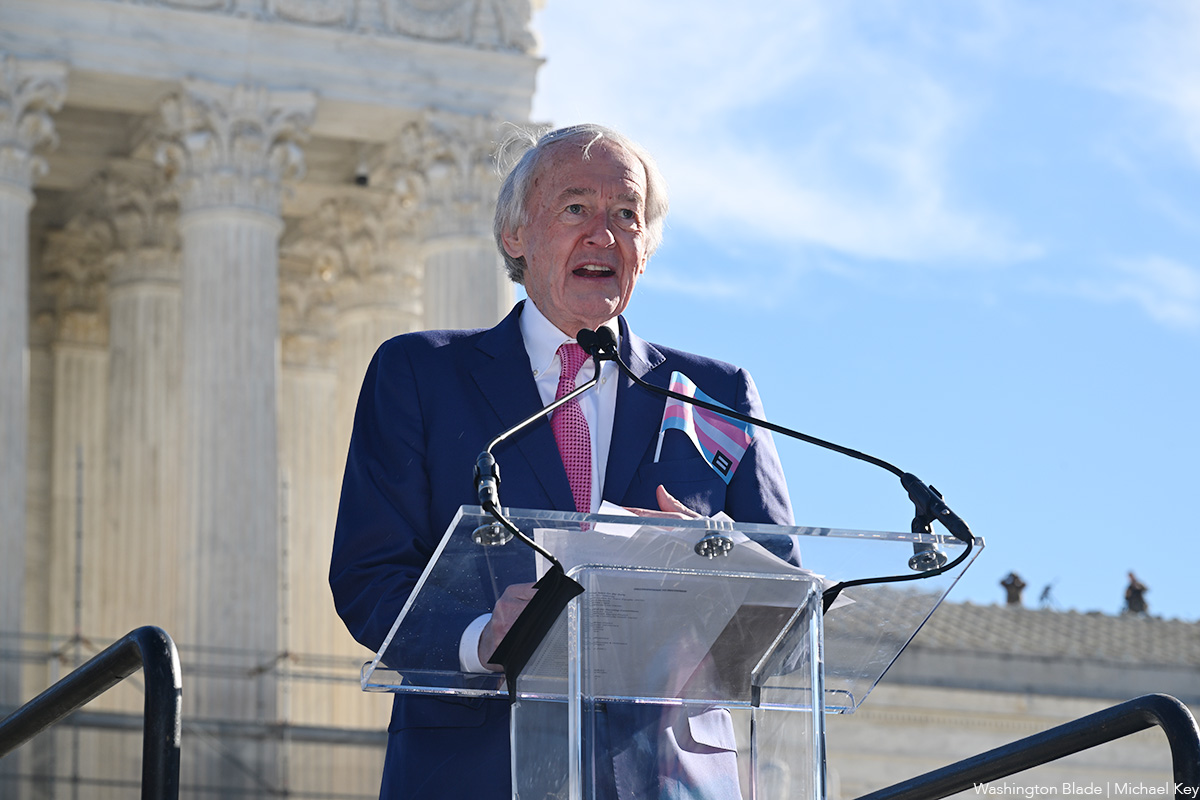
U.S. Sen. Ed Markey (D-Mass.) clinched the Democratic seat for his reelection campaign in Massachusetts’s primary election on Tuesday.
Markey won the deep-blue state with 64.8 percent of the vote, according to NBC News, triumphing over Marine Corps combat veteran and Congressman Seth Moulton, who received 35.2 percent of the vote.
Massachusetts’s primary election, which determined which Democratic candidate will head to the polls to face off against the Republican challenger in November, is being considered a victory for LGBTQ-inclusive policy, as well as for a divisive pro-transgender rights candidate — both things Markey has become an outspoken champion of.
Markey has experience at multiple levels of government, from the state level, where he served three terms in the state House of Representatives, to his federal tenure, including 20 terms in the U.S. House of Representatives and is now serving his second term as a senator. He has become a fixture of a changing Democratic Party in one of the most consistently blue places in the U.S.
This primary — and much of the national discussion surrounding the Senate seat — focused a lot of campaigning power on fighting the growing sentiment, led mostly by Republicans, that the frustration many Americans feel lends itself to an anti-establishment and anti-incumbent attitude.
Markey ran his campaign using his past as a reflection of his commitment to constantly putting his best foot forward for Bay Staters — particularly with apprehension for issues younger and more progressive democrats have been righting for — including Green New Deal and “Medicare for All” while Moulton — who was also elected to federal office prior to this run — campaigned on being younger than Markey, arguing that he was not the same type of established politician.
Moulton also faced backlash for negative comments about trans athletes, sparking criticism for those who did want younger candidate but want for trans rights to be protected.
Markey’s track record of supporting the LGBTQ community is one of the most clear in federal politics, one that has garnered a “100 percent lifetime voting record” on the Human Rights Campaign’s PAC politician review scorecard.
That list of Markey’s actions includes being a cosponsor of the Equality Act, driving landmark legislation to ensure federal protections for LGBTQ Americans, and being one of the most vocal proponents for trans rights in the federal government — specifically in multiple appropriations bills and in the National Defense Authorization Act. He was also the lead sponsor of the Transgender Health Care Access Act and the Transgender Bill of Rights resolution.
Markey first introduced the Transgender Bill of Rights in the Senate in 2023, where it ultimately failed to be brought to law. He reintroduced the legislation this year once again. This was a direct response to the attitude pushed by many conservatives after 2021, when the push to minimize trans rights started to become a key part of their cause and has been constantly propped up by the Trump-Vance administration.
“Massachusetts needs a senator who stands up and fights back, a senator who never forgets who they are fighting for,” Markey said during his victory speech. “That has been the mission of my life, and it always will be.”
Following the calling of the primary, a slew of LGBTQ organizations rallied behind Markey, many pushing his past as an asset that puts his money where his mouth is through advocating for legislation specifically protecting the LGBTQ community.
Tyler Hack, the executive director of the Christopher Street Project, an organization dedicated to pushing for legal protections for trans americans, released a statement following Markey’s win. Hack argued that putting forward such a staunchly pro-trans candidate is a win for the community, especially after endorsing him earlier this year.
“Tonight, anti-trans politics lost. Massachusetts rejected the idea that attacking transgender people is a shortcut to political power. Voters chose a different path: one where equality is not negotiable, cruelty is not courage, and transgender people do not have to disappear for Democrats to succeed.”
The Human Rights Campaign also endorsed him as a candidate earlier this year and issued a statement via its president, Kelley Robinson.
“Ed Markey has spent decades fighting for LGBTQ+ equality, for working people, and for a more livable world,” Robinson said. “He knows why equality matters. He’s stood with us no matter what. We were proud to endorse him this year, and when a pro-equality majority takes back the Senate this fall, we will continue to count on him as a champion for our community.”
Markey is running for reelection against Republican John Deaton in November, where he is expected to win.
Bulgaria
Top Bulgarian court rules government must legally recognize trans people
Decision caps off decade-long legal fight

Bulgaria’s top court has ruled the country’s government must allow transgender people to legally change their name and gender on ID documents.
A trans woman from Bulgaria who moved to Italy, had tried to change her gender and name on her Bulgarian ID documents, but courts in the country denied her requests for nearly a decade.
The Bulgarian Supreme Court of Cassation in a 2023 ruling essentially banned trans people from legally changing their name and gender on ID documents.
The EU Court of Justice in Luxembourg, which is the European Union’s highest court, in March ruled in the “Shipova” case that member states must allow trans people to legally change their name and gender on ID documents. The lead plaintiff in the “Shipova” case is among the four litigants in the Bulgarian Supreme Court of Cassation case.
Two Bulgarian advocacy groups — Bilitis and Deystvie — along with TGEU – Trans Europe and Central Asia and ILGA-Europe in a joint statement they issued on Tuesday noted the Bulgarian Supreme Court of Cassation’s July 22 decision “aligns Bulgarian practice with the Court of Justice of the EU, enabling changes to gender markers, names, and personal identification numbers.”
“The judges also concluded that EU law requires Bulgaria to establish a legal procedure for legal gender recognition, which is necessary so that Bulgarian trans citizens can travel and reside freely inside the EU,” they added.
Bulgaria has been a member of the EU since 2007.
The country borders Romania, Serbia, North Macedonia, Greece, and Turkey.
“We are very glad to see that the judges of the Supreme Court clearly stated that it is actually a matter of rule of law for Bulgaria to respect the universal equality and the dignity of all human beings, including trans people for whom human rights-based legal gender recognition procedures are an indispensable element,” said Denitsa Lyubenova, co-chair of Deystvie who represented the four plaintiffs in the Bulgarian courts and the lead litigant in the “Shipova” case at the EU Court of Justice. “The government needs to act swiftly now to put in place an LGR procedure that is fully in line with European human rights case law, which means without any conditions requiring proof of medical, surgical or hormonal treatment.”
The groups also urged the Bulgarian government to codify the ruling into law.
“While lower courts are expected to follow this ruling directly, a court decision is not a substitute for law,” they said. “Bulgaria still needs a fast, transparent, and accessible legal gender recognition procedure written into legislation, not left to case-by-case court precedent. TGEU – Trans Europe and Central Asia, Bilitis, Deystvie, and ILGA-Europe call on the Bulgarian government to start that legislative process now, with meaningful involvement from civil society.”
National
Lou Chibbaro Jr. documentary wins award from NLGJA
‘Lou’s Legacy’ produced by D.C.’s Mattachine Society

“Lou’s Legacy: a Reporter’s Life at the Washington Blade,” a documentary produced by The Mattachine Society of Washington, D.C., will receive an Excellence in Journalism Award from NLGJA, the Association of LGBTQ+ Journalists.
The film premiered on WETA PBS in D.C. and Maryland Public Television (MPT) in June of 2025. The documentary’s Emmy-nominated director and producer Patrick Sammon will accept the award for Excellence in Local Television on Sept. 11 at NLGJA’s National Convention in San Francisco.
“Lou’s Legacy” was produced in association with the Mattachine Society of Washington, D.C., a non-profit LGBTQ history society dedicated to conducting original archival research. Aside from Sammon, the NLGJA is recognizing other members of the film’s production team including Producer Julianne Donofrio, Editor Amir Jaffer, Executive Producer Charles Francis, and Executive Producer Pate Felts.
“Lou’s Legacy” tells the story of two D.C. icons — legendary Washington Blade reporter Lou Chibbaro Jr. and beloved drag performer Donnell Robinson, known to generations of Washington audiences as “Ella Fitzgerald.” Through Lou’s nearly five-decade career at the Blade and Ella’s return to the stage after a three-year hiatus following COVID, the 29-minute documentary explores the history of Washington’s LGBTQ community and today’s rising backlash against LGBTQ rights, including laws targeting drag performers.
“All students of journalism can learn a lot from the story of Lou Chibbaro, Jr. Lou has chronicled nearly five decades of LGBTQ+ life and the community’s struggle for equality in Washington, D.C. Lou’s work and the role of the queer press has been essential in covering stories the mainstream media would often ignore or erase,” said Ryan Levi, president of the D.C. chapter of the NLGJA.
“We are thrilled to receive this award from the NLGJA,” said the film’s director Patrick Sammon. “Lou Chibbaro’s nearly five decade career at the Washington Blade demonstrates the essential role LGBTQ journalism plays in telling our community’s stories and documenting its history. This recognition from journalists who follow in Lou’s footsteps is particularly meaningful to me and the rest of our production team.”

Gloria Steinem dies at 92

The mastery of love

Trans people need a politics of ordinary life

Enlarging the Supreme Court keeps making more sense

Markey’s primary win deemed success for LGBTQ activists

Immersive ‘Nation-State’ imagines a society free of authoritarianism

Poland begins to legally recognize same-sex marriages from other countries

HRC president campaigns for Chris Pappas in NH

We’re getting married but our parents object

Michael Smith could make history as Delaware’s first LGBTQ treasurer
-

 Theater5 days ago
Immersive ‘Nation-State’ imagines a society free of authoritarianism
-
Poland4 days ago
Poland begins to legally recognize same-sex marriages from other countries
-
Congress4 days ago
HRC president campaigns for Chris Pappas in NH
-
Advice4 days ago
We’re getting married but our parents object