News
O’Malley first 2016 candidate to endorse Equality Act
2016 hopeful seeks to ‘fight for a more open, respectful & inclusive nation’
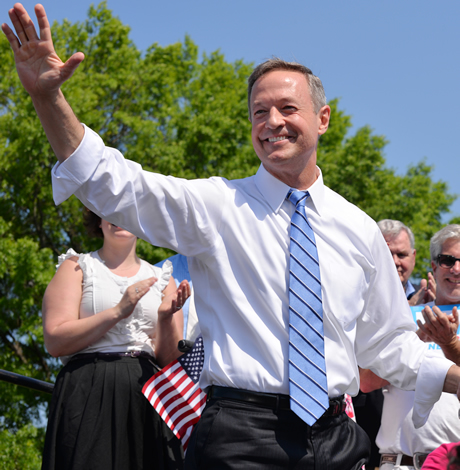

Martin and Katie O’Malley (Washington Blade photo by Michael Key)
The sweeping legislation, introduced by Rep. David Cicilline (D-R.I.) and Sen. Jeff Merkley (D-Ore.), would bar discrimination against LGBT people in the areas of employment, education, jury service, federal programs, housing, credit and public accommodations.
O’Malley signaled support for the bill in a Twitter message at 12:30 just as a news conference was taking place on Capitol Hill announcing the introduction of the Equality Act. The tweet made him the first candidate out of the gate to publicly support the bill.
I proudly support the new LGBT civil rights bill—we must continue to fight for a more open, respectful & inclusive nation. #EqualityAct -O’M
— Martin O'Malley (@MartinOMalley) July 23, 2015
Hours later at 2:52 pm, Democratic front-runner and former Secretary of State Hillary Clinton also declared support for the legislation via Twitter.
The Equality Act will mean full federal equality for LGBT Americans & stronger anti-discrimination protections for everyone. Past time. -H
— Hillary Clinton (@HillaryClinton) July 23, 2015
Previously, Clinton called for an end to discrimination against LGBT people in marriage, employment and other areas, but hasn’t until now articulated a vehicle to achieve that goal.
O’Malley has in another sense beaten Clinton to the punch weeks ago. After the U.S. Supreme Court decision in favor of same-sex marriage, an O’Malley campaign spokesperson in late June confirmed for the Washington Blade the candidate was aware of the Equality Act as it was in its planning stages and supported the bill.
Meanwhile, Sen. Bernie Sanders has said nothing about the bill upon its introduction on his Twitter accounts. Michael Briggs, a Sanders spokesperson, confirmed his boss would be among the 40 co-sponsors of the Equality Act in the Senate.
“He believes that these protections are long overdue,” Briggs said. “Vermont has banned discrimination based on sexual orientation since 1992 and gender identity since 2007.”
In a May interview with the Washington Blade, Sanders said he would support amending the Civil Rights Act and the Fair Housing Act to include sexual orientation and gender identity — which is the basis of the Equality Act — and said he suspected he would support the legislation then being drafted by Merkley. But Sanders wasn’t a confirmed supporter of the Equality Act until Thursday when his office announced he would be an original co-sponsor.
Each of the Republican presidential candidates have stayed mute on the legislation on the day of its introduction.




Canada
Shooter who killed 7 people inside Canada school was transgender
Advocacy groups have condemned efforts to link trans people to mass shootings

Canadian authorities on Wednesday said the person who killed seven people and injured more than two dozen others at a school in Tumbler Ridge, British Columbia, the day before was transgender.
Dwayne McDonald, the deputy commissioner for the Royal Canadian Mounted Police in British Columbia, during a press conference said Jesse Van Rootselaar, 18, “was born as a biological male who approximately … six years ago began to transition as female and identified as female both socially and publicly.” McDonald added it is “too early to say whether” the shooter’s gender identity “has any correlation in this investigation.”
The shooter died by suicide, and authorities found her body inside the school.
“We have a history of police attendance at the family residence,” said McDonald. “Some of those calls were related to mental health issues.”
Egale Canada, the country’s LGBTQ and intersex rights group, on Wednesday said it is “heartbroken by the horrific shooting in Tumbler Ridge.”
“Our deepest condolences are with the victims, their families, and the entire community as they navigate unimaginable grief,” said the group in a statement. “We unequivocally condemn this act of violence. There is no place for violence in our schools or in our communities. At this profoundly difficult time, we hold the people of Tumbler Ridge in our thoughts and stand in solidarity with all those affected.”
Mass shootings are relatively rare in Canada, unlike in the U.S.
GLAAD notes statistics from the Gun Violence Archive that indicate trans people carried out less than 0.1 percent of the 5,748 mass shootings in the U.S. between Jan. 1, 2013, and Sept. 15, 2025. The Human Rights Campaign, the National LGBTQ Task Force, and other advocacy groups last August condemned efforts to scapegoat the community after a trans woman shot and killed two children and injured 17 others inside the Annunciation Catholic School in Minneapolis.
Russia
Russia’s anti-LGBTQ crackdown takes absurd turn
Authorities targeted one of the country’s largest bookstore chains last month
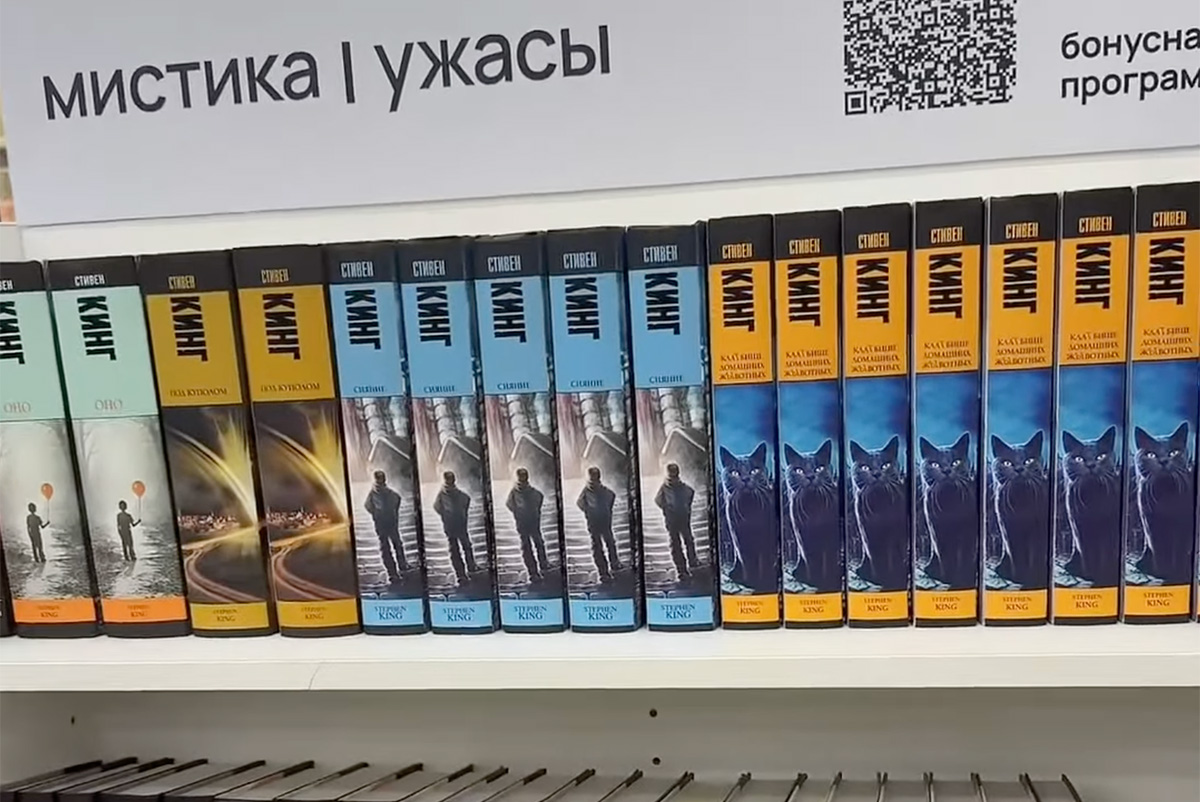
While MAGA continues to attack LGBTQ rights in the U.S. — including erasing queer history and removing children’s books with LGBTQ characters from libraries and pushing an ever‑broader censorship agenda — and as the UK faces MAGA‑inspired campaigns demanding the removal of LGBT literature from public libraries, Russia’s assault on LGBTQ‑related media has taken an extreme and frankly absurd turn. It is a cautionary tale for Western countries of just how far censorship can go once it becomes normalized. From books to anime, TV shows, and even academia, queer existence is being systematically erased.
In January, one of Russia’s largest private bookstore chains, Chitai‑Gorod-Bukvoed, faced the risk of being shut down over alleged “LGBT propaganda” under a law that prohibits any positive mention of LGBTQ content and equates LGBTQ material with pornography and pedophilia.
Among the books targeted were “Beartown,” “Us Against You,”and “The Winners”by Fredrik Backman, “The Left Hand of Darkness” by Ursula K. Le Guin, and “The Heart’s Invisible Furies” by John Boyne.
According to Chitai‑Gorod-Bukvoed CEO Alexander Brychkin, once it became known in mid‑December that law enforcement agencies had launched inspections, the Chitai‑Gorod–Bukvoed network immediately removed these titles from sale nationwide. In a comment to Kommersant, Brychkin stressed that the chain “operates strictly within the legal framework,” noting that the books were not listed in any official register of banned materials at the time the inspections began and had been on sale for several years.
Previously, two of the biggest online film distribution companies were charged as well under the “LGBT Propaganda law.”
Private businesses had no more right to speak up than writers or artists who are persecuted for their work. This is a nightmare scenario for many Americans who believe the free market itself can protect freedom of expression. This is the reality of modern‑day Russia.
A censored version of the anime “Steins;Gate” has also been released on Russia’s most prominent streaming platform, “Kinopoisk,” in which the storyline of one of the main characters was altered due to the ban on so‑called “LGBT propaganda,” as reported by opposition outlets Verstka and Dozhd, as well as fans on Reddit.
In the original series, the character Ruka Urushibara is a young person with an androgynous appearance who struggles to accept themself in a male body — an obvious indication that Ruka is a transgender girl. Ruka wears women’s clothing and dreams of becoming a girl. In episode eight, Ruka is given the chance to intervene in the past by sending a message to their mother in order to be born female.
In the Kinopoisk version, released in late 2025, Ruka is instead portrayed as a girl living with HIV — something entirely absent from the original anime and invented in translation. The storyline and dialogue were rewritten accordingly, completely distorting the original meaning: in this version, Ruka attempts to change the past in order to be born “healthy,” without HIV, rather than to be born a girl. This is not only absurd, but deeply offensive to the LGBTQ community, which has long been stigmatized in relation to HIV.
A similar distortion appears in “Amediateka”’s translation — or, better to say, rewriting — of the new AMC series “Interview with the Vampire.” Translators rewrote dialogue in ways that fundamentally misrepresented the plot, downplaying the openly queer nature of the characters to the point that romantic partners were translated merely as “friends” or “pals,” rendering entire scenes meaningless. At the same time, even brief critical references to Russian or Soviet politics were removed.
As for queer romance, such as the popular Canadian TV show “Heated Rivalry,”it has no official Russian translation at all and circulates only through fan translations. The show remains popular among millennials and Gen Z, and Russian social media platforms like X (Twitter) and Instagram are full of positive reviews. Yet, in theory, promoting such a show could put someone at risk under the law. People still watch it, still love it, still build fan communities, but it all exists quietly, pushed under the carpet.
The prohibition is not total, but it is a grotesque situation when even such a nice and harmless show is stigmatized.
Books suffer even more. Some classics fall under bans, and books are physically destroyed. In other cases, the outcome is worse: texts are rewritten and censored, as with “Steins;Gate.” This affects not only fiction but also nonfiction. For example, in “Deep Color” by Keith Recker, an American researcher of visual arts, all mentions of queer, feminism or BDSM culture were erased in the Russian edition. Even historically necessary references were removed, including mentions of the pink triangle used by the Nazis.
In the Russian edition of Skye Cleary’s “The Thirst for Authenticity: How Simone de Beauvoir’s Ideas Help You Become Yourself,” dozens of paragraphs were blacked out. Passages discussing the fluidity of gender and a person’s right to define themselves outside the rigid male–female binary were removed. Sections on contraception and abortion, critiques of biological reductionism and social pressure on women, details of Simone de Beauvoir’s intimate life and her relationships with women, as well as reflections on non‑monogamous relationships, were all excised. Even footnotes referencing quotes about gender identity were hidden.
Those two books are one of the many examples of the fate of Russian-translated nonfiction. Actually, even books about animal reproduction were demanded to be censored because of the “LGBT propaganda law”. Apparently, the authorities couldn’t accept a neutral scientific description of same-sex behavior and reproductive diversity in animals.
The authorities know what they are doing. Most people are less likely to read dense nonfiction or search actual studies about animal sexual behavior than to watch a popular TV show about queer hockey players, which makes visual media easier to censor quietly and effectively. So they really could show LGBTQ as something negative and absolutely unnatural for most of the Russian population.
And this is the core of the problem. This is not just censorship of content — it is the rewriting of history, even the narrative around biology. It is the deliberate marginalization of queer existence, the systematic erasure of queer people’s ability to see themselves reflected in culture, literature, and art.
The U.S. still retains independence in academia, publishing, and private business when it comes to queer voices. Russia does not. History shows where this path leads: Nazi Germany burned books; the Taliban destroyed cultural and historical materials. This is always one of the first steps toward genocide — not immediate, perhaps, but inevitable once dehumanization becomes official policy. It never stops with just one group. In Russia, immigrants, people from the North Caucasus and Central Asia, Ukrainians, and even disabled citizens face daily dehumanization — it’s all part of the same system.
And now, alarmingly, the U.S. seems to be following in Russia’s footsteps — the same path that enabled war in Ukraine and the thriving of authoritarianism.
Virginia
McPike wins special election for Va. House of Delegates
Gay Alexandria City Council member becomes 8th LGBTQ member of legislature

Gay Alexandria City Council member Kirk McPike emerged as the decisive winner in a Feb. 10 special election for a seat in the Virginia House of Delegates representing Alexandria.
McPike, a Democrat, received 81.5 percent of the vote in his race against Republican Mason Butler, according to the local publication ALX Now.
He first won election to the Alexandria Council in 2021. He will be filling the House of Delegates seat being vacated by Del. Elizabeth Bennett-Parker (D-Alexandria), who won in another Feb. 10 special election for the Virginia State Senate seat being vacated by gay Sen. Adam Ebbin (D-Alexandria).
Ebbin is resigning from his Senate this week to take a position with Virginia Gov. Abigail Spanberger’s administration.
Upon taking his 5th District seat in the House of Delegate, McPike will become the eighth out LGBTQ member of the Virginia General Assembly. Among those he will be joining is Sen. Danica Roem (D-Manassas), who became the Virginia Legislature’s first transgender member when she won election to the House of Delegates in 2017 before being elected to the Senate in 2023.
“I look forward to continuing to work to address our housing crisis, the challenge of climate change, and the damaging impacts of the Trump administration on the immigrant families, LGBTQ+ Virginians, and federal employees who call Alexandria home,” McPike said in a statement after winning the Democratic nomination for the seat in a special primary held on Jan. 20.
McPike, a longtime LGBTQ rights advocate, has served for the past 13 years as chief of staff for gay U.S. Rep. Mark Takano (D-Calif.) and has remained in that position during his tenure on the Alexandria Council. He said he will resign from that position before taking office in the House of Delegates.

CMS moves to expand HIV-positive organ transplants

Shooter who killed 7 people inside Canada school was transgender

Russia’s anti-LGBTQ crackdown takes absurd turn

McPike wins special election for Va. House of Delegates

As Oscars approach, it’s time to embrace ‘KPop Demon Hunters’

PHOTOS: Drag in rural Virginia

New book explores homosexuality in ancient cultures

I keep getting rejected on the apps

Gay man details secret struggle with bulimia