Local
Slain D.C. middle school principal was gay
Brian Betts hailed as innovative educator, hero to students

Brian Betts (Photo by Bel Perez Gabilondo; courtesy of D.C. Public Schools)
Brian Betts, the highly acclaimed D.C. middle school principal who was found shot to death April 15 at his home in Silver Spring, Md., was out as a gay man to a circle of friends and D.C. public school system colleagues, multiple sources have told the D.C. Agenda.
Montgomery County police said they discovered Betts’ fully clothed body in a second floor bedroom in his house along the 9300 block of Columbia Boulevard in Silver Spring. Police noted there were no signs of a forced entry into the house, leading them to believe that Betts, 42, invited his killer or killers inside.
Police spokesperson Sgt. C. Thomas Jordan said he could not comment on whether Betts’ murder was related to the slain principal’s sexual orientation, saying only that homicide detectives were investigating all possible angles of the case to identify a suspect or suspects.
“I know our investigators are talking to everyone they know of to get to the bottom of the case,” he said. “We are going to investigate every avenue. Our role is to solve a homicide.”
Betts established a reputation as a rising star in the Montgomery County public school system as a teacher and assistant principal before D.C. Public Schools Chancellor Michelle Rhee recruited him to join her and Mayor Adrian Fenty’s efforts to overhaul the District’s long troubled school system.
In 2008, Rhee named Betts principal of Shaw Middle School at Garnet-Patterson, a recently reorganized school in the city’s historic Shaw neighborhood. School officials said he quickly emerged as one of the school system’s most innovative principals.
The Washington Post reported that students liked him so much that they asked and Rhee agreed to allow 100 students to remain at the middle school for their ninth grade instead of the normal process of advancing to another school for that grade.
“The unexpected death of Brian Betts is unspeakably tragic for his family, for the Shaw Middle School community, and for all of D.C. Public Schools,” Rhee said in a statement.
“Brian Betts had the courage to take on the leadership of a struggling, underperforming DCPS school,” she said. “He was an inspirational leader for the teachers and for the students, and that leadership was bringing results. He knew what the children under his care were capable of, and he was determined to show them how to get there.”
Montgomery County police disclosed that D.C. police found Betts’ blue Nissan Xterra SUV on April 16 along the 3900 block of Fourth Street, S.E., in D.C., where it was believed to have been abandoned by two suspects between noon and 3 p.m. Police sources said investigators learned from a nearby resident that two males were seen leaving the vehicle, but as of Tuesday police declined to release a description of them.
On Monday, a Montgomery police spokesperson issued another statement saying investigators established that Betts was alive at least until 11:30 p.m. April 14. News media have reported neighbors observing that Betts had hosted a barbeque cookout for one or more people in his back yard on the night of April 14. Police would neither confirm nor deny that report.
Police arrived at Betts’ house about 7:30 p.m. April 15 after a co-worker called to report he had failed to show up at work that morning and could not be reached. The co-worker arrived at the house to investigate his whereabouts and entered the house after discovering the front door was unlocked, police said. Rather than investigate further, the co-worker called police, and police discovered Betts’ body in an upper floor bedroom.
One gay man who knew Betts from the time Betts lived in D.C.’s Shaw neighborhood said Betts had a circle of gay friends and was seen patronizing the Dupont Circle gay bars Omega and Fireplace.
Another gay man who knew him said he assumed Betts was “out” as gay because many people in the gay community knew him in gay circles.
“He was definitely a member of the GLBT community,” said the man, who spoke to D.C. Agenda on condition that he was not identified.
Capt. Paul Starks, director of the Montgomery County police’s public affairs office, declined to comment on Betts’ sexual orientation or whether police were looking into whether the case was a possible hate crime or pick-up murder.
Gay activists and LGBT anti-violence groups in D.C. and other cities have expressed concern in the past that police investigators sometimes failed to seek help from the LGBT community in cases where mostly gay men were robbed or killed by men they met in gay clubs or meeting places and invited home.
In an investigative series of stories in the 1980s and 1990s, the Washington Blade reported more than 20 murders of gay men in the D.C. metropolitan area believed to be pick-up murders remained unsolved. Police confirmed that in each of the cases, investigators found no signs of a forced entry into the victims’ homes, where their bodies were found.
Following the murder of D.C. gay resident Anthony Perkins in December, when police found him shot to death inside his parked car in Southeast D.C., the D.C. police’s Gay & Lesbian Liaison Unit distributed flyers with Perkin’s photo to local gay clubs seeking information from members of the LGBT community.
The GLLU issued a similar flyer in February following the murder of a gay man from Maryland who also was shot inside his car on a Northeast Washington street.
D.C. police have arrested and charged suspects with first-degree murder while armed in both cases.
“Brian Betts was by all accounts an amazingly dedicated teacher and administrator,” said Peter Rosenstein, a D.C. gay activist. “Nothing can ever take that reputation from him. I never knew Brian, but friends did and according to them he was a brilliant, charming, funny, committed-to-his-family-and-students gay man.
“If this is true, my question to the police is: If his murder could be related to his being gay, are they using the GLBT community to help find his murderer?” Rosenstein said. “Are notices being sent out through the GLLU and other avenues to find this murderer and bring him [or] them to justice? Brian deserves no less from society than that we find who is responsible for this heinous crime.”
Sharon Stapel, executive director of the New York City Anti-Violence Project, which monitors violence against LGBT people, said her group defers to police, family members and relatives of LGBT crime victims on whether to disclose the sexual orientation of such victims.
But she added, “Certainly the stigma and fear about being outed is something that can be an obstacle to investigating cases where someone may identify as LGBT.”
“We want people to feel free to come forward if they think that they have information that would be helpful,” Stapel said. “But all of those decisions have to be made in the context of what’s going on in their lives and in the victims’ lives and in the lives of other folks who care for the victim.
“And the reality is we still live in a very violent and very dangerous homophobic world.”
Eliza Byard, executive director of the Gay, Lesbian & Straight Education Network, called Betts “a remarkable example of many, many, many men and women who are gay and lesbian who dedicate their lives to education.”
Pointing to Betts’ work to help transform D.C.’s public schools through his job as a middle school principal, Byard characterized him as “a real example of the amazing work that lesbians and gay men are doing as leaders in schools every single day, whether they are principals or teachers, and the contributions they are making to our schools.”




District of Columbia
Hands Off the Arts to form ‘human chain’ around Kennedy Center
Drag performer Tara Hoot among event organizers
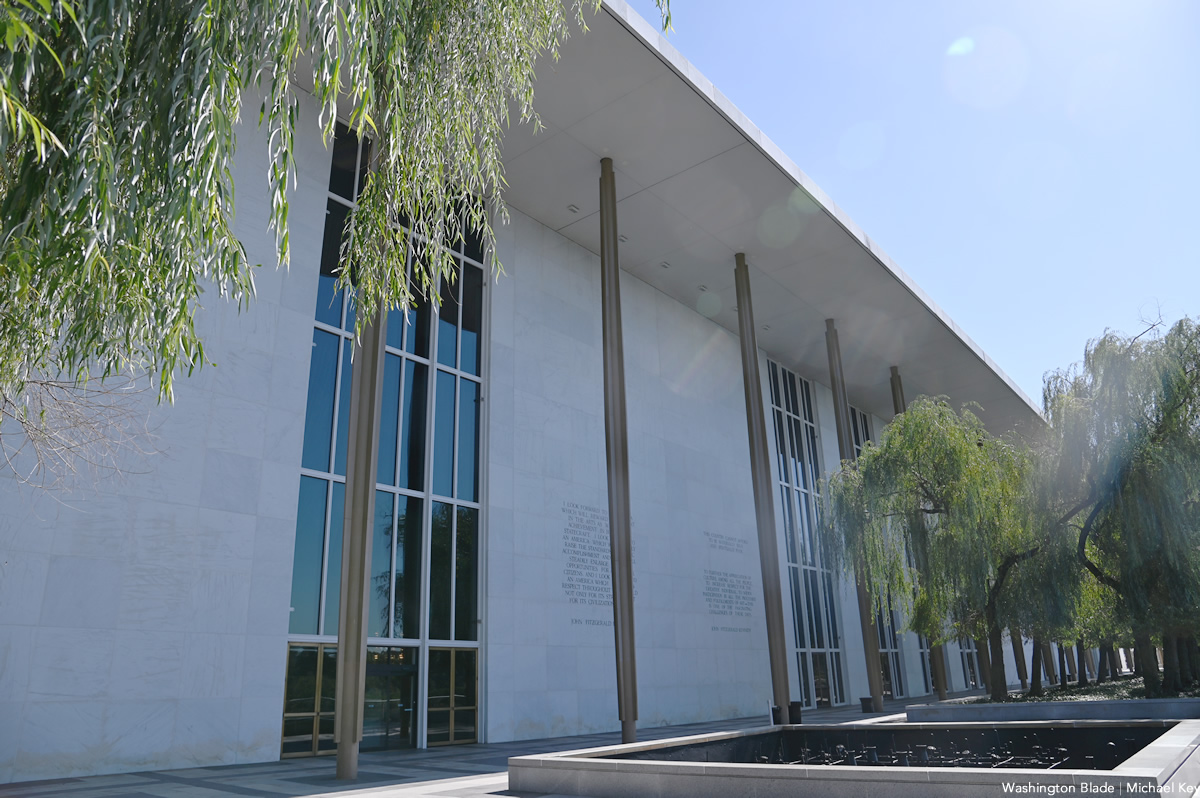
An organization called Hands Off the Arts has announced it is holding a pretest on Friday, Sept. 18, in which between 400 and 800 participants are expected to create a “human chain” around the Kennedy Center to voice their strong objection to President Donald Trump’s call for possibly demolishing the Kennedy Center.
“Hands Off the Arts is organizing a rally Sept. 18 against the president’s defacing of JFK’s memorial, his removal and censorship of art, and the threat to demolish the center if he can’t remake the site in his image,” a statement released by the group says.
The statement says the event will start with a rally at 6:30 p.m. on the Kennedy Center steps and culminate with a “human chain” around the building. “There will be musical performances, testimonials from current and former employees, along with other special guest speakers,” it says
A separate announcement by the group says longtime D.C. drag performer Tara Hoot, who has performed at the Kennedy Center in past years, was among the organizers of the Sept. 18 protest.
The planned protest follows Trump’s decision last year to use his authority to replace the existing members of the Kennedy Center’s board of directors with new members loyal to him. Over the objection of longtime Kennedy Center supporters, the Trump-appointed board changed the name of the center, at Trump’s request, from the John F. Kennedy Memorial Center for the Performing Arts to the Donald J. Trump and the John F. Kennedy Center for the Performing Arts.
But follow the threat of legal action by opponents who pointed out that the name change could not be legally made unless approved by Congress, the name change was cancelled, with Trump saying he would take steps to restore it later.
The Washington Post, meanwhile, reports in a Sept. 13 news story that because of negative publicity related to Trump’s actions, the Kennedy Center was facing “fiscal collapse” and possible bankruptcy and could be forced to shut down as early as this week.
According to the Post report, a 57-page document presented to the Kennedy Center’s board of trustees says the center was facing a financial and structural building crisis, with the recent collapse of part of the building’s inside ceiling, indicating the building was unsafe for employees and the public. Among other things, the document says the Kennedy Center may not be able to make payroll or pay for routine maintenance “within a matter of weeks,” the Post reports.
Some LGBTQ advocates were among those who joined others in boycotting the Kennedy Center to express their objections to Trump’s actions, including a statement by Trump that he objected to the Kennedy Center’s practice of hosting drag performances.
The Gay Men’s Chorus of Washington has been among the LGBTQ performing arts groups and artists that have performed at the Kennedy Center.
“With the future still very much uncertain, now more than ever, the Center needs you to stand up for freedom of expression and against authoritarian overreach into arts and culture institutions,” the Hands Off the Arts group says in its announcement of the Hands Around the Kennedy Center protest.
“You have the opportunity to make a difference — show up with Hands Off the Arts and show your power as part of Hands Around the Kennedy Center,” it says.
A spokesperson for the Kennedy Center couldn’t immediately be reached for comment.
Baltimore
Transgender woman killed in Barclay community mourned by friends, advocates
Sophie Lee shot to death on Friday morning

By DARREONNA DAVIS | Denise Johnson imagined spending Sunday with her daughter, Sophie Lee, eating crabs at the park. Instead, she stood on a Barclay street corner Sunday evening surrounded by nearly 100 people who came to remember her daughter, a transgender woman who was fatally shot there Friday.
The 27-year-old woman was found in the 2400 block of North Calvert Street around 1:15 a.m. Friday, Baltimore Police said in a news release.
Lindsey Eldridge, a police department spokesperson, said it’s unclear if her identity had anything to do with her death and the investigation is ongoing.
The rest of this article can be read on the Baltimore Banner’s website.

The Comings & Goings column is about sharing the professional successes of our community. We want to recognize those landing new jobs, new clients for their business, joining boards of organizations and other achievements. Please share your successes with us at [email protected].
The Comings & Goings column also invites LGBTQ+ college students to share their successes with us. If you have been elected to a student government position, landed an exciting internship, or are graduating and beginning your career with a new job, let us know so we can share your success.
Congratulations to Jaime Christopher Pierce on their appointment to serve as a member of the Virginia Governor’s LGBTQ+ Advisory Board. Pierce was sworn in on Sept. 3 by Greg Parks, clerk of the Alexandria Circuit Court.
Pierce currently serves as vice chair of the Alexandria City LGBTQIA+ Task Force and as a member of the Alexandria Pride planning committee. They previously served on the board of directors of Equality Virginia.
Upon being sworn in, Pierce said, “Public service has been a central part of my life for more than 30 years, and this appointment gives me an opportunity to serve the Commonwealth in a different and very personal way. My career has allowed me to work with people and communities throughout Virginia, and I hope to bring that experience, along with my own lived experience and my involvement in the LGBTQ+ community, to the work of the Board.” They added, “Having Greg administer the oath makes the occasion even more meaningful because of his own historic role as Virginia’s first openly gay elected circuit court clerk.”
Pierce also serves as Circuit Court Services Manager for the Department of Judicial Services, at the Office of the Executive Secretary of the Supreme Court of Virginia. They began their career in Virginia’s judiciary in 1994 as a deputy clerk with the Virginia Beach Circuit Court and have since held several professional and leadership positions within the court system. Pierce is a member of the National Association for Court Management (NACM) and the Mid-Atlantic Association for Court Management. At the national level, Pierce participated in the workgroup that developed the National Association for Court Management’s Diversity, Equity, and Inclusion Guide, a resource designed to help court professionals advance inclusive practices and strengthen access, fairness and belonging within the justice system.
Pierce earned a degree in Criminal Justice from Liberty University, and a certificate in Paralegal Studies from Norfolk State University.

Indonesia’s top Muslim clerical body proposes criminalizing LGBTQ people, advocacy

Hands Off the Arts to form ‘human chain’ around Kennedy Center

LGBTQ issues, attacks on Democrats dominate unusual RNC midterm convention

Acclaimed Chef Patrick O’Connell’s memoir reveals the arc of a life well lived

New Hungarian government to scrap anti-LGBTQ adoption law

Ind. prosecutor declines to press charges over false Buttigieg child welfare complaint

Multi-billion-dollar 9/11 Victim Compensation Fund to continue until 2090

Calendar: September 11-17

LGBTQ Military Happy Hour set for Sept. 15

Comings & Goings
-

 Politics5 days ago
Ind. prosecutor declines to press charges over false Buttigieg child welfare complaint
-
National4 days ago
Multi-billion-dollar 9/11 Victim Compensation Fund to continue until 2090
-
Calendar4 days ago
Calendar: September 11-17
-
Out & About4 days ago
LGBTQ Military Happy Hour set for Sept. 15