Local
Gay Discovery hostage shares story
Former Blade staffer on how life has changed since terrifying standoff
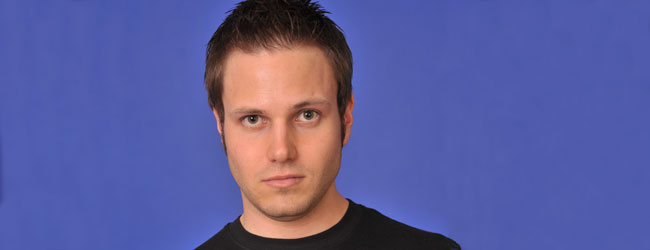
Chris Wood in a December, 2008 Blade staff photo outtake. (Blade file photo by Henry Linser)
A gay man who was one of three hostages held at the Discovery Channel headquarters in Silver Spring, Md., on Sept. 1 used hand signals to initiate his and a fellow hostage’s escape seconds before police shot and killed a gunman who threatened to blow up the building.
Christopher B. Wood, 25, a former Washington Blade employee who works as a marketing specialist with Discovery Communications, gave a harrowing account of his four-hour ordeal in captivity at the hands of a disturbed gunman that has attracted national media coverage.
Seconds after Wood and Discovery Channel producer Jim McNulty ran for the exit door in a plan orchestrated by hand signals between Wood, McNulty, and a security guard who was also held hostage, members of a police swat team shot and killed the gunman, James Lee.
Authorities described Lee as a disturbed “environmental extremist” who believed the Discovery Channel was broadcasting harmful programs that would worsen global warming and other environmental problems.
In an interview with the Blade, Wood explained how he was able to clandestinely respond to a text message that a co-worker sent him from outside the building. Wood said the text message came at a time when he believed he would likely die at the hands of the gunman, who had explosives strapped to his body.
“Please tell Mark I love him,” Wood told co-worker Carlos Gutierrez in a text message referring to Wood’s partner.
About two hours later, while thinking of his partner Mark and other loved ones while being forced to lie face down on a marble floor in the Discovery building’s lobby, Wood said his fright and anxiety began to change to anger.
“I started to think in my head…no, this is not the way this is going to end,” he told the Blade in discussing his thoughts of a plan to escape. “I’m not going to die here on the floor. I’m not going to let somebody take over my life and tell me when I’m going to die.”
According to Wood and accounts by authorities, both Wood and fellow hostage McNulty walked into the Discovery building lobby shortly after returning from their lunch break about 1 p.m. on Sept. 1. McNulty said he saw Lee pointing his gun at the building’s lobby security guard and initially thought the two were actors participating in the filming of a movie until Lee pointed the gun at him and ordered him to lie face down on the floor.
Wood said he first noticed McNulty lying on the floor when he entered the lobby minutes later and thought McNulty was ill and wondered why someone wasn’t helping him. Before he could take more than a few steps, Wood said Lee pointed the gun at him and ordered him to lie on the floor.
During their four hours in captivity, Lee forced Wood and McNulty to remain on the floor except for times when he ordered them to stand and answer his questions about the plight of the earth, Wood said. Wood said the security guard remained at a desk where there was a phone that police hostage negotiators used to talk to Lee on and off throughout his stay in the building’s lobby.
Wood said he sized up Lee’s state of mind after hearing him talk to the negotiators through a speakerphone, where both parties could be heard.
“[T]he negotiator was asking how the hostages were,” said Wood. “And he kept saying, ‘I don’t care about these hostages. I don’t care if they die. I don’t care about them. I just care about what I want…If I blow up it will take all of them with me.”
Wood said that Lee “ranted” at McNulty after asking McNulty if he had kids. When McNulty told him he had two children Lee shouted that having children contributes to overpopulation, which is destroying the natural environment, according to an account by McNulty in media interviews.
When Lee called Wood over to the guard’s desk to question him, Wood said he had determined he would try to say as little as possible to avoid antagonizing Lee.
“So the gunman [said], ‘Stand up, you stand up. Put your hands on the desk,’” Wood said. “I walked up over to the desk, put my hands on the desk. And he [said], ‘He looks fine. Look at him, young, healthy.’”
From that point on, Wood said, Lee allowed him and McNulty to remain standing. It was at that time that Wood noticed the guard making subtle gestures that Wood thought suggested that he and McNulty should attempt to “make a run for it.”
“I looked at the guard,” said Wood. “I finally got his attention and I mouthed the word ‘run.’ And he shook his head yes. And so I then turned my body trying to get Jim’s attention.”
After what seemed like an eternity, Wood said, McNulty looked toward him “and I mouthed the word ‘run.’ He shook his head yes.”
Wood said he then began counting down with his fingers to McNulty with his body turned so that Lee could not see his fingers counting down from three to one, when the two would bolt for the door.
“And as soon as the gunman looked down toward the negotiator [on a speaker phone] I dropped my arms and ran to the same door that I came in,” he said, noting that he heard the sound of a “pop.”
Although he did not witness it, Wood learned later the sound he heard was the first of several shots fired by the Montgomery County police swat team. Police said members of the swat team, who entered the building earlier and were ready to rush into the lobby, shot Lee several times, killing him instantly.
“I’m not sure what the next chapter holds,” Wood said. But I will say that I have a whole new perspective on life. I went from dying and thinking I was dead to making a decision to live, making the decision to be the one that got us out of there safely and ran and made the initial stand. And my life will never be the same.”
A transcript of the Blade’s interview with Wood follows:
Washington Blade: Can you describe how it happened that you walked into this hostage situation on Sept. 1 at the Discovery Channel headquarters in Silver Spring, Md.?
Chris Wood: I had my one o’clock and my noon [meetings] cancelled so I decided I was going to go out and grab a quick lunch. And I did right in downtown Silver Spring. I was walking back to the lobby taking my iPod headphones out of my ears, putting everything into my hands getting ready to walk into the lobby. I walked into the first door — it’s double doors. I opened the first door and started walking in and realized somebody was laying face first on the ground. And I looked to the left and I noticed a bag that I guess belonged to an individual and I recognized the bag was my co-worker Jim McNulty. And I looked back at the person laying face first on the ground and I put it together that it was Jim laying on the ground and that was his bag. By this point I’m reaching for the second door and basically looking up toward my left toward the reception desk trying to see why isn’t anyone helping him? What’s going on? And as I’m looking up to the left the gunman is wielding the gun at me saying, ‘Get on the ground, get on the ground.’ This was while I was walking into that second door. And I immediately switched everything from my left hand to my right hand — my iPod and my Blackberry and went down to the ground on the cold marble.
Blade: And this was in this very expansive lobby of the Discovery Channel headquarters?
Wood: Yes it is.
Blade: After that initial command, did the gunman say anything to you?
Wood: No. At this point he had gone back to the guard and he was continuing to assemble the device that was strapped to him. And as I was on the ground, I was looking up to the left looking at him and the guard and what was going on. Eventually, my phone kept going off in my right hand. I kept trying to answer it but I wasn’t looking at my phone. My head was to the left paying attention to the gunman and the other two hostages and I kept trying to answer it and answer it every time it rang or buzzed and eventually he asked Jim to get up. Jim got up and he was asking him questions.
The NBC reporter had called in that time [to the guard desk]. He was the first phone call in. The gunman eventually thought that that NBC reporter was a cop and ended up hanging up on him. But while he was asking Jim questions, Jim became in between the site of the gunman and I so the gunman could not look over and see me. I took my phone out of my right hand and switched it over to my left hand above my head while still lying on the floor. And the first thing I did was saw that my boss had called and I called the number back. Whoever was on the other end of that phone listened for two minutes and hung up.
And then I looked at my e-mail and saw that my boss wrote me an e-mail that said, “Are you O.K?” And I wrote back and said I’m a hostage with Jim McNulty and the guard in the lobby. And then I had two more text messages come in, one from a friend that works at Discovery. I texted him back and said I’m a hostage in the lobby. And my second text message to him was please tell Mark I love him. Mark is my partner.
… So I sent out the phone call and two text messages and at that point the gunman had finished his conversation with Jim and told Jim to get on the ground. And eventually he asked me to get up and walk over to the desk.
He asked me an array of questions. The first thing he said to me was you look like a strong man. And then he said, “What do you do here?” And I lied and I said I’m admin. And he said, “Admin, what is admin? What do you do?” And I said I file papers. Obviously, I lied. I didn’t want him to know what I did. I didn’t want him to know that I worked for a particular channel. I didn’t want him to know that I worked in the marketing department because of the way he was going on and ranting off and on with the negotiator and the NBC reporter that I heard earlier. And then he asked me, “Are you in the military?” I said no. He’s like, “Look me in the eyes when I talk to you. I looked at him twice and answered two of those questions. He said, “Do you plan on having kids?” I said no. And he’s like, “Can you promise me you’ll never have kids?”And I said yes. Basically just giving him any answer that would get him to leave me alone and satisfy what he was asking.
Blade: Did he ask you if you were married?
Wood: No he did not … Eventually by giving him one-word answers he’s like, “I’m bored with you. Go lay back down.” So I started to walk back towards my stuff. He’s like, “Right there on the ground.” I laid down first and he said, “Turn around the other way so I can see you.” So I laid down the other way and he asked Jim to get up at that point. It was about three o’clock. Jim stood up. He continued to have a lot of questions for Jim, asking him about his kids, about his family, about what he did and ranting back and forth with the negotiators. You know, getting really annoyed at the negotiators. So eventually I was laying there and my arms and hands started to fall asleep and went through a range of emotions when I went down to the ground for the second time. I was really upset when I laid back down. I was crying.
In my mind I was thinking this is the end, this is the end of my life. This is what my life has come to. I got really upset and started to get really mad. And the fact that somebody could take this power away from me and he’s going to decide when I lose my life. I started to thinking in my head. I’m like, “No this is not the way this is going to end. I’m not going to die here on the floor. I’m not going to let somebody take over my life and tell me when I’m going to die.” My arms at that time started to fall asleep on the cold marble floor. So I started moving my hands just trying to get them to wake up …
I guess I had been lying there for quite a while. And the gunman was on the phone with the negotiators and the negotiator was asking how the hostages were. And he kept saying “I don’t care about these hostages. I don’t care if they die. I don’t care about them. I just care about what I want. You have my demands. I want this done and I don’t care if they die. If I blow up it will take all of them with me.” And the guard said he hasn’t moved in a while and he pointed at me on the floor. So the gunman was like, “Stand up, you stand up. Put your hands on the desk.” I walked up over to the desk and put my hands on the desk. And he’s like, “He looks fine. Look at him, young, healthy.” And he went back to talking to the negotiators. I eventually let my hands slowly slip off the desk. We were able to move about freely quite a bit. My legs were hurting, my back was hurting.
Blade: You mean at that time he allowed you to walk around in the lobby?
Wood: Not walk around — we were staying in place but I could move my arms, I could fold my arms. I could scratch my face. He wasn’t restricting our movement in our place. So I started watching the guard standing behind the desk … the gunman was there talking on the speaker phone with the negotiators. The guard is behind the desk. Jim and I were off kind of in front of the desk but toward the right hand side. I looked at the guard and he’s making hand signals — not looking at me, making like taking two fingers and wiggling them like legs and I couldn’t figure it out and I finally just got it in my head that this is the opportunity to run, this is our chance to run. He’s on the phone with the negotiator. We can make it. We can do this. I looked at the guard. I finally got his attention and I mouthed the word “Run.”And he shook his head yes. And so I then turned my body trying to get Jim’s attention. Jim had no idea it was me until I stood up next to him that last and final time. It was about four o’clock. It was about an hour before the incident ended.
Blade: At the time you were thinking about making a run for it, were you and Jim both standing at that moment?
Wood: Yes. Jim, myself and the guard were standing.
Blade: How long were you standing?
Wood: For the last hour we were standing … So Jim finally looked over at me and I mouthed the word “Run.” He shook his head yes. I crossed my arms and took my left hand it tucked it underneath my right arm so that the gunman couldn’t see my fingers but Jim could. And I held up three fingers. And I started to put one down in a countdown but got nervous because the gunman looked at me. I put it back up and then he looked away and I started counting down again. I put one finger down and I put the next finger down and I put the final finger down and I froze. I looked at Jim, I looked at the gunman and the gunman was looking right at me. And as soon as the gunman looked down toward the negotiator I dropped my arms and ran to the same door that I came in. I hit that first door with my right palm. I hit the second door with my right hand palm. In between the first door and the second door I heard a pop. I didn’t know what it was. And I went out, straight out around a pole that was probably 10 feet wide or so or eight feet wide. And as I was rounding the corner there were like five police officers …
… I’m not sure what the next chapter holds. But I will say that I have a whole new perspective on life. I went from dying and thinking I was dead to making a decision to live, making the decision to be the one that got us out of there safely and ran and made the initial stand. And my life will never be the same.
Blade: Do you eventually think you will go back to work at the Discovery Channel?
Wood: I would like to. At this time I just don’t know when.
Blade: Are you on some form of leave from work?
Wood: They’re just providing assistance and providing everything to me —everything that I need. They have not — my job is there and that still stands. But other than that I really can’t comment on much of how they’re proceeding with everything.
Blade: What is your official title there and what have you being doing?
Wood: I’m a marketing specialist for TLC Strategic Marketing.
Blade: Can you remind me the time period you were with the Blade?
Wood: August 2009 was when I was laid off. And I came in December of 2007.
Blade: And were you also a marketing person?
Wood: Yes, I was marketing manager….
Blade: Was Lee, the hostage taker, interrogating Jim McNulty before you about things like his having kids and things like that?
Wood: Yes, he interrogated him first because Jim stood up first and then he laid him back down and got me up and interrogated me.
Blade: Did you have any thoughts about how he would react if he knew you were gay?
Wood: I didn’t know how he would react but I most certainly wasn’t going to antagonize him or bring it up if he didn’t bring it up.
Blade: Do you have any other thoughts that might be important that I didn’t ask about?
Wood: It’s just the support from the community, from friends, from the Discovery Channel — it’s all been amazing and overwhelming. It really makes me think about life and how not to take it for granted. A lot of people take life for granted and you just really can’t because you never know what’s going to happen.
Blade: Has the support come through calls, e-mails and on Facebook — things like that?
Wood: I kept myself very sheltered. The media was very overwhelming and so I didn’t have a phone for a week because it became part of the investigation. I had left it on the floor and didn’t have a phone for a week. And everybody was communicating through friends. I wouldn’t log onto Facebook. I wouldn’t go anywhere. Now it’s starting to become e-mail and phone but for about a week — a week and a half I wouldn’t communicate with anybody.
Blade: Have you had a chance to go out at all to the clubs or anywhere else?
Wood: I have not gone out at all.
Blade: You want to wait until you’re ready to do that?
Wood: I wanted to do the media because I want to explain the story a couple of times. I don’t want to explain it 3,000 times.

District of Columbia
Activists praise Mayor Bowser’s impact on city, LGBTQ community
‘She made sure LGBTQ residents knew they were seen, valued, loved’

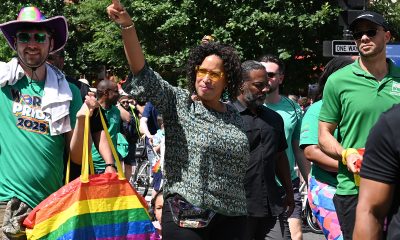
Members of D.C.’s LGBTQ community offered their thoughts on the impact Mayor Muriel Bowser has had on them, the city, and LGBTQ people in statements and interviews with the Washington Blade in the week following Bowser’s announcement that she will not run for re-election in 2026.
Bowser’s Nov. 25 announcement came during the third year of her third four-year term in office as mayor and after she served as a member of the D.C. Council representing Ward 4 from 2007 to Jan. 2, 2015, when she took office as mayor.
The LGBTQ activists and mayoral staffers who spoke to the Blade agreed that Bowser has been an outspoken and dedicated supporter on a wide range of LGBTQ-related issues starting from her time as a Council member and throughout her years as mayor.
Among them is one of the mayor’s numerous openly LGBTQ staff members, Jim Slattery, who has served in the Cabinet-level position as the Mayor’s Correspondence Officer since Bowser first became mayor.
“As Mayor Muriel Bowser’s longest serving LGBTQIA+ staffer – dating back to her first term as the Ward 4 Council member – and a proud member of her Cabinet since day one of her administration, I have had the opportunity to witness her at work for the people she serves and leads,” Slattery said in a statement. “Noteworthy is that throughout the entirety of my 27 years in District government, I have always been able to do so as an out and proud gay man,” he stated.
Slattery added that he has witnessed first-hand Bowser’s “absolute belief” in supporting the LGBTQ community.
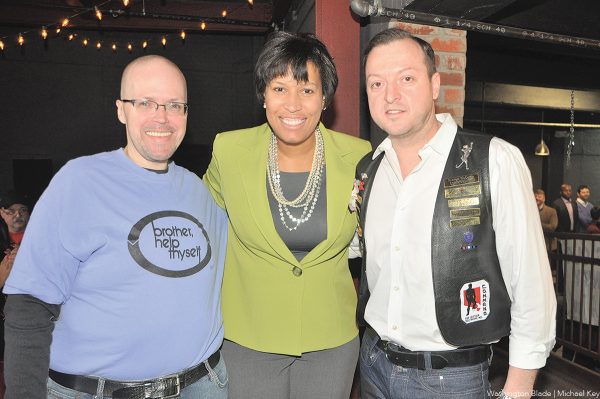
“She has led on HIV/AIDS prevention and treatment, on shelter for vulnerable members of our community, housing for older members of the community, and has been a reliable and constant presence at events to LGBTQIA+ residents,” Slattery said. Among those events, he said, have been World AIDS Day, the D.C. Pride Parade, the 17th Street LGBTQ High Heel Race, and WorldPride 2025, which D.C. hosted with strong support from the mayor’s office.
Ryan Bos, CEO & president of Capital Pride Alliance, the D.C. group that organizes the city’s annual LGBTQ Pride events and served as lead organizer of WorldPride 2025, praised Bowser for being a longtime supporter of that organization.
“She played a very supportive role in helping us as an organization grow and to be able to bring WorldPride to Washington, D.C.,” Bos told the Blade. “And we commend her years of service, And our hope is that she helps us to continue to advocate for the support from the D.C. government of the LGBTQ+ community, especially during these times,” Bos said.
Bos, who was referring to the Trump administration’s hostility toward LGBTQ issues and sharp cutbacks in federal funds for nonprofit organizations, including LGBTQ organizations, said Capital Pride Alliance appreciated Bowser’s efforts to provide city funding for events like WorldPride.
“She provided support through the event process of WorldPride and ultimately along with the D.C. Council provided necessary funding to ensure WorldPride was a success,” Bos said. “And we are proud that we are able to show that Capital Pride and WorldPride had such a large economic impact for D.C. and the D.C. government,” he added.
Marvin Bowser, Mayor Bowser’s gay brother who operates a local photography business and has been active in the D.C. LGBTQ community for many years, said he has also witnessed first-hand his sister’s support for the LGBTQ community and all D.C. residents since the time she became a Council member and even before that.
Among his vivid memories, he said, was his sister’s strong support for the marriage equality law legalizing same-sex marriage in D.C. that the Council approved in 2009 under then-Mayor Adrian Fenty.
“I remember the first time she was standing up and giving clear and unequivocal support to the community when that law passed,” Marvin Bowser told the Blade. “And she was front and center in speaking very strongly in support of marriage equality,” he said.
Marvin Bowser also credits his sister with expanding and strengthening the then-Mayor’s Office of GLBT Affairs, among other things, by appointing advocate Sheila Alexander Reid as the office’s director in 2015.
Reid, who for many years prior to becoming director of the GLBT Affairs office was founder and publisher of the national lesbian publication Women In The Life, had the reputation of a “rock star,” according to Marvin Bowser.
He recalls that Mayor Bowser also played a lead role in D.C.’s bid to host to the quadrennial international LGBTQ sports competition Gay Games for 2022.
D.C lost its bid for the 2022 Gay Games after the Federation of Gay Games selected Hong Kong to host the event in an action that Marvin Bowser says was unfair and based on the effort to hold the Gay Games for the first time in Asia even though D.C. had a stronger bid for carrying out the event.
“Everything she’s done for the community has been very visible and from the heart,” he said of Muriel Bowser. “And in my personal relationship with her, she has also been nothing but absolutely supportive of me and my partner over the years,” he said.
“And we were just at her house helping her put up Christmas decorations,” he added. “And so, it’s been wonderful having her as a sister.”
Veteran D.C. LGBTQ advocate Japer Bowles, who serves as the current director of the Mayor’s Office of LGBTQ Affairs, discussed the mayor’s record on LGBTQ issues in his own statement to the Blade.
“Mayor Muriel Bowser has been an unwavering champion for D.C.’s lesbian, gay, bisexual, transgender, queer, intersex, and asexual community and movement,” he said. “Her more than 20 years of leadership brought consistent and historic investments for our LGBTQIA+ youth, seniors, veterans, and residents experiencing homelessness as well as impactful violence-prevention initiatives,” he added.
“Under her leadership, the Mayor’s Office of LGBTQ Affairs grew into a national leader, delivering more than $10 million in community grants for LGBTQIA+ programs and managing 110 Housing Choice vouchers,” Bowles said in his statement.
“Because of her work, we are stronger, safer, more visible, and, proudly, ‘the gayest city in the world,’” he said in quoting Bowser’s often stated comment at LGBTQ events about D.C. being the world’s gayest city.
In a statement that might surprise some in the LGBTQ community, gay D.C. small business owner Salah Czapary, who served from 2022 to 2024 as director of the Mayor’s Office of Nightlife and Culture as a Bowser appointee, criticized some of the city’s non-LGBTQ related polices under the Bowser administration as being harmful to small businesses.
Bowser appointed Czapary, a former D.C. police officer, to the nightlife office position shortly after he lost his race as an openly gay candidate for the Ward 1 D.C. Council seat held by incumbent Brianne Nadeau.
“Mayor Bowser led D.C. through turbulent years and major growth, and we can all be proud of her leadership on many fronts,” Czapary said in a statement to the Blade. “She is also setting an example that more leaders should follow by stepping aside to allow a new generation to lead,” he said. “But as we turn the page, we must be honest about what the next mayor should deliver,” he says in his statement.
Without mentioning Bowser by name, he went on to list at least four things the next mayor should do that implied that Bowser did not do or did wrong. Among them were treating the D.C. Council as a “true governing partner,” not letting residents and small businesses “feel the weight of outdated, slow, and unresponsive systems,” and the need for leadership that “values competence over loyalty.”
He added that a “reversal” by the city of the city’s streetery program that was put in place during the COVID pandemic to allow restaurants to install outdoor seating into street parking lanes, was a “roll it back” on progress for small businesses.
He concluded by stating, “LGBTQ rights and inclusion are among the many fronts on which we can be very proud of the mayor’s leadership.”
The mayor’s office did not immediately respond to an offer by the Blade to give the office an opportunity to respond to Czapary’s statement.
A significantly different perspective was given by Sheila Alexander Reid, who said she was proud to serve as director of the Mayor’s LGBTQ Affairs Office during the first six-and-a-half years of Bowser’s tenure as mayor.
“I watched her evolve from a newly elected mayor finding her footing into a confident, seasoned leader who met every challenge head-on and time after time slayed the competition,” Alexander Reid said in a statement to the Blade.
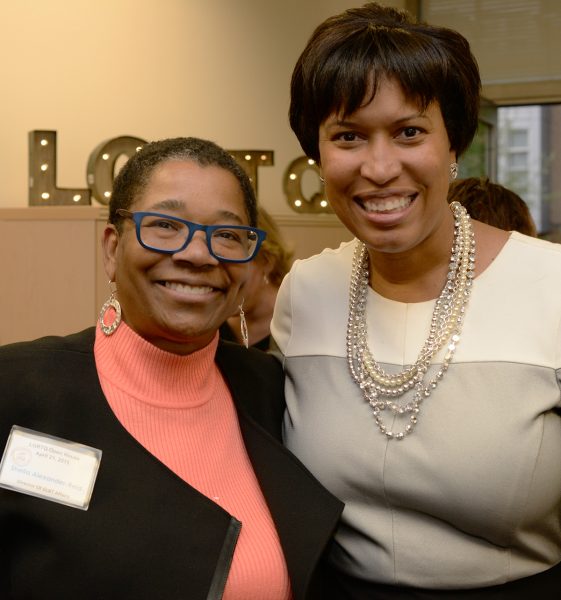
“With each year in office, her voice grew stronger, more grounded, and more fearless,” her statement continues. “And she needed that strength, because being a Black woman mayor is not for the faint of heart, But Mayor Bowser never backed down. Instead, she showed the city what courageous, compassionate leadership truly looks like.”
Alexander Reid added that Bowser funded a new LGBTQ Community Center facility, expanded a workforce development program for the transgender community, and “made D.C. the first jurisdiction in the nation to require LGBTQ+ cultural competency training for healthcare providers.”
She also pointed to the mayor’s LGBTQ “safety nets” through low-barrier shelters and housing vouchers and her support for LGBTQ celebrations like the 17th Street High Heel Race.
“But what inspired me most was this,” Alexander Reid stated. “At a time when some elected officials across the country were retreating from LGBTQ support, Mayor Bowser was doing the opposite. She leaned in, she doubled down. She made sure LGBTQ residents knew they were seen, valued, protected, and loved by their city.”
District of Columbia
HIV/AIDS activists block intersection near White House
World AIDS Day provided backdrop for calls to fully fund PEPFAR
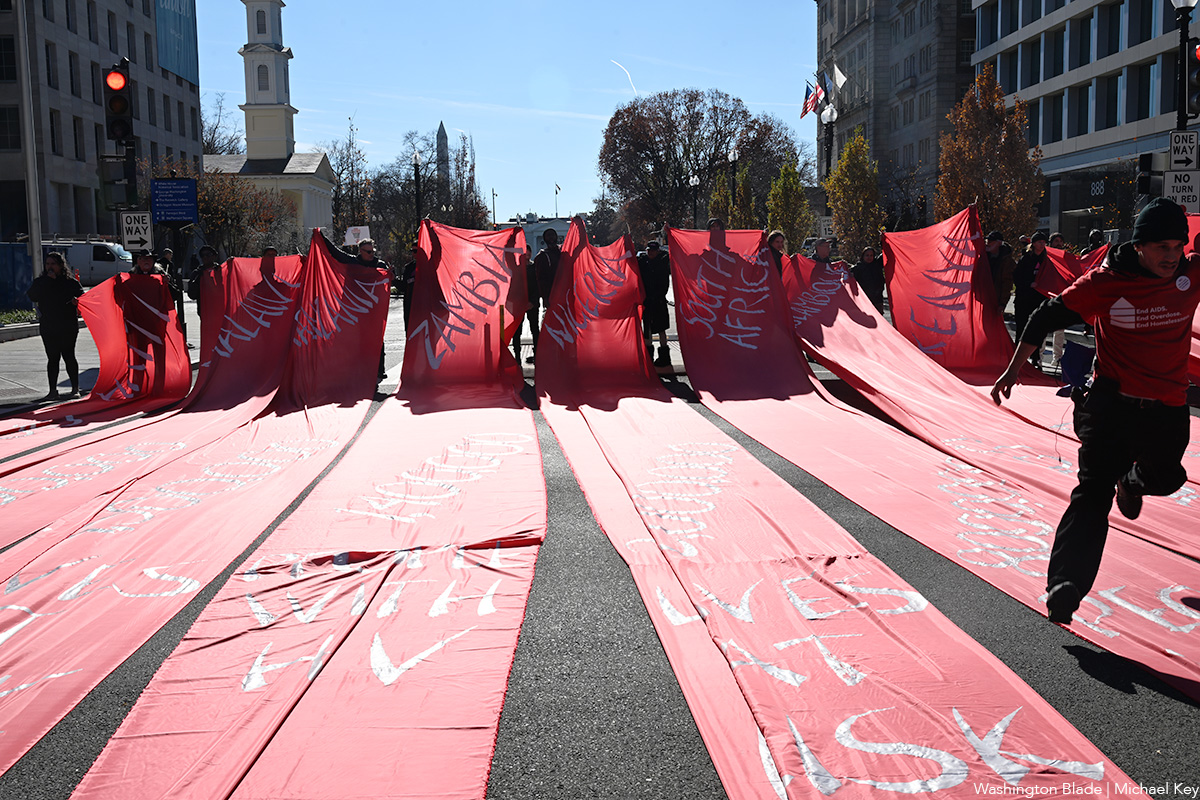
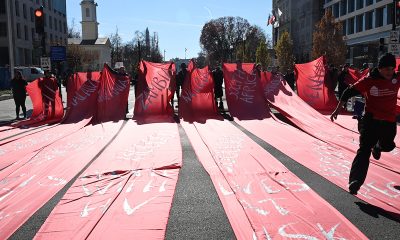
Upwards of 100 HIV/AIDS activists on Monday blocked an intersection near the White House and demanded the Trump-Vance administration fully fund PEPFAR.
Housing Works, Health GAP, Treatment Action Group, AIDS United, ACT UP Philadelphia, and the National Minority AIDS Council organized the protest that took place at the intersection of 16th and I Streets, N.W. The activists then marched to Lafayette Park.
(Washington Blade video by Michael K. Lavers)
(Washington Blade video by Michael K. Lavers)
Activists since the Trump-Vance administration took office in January have demanded full PEPFAR funding.
Secretary of State Marco Rubio Jan. 28 issued a waiver that allowed PEPFAR and other “life-saving humanitarian assistance” programs to continue to operate during the freeze on nearly all U.S. foreign aid spending. HIV/AIDS service providers around the world with whom the Washington Blade has spoken say PEPFAR cuts and the loss of funding from the U.S. Agency for International Development, which officially closed on July 1, has severely impacted their work.
The State Department in September announced PEPFAR will distribute lenacapavir in countries with high prevalence rates. The first doses of the breakthrough HIV prevention drug arrived in Eswatini and Zambia last month.
The New York Times in August reported Office of Management and Budget Director Russell Vought “apportioned” only $2.9 billion of $6 billion that Congress set aside for PEPFAR for fiscal year 2025. (PEPFAR in the coming fiscal year will use funds allocated in fiscal year 2024.)
Bipartisan opposition in the U.S. Senate prompted the Trump-Vance administration in July withdraw a proposal to cut $400 million from PEPFAR’s budget. Vought on Aug. 29 said he would use a “pocket rescission” to cancel $4.9 billion for HIV/AIDS prevention and global health programs and other foreign aid assistance initiatives that Congress had already approved.
“Russell Vought, director of the Office of Management and Budget, has defied the appropriations authority of Congress, slashing the budget for the program despite full funding enacted by lawmakers, stealing $1.6 billion despite the direction of Congress that PEPFAR be fully funded,” notes a press release that detailed Monday’s protest. “As a result, lifesaving treatment and prevention programs have closed across dozens of sub-Saharan African countries, while Vought has refused to release money ringfenced by Congress to save lives.”
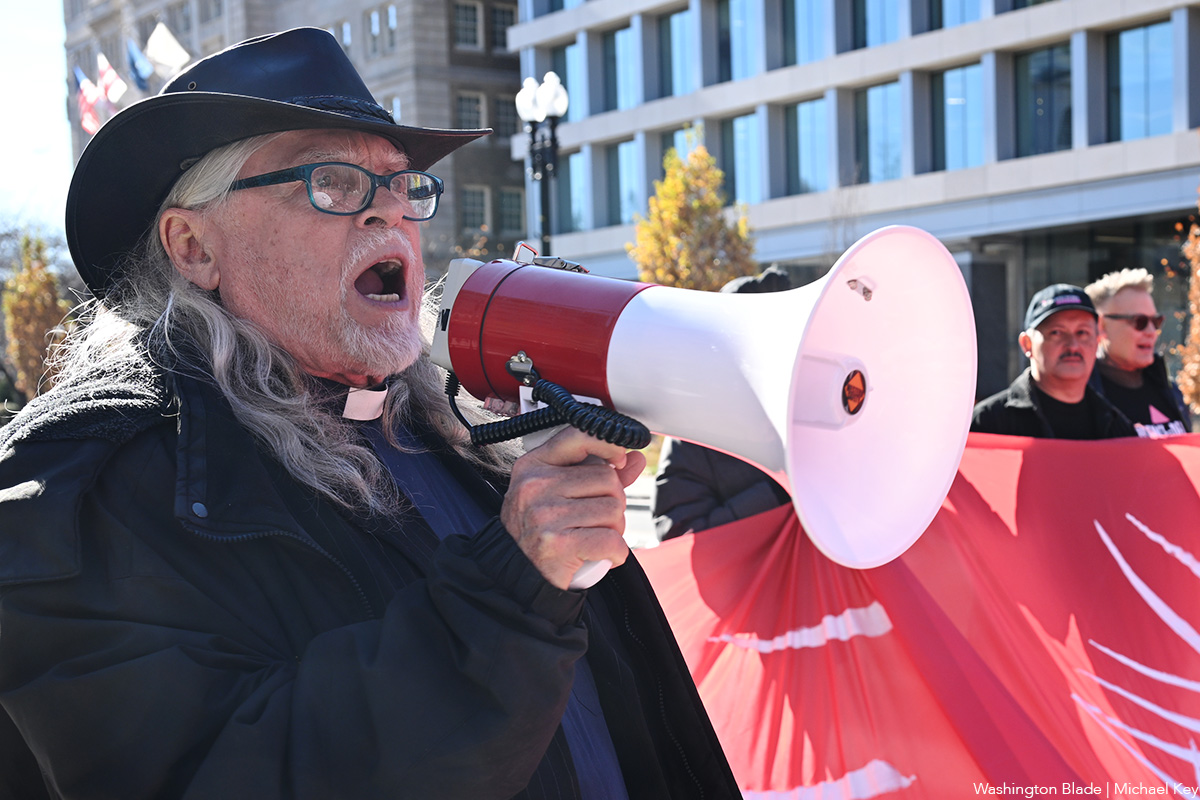
Monday’s protest coincided with World AIDS Day.
The White House has not publicly acknowledged World AIDS Day. A State Department directive the New York Times obtained last week mandated employees and grantees “to refrain from messaging on any commemorative days, including World AIDS Day.”
“Trump thinks by banning commemoration of World AIDS Day, he can hide from the death and destruction that he’s causing around the world,” said Health GAP Executive Director Asia Russell in Lafayette Square. “But we’re here to say, we can see him. We see him stealing medicine, stealing support services, stealing HIV testing, stealing life-saving care from communities all around the world suffering and dying without access.”
The Clinton Health Access Initiative in a report it published last month said more people with HIV or are at risk of contracting the virus because of “HIV treatment and prevention cascades” during the first half of 2025. Specific figures include:
• 3.4 million fewer adults tested for HIV
• 24,000 fewer infants tested for HIV
• A 22 percent decline in new HIV diagnoses due to a reduction in testing among the most vulnerable, highest-risk people
• An 8 percent decline in people living with HIV receiving CD4 tests to diagnose advanced HIV disease
• 2,000 fewer infants and children with HIV started on life-saving medication
• A 37 percent reduction in PrEP initiations for people at risk for HIV
• 26,000 fewer infants and children on antiretroviral medications
• A 5 percent reduction in adults starting antiretroviral medications
• A 10 percent increase in people living with HIV disengaging from treatment
The Clinton Health Access Initiative also said more children around the world will die “due to undiagnosed and un- or under-treated HIV infection” if “these trends persist.”
The Human Rights Campaign Foundation in its 2025 Annual LGBTQ+ Community Survey notes more than 20 percent of adults said “policies the federal government have made accessing HIV prevention and treatment care more difficult in the last year.” The report indicates 30 percent of respondents identify as LGBTQ.
The Comings & Goings column is about sharing the professional successes of our community. We want to recognize those landing new jobs, new clients for their business, joining boards of organizations and other achievements. Please share your successes with us at [email protected].
Congratulations to RODRIGO HENG-LEHTINEN on his new role as Trevor Project Senior Vice President of Public Engagement Campaigns. On accepting the position, he said, “My mission has long been to stop LGBTQ, and especially trans, people from being perceived as political footballs and start getting us seen as real people – your friends, your families, your neighbors. Now I get to focus on that 100% at The Trevor Project.”
Prior to this, he was executive director, Advocates for Trans Equality (A4TE), where he co-led the merger of two national transgender rights organizations, NCTE and TDLEF, to create the new organization. He had served as executive director of the National Center for Transgender Equality, leading that organization through a period of growth, restoring organizational size and stability. He had served as deputy executive director prior to that. Previously he served as vice president of Public Education, Freedom for All Americans, where he led a successful campaign for transgender nondiscrimination protections in New Hampshire. He oversaw a full range of legislative lobbying, field organizing, and communications strategies and oganized a leadership coalition, established structure, and divided roles for key committees of 17 state and national partner organizations and local activists.
Heng-Lehtinen conducted English-language interviews with outlets such as The New York Times, CNN, MSNBC, and Politico. He planned a Transgender Leadership Summit for the Transgender Law Center and served as Development & Donor Services Assistant, Liberty Hill Foundation. He earned his bachelor’s degree in Latin American Studies from Brown University.

Lawmakers warn of HIV crisis as federal support collapses

Maine governor opens LGBTQ+ Victory Institute’s D.C. conference

Puerto Rico’s largest LGBTQ organization struggling amid federal funding cuts

Meet Mr. Christmas

My federal worker husband is depressed and I don’t know how to help

‘Lavender Scare 2.0’: inside the White House’s campaign against LGBTQ federal employees

HIV/AIDS activists block intersection near White House

Holiday movie season off to a ‘Wicked’ good start

Activists praise Mayor Bowser’s impact on city, LGBTQ community
Meet Mr. Christmas
-

 The White House1 day ago
‘Lavender Scare 2.0’: inside the White House’s campaign against LGBTQ federal employees
-
District of Columbia3 days ago
HIV/AIDS activists block intersection near White House
-
Movies4 days ago
Holiday movie season off to a ‘Wicked’ good start
-
District of Columbia2 days ago
Activists praise Mayor Bowser’s impact on city, LGBTQ community