Politics
Dempsey: Process ‘on track’ for ‘Don’t Ask’ repeal
Nominee for Chair of JCS commented on ‘Don’t Ask’ before Senate
The nominee to become the next top uniform military adviser to President Obama gave responses to a questionnaire earlier this year indicating he shares the belief that “Don’t Ask, Don’t Tell” repeal is proceeding smoothly and educating the armed forces is essential before moving forward with open service.
Gen. Martin Dempsey, whom President Obama nominated on May 30 to become the next chair of the Joint Chiefs of Staff, offered his views on “Don’t Ask, Don’t Tell” in written responses to policy questions when his previous nomination to become Army chief of staff was pending before the Senate Armed Services Committee in April.
The responses that Dempsey gave to the committee on “Don’t Ask, Don’t Tell” follow:
——————————————-
Implementation of the Repeal of “Don’t Ask Don’t Tell” Policy
What is your assessment of the Army’s readiness and capability to implement the repeal of the “Don’t Ask Don’t Tell” (DADT) policy?
The Army is on track with its implementation plan in accordance with DOD guidance and timelines, and I believe the Army is fully capable of executing the implementation. Our plan includes periodic assessments to review and consider feedback from the field throughout the implementation.
What in your view are the major challenges, if any, that could confront the Army in implementing the repeal of DADT? If confirmed, what actions, if any, would you propose taking to deal with these challenges?
The most important challenge is that we educate our Soldiers who are in combat situations with a minimum of disruption and risk. We are making every effort to train units prior to deploying. We will also provide the training to currently deployed units and we will follow up with these deployed units to ensure that all Soldiers receive the required training upon their return from deployment.
What measures is the Army taking to focus training on combat units and other deployed units and ensure that repeal of the current policy does not adversely affect combat operations?
The Army is using a Chain Teach methodology, where each commander is responsible for educating his/her subordinates and they in turn train their Solders. Commanders and leaders will carefully manage deployed units’ training to minimize impact on the mission. The Army is making every effort to train units prior to deployment.
If confirmed, what conditions or circumstances would you expect to be achieved, if any, before recommending that the Chairman of the Joint Chiefs certify that DADT can be repealed without adversely affecting the Army?
If confirmed, I would base my recommendation on the input I receive from commanders and leaders consistent with the requirements established by the Congress and Department of Defense leadership. I would also seek to ensure that the Army completes training according to Army guidance.
——————————————-
Dempsey’s comment that the implementation plan for “Don’t Ask, Don’t Tell” repeal is on track recalls congressional testimony earlier this year in which the military service chiefs maintained the path to repeal was proceeding smoothly.
Additionally, identifying the education of soldiers as “the most important challenge” in implementing repeal echoes Defense Secretary Robert Gates’ stated desire to train the armed forces on handling open service before “Don’t Ask, Don’t Tell” is lifted from the books.
Aubrey Sarvis, executive director of the Servicemembers Legal Defense Network, said the responses Dempsey gave to the committee indicate he’s on board with the idea of “Don’t Ask, Don’t Tell” repeal.
“I think his statements before the Senate were encouraging and indicative that he’s in tune with [current Chair of the Joint Chiefs of Staff] Adm. [Mike] Mullen and Secretary Gates,” Sarvis said.
Under the repeal law signed by President Obama in December, “Don’t Ask, Don’t Tell” won’t be off the books until 60 days pass after the president, the defense secretary and the chair of the Joint Chiefs of Staff certify that U.S. military is ready for open service.
But the decision to certify likely won’t fall to Dempsey. Mullen, a supporter of “Don’t Ask, Don’t Tell” repeal, isn’t set to leave his role until his term expires on Sept. 30 and Pentagon leaders have testified certification could happen mid-summer. If certification hasn’t taken place by the time Mullen retires, it would be delayed significantly beyond expectations.




2026 Midterm Elections
As Washington shifts right, Democratic Socialists gain ground
Next major test for movement comes in Midwest

As President Donald Trump’s second administration has pushed the federal government further to the right on issues ranging from immigration to LGBTQ rights, a different political movement has been gaining momentum inside the Democratic Party.
From industrial communities in upstate New York to Colorado’s Front Range, candidates aligned with the Democratic Socialists of America (DSA) have won a series of victories in Democratic primaries this year, in several cases defeating longtime incumbents who had represented Democratic strongholds for years. Their success has reignited debate over the Democratic Party’s future, as a growing faction of progressive voters calls for a more confrontational approach to economic inequality, healthcare, housing, labor rights, climate policy, and LGBTQ protections rather than what they view as the party’s increasingly cautious establishment.
These victories also reflect a broader ideological divergence in American politics. While Republicans under Trump have embraced a more conservative governing agenda, many Democratic primary voters in safely blue districts appear to be rewarding candidates running on unapologetically progressive platforms that reject incremental change in favor of more sweeping reforms.
The Democratic Socialists of America (DSA), the nation’s largest socialist organization, says it has more than 100,000 members and chapters in all 50 states. The organization advocates what it describes as democratic socialism — promoting social and economic equality through democratic government while supporting a larger public role in healthcare, housing, labor protections, education, and other social programs alongside a regulated market economy.
On its website, the DSA explains its goals are to utilize “progressive movements for social change while establishing an openly democratic socialist presence in American communities and politics.”
For LGBTQ Americans, the organization has long supported expansive nondiscrimination protections, marriage equality, transgender rights, and broader legal protections through a platform first adopted in 2017. Its LGBTQ policy calls for federal legislation prohibiting discrimination, expanded access to gender-affirming healthcare, reproductive freedom, and opposition to laws targeting LGBTQ people.
The movement’s biggest victories came in New York.
Just months after the election of New York City Mayor Zohran Mamdani, a democratic socialist, candidates backed by the DSA and allied progressive organizations swept Democratic primary elections that many political observers viewed as a referendum on the party’s ideological direction.
Among the most notable victories were Brad Lander’s defeat of incumbent Rep. Dan Goldman in New York’s 10th Congressional District, Claire Valdez’s victory over Brooklyn Borough President Antonio Reynoso in the 7th District, and Darializa Avila Chevalier’s upset of five-term incumbent Rep. Adriano Espaillat in New York’s 13th Congressional District.
Overall, nine of the 10 New York City candidates backed by the DSA won their Democratic primaries, further cementing the organization’s growing influence in the nation’s largest city and demonstrating that democratic socialist candidates can compete beyond isolated local races.
Outside New York, the trend continued.
In Colorado, Melat Kiros defeated 15-term incumbent Rep. Diana DeGette in one of the cycle’s biggest primary upsets. Kiros campaigned without accepting corporate PAC contributions and criticized DeGette’s fundraising practices and foreign policy positions, presenting herself as an alternative to the Democratic establishment.
While socialist movements have existed in the United States for more than a century, democratic socialism remained largely on the political margins for decades. That began to change following Sen. Bernie Sanders’ presidential campaigns in 2016 and 2020, which introduced millions of Americans to democratic socialist ideas and energized a younger generation of progressive activists.
Although Sanders never won the Democratic nomination, his campaigns helped reshape the party’s left flank by elevating issues such as universal healthcare, tuition-free public college, stronger labor protections, and economic inequality into the mainstream Democratic conversation.
Today, the movement’s most recognizable elected officials include Rep. Alexandria Ocasio-Cortez and several members of the congressional “Squad,” who have helped normalize the democratic socialist label among younger Democratic voters and increasingly challenged party leadership from the left.
For LGBTQ voters, democratic socialist candidates have frequently positioned themselves among the Democratic Party’s strongest advocates for transgender rights, particularly as the Trump administration has sought to restrict access to gender-affirming healthcare, military service, and other legal protections for transgender Americans.
The next major test for the movement may come in the Midwest.
In Michigan, progressive candidate Abdul El-Sayed is locked in a closely watched Democratic Senate primary, while in Wisconsin, DSA-backed Francesca Hong is seeking her party’s nomination for governor. The outcomes of those races could offer another measure of whether democratic socialism’s recent gains represent a lasting realignment within the Democratic Party or are concentrated primarily in deep-blue urban districts.
Politics
In Trump’s divided America, Michael Weinstein’s AHF responds
PART 1 | Group helps Venezuela, president on Democratic Socialists, Fla. march
As the United States of America acknowledges her 250th birthday, too many Americans are partying with fewer family and friends because their wallets and their patriotic hearts just aren’t in it. Meanwhile, the president is using taxpayer dollars to finance ugly pet projects, and a war of choice with Iran that no one wants, and Congress didn’t authorize, while We the People just watch an uncontrolled Trump train speeding through American lives.
Theoretically, this is nothing new. Since the nation’s founding in 1776, individuals have struggled with where to place their allegiance to best uphold their personal freedom and protect the collective unity of the country.
But now the simple democracy-project premise “of the people, by the people, and for the people” has been upended and subverted by Donald Trump, the amoral corrupt 47th president who is using the once independent Justice Department to bypass “due process” and pursue retribution against his enemies — especially around his baseless 2020 election claims — while rewarding his Jan. 6 army of criminal loyalists with pardons and a proposed $1.8 billion “anti-Weaponization” slush fund, now temporarily blocked by a federal judge.
There have been amoral and ineffectual presidents in the past, as well as arrogant presidents who wielded power inhumanely, such as Andrew Jackson, who defied the Supreme Court and oversaw the Indian Removal Act, and Rutherford B. Hayes, who pulled troops out of the South, effectively ending the post-Civil War Reconstruction era. And there have been dangerous, outright liars like Richard Nixon, Lyndon Johnson, and Warren G. Harding, whose Teapot Dome Scandal in his administration may have killed him.
But American history has never seen such a profoundly corrupt con artist who has taken over the federal government, installing ideological autocratic loyalists intent on expanding Trump’s power in the Supreme Court and Congress — the second and third branches of government intended to provide checks and balances to an overreaching Executive.
And now, in allegiance to White Supremacy and Christian Nationalism, Trump is trying to claim the right and power to decide who gets to claim citizenship, how he can pre-determine the outcome of elections through gaslighting and disinformation, and how he can make American residents afraid and silently complicit by not challenging his blatant racism, sexism, and transphobia.
New York Times columnist M. Gessen writes: “Read the Supreme Court’s recent ruling on transgender athletes — the majority’s decision, written by Justice Brett Kavanaugh, and the dissent, written by Justice Sonia Sotomayor — and you will see the members of the court arguing about something more fundamental than the law. They are arguing about who should be seen, whose story ought to be heard, and who deserves to be protected.”
AIDS Healthcare Foundation co-founder and President Michael Weinstein might add that deciding who lives and dies is fundamental, too. The nonprofit is the world’s largest provider of HIV medical care, cutting-edge medicine, and advocacy regardless of ability to pay with 3 million in care and 50 countries served.
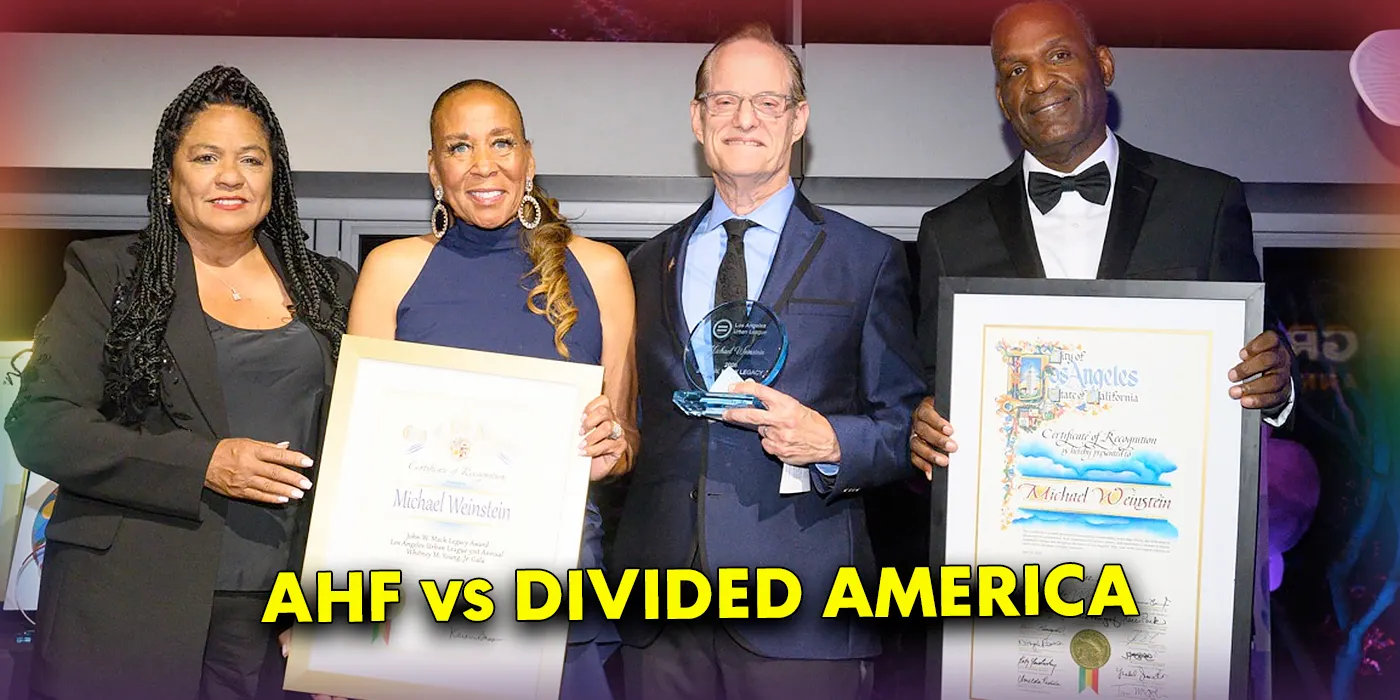
AHF has a history of acting quickly with coalitions when there is a need. For that, Weinstein was honored by the Los Angeles Urban League on June 24 with the John W. Mack Legacy Award during the annual Whitney M. Young Jr. Awards Celebration.
“The Los Angeles Urban League is proud to present the John W. Mack Legacy Award to Michael Weinstein — transformative leader, fearless advocate, and champion for health equity and human rights,” they wrote in their announcement on Facebook.
“As founder and president of AIDS Healthcare Foundation, Michael Weinstein has led one of the largest global HIV/AIDS medical care providers in the world, expanding access to treatment, housing, prevention, and advocacy for underserved communities. His bold leadership has saved lives while challenging stigma and systemic inequities in healthcare,” they continued.
“For decades, he has stood at the intersection of public health and social justice — building systems of care that affirm dignity, expand access, and ensure that the most vulnerable are not left behind. His unwavering advocacy reflects the very principles that guide the Los Angeles Urban League’s mission: advancing equity, protecting opportunity, and strengthening communities,” they said. “In many ways, his work echoes the legacy of Whitney M. Young Jr. — courageous leadership rooted in policy, partnership, and a belief that justice must be both spoken and enacted.”
Interestingly, on June 24, the night the Urban League celebrated Weinstein as “a leader whose impact continues to shape a more just and compassionate future,” two consecutive 7.2 and 7.5 magnitude earthquakes struck northern Venezuela, killing and injuring thousands.
Interim President Delcy Rodríguez later called the earthquakes the “most brutal natural catastrophe” in Venezuela’s history.
In a horrific twist of fate, the BBC reported that ICE had deported more than 140 Venezuelans back to their home country on June 24, where they were housed in a hotel near the coast. The massive quakes struck there hours later, killing at least 2,200 people, injuring more than 10,000, and, according to UN figures, leaving 50,000 missing.
On July 2, the Venezuelan government estimated that 2,295 people died in the earthquakes, with another 11,000 injured.
“However, that’s believed to be a vast undercount. Gianluca Rampolla del Tindaro, the United Nations’ humanitarian coordinator for Venezuela, said the organization was procuring 10,000 body bags. And U.N. emergency relief coordinator Tom Fletcher called an estimate of 50,000 missing people ‘terrifyingly plausible,’” PBS reported.
Remember when Trump said the U.S. will ‘run’ Venezuela after capturing Maduro in surprise military strike?
Meanwhile, the Associated Press reported that Immigration and Customs Enforcement arrested 10,000 people over a five-day period at the end of June — that’s roughly 2,000 arrests per day — continuing Trump’s mass deportations agenda. No news about where they might be sent.

But while Trump is wildly spinning about his Fourth of July plans, AHF is in Venezuela, actively helping those in desperate need.
“The number of fatalities continues to rise, and many shelters have been set up in public spaces to help those in need. Hospitals and morgues are working tirelessly beyond their capacity, demonstrating the community’s resilience. Fortunately, international rescue teams have arrived, offering much-needed assistance to recover those still trapped in the debris. Venezuela’s government response has been uncoordinated, poor, and delayed, influenced by political interests,” AIDS Healthcare Foundation Latin America Bureau Chief Patricia Campos wrote to Weinstein on June 29.

“Despite the communication challenges, our team from AHF Colombia has been communicating with 600 of the 1080 of our patients in care who live in Venezuela. We are continuing to search for the 480 others to be sure they are alive or to support them,” Campos concluded, noting that AHF´s Emergency Aid supplies arrived with 11/13 Foundation and distribution was underway.
In an hour-long Zoom interview, Weinstein talked about a number of issues, including his long association with U.S. Sen. Bernie Sanders (I-Vt.), a self-described Socialist, and the New York races that just yielded three Democratic Socialist candidates (Part 1) and his long, successful fight against Florida Gov. Ron DeSantis’s HIV/AIDS cuts (Part 2).
Check out the video interview here.
“Well, as a native New Yorker,” Weinstein says, “the election in New York is a clash between the corporate Democrats and, particularly, a younger generation, with the exception of Bernie. It’s an epic change, right? And I would say that younger people who powered this (New York Mayor) Mamdani, AOC (New York Congresswoman Alexandria Ocasio-Cortez), and the rest of the movement do not feel that they have a stake in the system the way it is, right? And so, they’re willing to look at more radical answers.
“And this really is similar to the 1930s, you know, whereby when [President Franklin D.] Roosevelt came to office, who was a blue blood, right? He basically said, ‘in order to save the system, we have to move in the direction of socialism.’ He may not have called it that, but that’s essentially what it was,” Weinstein says.
“I mean, the model for democratic socialism is essentially Scandinavian and Northern European countries, right? Which is, essentially, a capitalist system that has a strong safety net, or basically says, ‘we’re going to tax the rich heavily in order to maintain a minimum level of existence for everyone.’
“So that’s basically what Bernie is espousing, and what Mamdani and others are espousing. And I don’t take too seriously … the characterizations that Trump has of them being Communist, et cetera, et cetera.”
Weinstein, longtime Latina activist Dolores Huerta, and an expected crowd of thousands in an AHF-created coalition are participating in a We The People March for Freedom in Trump’s Florida backyard on July 3.
“At a time in our nation when healthcare is being rationed, and rents are outpacing wages, teachers are working second jobs, and rural hospitals are closing, we must continue to stand up for what’s right for all Americans. July 4, 2026, marks 250 years since the Declaration of Independence. The We the People March for Freedom is not just an event to celebrate this document or its declaration of independence, but the night before the fireworks, to remind America what and who it’s for,” stated Esteban Wood, AHF director of advocacy and legislative affairs and March for Freedom coordinator.
This is a cross-post from Ocamb’s LGBTQ+ Freedom Fighters Substack.
Politics
Buttigieg says false report temporarily separated him from his children
Michigan State Police corroborated his account

Former Transportation Secretary Pete Buttigieg on Friday recounted being separated from his children following an anonymous police report later determined to be false.
The openly gay former mayor of South Bend, Ind., and current 2028 presidential contender was accused of posing a danger to his children and was not allowed to be with his four-year-old twins until after interviews were conducted.
Buttigieg went public with this account on his Substack, sharing how a woman anonymously — and falsely — accused him of posing a danger to his children.
“The caller said that he had spoken to a woman who claimed to have met me at a conference several years ago in Alabama, where she said I told her that I had committed unspeakable violent crimes, and the caller believed my children were still at risk,” Buttigieg wrote in a post he titled “A Terrible Thing Happened to My Family.” “I am a reasonable man. I try to keep as calm and low-key as possible. But I cannot describe the mix of rage and sadness that I feel at the idea that someone brought our children into this.”
Michigan State Police spoke to the BBC following Buttigieg sharing his story.
“The Michigan State Police and Child Protective Services responded and determined the report was false.”
The statement also went on to explain that these types of false reports were “dangerous” and divert “workers from responding to legitimate emergencies and protecting vulnerable children and families.”
In that post recounting the ordeal, Buttigieg continued, saying that it was “among the darkest hours of my life,” and pointed out that his children should not be subjected to this type of harassment as a circumstance of his own place in the national political spotlight.
“They are four years old. Four. They do not know or care what a Democrat or a Republican is.”
He finished his post:
“We cannot let American politics keep going in this direction. And we must not all go on as if it’s acceptable for this kind of thing to be part of the cost of entering public service.”
“Most importantly, Chasten and I will continue to pour ourselves into the joyful and demanding work of raising and educating our two children. Being their parents is the best thing in our lives. They are just children, kids who deserve the best upbringing that their parents can provide, who mean more to us than anything, whom we love beyond words and will do anything to protect, and whose right to a safe and happy childhood deserves absolute and unconditional respect.”
In response to the story Buttigieg shared on his Substack, Kelley Robinson, president of the Human Rights Campaign, released the following statement:
“I know how I would feel if someone tried to come between me and my kids. This is truly bottom-of-the-barrel stuff. It takes an awful, hateful person to question someone’s fitness as a parent just because of who they are, who they love, or in Sec. Buttigieg’s case, perhaps even who he speaks out against politically. We’re thinking of Pete, Chasten, and their whole family in this moment — and we aren’t resting until all LGBTQ+ families have the kind of safety and justice every one of us deserves.”
Buttigieg was transportation secretary during the Biden-Harris administration.
The Washington Blade reached out to Michigan State Police to ask if any disciplinary actions would be imposed on the woman who made the false report, but was told to file a FOIA request to view the full report. the story will be updated as new information is shared.
Former Fla. gubernatorial candidate Andrew Gillum arrested on drug charges

Dutch prime minister scheduled to open World Pride human rights conference

Philadelphia murder suspect remains at large

Mary’s House founder, CEO retires

Va., Md., advocates brace for next fight after Supreme Court sports ruling

‘My Favorite Sociopath’ debuts at Shepherdstown’s CATF

Under-the-radar Delaware beach towns smart buyers are targeting

In Trump’s divided America, Michael Weinstein’s AHF responds

When a church fears the rainbow