Arts & Entertainment
Remembering Rue
‘Golden Girls’ actress wanted fans to have a chance to own her belongings
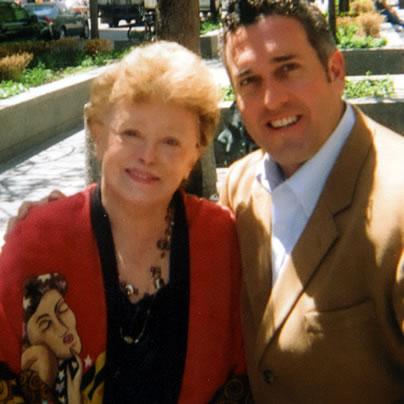
Some people can’t stand having stuff around they don’t use. Rue McClanahan was not one of them.
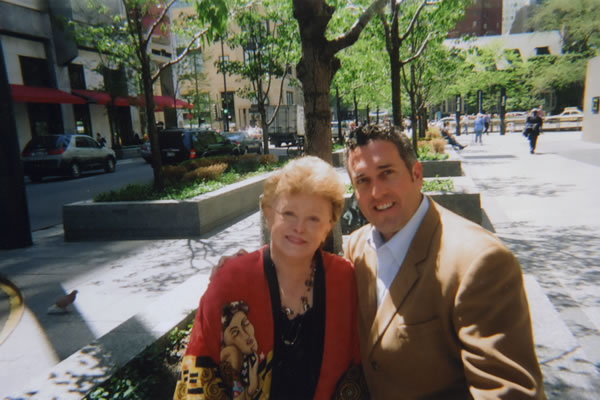
The “Golden Girls” actress, who died at age 76 in 2010 of a brain hemorrhage, wanted fans to have a chance to have her many personal belongings. Her best gay friend, Michael J. LaRue, has organized her items in a series of sales. The two met at Studio 54 of all places (for an animal charity event) about 10 years before she died and quickly became the closest of friends, LaRue says.
“For some reason, we could just crack each other up all the time,” LaRue says. “We just became really good friends. She always joked about marrying me so she could be Rue LaRue, but of course that wouldn’t have worked.”
LaRue, who was collaborating with the actress on a stage adaptation of her memoirs, says McClanahan was a keeper and collector.
“Let me tell you, that woman was a shopper and she saved everything,” he says. “She had this sprawling urban oasis in mid-town Manhattan … she had 13 closets in the house and five external storage areas and you couldn’t fit a paperclip in any one of them.”
As per McClanahan’s instructions, after family and friends had their pick, the rest goes to auction. Some was sold in Beverly Hills. A large sampling, including several scripts, costumes and collectibles from “The Golden Girls,” are available for purchase at estateofrue.com. The items are direct purchase and some are available for about $100.
“She really wanted the fans to have a chance to have what they wanted,” he says. “This isn’t about generating a zillion dollars. It’s about getting the stuff out there.”
LaRue says he’s “not a stuff person.” He has a drawing McClanahan made for him, her ashes and her Emmy. Her only child, her son Mark who lives in Texas, also took many items he wanted. In all, McClanahan named 22 beneficiaries in her will.
LaRue says McClanahan was a great pal. In addition to the work on the autobiography adaptation (“It was tight and really coming together when she got sick,” he says), a film crew followed the actress around for two years while she worked on it. Of the 150 hours they shot, a documentary is being made LaRue hopes will be finished within 18 months or two years.
LaRue says McClanahan was completely unguarded with him and had high regard for her fellow actresses, Betty White and the late Bea Arthur, though Arthur didn’t particularly care for White.
“Betty and Rue were friends and Rue and Bea were friends, and they all loved Estelle (Getty),” he says. “Susan Harris told Rue, ‘Thank God you’re here to play mediator. This show would never work without you.’”
The actresses, though, were always professional with each other, LaRue says. On taping nights, they would wait until all four were ready to go to the commissary. A reunion in which their segments were filmed separately was done because of logistics, not animosity LaRue says.
“She used to say she was nothing like Blanche, but that was such bullshit,” LaRue says of his pal. “I mean come on, she had six husbands … she was like Blanche in a lot of ways.”
The ultimate, LaRue says, was watching “Golden Girls” reruns with McClanahan, who also had starring roles on “Maude” and “Mama’s Family” in addition to the 70 movies and 250 theatrical plays she was in over her lifetime.
“We’d sit there watching and she’d say, ‘Listen to that, listen to that.’ It wasn’t about her performance. She was always pointing out how brilliant the writing was.”
Nightlife
In D.C. comedy, be sure to shop local
A thriving patchwork of queer-friendly stages in Washington, Baltimore
Most people know stand-up comedy from Netflix specials or late-night sets on Comedy Central. The reality is far different for local working comics like me. A few times a month, I might get paid $50 for a 10-minute set and my photo on a bar flyer to show off to the ladies in my scrapbooking club.
Still, it’s a joy sharing laughs about my well-worn Washington career arc — from conservative reporter to openly trans organic grocery store worker and nightclub comedian. Or, as I like to say onstage, from Fox to foxy.
Stand-up is hard. Offstage, it’s even harder. It took more than a year and nearly 80 open mics to land my first paid set. Since then, I’ve performed in coffee shops, bars, restaurants and even on a city sidewalk. I once performed in the Catskills, which felt like a big deal — even if it was a bigger deal in the 1950s.
As an older trans comic in Washington, I’ve found it nearly impossible to get stage time — or even the courtesy of a returned email — at the big, corporate-owned comedy clubs. Fortunately, there’s a thriving patchwork of queer-friendly producers in Washington and Baltimore creating shows that reflect the diversity of our communities, instead of straight male-dominated lineups that look like the cast of “Ice Road Truckers.”
“There are so many kinds of funny people, but a lot of barriers exist for women and queer people because it’s a very masculine culture,” said Dana Fleitman, who runs the Just Kidding Comedy Collective and is helping produce the Woke Mob Comedy Festival in April, featuring many women and queer comics.
Full disclosure: I’m not performing in the festival. But I am proud to be one of more than 50 women and nonbinary comics Fleitman and her colleagues have helped “train up” through an incubator program she first ran through Grassroots Comedy and now through Just Kidding Comedy Collective.
Another trans comic, Charlie Girard, who splits time between New York and Washington, runs an incubator program called Queers Can’t Take a Joke. He has trained more than 100 comics in Washington.
Girard has one rule: no punching down.
“The best comics speak truth to power,” Girard said. “Making fun of marginalized communities is simple lazy writing based on tired, old stereotypes.”
Ultimately, Girard wants to prepare students not just for queer rooms, but to find their voice and expand into all kinds of spaces.
Comics trained by Girard and Fleitman have gone on to produce or help run shows like Clocked Comedy, Backbone Comedy, the Crackin’ Up open mic and Funny Side Up. Several have found a home on Barracks Row at As You Are — one of my favorite places to perform. In Washington, comic Jenny Cavallero’s show Seltzer is a sober comedy night frequently featuring local queer comics.
In Washington, performer and producer Arzoo Malhotra, who runs Zoo Animal Productions, said it’s a critical moment to support community-based comedy producers, often the first hit by worsening economic conditions.
“We’re losing spaces faster than we’re creating them,” Malhotra said. “We are in the use-it-or-lose-it stage. If there’s a restaurant you like or a performer you want to keep seeing, patronize them now — because they’re going away.”
I’m also grateful for producers in Baltimore, which has a thriving queer comedy scene. Comic Hannah Alden Jeffrey’s monthly “The Really Cool Open Mic,” created for women and trans performers but open to all, regularly draws up to 100 people.
Hannah’s mic and Kenny Rooster’s “Dramedy” open stage have provided safety and opportunity when other stages felt out of reach. Comedians Michael Furr and Jake Leizear also produce shows regularly featuring queer comics.
“We started the REALLY COOL Open Mic because every other mic in town catered toward straight dudes that dominated the Baltimore scene,” Alden Jeffrey said. “Contrary to the lineups of many shows today, people don’t want to see a show of eight guys being bigots. Go figure.”
One of the most important moments for me came when I attended a free showcase at a well-known Adams Morgan club. Like other big venues, it hadn’t responded to emails from a new comic looking for a shot. I sat in the back row thinking maybe these comics were just way funnier than I am.
Then a straight male comedian — with hair even more gorgeous than mine — launched into a long joke comparing eating pizza to performing oral sex on a woman.
At that moment, I walked out feeling better about myself. I remember thinking: nope. I absolutely deserve to be on that stage, too.
Lots of us do.
Jamie Mack is a stand up comedian, speaker and writer. Follow them on Instagram at @jamiemack_blt or email [email protected].
Celebrity News
Liza Minnelli makes surprise appearance at GLAAD Media Awards
Laverne Cox’s fiery speech earned standing ovation
Last night’s GLAAD Media Awards had a few pleasant surprises in store.
Throughout the evening, which was hosted by “Mean Girls” star Jonathan Bennett on Thursday at the Beverly Hilton in Los Angeles, the audience was clued into the fact that a mystery guest would make an appearance. By the end of the night, it was revealed to be none other than “Cabaret” star and queer icon Liza Minnelli, who was in attendance to accept the newly-created Liza Minnelli Storyteller Award.
An emotional Minnelli told the crowd of queer attendees and creatives, “You make me so proud because you’re so strong, and you stand up for what you believe in. You really do, and it’s so nice to be here. I feel like a five-year-old!” Everyone then joined in a happy birthday celebration for Minnelli’s upcoming birthday on March 12, and the release of her upcoming memoir, “Kids, Wait Till You Hear This!”
Another moment that got the audience standing and cheering was when “Orange Is the New Black” star Laverne Cox took to the stage to call out how “what is going on right now in the United States of America is not right.”
She said, “Identify, I said this earlier, and I’m going to say it again, what dehumanizing language and images are. Call it out and don’t buy into it! So much of my struggle over the past several years [has been] trying to figure out how to combat this assault on my community, rhetorically. I do not want to have the conversation about my life and my humanity on the oppressor’s terms.”
That message was echoed by Bowen Yang and Matt Rogers when accepting the Stephen F. Kolzak Award for their “Las Culturistas” podcast and pledging to donate $10,000 to Equality Kansas after the state revoked transgender people’s driver’s licenses. “We cannot accept this award without condemning the rampant active transphobia from this administration,” Rogers said. “We are also here to let them know in advance that they are fighting a losing battle. When we gather in rooms like this, we are always going to have each other’s backs.”
Among the big winners last night were “Heated Rivalry” for outstanding new TV series, “The Traitors” for outstanding reality competition program, “Stranger Things” for outstanding drama series, “Palm Royale” (which was just cancelled after two seasons) for outstanding comedy series, “Come See Me in the Good Light” for outstanding documentary, “Kiss of the Spider Woman” for outstanding wide theatrical release film and a tie between “A Nice Indian Boy” and “Plainclothes” for outstanding limited theatrical release film.
Quinta Brunson received the Vanguard Award for her hit TV series “Abbott Elementary,” which features Jacob, an openly queer character played by Chris Perfetti. Brunson said, “Queer people have been a part of my life since birth. I have to shout out my uncle … who was the first example of representation in my life of queer people, who allowed me to be free. There are so many people in the room who changed my life.”
On the music side, Young Miko won for outstanding music artist, and KATSEYE won for outstanding breakthrough music artist. Demi Lovato even opened the show with a steamy performance of her single “Kiss.”
The GLAAD Media Awards will officially air Saturday, March 21 on Hulu.
Photos
PHOTOS: Sydney Gay and Lesbian Mardi Gras Parade
48th annual LGBTQ event held in Australian city
The 48th annual Sydney Gay and Lesbian Mardi Gras Parade was held on Feb. 28.
(Photos by Cori Mitchell)


-
National4 days agoSupreme Court deals blow to trans student privacy protections
-
District of Columbia4 days agoD.C. Black Pride theme, performers announced at ‘Speakeasy’
-
Opinions4 days agoWhy innovation matters for Black health
-
National4 days agoPeter Thiel’s expanding power — and his overlap with Jeffrey Epstein