Arts & Entertainment
Film, food and fun
D.C. Shorts kicks off ninth annual festival Thursday
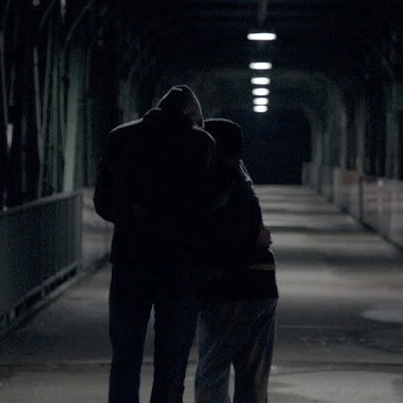
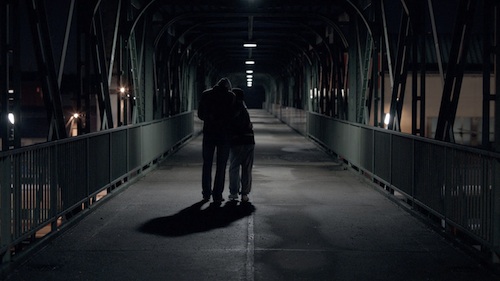
A scene from ‘Hatch,’ a 19-minute LGBT-themed drama directed by Christoph Kuschnig from Austria about two couples forced to make hard decisions on a wintry night. It’s part of ‘Showcase 10,’ a series of films that will be shown on Sept. 8 and 10 at E Street Cinema as part of the D.C. Shorts Film Festival. (Photo courtesy D.C. Shorts)
The D.C. Shorts Film Festival
September 6-16
Various venues
Ticket prices start at $12 and include an online only option
The numbers behind the ninth annual D.C. Shorts Film Festival are staggering: 140 films under 20 minutes long, 27 countries, four venues, eight chefs, 16 showcases, 11 days, five parties and six screenplays staged by local actors. Luckily, Jon Gann and his talented colleagues have it under control and their excellent website guides audience members easily through the festival.
Gann, the openly gay founder and director of the Festival, became interested in filmmaking when he became disenchanted with his work in media relations.
“I owned a graphic design firm for many, many years and I was tired of producing stuff that I thought was great that clients thought was schlock and stuff I thought was schlock that they thought was great, so I decided to go to film school,” he says.
His most notable film to date is the award-winning “Cyberslut,” a nine-minute confession of an unnamed man obsessed with finding sex on the Internet. In intimate and riveting detail, the film tracks his fascination of the online hunt, the frequent disappointment at the first meeting and the occasional ecstatic encounter that sends him back to the computer to hunt again. As the narrator wryly notes, “a computer lets you make more mistakes faster than any other invention in human history, with the possible exception of handguns and tequila.”
Gann’s experience with film festivals (“Cyberslut” has had 47 screenings worldwide, making it one of the most successful gay-themed short films) inspired him to create a different kind of film festival.
“I travelled to festivals all over the world and that’s when I realized that many festivals were about food and parties and sponsors but not necessarily about films or filmmakers,” Gann says. “That’s when I said I need to do something that’s different. The focus of my festival was going to be on filmmakers and if I did that right, then the food and the money and the parties would come.”
Gann has established a system to make the Festival a supportive environment for filmmakers.
“We give feedback to all the filmmakers who enter, whether they make it into the festival or not. We allow them to see their scores and the judges’ comments. That has helped some filmmakers recraft their final edit to make it tighter.”
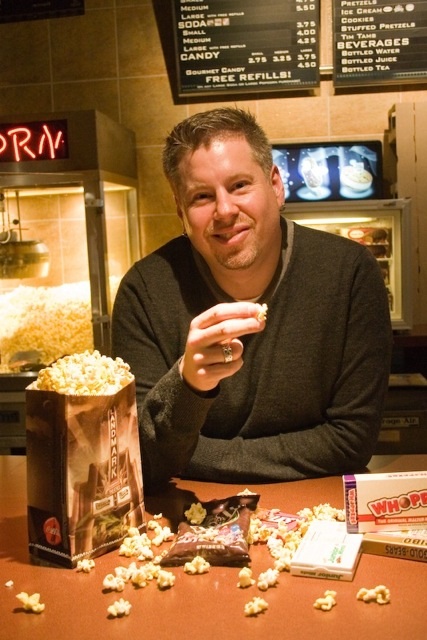
Jon Gann (Photo courtesy the Festival)
Gann also realized he wanted to focus on short films (less than 20 minutes). He thinks that “there’s a hunger for really good short content. If Internet use is any indication, people like to see a story in a few minutes.” He adds that short films are also a great way for fledgling artists to learn their craft.
“As a filmmaker,” he says, “if you’re able to tell a succinct story that grabs the audience’s attention and is emotionally gripping in a few minutes, then you know what you’re doing as a storyteller. And that to me is impressive.”
So, in 2004, Gann started the D.C. Shorts Festival, financed largely with money from his own checking account. The first year, 75 films were submitted and 32 films were presented in three screenings for enthusiastic audiences. Looking back on the experience, he says, “It made me a nervous wreck but the whole thing was a big success. We sold out all the tickets and had to turn people away, which was amazing. And it’s grown from there.”
Today, D.C. Shorts is the largest short film festival on the East Coast.
There were more than 850 submissions for the 2012 Festival. After a rigorous selection process, 140 movies were chosen for screening. The films, with run times ranging from one to 20 minutes, are being presented in 16 showcases. Each showcase lasts around 90 minutes. An interactive online tool called “The Film Finder” helps audience members select the programs they’re most interested in seeing. Browsers can sort by showcase, country of origin, genre (documentary, animation, horror, comedy, drama and so on) and interest area (including LGBT, local films and celebrities).
The showcases will be presented at four venues throughout the D.C. region, including the E Street Cinema, the U.S. Navy Memorial, the Atlas Performing Arts Center and the new Angelika Film Center in Fairfax.
In addition to the showcases, there are a variety of other events for filmmakers and film fans to enjoy. For example, patrons can enjoy:
• Free lunch time screenings at the E Street Cinema in downtown D.C.
• Free family and teen screenings at the new Angelika Film Center in Virginia
• A screenplay competition where six scripts (selected from 185 submissions) are given a staged reading by local actors and directors. The winner will receive a cash prize ($1,000 when the award is made and $1,000 when the film is completed) and a slot in the 2013 Festival.
• Free seminars for aspiring and practicing filmmakers
• “The Best of DC Shorts” showcase which features movies selected by audiences during the festival’s opening weekend
• An Awards Brunch with accolades from the festival jury, the festival director, audience members, and a peer award from the filmmakers themselves
• And, a variety of legendary parties that offer “food and drink and DJs and dancing and lots of chances to meet filmmakers.”
Gann adds that that this year’s festival has an emphasis on films about food and includes partnerships with area restaurants.
“We have a big food-film program this year,” he says. “We’ve paired eight films with local chefs who’ve prepared special dishes based on those films. At those films, you can actually sample the food at the end of the screening.”
For example, “Murder Mouth” by first-time Australian filmmaker Madeleine Parry is a documentary showing how, “Madeleine decides that unless she kills it, she can’t eat it.” The film is paired with Ed Witt’s recipe for Crostini with Lamb Tartare, which will be served to audience members after select screenings. Like Maddie in the film, the chef from 701 argues that, “Modern day carnivores have become so disconnected from their food that they are unable to identify it without the labels from the grocery store.”
Queer themes
Several selections in this year’s Festival have LGBT storylinesThe D.C. Shorts Film Festival includes 10 films with explicitly LGBT content. They are sprinkled throughout the showcases, often in interesting combinations with other films.
The most delightful, a modern day fairy tale called “The Maiden and the Princess,” is actually part of the free Family Showcase on Sept. 15 at the Angelika Film Center. Directed by American filmmaker Ali Scher, this charming film tells the story of Emmy, who is teased by her classmates and rebuked by her parents when she kisses another girl.
Luckily Hammond, a narrator with the Grand High Council of Fairy Tale Rules and Standards intervenes. He transports himself (in fairy godmother drag) and Emmy into a musical fairy tale that reassures Emmy that her feelings are perfectly normal and that convinces Hammond’s stodgy superior to let him put the “fairy” back in fairy tale.
Scher was very clear about her aim in making the film, saying “My goal with this project is to cut through the silence and facilitate honest communication between children and parents about sexual orientation.” She affirms that she made the movie so that “no kid ever has to feel ashamed of who they are. We as a society need to encourage individuality in children, even if it means exposing them to things we are afraid of.”
A much darker story is told in “Hatch” by Austrian director Christopher Kuschnig, who won a student Oscar for the film. “Hatch” tells the stories of two couples whose lives intersect on a wintry night in Vienna and the baby whose fate will be changed by the decisions they make. Kuschnig succeeds in using an innovative narrative and visual style to capture both the inner dynamics of each couple and the broader social implications of their desperate acts.
“‘Hatch’ is much more than the story of one couple’s wrenching decision and another’s criminal act,” he says. “I was particularly interested in each couple’s distinct dynamics and how these events on this particular night could challenge their assumptions of each other, and therefore alter their relationships and eventually their lives.”
Some of the other LGBT films in the Festival are “The Queen of My Dreams,” a Bollywood influenced take on a young lesbian’s coming-out story; “Cobra,” which takes a grieving father from the funeral of his estranged son to the bar where his son performed; and “The Gay Who Wasn’t Gay Enough,” a hard-hitting take on conformity in the gay community. — BRIAN T. CARNEY
Photos
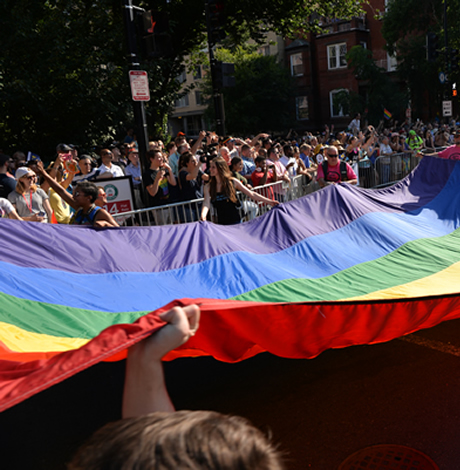
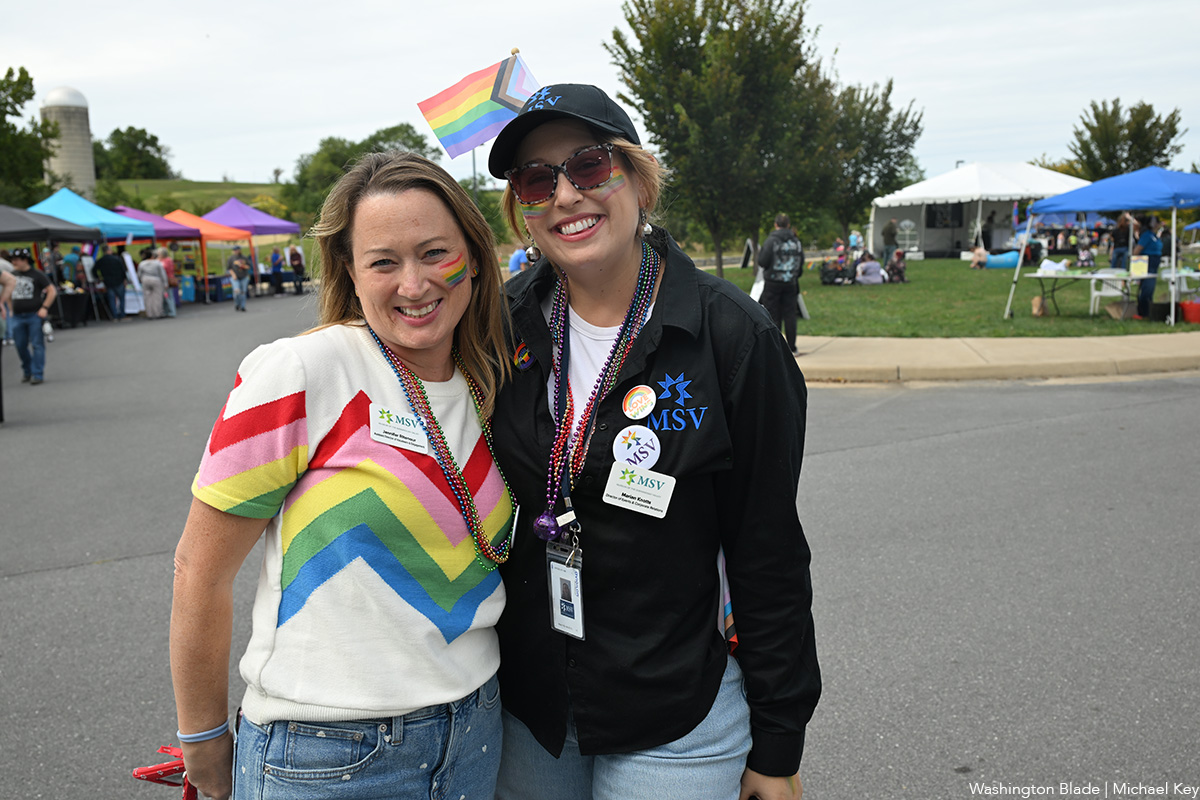
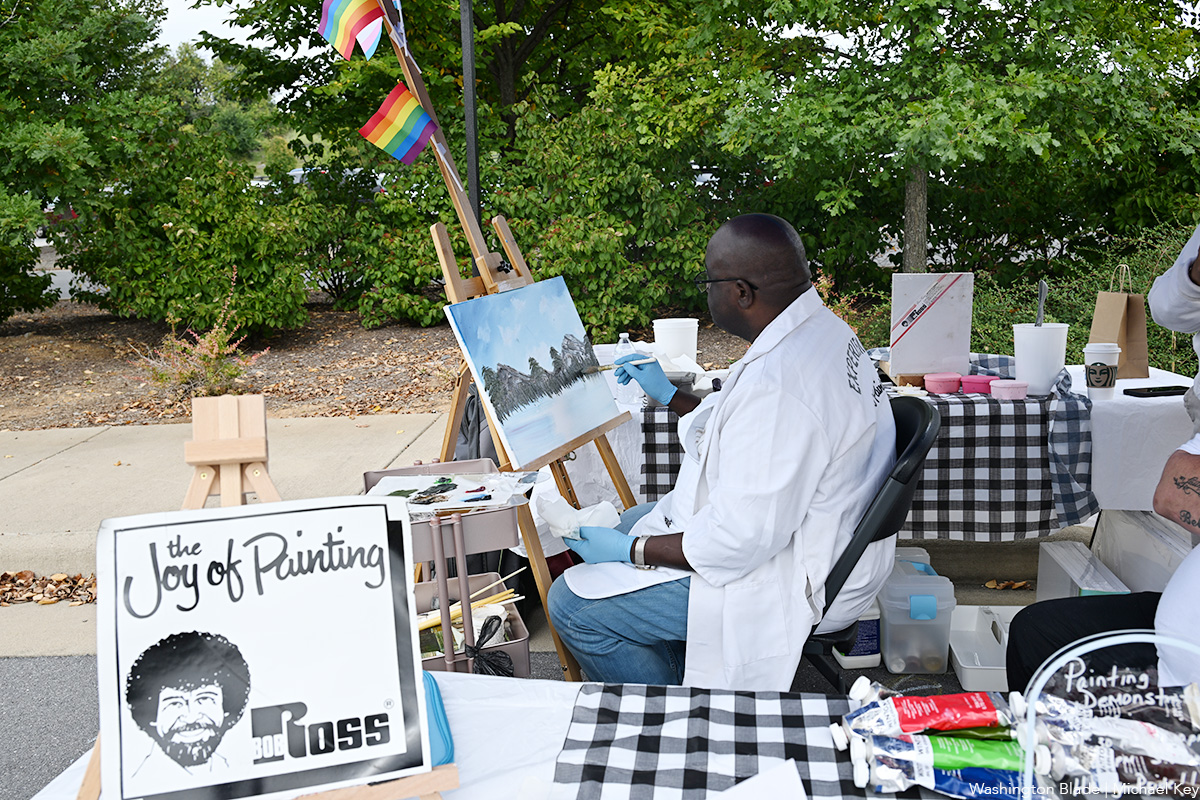
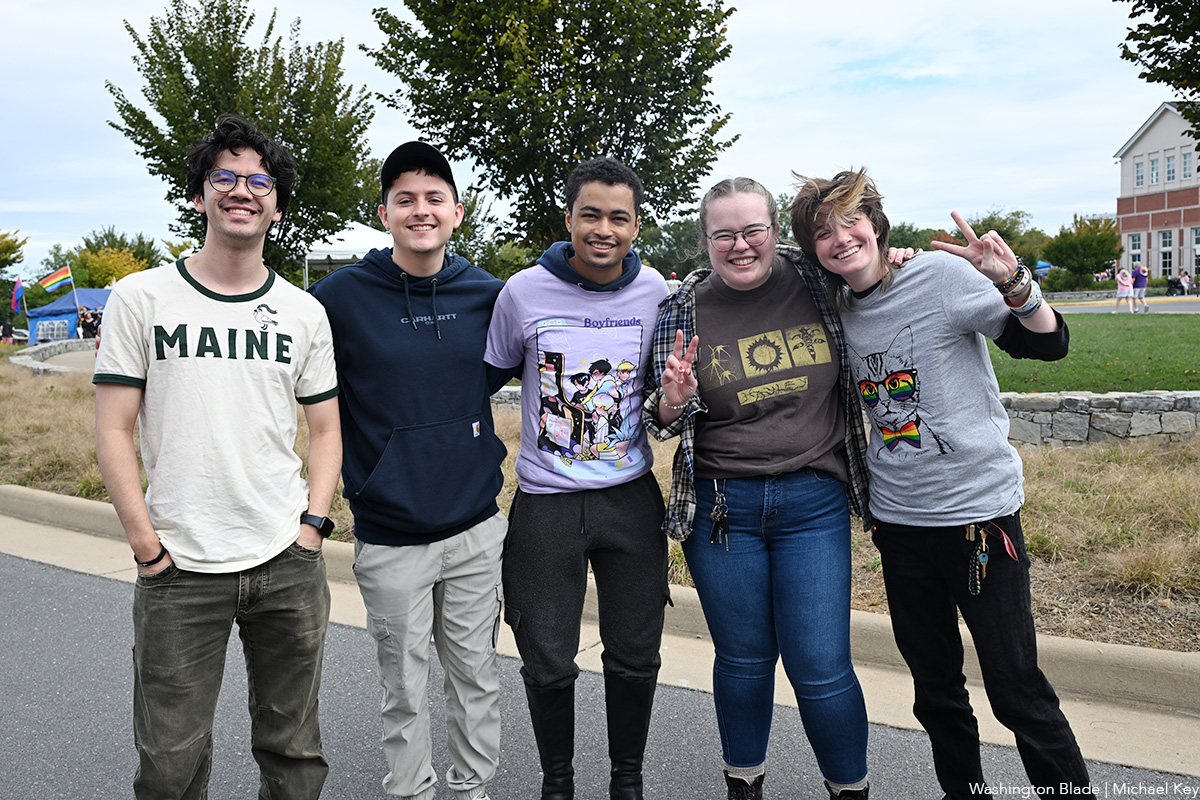
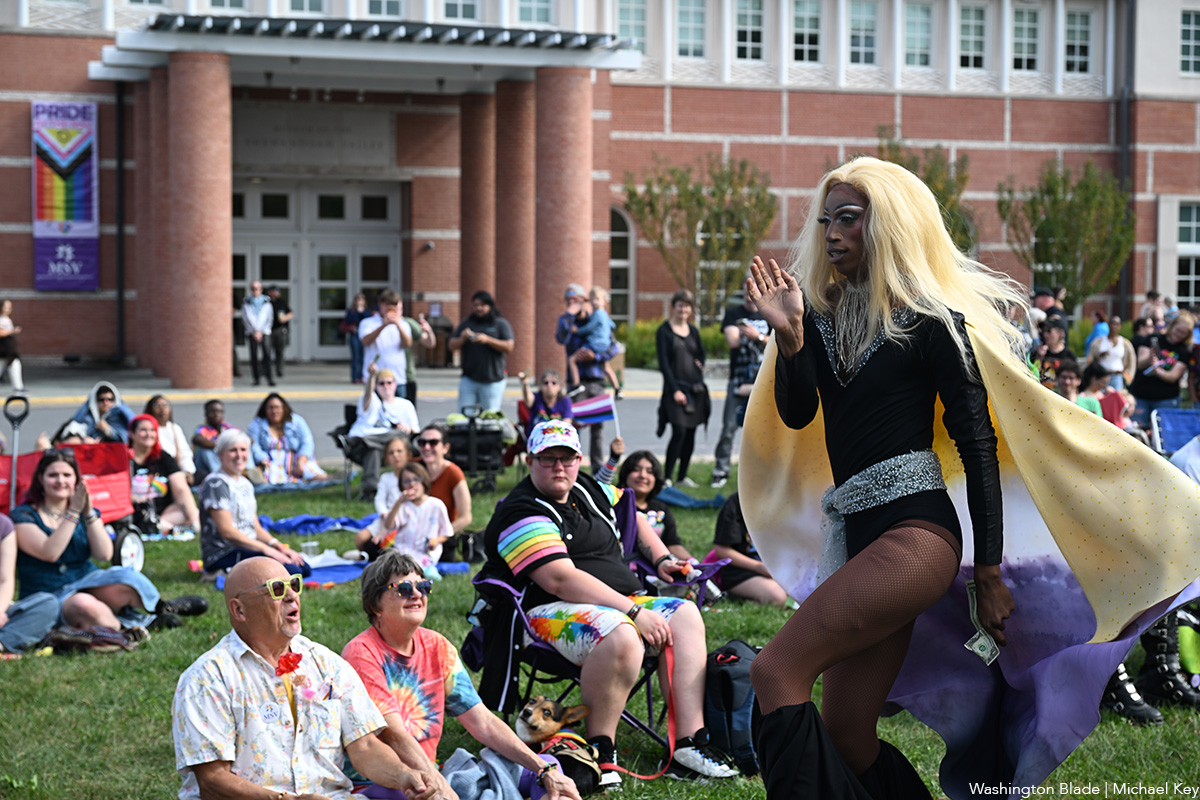
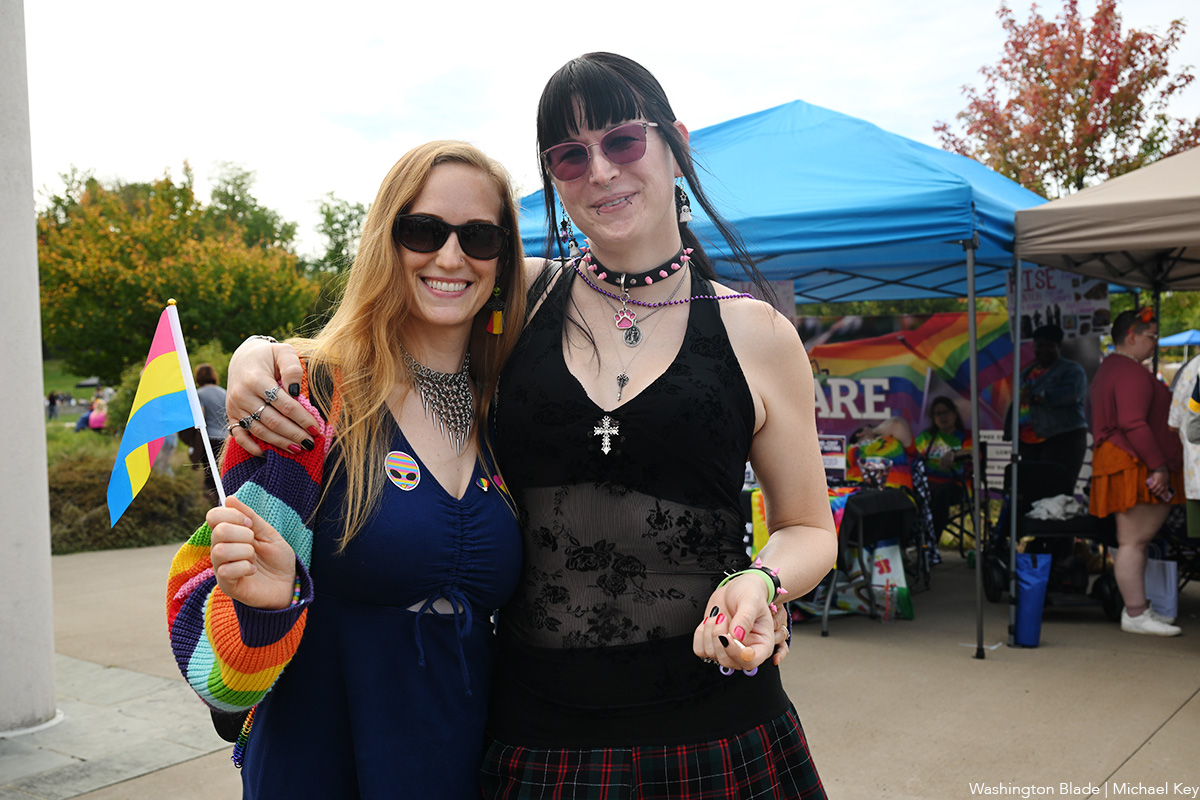
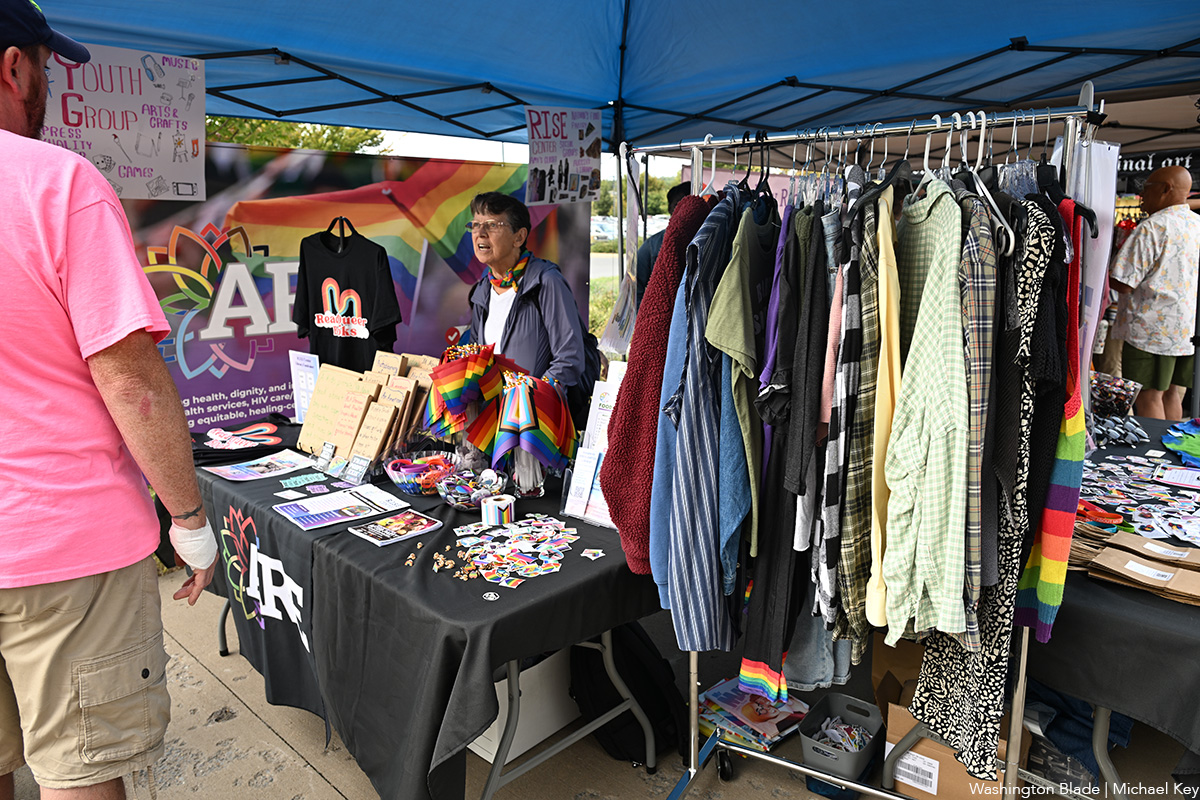
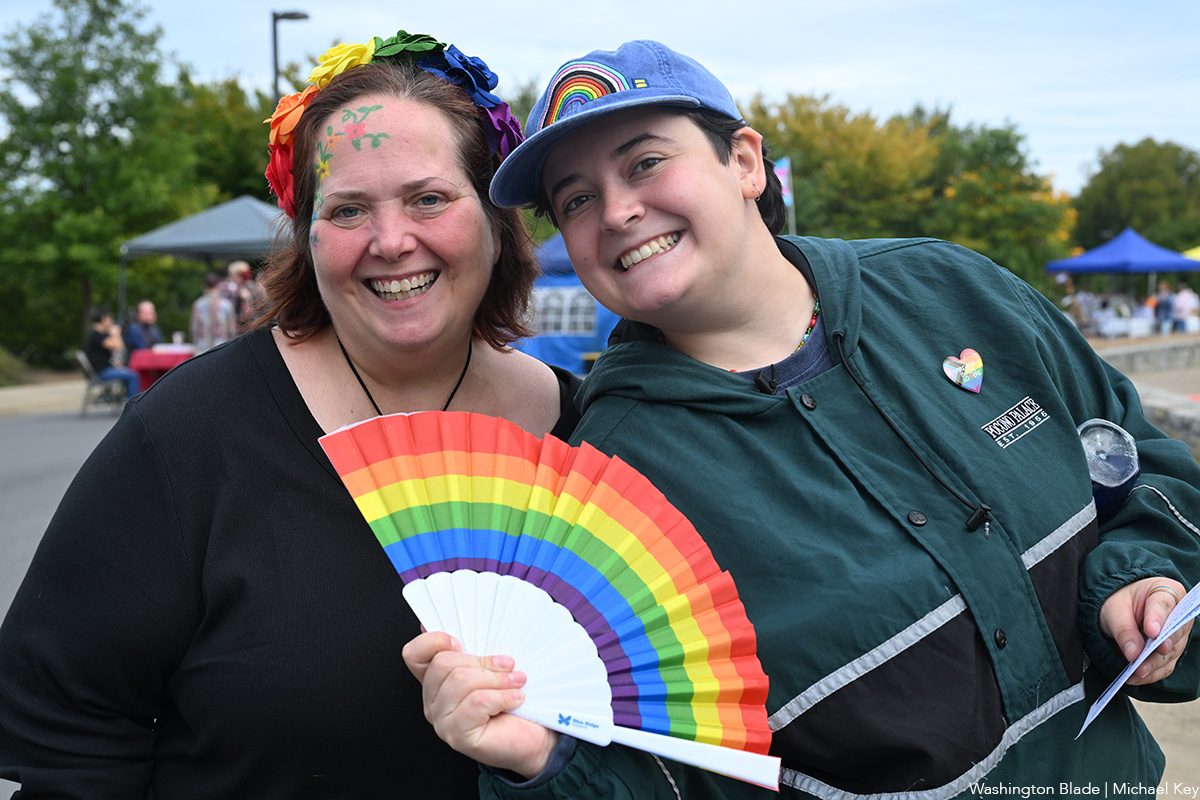
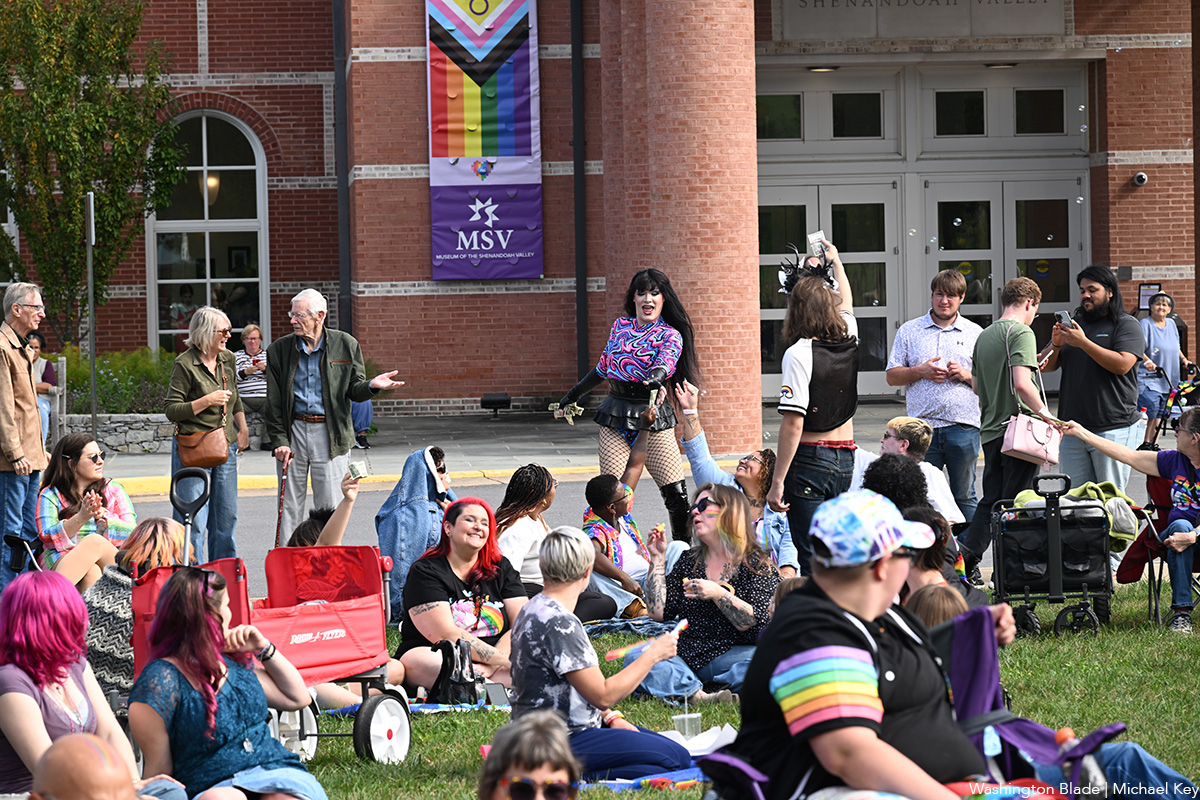
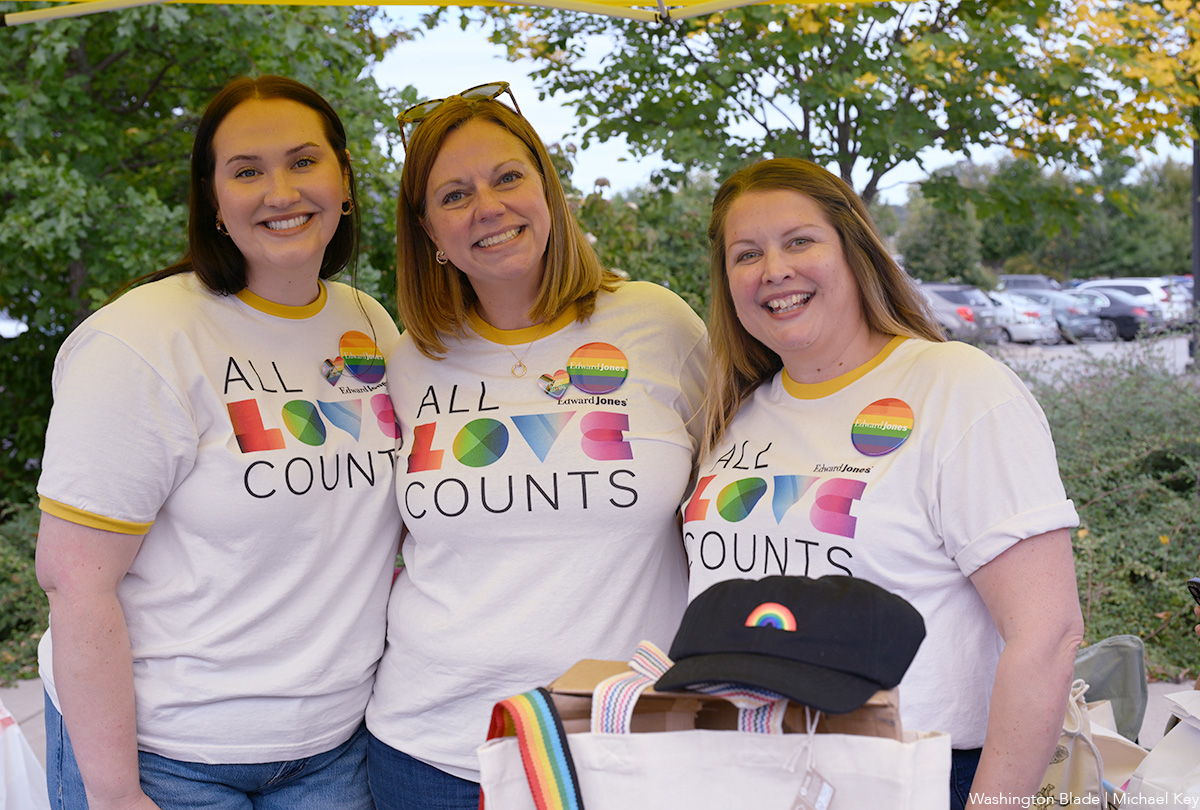
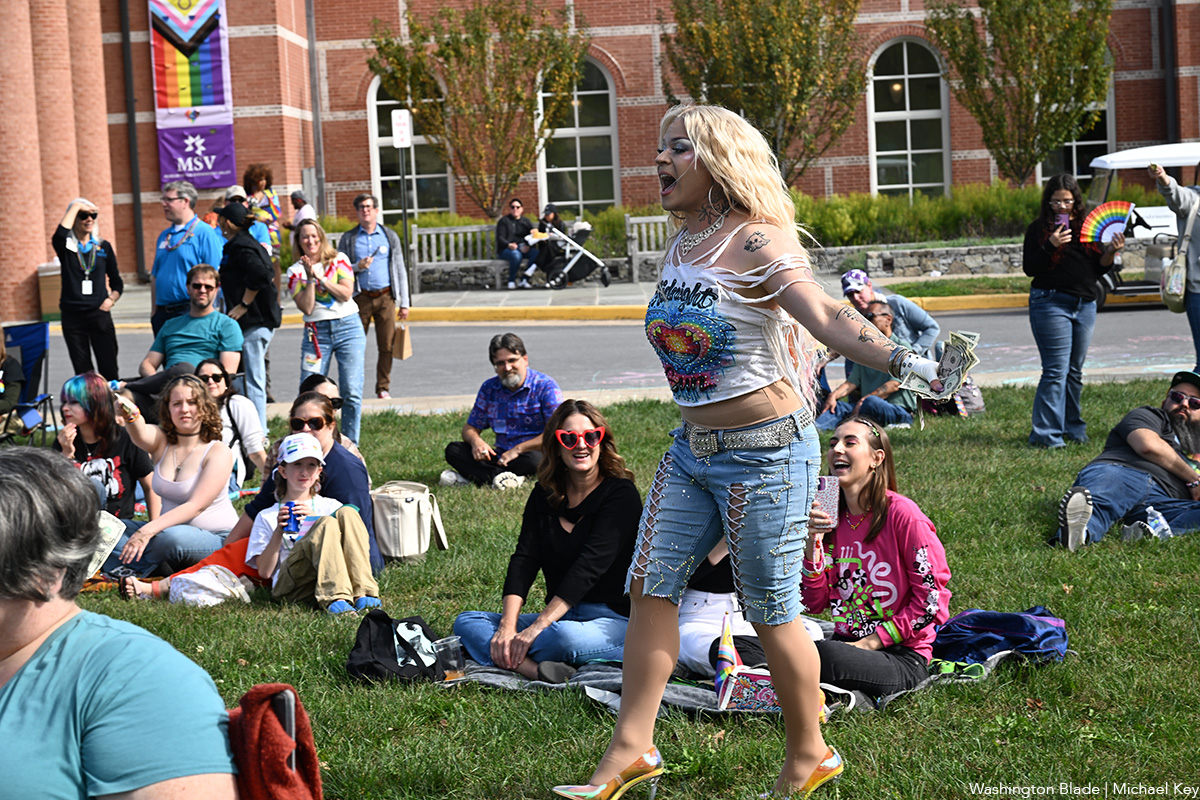
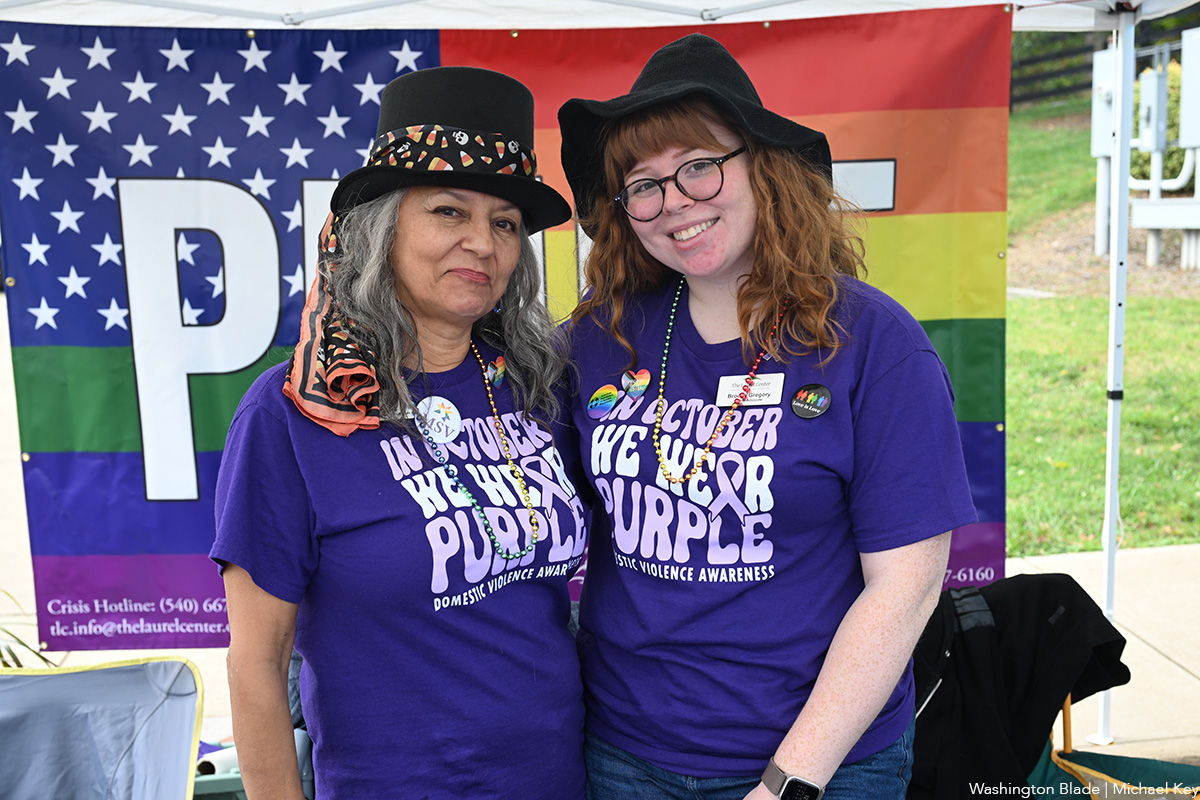
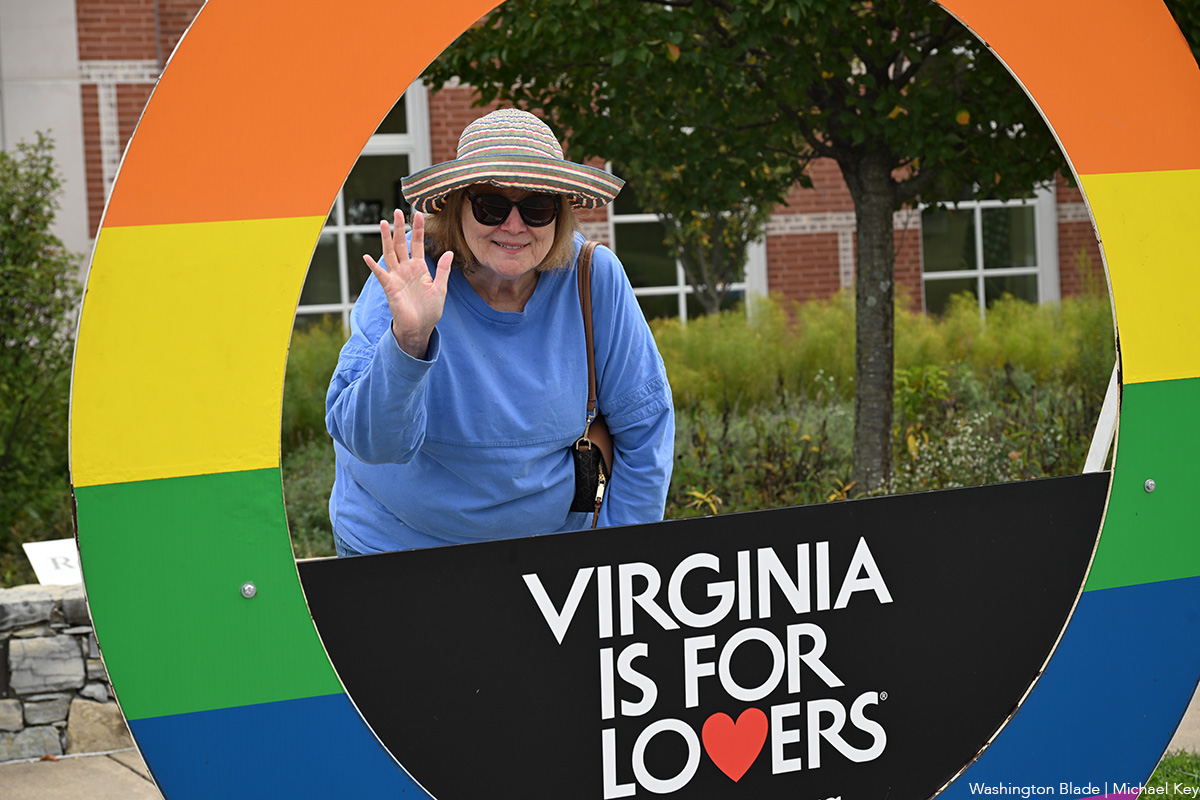
PHOTOS: Winchester Pride
Annual LGBTQ celebration held at the Museum of the Shenandoah Valley
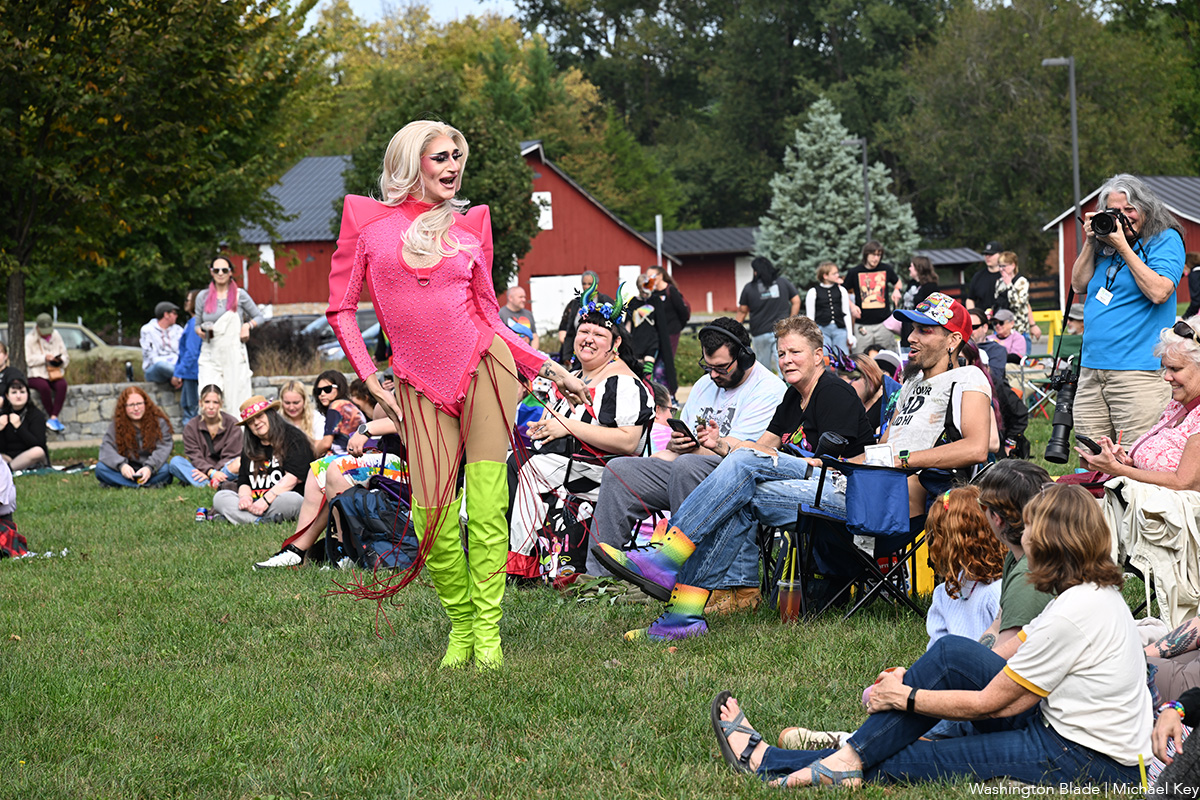
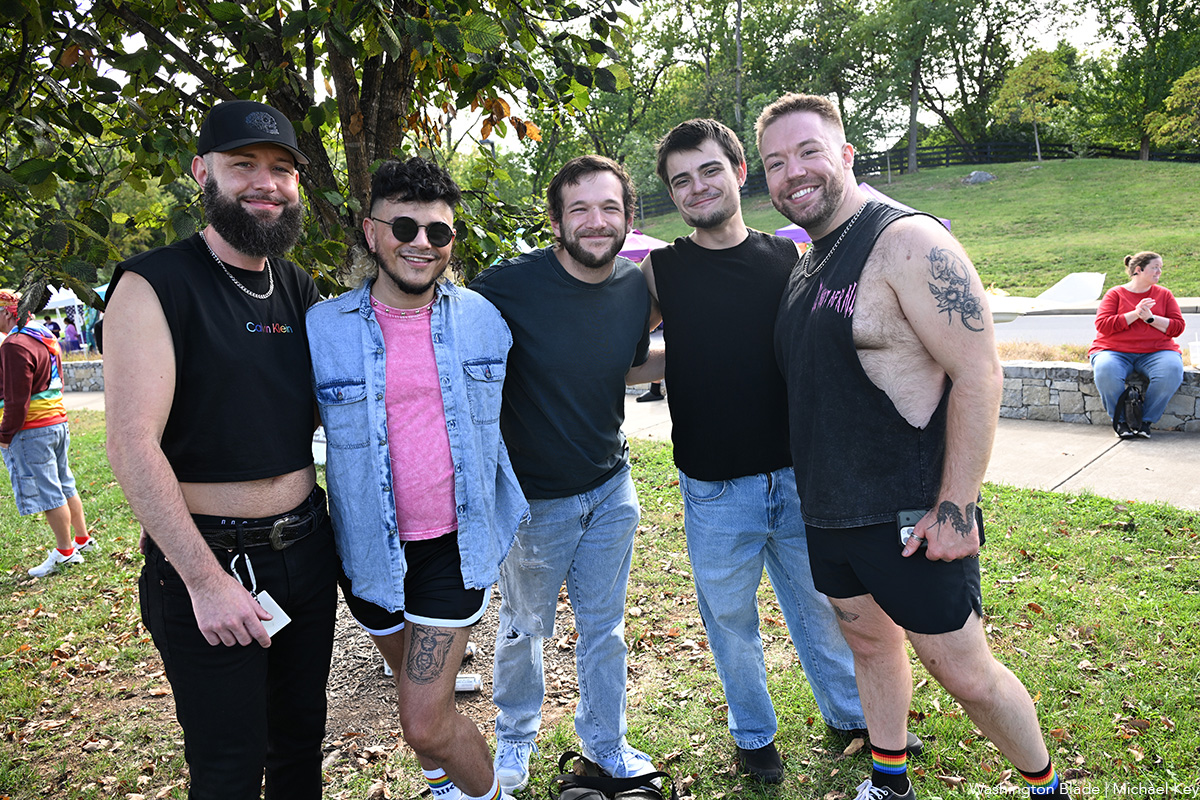
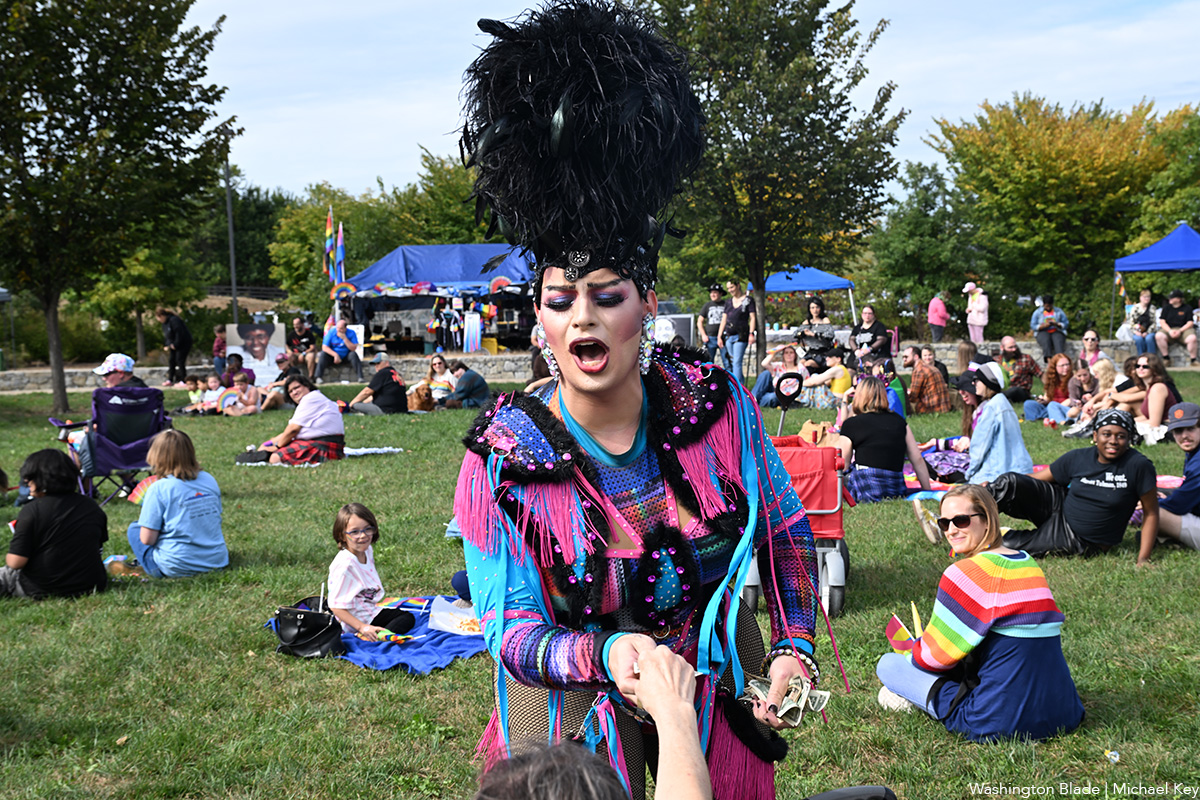
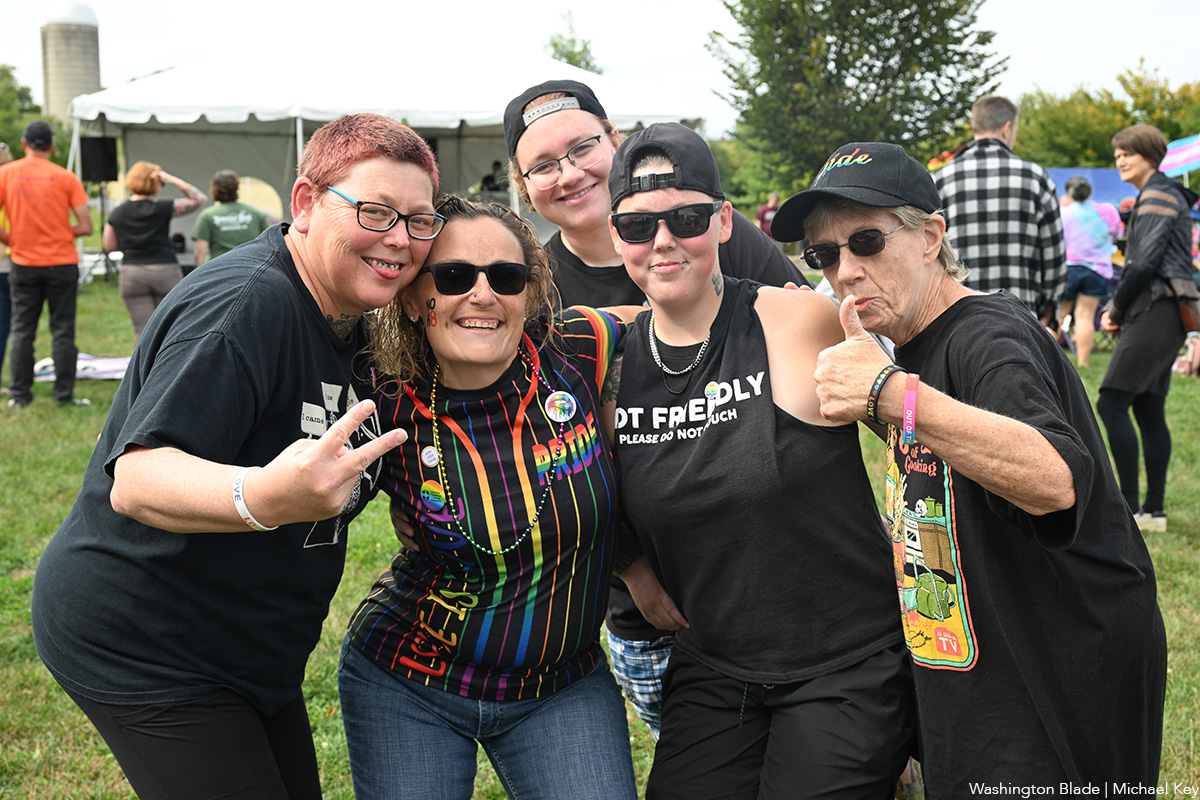
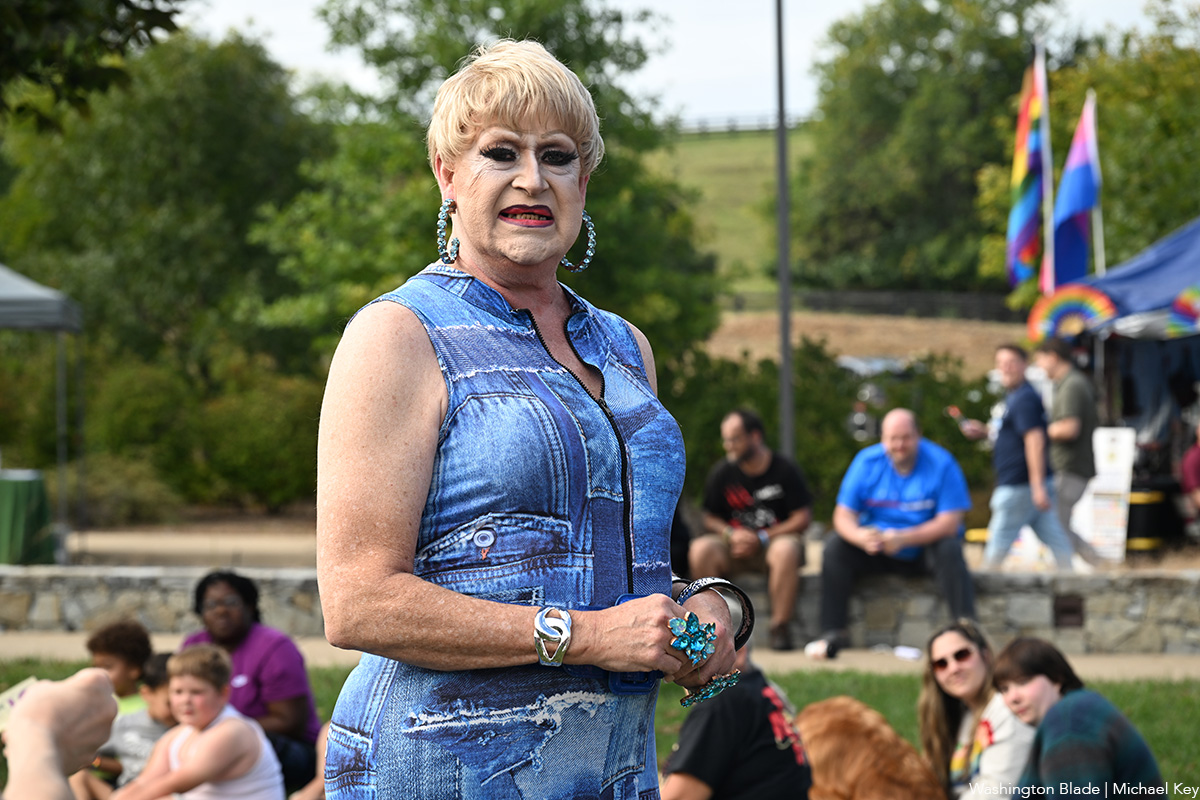
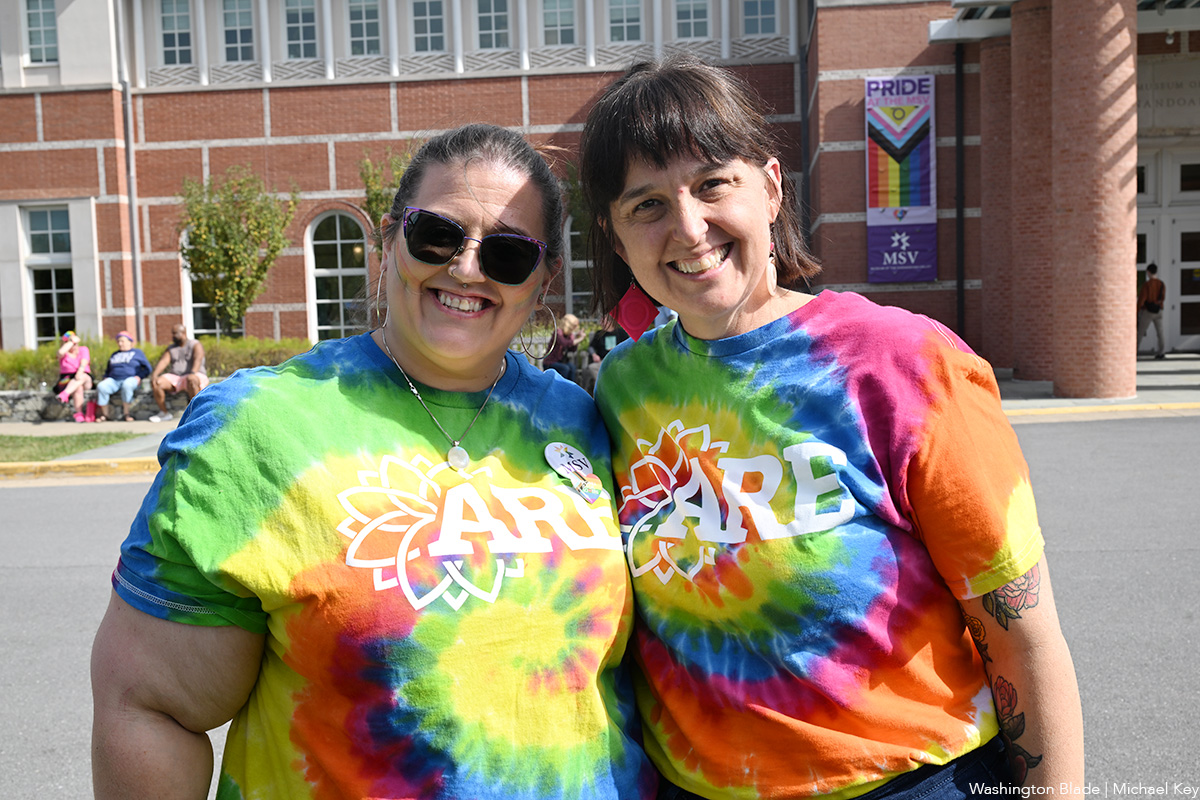
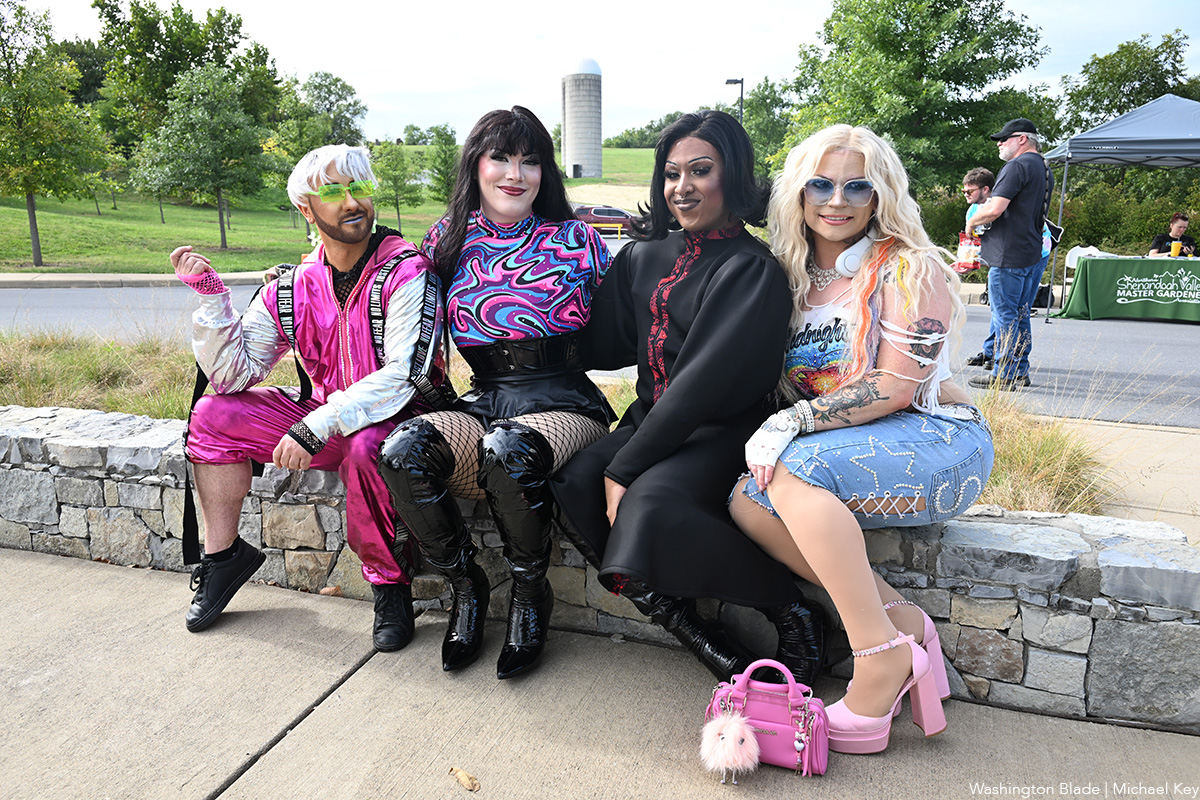
The 2026 Winchester Pride Festival was held at the Museum of the Shenandoah Valley in Winchester, Va. on Saturday, Oct. 3.
(Washington Blade photos by Michael Key)
Theater
‘Merrily’ is for Sondheim super fans, the uninitiated, and anyone in between
Experience it in an intimate setting with beautiful design, incredible cast
‘Merrily We Roll Along’
Through Nov. 1
Signature Theatre
4200 Campbell Ave., Arlington, Va.
Tickets start at $47
Sigtheatre.org
Unfaithful. Compromised. A sellout. Just a few descriptors that might fit Frank Shepard, the talented composer in the Stephen Sondheim musical “Merrily We Roll Along.”
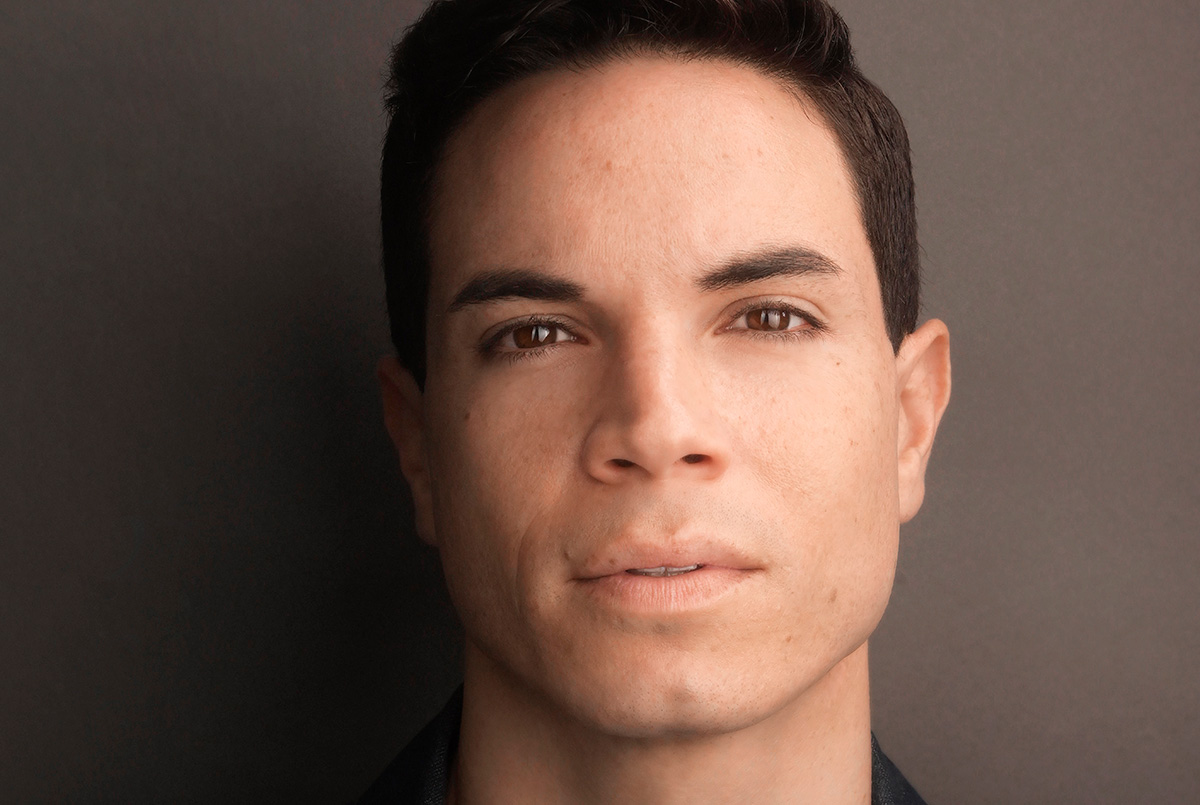
“Personally, I think he gets a bad rap,” says Jason Gotay, the gay actor who’s currently playing womanizing Frank at Signature Theatre in Arlington. “At his core he wants to be loved. He’s concerned with making those around him happy and he’s a people pleaser. That’s my window into Frank.”
Whatever your thoughts, by show’s end, we know Frank started out as a nice guy. “Merrily” famously moves in a reverse chronological order. We meet Frank and friends, lyricist Charley Kringas (Jake Loewenthal) and writer Mary Flynn (Melanie Field), disillusioned in a New York penthouse in 1976. Ensuing scenes filled with disappointments and broken relationships move toward more hopeful times, eventually leaving the trio on a rooftop in 1957, young and full of promise searching the night sky for a happy future.
“Moving backward makes it difficult to build on the prior scene,” explains Gotay. 37. “You live heightened moments followed by 30-second costume changes, and you’re meant to forget everything you just did. To be honest, it’s a bit of a mind fuck.”
A marvelous but humble tenor, he begrudgingly acknowledges his artistic versatility. At New York City Center he sang Che in “Evita” (contemporary almost operatic), and he was solemn Henrik in Lincoln Center’s “A Little Night Music,” (classical Sondheim). On Broadway, he played Homer, the loyal brother in “Floyd Collins” (folksy bluegrass), and he’s sung the sweeping songs of a few Disney princes.
“I’m asked to do a lot of things because vocally I sing in many styles; it’s something I can do and I love doing it.”
Growing up in residential Dyker Heights, Brooklyn, Gotay was immersed in school plays and community theater. For high school, he attended the Professional Performing Arts School in midtown Manhattan with a focus on musical theater.
He continued on the same track for a year at Emerson College in Boston followed by Marymount Manhattan before graduating in 201l. A year later, he made his Broadway debut as Randall in Lin-Manuel Miranda’s hip-hop inspired “Bring It On: The Musical.”
Along the way, Gotay became a huge Sondheim fan. As a musical theater kid, he was introduced to the composer’s enduring classics all written before Gotay was born: “Into the Woods,” “Sweeney Todd,” and the actor’s forever favorite “Sunday in the Park with George.”
To many theatergoers’ surprise, “Merrily” flopped badly when it premiered on Broadway in 1981. But over many years of tweaks, reimaginings and revivals, the show became a major Broadway hit in 2023, with Jonathan Groff winning a Tony Award for playing Frank.
While he was aware of “Merrily,” Gotay didn’t make a deep dive into its wild provenance until he was asked to audition for the Broadway revival. (Briefly it looked like Groff, long attached to the show, might come up against some film conflicts.) It was during this short time that Gotay fell in love with Frank.
The experience left him further determined to sink his teeth into the complex character along with Sondheim’s lush melodic score with songs like “Not a Day Goes By,” “Old Friends,” and “Our Time.” So, when Gotay learned that Signature was slated to do “Merrily” this season, he reached out to Matthew Gardiner, the company’s artistic director as well as the production’s director/choreographer, asking how the role of Frank might be his. Long story short, he sought it, got it, and is ecstatically happy that it has worked out.
Several years ago, when Audible (Audible.com) came calling with an invitation to record a cabaret entirely of his own creation, he was thrilled.
“It’s probably the most personal thing I’ve ever done. My own story is a love letter to the women – my mother, friends, mentors, Broadway icons – who helped to shape my life; it’s about self-acceptance and what it is to grow up queer.”
He titled the solo show “Where You’ll Find Me,” a nod to his first love Dorothy Gale from “The Wizard of Oz.”
Often described as “a television heartthrob” (something the once chubby 12-year-old sometimes finds hard to process), Gotay is not unfamiliar with screens large and small. He’s remembered for various screen roles including his turn as Rafa Caparros, a prep school classics teacher who becomes entangled with a male student in HBO Max’s reboot of “Gossip Girl.”
Gotay recommends Signature’s “Merrily” for Sondheim superfans, the uninitiated, and anyone in between. He says, “It’s a great opportunity to learn about this once niche now increasingly mainstream musical. And if you have seen it before, this is a chance to experience it in an intimate setting with beautiful design and an incredible cast that truly brings the show to life.”
Television
Engrossing ‘Tip Toe’ delivers tension and an ominous warning
A chilling reminder that violent homophobia is on the rise

Whenever a new project comes from queer Welsh screenwriter and producer Russell T Davies – who created the original “Queer As Folk” in 1999 before spearheading the revival of the classic BBC sci-fi series “Dr. Who” as head writer and showrunner in the mid-2000s – it generally leaps to the top of every queer “must watch” list, and with good reason.
A genuinely versatile creative force who can move easily between genres without losing the core of humanity that keeps us engaged, he’s particularly known for his unequivocal, unsentimental, and always fearlessly candid narratives about queer life, set within a social context that’s barely tolerant, at best. He has a knack for capturing both the transient beauty and persistent hardships that seem to define our beleaguered community. His most recent such endeavor, 2021’s “It’s a Sin,” took us back to the harrowing years of the AIDS epidemic, following a group of gay young Londoners as the disease – and the societal homophobia that surrounded it – wreaked its merciless havoc, even as they began to break free from their closets and embrace their queer identities; and while it may have broken our hearts, it was also somehow empowering, a tale that reminded us not just of what we lost, but of what we have survived.
His latest miniseries, however, takes place in the here and now, and it offers a markedly bleaker assessment of the state of things.
“Tip Toe,” which appeared on the UK’s Channel 4 last summer, debuts on U.S. screens via the Starz streaming service on Oct. 2, and it lets us know from its first few minutes that things are not going to end well; that’s not a spoiler – it’s a warning, because if you’re looking for a happy ending, you’re not going to find it here.
A tale of resurgent and emboldened homophobia in a modern-day Britain where open hate for the queer community has surged at an alarming rate, it’s the story of two men whose intertwining destinies feel almost like a tragic accident of fate. Leo (Alan Cumming) is a Gen-X AIDS survivor who has become a beloved figure in Manchester’s queer community, the owner of a popular gay bar that has always been a safe space for the queer, trans, and questioning souls who are struggling toward self-acceptance; his next-door neighbor, Clive (David Morrissey), is a working-class electrician with a floundering marriage and two sons who live secret lives he knows nothing about. He’s an old-school “macho man” whose ingrained misogyny and homophobia have grown increasingly unfiltered with the rise of online “culture war” rhetoric; and while there’s a kind of forced “neighborly” friendship between himself and Leo, there’s also a clear-cut line of judgement – on both sides – that gives their interactions a sense of barely concealed hostility.
When Leo is locked out of his apartment after a messy hook-up gone wrong, Clive comes to his rescue, but uses the opportunity to impose himself on Leo’s privacy. He levies the situation into an opportunity for work – an electrical revamp of Leo’s bar, where he makes no secret of his disdain for the queer “lifestyle” – and the tension between them continues to build despite Leo’s best efforts at being polite. The escalation reaches a boiling point when the secrets and lies in his own household lead Clive to suspect Leo of being a sexual predator, turning their precarious relationship into a minefield of hostility and inevitably pushing both men into a confrontation that will end in a shocking act of violence.
It might go without saying that “Tip Toe” is not the kind of show most of us would watch “for fun.” Russell’s script starts the relationship between its two antagonists at the threshold between a simmer and a boil, and shows us the outcome before either of them has even said a word, so it’s mostly impossible to avoid the sense of dread that hangs over everything that comes after. This is not a weakness; instead, aided by Peter Hoar’s masterful direction, it gives the show’s five episodes a slow build of tension that keeps us watching with morbid fascination, like the scene of a horrible road accident we’re forced to drive past in slow motion. We’re allowed to feel some hope along the way – after all, we’ve only had a glimpse of what is to happen, and there are other characters with storylines in which we can become invested along the way – but it’s a kind of grim hope, and it perfectly captures the fearful cultural zeitgeist-of-the-moment that the series is ultimately about.
The characters, too, are richly drawn and layered enough to avoid a simplistic “good guy/bad guy” dynamic. Clive is a brute – arrogant, uncivil, and forcefully antagonistic with a hair trigger that responds to anything or anyone that doesn’t meet his approval – but there’s enough broken humanity underneath all that to allow us to see a glimmer of potential for redemption. Likewise, Leo is mostly good-natured and likable, but he has an arrogance of his own, as well as some bitter resentments (most of them related to his ex-husband Curtis played by Charlie Condou), who left him for a woman), which – more than occasionally – surface to provide him with some ugly moments.
There are others, too; Melba (Paul Rhys), Leo’s gender-bending longtime bestie, who sees the growing danger in the world around them and voices it with the resigned stoicism of a reluctant Cassandra; Steph (Elizabeth Barrington), Leo’s straight friend who is not afraid to let him know when he’s too full of himself; Saul (Joseph Evans), Clive’s 20-something son who has evolved a more tolerant and easy-going outlook than his father, and teenaged George (Jackson Connor), Clive’s other son, whose struggles with his own identity take him on a roller-coaster ride of conflicted emotions; Marie (Pookie Quesnel), the wife who despises Clive but is unable to escape her unhappy existence with him; and Zee (Iz Hekseth), Leo’s employee who is trying to choose a name for herself after coming out as trans – along with a variety of other young, queer supporting players who have found refuge at the bar. All of them are written with depth and nuance, even those who remain more or less in the background, and brought to life through excellent, measured performances.
It is, however, Cumming and Morrissey who give the show its irresistible pull, their complex, bristling characters endowed with a palpable authenticity that makes us forget they are merely actors playing roles. They fully inhabit these two thorny men, creating a dynamic between them that feels like a force of nature, and it’s they who provide the terrible power that keeps us from looking away, no matter how much we might occasionally want to.
That’s a good thing, because “Tip Toe” is less a television event than it is a grim reminder that being “out” may no longer be as safe as we were finally beginning to think it was – and just because the alarm bell is coming from the UK, that doesn’t mean we shouldn’t heed its warning on our side of the Atlantic, too.

Alianza para la Inclusión fortalece la defensa de derechos LGBTQ en Centroamérica

The facts about Victory Fund’s investigation and the path forward

In Ga., 2 trans candidates believe voters are ready for them

Bowser, Office of LGBTQ Affairs announce LGBTQ+ History Month events

PHOTOS: Winchester Pride

LGBTQ community must vote in big numbers

The right to be an ordinary transgender man

Ryan Murphy’s ‘Monster’ vilifies the lesbian

To school to homeschool to school again