Connect with us

Arts & Entertainment

Calendar through May 30

parties, events and concerts for the end of May
Published

on

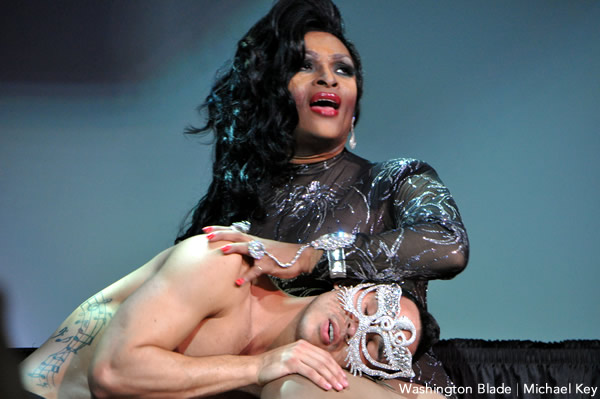
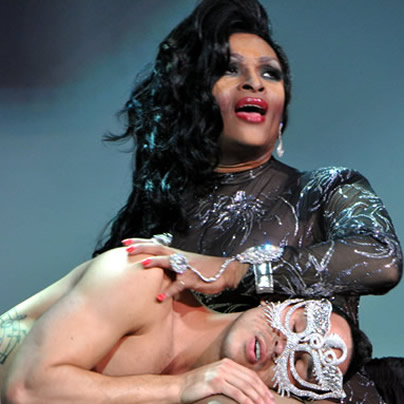
Shi-Queeta Lee, drag, drag queen, gay news, Washington Blade, Howard Theatre, Drag Salute to the Divas

‘Drag Salute to the Divas’ returns to the Howard Sunday night. (Washington Blade file photo by Michael Key)

Friday, May 24

The Muslim Alliance for Sexual and Gender Diversity hosts a retreat for LGBT Muslims and their partners starting today and lasting until Monday. The weekend will include workshops, art, talent show, plenaries, community building, prayer, politics and spirituality. The goal of this retreat is to reconnect with the community while creating a dialogue with one another. Costs for the retreat is $100. For more information, visit lgbtmuslimretreat.com.

“A Prairie Home Companion” with Garrison Keillor will be presenting a live broadcast in the Filene Center at Wolf Trap (1551 Trap Rd.,Vienna) tonight at 8 p.m. and Saturday at 5:45 p.m. Ticket prices for the event ranges from $25-$60. For more information visit walftrap.org.

Mystery Dinner Playhouse (located inside the Courtyard by Marriot Crystal City, 2899 Jefferson Davis Highway, Arlington, Va.) presents its new show “The Spy Who Killed Me” tonight and Saturday at 7:30 p.m. Attendees can enjoy this comedic butler convention murder mystery during a four-course dinner. The show runs until Nov. 24, every Friday and Saturday at 7:30 p.m. The group is also available for private events. Tickets are $53. Visit mysterydinner.com for more information.

Special Agent Galactica returns with her happy hour show at the Black Fox Lounge (1723 Connecticut Ave., NW) with repeat guest Nora Palka, who will be back to share her amazing vocals this evening at 6 p.m. Locals may know Palka from her performance in “Spring Awakening” at Keegan Theatre, “Best Little Whorehouse in Texas” at Signature, and “Pygmalion” at the Washington Stage Guild. Admission is free. For more information, visit pinkhairedone.com.

Town (2009 8th St., N.W.) hosts Bear Happy Hour tonight from 6-11 p.m. This event is for people 21 and older. There is no cover charge. Later, Town hosts DJ Mad Science on the main floor tonight at 10 p.m. The cover is $8 before 11 p.m. and $12. The drag show begins at 10:30 p.m. Visit towndc.com for more information.

Cobalt (1639 R St., NW) hosts its second annual “Mthr Fckn Pop Off!” where people can vote tournament style on the perfect song for summer. Voters can go on the Facebook event page to vote. That night, the club offers free rail vodka from 11 p.m-midnight. Cover is $10. For details, visit cobaltdc.com.

Saturday, May 25

Cobalt (1639 R St., NW) hosts “CTRL: Tank-Tacular Summer Kick-Off” tonight at 10 p.m. Cover is $5. Drink specials include $3 PBR Tallboys, $5 Rail and $4 Jameson shots. Visit cobaltdc.com for more information.

Burgundy Crescent volunteers this morning at Food and Friends (219 Riggs Rd., NE) at 8 a.m. and 9:45 a.m. Volunteers will help with food preparation and packing groceries. The shifts are limited to 10 per shift. For more information, visit burgundycrescent.org.

Sunday, May 26

The D.C. Center needs volunteers with the demolition of the new space today at 10 a.m. at the Reeves Center (2000 14th St., NW). This will be the new permanent home of the Center, but they need help renovating.Volunteers are not required to bring supplies, just appropriate footwear and clothes that can get messy. They are also encouraged to bring water and snacks since there will be no formal lunch break. Visit thedccenter.org for more information.

The Howard Theatre (620 T St., NW) presents “A Drag Salute to the Divas” in honor of D.C. Black Pride tonight at 7 p.m. The show is lead by Shi-Queeta-Lee and several other of D.C.’s top illusionists as they bring Whitney Houston, Beyonce, Missy Elliott and many more to the stage. Tickets are $20. For more information, visit thehowardtheatre.com.

Monday, May 27

The Bachelor’s Mill (1104 8th St., S.E.) hosts its annual Memorial Day Cookout with free food from the grill starting at 5:30 p.m. There will also be a pool, video gaming systems and cards. Karaoke starts at 6 p.m. and goes until 10 p.m. DJ Alchemy begins the party at 10 p.m. For more information, visit bachelorsmill.com.

Whitman-Walker Health (1701 14th St., NW) holds its HIV+ Newly Diagnosed Support Group tonight at 7. It is a confidential support group for anyone recently diagnosed with HIV and the group welcomes all genders and sexual orientations. Registration is required and attendees must call 202-797-3580 or email [email protected]. For details, visit whitman-walker.org.

Tuesday, May 28

Green Lantern (1335 Green Court, N.W.) hosts its Safer Sex Kit-packing program tonight from 7-10:30. The packing program is looking for more volunteers to help produce the kits because they say they are barely keeping up with demand. Admission is free and volunteers can just show up. For more information, visit thedccenter.org.

Wednesday, May 29

The Lambda Bridge Club meets at 7:30 p.m. tonight at the Dignity Center (721 8th St., SE) for Duplicate Bridge. Reservations are not needed and newcomers are welcome. Attendees can call 703-407-6540 if they need a partner. Visit lambdadc.org for more information.

Whitman-Walker Health (1701 14th St., NW) holds its HIV+ Newly Diagnosed Support Group tonight at 7. It is a confidential support group for anyone recently diagnosed with HIV and the group welcomes all genders and sexual orientations. Registration is required and attendees must call 202-797-3580 or email [email protected]. For details, visit whitman-walker.org.

Thursday, May 30

Rainbow Response Coalition kicks off its fundraiser for the D.C. Capital Pride season this evening at Annie’s Paramount Steakhouse (1609 17th St., NW). The organization is committed to raise awareness and provide education on intimate partner violence in the LGBT community and hopes to broaden its network of dedicated members. Annie’s has offered to donate a portion of the proceeds for the night. For more information, visit thedccenter.org.

The D.C. Center’s newest initiative, Center Global, a frank discussion on the challenges facing LGBT asylum seekers, takes place tonight at 7 p.m. Asylees, current asylum seekers and legal experts will talk about the difficult process LGBT asylum seekers face. The location is to be announced. Visit thedccenter.org for more information.

Advertisement
FUND LGBTQ JOURNALISM
SIGN UP FOR E-BLAST

Books

‘The Director’ highlights film director who collaborated with Hitler

But new book omits gay characters, themes from Weimar era

Published

on

(Book cover image courtesy Amazon)

‘The Director’
By Daniel Kehlmann
Summit Books, 2025

Garbo to Goebbels, Daniel Kehlmann’s historical novel “The Director” is the story of Austrian film director G.W. Pabst (1885-1967) and his descent down a crooked staircase of ambition into collaboration with Adolph Hitler’s film industry and its Minister of Propaganda Joseph Goebbels. Kehlmann’s historical fiction is rooted in the world of Weimar German filmmaking and Nazi “Aryan” cinema, but it is a searing story for our challenging time as well.

Pabst was a legendary silent film director from the Weimar Republic’s Golden Era of filmmaking. He “discovered” Greta Garbo; directed silent screen star Louise Brooks; worked with Hitler’s favored director Leni Riefenstahl (“Triumph of the Will”); was a close friend of Fritz Lang (“Metropolis”); and lived in Hollywood among the refugee German film community, poolside with Billy Wilder (“Some Like it Hot”) and Fred Zinnemann (“High Noon”) — both of whose families perished in the Holocaust. 

Yet, Pabst left the safety of a life and career in Los Angeles and returned to Nazi Germany in pursuit of his former glory. He felt the studios were giving him terrible scripts and not permitting him to cast his films as he wished. Then he received a signal that he would be welcome in Nazi Germany. He was not Jewish.

Kehlmann, whose father at age 17 was sent to a concentration camp and survived, takes the reader inside each station of Pabst’s passage from Hollywood frustration to moral ruin, making the incremental compromises that collectively land him in the hellish Berlin office of Joseph Goebbels. In an unforgettably phantasmagoric scene, Goebbels triples the stakes with the aging filmmaker, “Consider what I can offer you….a concentration camp. At any time. No problem,” he says. “Or what else…anything you want. Any budget, any actor. Any film you want to make.” Startled, paralyzed and seduced by the horror of such an offer, Pabst accepts not with a signature but a salute: “Heil Hitler,” rises Pabst.  He’s in.

The novel develops the disgusting world of compromise and collaboration when Pabst is called in to co-direct a schlock feature with Hitler’s cinematic soulmate Riefenstahl. Riefenstahl, the “Directress” is making a film based on the Fuhrer’s favorite opera. She is beautiful, electric and beyond weird playing a Spanish dancer who mesmerizes the rustic Austrian locals with her exotic moves. The problem is scores of extras will be needed to surround and desire Fraulein Riefenstahl. Mysteriously, the “extras” arrive surprising Pabst who wonders where she had gotten so many young men when almost everyone was on the front fighting the war. The extras were trucked in from Salzburg, he is told, “Maxglan to be precise.” He pretends not to hear.  Maxglan was a forced labor camp for “racially inferior” Sinti and Roma gypsies, who will later be deported from Austria and exterminated. Pabst does not ask questions. All he wants is their faces, tight black and white shots of their manly, authentic, and hungry features. “You see everything you don’t have,” he exhorts the doomed prisoners to emote for his camera. Great art, he believes, is worth the temporal compromises and enticements that Kehlmann artfully dangles in the director’s face.  And it gets worse.

One collaborates in this world with cynicism born of helpless futility. In Hollywood, Pabst was desperate to develop his own pictures and lure the star who could bless his script, one of the thousands that come their way.  Such was Greta Garbo, “the most beautiful woman in the world” she was called after being filmed by Pabst in the 1920s. He shot her close-ups in slow motion to make her look even more gorgeous and ethereal. Garbo loved Pabst and owed him much, but Kehlmann writes, “Excessive beauty was hard to bear, it burned something in the people around it, it was like a curse.” 

Garbo imagined what it would be like to be “a God or archangel and constantly feel the prayers rising from the depths. There were so many, there was nothing to do but ignore them all.”  Fred Zinnemann, later to direct “High Noon”, explains to his poolside guest, “Life here (in Hollywood) is very good if you learn the game.  We escaped hell, we ought to be rejoicing all day long, but instead we feel sorry for ourselves because we have to make westerns even though we are allergic to horses.”

The texture of history in the novel is rich. So, it was disappointing and puzzling there was not an original gay character, a “degenerate” according to Nazi propaganda, portrayed in Pabst’s theater or filmmaking circles. From Hollywood to Berlin to Vienna, it would have been easy to bring a sexual minority to life on the set. Sexual minorities and gender ambiguity were widely presented in Weimar films. Indeed, in one of Pabst’s films “Pandora’s Box” starring Louise Brooks there was a lesbian subplot. In 1933, when thousands of books written by, and about homosexuals, were looted and thrown onto a Berlin bonfire, Goebbels proclaimed, “No to decadence and moral corruption!” The Pabst era has been de-gayed in “The Director.”

“He had to make films,” Kehlmann cuts to the chase with G.W. Pabst. “There was nothing else he wanted, nothing more important.” Pabst’s long road of compromise, collaboration and moral ruin was traveled in small steps. In a recent interview Kehlmann says the lesson is to “not compromise early when you still have the opportunity to say ‘no.’” Pabst, the director, believed his art would save him. This novel does that in a dark way.

(Charles Francis is President of the Mattachine Society of Washington, D.C., and author of “Archive Activism: Memoir of a ‘Uniquely Nasty’ Journey.”)

The Blade may receive commissions from qualifying purchases made via this post.

Continue Reading

Theater

Swing actor Thomas Netter covers five principal parts in ‘Clue’

Unique role in National Theatre production requires lots of memorization

Published

on

Thomas Netter stars in ‘Clue.’

‘Clue: On Stage’
Jan. 27-Feb. 1
The National Theatre
1321 Pennsylvania Ave., N.W.
thenationaldc.com

Out actor Thomas Netter has been touring with “Clue” since it opened in Rochester, New York, in late October, and he’s soon settling into a week-long run at D.C.’s National Theatre.

Adapted by Sandy Rustin from the same-titled 1985 campy cult film, which in turn took its inspiration from the popular board game, “Clue” brings all the murder mystery mayhem to stage. 

It’s 1954, the height of the Red Scare, and a half dozen shady characters are summoned to an isolated mansion by a blackmailer named Mr. Boddy where things go awry fairly fast. A fast-moving homage to the drawing room whodunit genre with lots of wordplay, slapstick, and farce, “Clue” gives the comedic actors a lot to do and the audience much to laugh at.  

When Netter tells friends that he’s touring in “Clue,” they inevitably ask “Who are you playing and when can we see you in it?” His reply isn’t straightforward. 

The New York-based actor explains, “In this production, I’m a swing. I never know who’ll I play or when I’ll go on. Almost at any time I can be called on to play a different part. I cover five roles, almost all of the men in the show.”

Unlike an understudy who typically learns one principal or supporting role and performs in the ensemble nightly, a swing learns any number of parts and waits quietly offstage throughout every performance just in case. 

With 80 minutes of uninterrupted quick, clipped talk “Clue” can be tough for a swing. Still, Netter, 28, adds, “I’m loving it, and I’m working with a great cast. There’s no sort of “All About Eve” dynamic going on here.” 

WASHINGTON BLADE: Learning multiple tracks has got to be terrifying. 

THOMAS NETTER: Well, there certainly was a learning curve for me. I’ve understudied roles in musicals but I’ve never covered five principal parts in a play, and the sheer amount of memorization was daunting.

As soon as I got the script, I started learning lines character by character. I transformed my living room into the mansion’s study and hallway, and got on my feet as much as I could and began to get the parts into my body.

BLADE: During the tour, have you been called on to perform much?

NETTER: Luckily, everyone has been healthy. But I was called on in Pittsburgh where I did Wadsworth, the butler, and the following day did the cop speaking to the character that I was playing the day before. 

BLADE: Do you dread getting that call?

NETTER: Can’t say I dread it, but there is that little bit of stage fright involved. Coming in, my goal was to know the tracks. After I’d done my homework and released myself from nervous energy, I could go out and perform and have fun. After all, I love to act.

“Clue” is an opportunity for me to live in the heads of five totally different archetype characters. As an actor that part is very exciting.  In this comedy, depending on the part, some nights it’s kill and other nights be killed. 

BLADE: Aside from the occasional nerves, would you swing again?

NETTER: Oh yeah, I feel I’m living out the dream of the little gay boy I once was. Traveling around getting a beat on different communities. If there’s a gay bar, I’m stopping by and  meeting interesting and cool people. 

BLADE: Speaking of that little gay boy, what drew him to theater?

NETTER: Grandma and mom were big movie musical fans, show likes “Singing in the Rain,” “Meet Me in St. Louis.” I have memories of my grandma dancing me around the house to “Shall We Dance?” from the “King and I” She put me in tap class at age four. 

BLADE: What are your career highlights to date? 

NETTER: Studying the Meisner techniqueat New York’sNeighborhood Playhouse for two years was definitely a highlight. Favorite parts would include the D’Ysquith family [all eight murder victims] in “A Gentleman’s Guide to Love & Murder,” and the monstrous Miss Trunchbull in “Matilda.” 

BLADE: And looking forward?

NETTER: I’d really like the chance to play Finch or Frump in Frank Loesser’s musical comedy “How to Succeed in Business Without Really Trying.”

BLADE: In the meantime, you can find Netter backstage at the National waiting to hear those exhilarating words “You’re on!”

Continue Reading

Movies

A ‘Battle’ we can’t avoid

Critical darling is part action thriller, part political allegory, part satire

Published

on

Leonardo DiCaprio stars in ‘One Battle After Another.’ (Photo courtesy of Warner Bros.)

When Paul Thomas Anderson’s “One Battle After Another” debuted on American movie screens last September, it had a lot of things going for it: an acclaimed Hollywood auteur working with a cast that included three Oscar-winning actors, on an ambitious blockbuster with his biggest budget to date, and a $70 million advertising campaign to draw in the crowds. It was even released in IMAX. 

It was still a box office disappointment, failing to achieve its “break-even” threshold before making the jump from big screen to small via VOD rentals and streaming on HBO Max. Whatever the reason – an ambivalence toward its stars, a lack of clarity around what it was about, divisive pushback from both progressive and conservative camps over perceived messaging, or a general sense of fatigue over real-world events that had pushed potential moviegoers to their saturation point for politically charged material – audiences failed to show up for it. 

The story did not end there, of course; most critics, unconcerned with box office receipts, embraced Anderson’s grand-scale opus, and it’s now a top contender in this year’s awards race, already securing top prizes at the Golden Globe and Critics’ Choice Awards, nominated for a record number of SAG’s Actor Awards, and almost certain to be a front runner in multiple categories at the Academy Awards on March 15.

For cinema buffs who care about such things, that means the time has come: get over all those misgivings and hesitations, whatever reasons might be behind them, and see for yourself why it’s at the top of so many “Best Of” lists.

Adapted by Anderson from the 1990 Thomas Pynchon novel “Vineland,” “One Battle” is part action thriller, part political allegory, part jet-black satire, and – as the first feature film shot primarily in the “VistaVision” format since the early 1960s – all gloriously cinematic. It unspools a near-mythic saga of oppression, resistance, and family bonds, set in an authoritarian America of unspecified date, in which a former revolutionary (Leonardo DiCaprio) is attempting to raise his teenage daughter (Chase Infiniti) under the radar after her mother (Teyana Taylor) betrayed the movement and fled the country. Now living under a fake identity and consumed by paranoia and a weed habit, he has grown soft and unprepared when a corrupt military officer (Sean Penn) – who may be his daughter’s real biological father – tracks them down and apprehends her. Determined to rescue her, he reconnects with his old revolutionary network and enlists the aid of her karate teacher (Benicio Del Toro), embarking on a desperate rescue mission while her captor plots to erase all traces of his former “indiscretion” with her mother.

It’s a plot straight out of a mainstream action melodrama, top-heavy with opportunities for old-school action, sensationalistic violence, and epic car chases (all of which it delivers), but in the hands of Anderson – whose sensibilities always strike a provocative balance between introspection, nostalgia, and a sense of apt-but-irreverent destiny – it becomes much more intriguing than the generic tropes with which he invokes to cover his own absurdist leanings.

Indeed, it’s that absurdity which infuses “One Battle” with a bemusedly observational tone and emerges to distinguish it from the “action movie” format it uses to relay its narrative. From DiCaprio (whose performance highlights his subtle comedic gifts as much as his “serious” acting chops) as a bathrobe-clad underdog hero with shades of The Dude from the Coen Brothers’ “The Big Liebowski,” to the uncomfortably hilarious creepy secret society of financially elite white supremacists that lurks in the margins of the action, Anderson gives us plenty of satirical fodder to chuckle about, even if we cringe as we do it; like that masterpiece of too-close-to-home political comedy, Stanley Kubrick’s 1964 nuclear holocaust farce “Dr. Strangelove,” it offers us ridiculousness and buffoonery which rings so perfectly true in a terrifying reality that we can’t really laugh at it.

That, perhaps, is why Anderson’s film has had a hard time drawing viewers; though it’s based on a book from nearly four decades ago and it was conceived, written, and created well before our current political reality, the world it creates hits a little too close to home. It imagines a roughly contemporary America ruled by a draconian regime, where immigration enforcement, police, and the military all seem wrapped into one oppressive force, and where unapologetic racism dictates an entire ideology that works in the shadows to impose its twisted values on the world. When it was conceived and written, it must have felt like an exaggeration; now, watching the final product in 2026, it feels almost like an inevitability. Let’s face it, none of us wants to accept the reality of fascism imposing itself on our daily lives; a movie that forces us to confront it is, unfortunately, bound to feel like a downer. We get enough “doomscrolling” on social media; we can’t be faulted for not wanting more of it when we sit down to watch a movie.

In truth, however, “One Battle” is anything but a downer. Full of comedic flourish, it maintains a rigorous distance that makes it impossible to make snap judgments about its characters, and that makes all the difference – especially with characters like DiCaprio’s protective dad, whose behavior sometimes feels toxic from a certain point of view. And though it’s a movie which has no qualms about showing us terrifying things we would rather not see, it somehow comes off better in the end than it might have done by making everything feel safe.

“Safe” is something we are never allowed to feel in Anderson’s outlandish action adventure, even at an intellectual level; even if we can laugh at some of its over-the-top flourishes or find emotional (or ideological) satisfaction in the way things ultimately play out, we can’t walk away from it without feeling the dread that comes from recognizing the ugly truths behind its satirical absurdities. In the end, it’s all too real, too familiar, too dire for us not to be unsettled. After all, it’s only a movie, but the things it shows us are not far removed from the world outside our doors. Indeed, they’re getting closer every day.

Visually masterful, superbly performed, and flawlessly delivered by a cinematic master, it’s a movie that, like it or not, confronts us with the discomforting reality we face, and there’s nobody to save it from us but ourselves.

Continue Reading

Popular