World
Colombia LGBT activist discusses challenges
Caribe Afirmativo Director Wilson Castañeda Castro attended Bogotá training
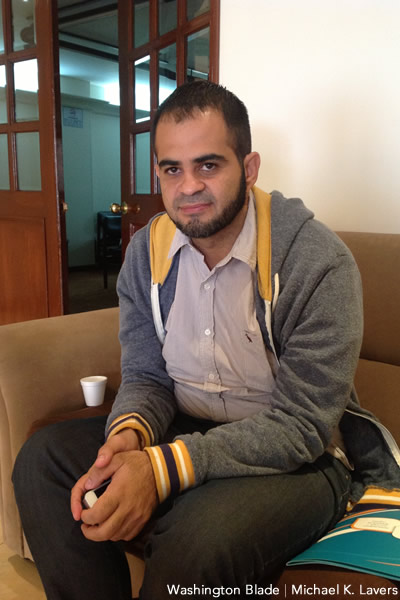
Wilson Castañeda Castro of the Colombian LBGT advocacy group Caribe Afirmativo. (Washington Blade photo by Michael K. Lavers)
“The Caribbean is a region of a high cultural diversity,” Caribe Afirmativo Director Wilson Castañeda Castro said during the USAID-backed Gay and Lesbian Victory Institute and Astraea Lesbian Foundation for Justice training that he and roughly 30 other activists from across the country are attending in the Colombian capital of Bogotá. “You find a very pluralistic cultural dynamic, but it goes against the recognition of sexual diversity.”
Friends of a gay activist of Cuban descent who was murdered in Cartagena in 2007 founded Caribe Afirmativo after his death.
The organization that also works in the cities of Barranquilla, Valledupar, Urabá, Sincelejo and Montería documents the impact that violence and the armed conflict that began in Colombia in the 1960s has had on the region’s LGBT population. It also seeks to educate the public about sexual minorities, organize LGBT people and highlight homophobic and transphobic politicians.
“The governments in these areas are very homophobic governments,” Castañeda said. “This agenda seeks commitments from them with respect to the LGBT community.”
He said his group continues to confront the sexual exploitation of young gay men of Afro-Caribbean descent due to increased tourism in Cartagena and Santa Marta. Caribe Afirmativo also works with many transgender women who have been displaced because of violence and those who have been threatened because they are open about their sexual orientation and gender identity and expression.
“It is a region full of challenges,” he said.
Castañeda further noted he feels the centralized Colombian government does not understand “this is a dynamic country made up of many regions.” He added life for LGBT people who live outside Bogotá remains difficult because of a lack of support from local officials and a lack of community engagement and visibility.
“We have not found a government that will help us address these goals,” Castañeda said.
Castañeda criticizes government for remaining silent on LGBT issues
The country’s highest court in 2011 ruled same-sex couples can legally register their relationships in two years if Colombian lawmakers don’t pass a bill that would extend to them the same benefits heterosexuals receive through marriage. The tribunal’s deadline is June 20, but the Colombian Senate last month overwhelmingly rejected a measure that would have allowed gays and lesbians to tie the knot.
Colombian lawmakers in 2011 passed a new anti-discrimination law that includes sexual orientation.
Colombia is also among the countries that helped secure passage of the United States’ first-ever resolution in support of LGBT rights in the same year.
Castañeda acknowledged to the Blade that LGBT-specific advances have taken place over the last four years. He also criticized President Juan Manuel Santos’ government for remaining silent on same-sex marriage, anti-LGBT violence and other issues.
“It is inconsistent that the government wanted to remain silent when we are talking about the vulnerability of rights,” Castañeda said.
Castañeda, who visited D.C. and two other U.S. cities in April with a group of other Colombian LGBT rights advocates on a State Department-sponsored trip, noted the strong ties between the two countries. He added he and other advocates can continue to learn from LGBT rights advocates in the United States.
“In Colombia the LGBT community remains one of the most marginalized communities,” he said. “The U.S. visit allowed us to see first-hand experiences, situations, specific examples of people and institutions and organizations. We can take some of what we experienced [there] and apply it here in Colombia.”


United Nations
UN human rights chief sounds alarm over ‘comprehensive onslaught’ against LGBTQ rights
Volker Türk on Monday spoke at UN LGBTI Core Group event
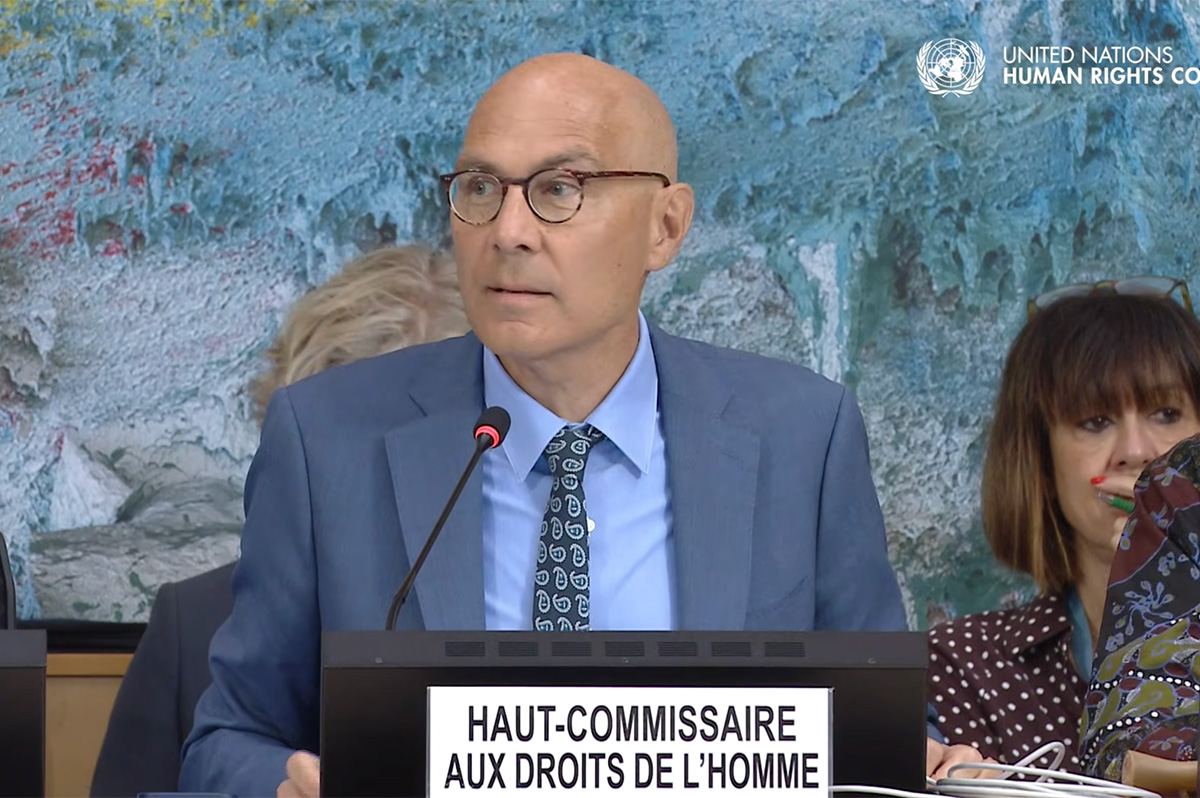
UNITED NATIONS — U.N. High Commissioner for Human Rights Volker Türk on Monday said there is a “comprehensive onslaught” against LGBTQ and intersex rights around the world.
“We know that progress for human rights has never been linear … but today’s backlash is deep and it is coordinated and the persecution of LGBTIQ+ people around the world is escalating at an alarming rate,” he said during an U.N. LGBTI Core Group event that took place on the sidelines of the U.N. General Assembly.
The Core Group is a group of U.N. member states that have pledged to support LGBTQ and intersex rights.
Mexico and Norway are the current co-chairs. The U.S. withdrew from the Core Group shortly after the Trump-Vance administration took office in 2025.
“We know that across every region, LGBTIQ+ people continue to live and to love in the face of hostility and exclusion,” said Türk. “Their rights, safety, well-being are under attack … it’s a comprehensive onslaught.”
The event took place days after Turkish authorities carried out raids in Istanbul and in other cities across the country that targeted the country’s LGBTQ community.
Türk in his remarks specifically referenced Turkey and Senegal, which further criminalized consensual same-sex sexual relations earlier this year. He also noted some countries have deemed LGBTQ and intersex rights groups as “terrorists, extremists, or national security threats.”
The Trump-Vance administration’s anti-terrorism strategy that it released in May specifically references “radically pro-transgender” groups.
Türk noted “more and more candidates and political parties … use bigotry in order to promote anti-LGBTIQ+ sentiments” during election campaigns. He pointed out trans people and women are often targeted.
“These attacks are designed to confuse and to distract,” said Türk. “They cloak bigotry in the language of decency and morality. They evoke the protection of children against manufactured threats, while real and growing dangers to children’s lives and futures, including those linked to technology, to inequality and to the climate disaster remain unaddressed.”
“More broadly those who seek to erase difference and independent thought, expression, and voices from our societies often begin this by erasing LGBTIQ+ people from books and classrooms, from film and culture and from our streets,” he added. “So, this is always the beginning. It’s a wedge issue that unfortunately is used politically to erase other portions of society eventually.”
90 percent of LGBTQ, intersex groups have lost funding since 2025
The event took place less than two weeks after Outright International released a report that found 90 percent of LGBTQ and intersex rights groups around the world have lost funding since January 2025.
The Trump-Vance administration froze nearly all U.S. foreign aid shortly after it took office.
Secretary of State Marco Rubio in March 2025 announced 83 percent of U.S. Agency for International Development contacts had been cancelled, and the State Department would administer the remaining programs. USAID officially shut down on July 1, 2025.
Rubio issued a waiver that allowed PEPFAR and other “life-saving humanitarian assistance” programs to continue to operate during the funding freeze. The Washington Blade has previously reported PEPFAR-funded programs in Kenya and other African countries have been forced to suspend services and even shut down because of gaps in U.S. funding.
Dutch Foreign Trade and Development Cooperation Minister Sjoerd Sjoerdsma in his remarks at the Core Group event noted his government — openly gay Prime Minister Rob Jetten took office in February — will pledge €50 million ($57.29 million) to support LGBTQ groups around the world. British Under Secretary of State Chris Elmore pointed out his government has pledged £21 million ($28.05) from 2026-2029 to bolster LGBTQ and intersex rights around the world.
“Equality benefits everyone,” said Elmore.
Mexican Foreign Affairs Secretary Roberto Velasco Álvarez, Norwegian International Development Minister Åsmund Aukrust, Icelandic Foreign Affairs Minister Þorgerður Katrín Gunnarsdóttir, Maltese Foreign and European Affairs Minister Chris Fearne, Brazil’s National Secretary for the Promotion and Defense of the Rights of LGBTQIA+ People Symmy Larrat, Irish State Minister for International Development and Diaspora Neale Richmond, South African Department of International Relations and Cooperation Director-General Zane Dangor, Uruguayan Multilateral Affairs Director María Noel Beretta, French Ambassador-at-Large for Human Rights Isabelle Rome, Cabo Verdean Permanent U.N. Representative Tania Romualdo, Estonian Department of International Organizations and Human Rights Director General Käthlin Saluveer, and Swedish International Development Cooperation Director-General Camilla Nevstad Bruzelius also spoke at the event that Outright International Executive Director Maria Sjödin moderated.
Other speakers included Jon Tilli of Deutsche Bank, UN Women Civil Society Division Director Lopa Banerjee and two activists: Gloria Quaye of Ghana and Nhuun Wannapong Yodmuang of Thailand.
Quaye was among the 21 people who Ghanaian authorities arrested in 2021 during a human rights workshop for LGBTQ activists. She was detained for three weeks until a court dropped the charges.
“In times of adversity, countries can often be tempted to turn inward at precisely the moment when international cooperation is needed the most,” said Sjödin. “The United Nations, of course, brings together sovereign states, but sovereignty cannot be used to decide whose rights count.”
Then-first lady Jill Biden in 2024 spoke at a Core Group event that took place on the sidelines of that year’s U.N. General Assembly. Then-Vice President Joe Biden in 2016 headlined the Core Group event that coincided with that year’s U.N. General Assembly.
The U.S. did not send any representatives to this year’s event.
Jessica Stern, the former special U.S. envoy for the promotion of LGBTQ and intersex rights under the Biden-Harris administration, and former U.S. Ambassador to Bosnia and Herzegovina Eric Nelson were among those from the U.S. who attended.
“The movement for the equal rights of LGBTIQ+ people has much to teach the world, particularly at this moment, but some seek to erase or reject those lessons,” said Türk. “The history of the movement for the equal rights is full of courage, dignity, and solidarity and it is an integral part of the human rights movement.”
“It’s not something separate; it’s an integral part of the full human rights movement,” he added. “In claiming their freedom, the LGBTIQ+ communities helped free our societies. We need to see it as a broader strive for freedom.”
Turkey
Activists protest outside Turkish Embassy in D.C.
Dozens detained during anti-LGBTQ ‘My Family Is Safe’ campaign raids
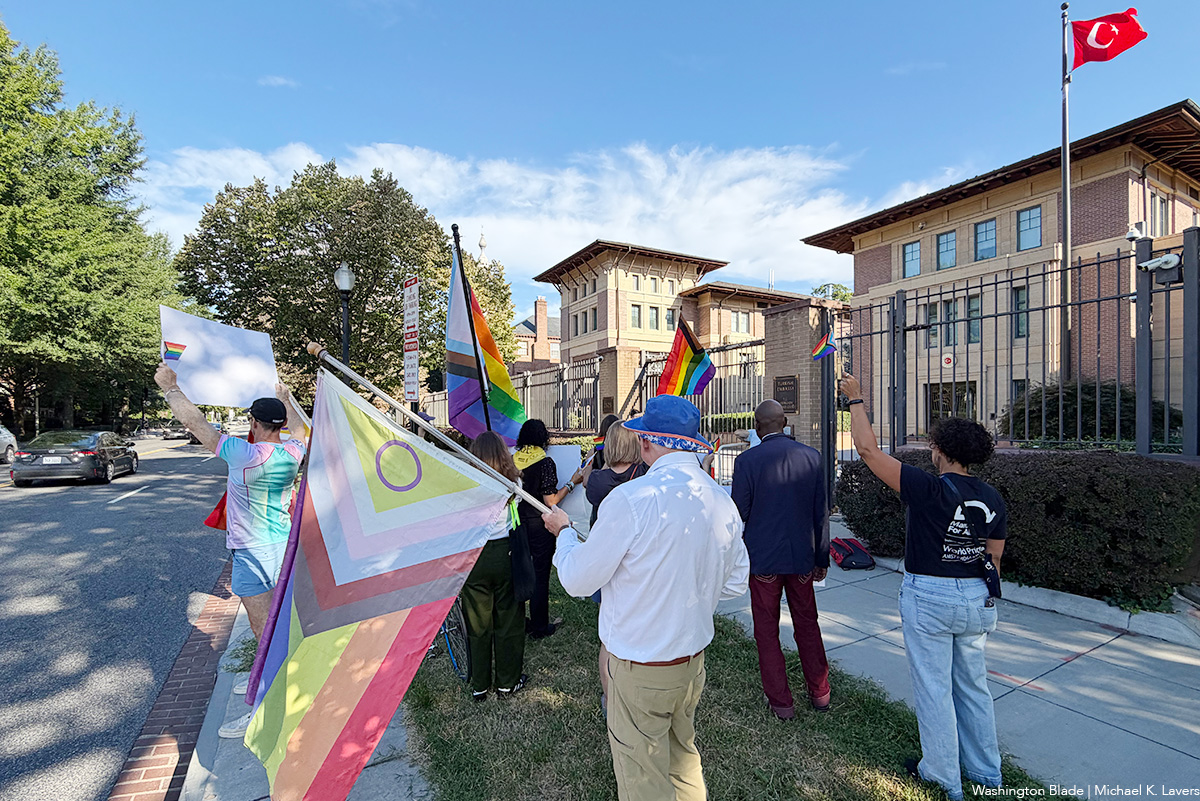
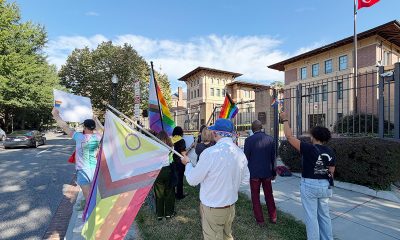
A group of activists on Friday gathered in front of the Turkish Embassy in D.C. to protest the country’s anti-LGBTQ crackdown.
The protest — which the Council for Global Equality, Amnesty International USA, Outright International, and Health GAP organized — took place less than a week after Turkish authorities detained dozens of people during raids that targeted the country’s LGBTQ community and advocacy groups and HIV/AIDS service organizations.
Authorities in Istanbul on Sept. 15 detained more than 150 people who gathered outside a courthouse to protest the raids that are part of the government’s “My Family Is Safe” campaign. Journalists are among those who were taken into custody.
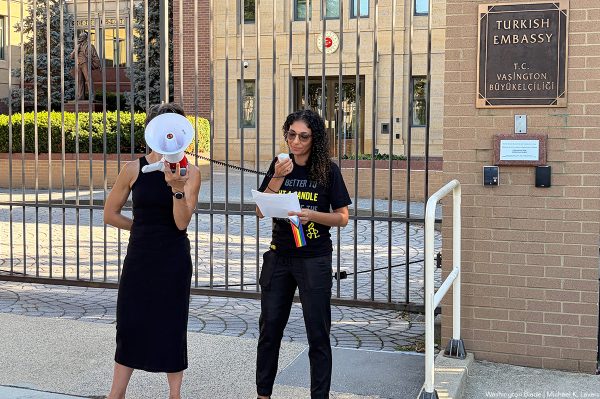
“This crackdown is not making families safer,” said Amnesty International USA Executive Director Nadia Daar, speaking in front of the Turkish Embassy.
Council for Global Equality Managing Director Keifer Buckingham stressed that “homosexuality is not a crime in Turkey.” Health GAP Executive Director Asia Russell and Outright International Senior Director of Law, Policy, and Research Neela Ghoshal also spoke.
View on Threads
Activists in Madrid and in other cities around the world held similar protests on Friday.
Turkey
More than 150 people detained outside Istanbul courthouse
Protesters gathered after raids targeted Turkey’s LGBTQ community
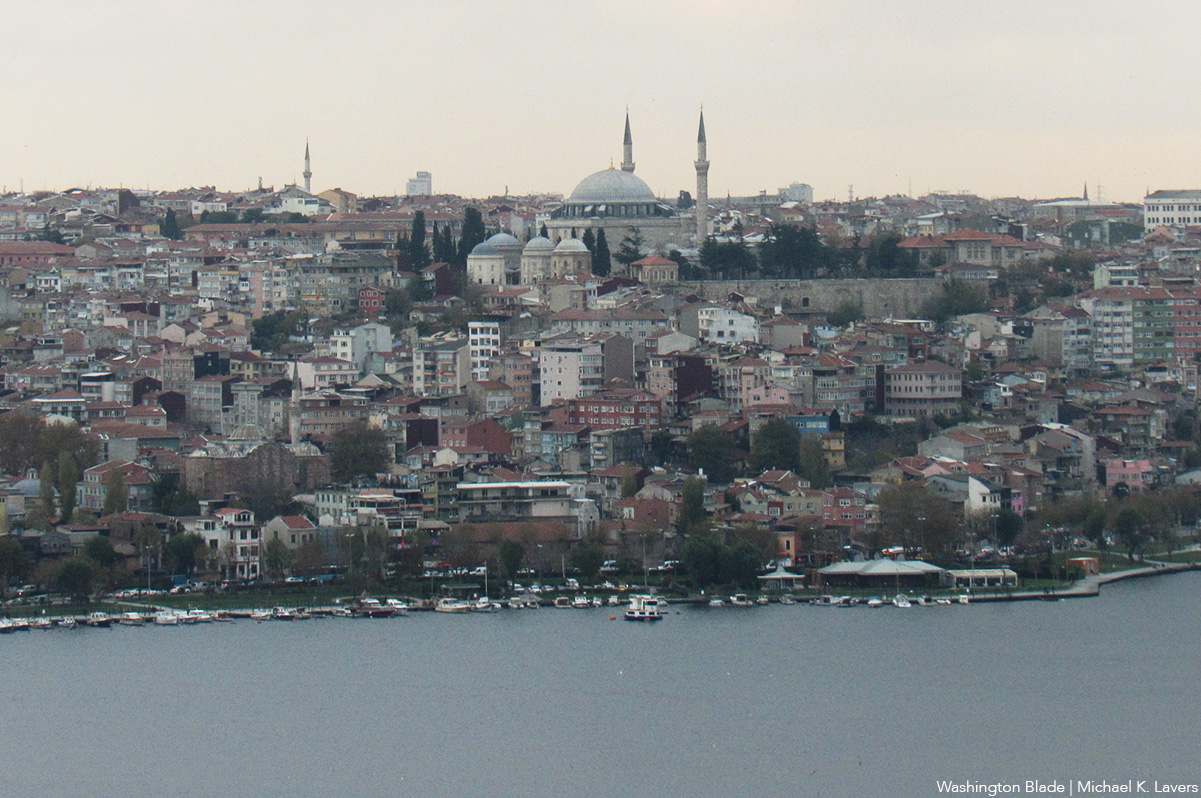
Turkish authorities on Tuesday detained more than 150 people who gathered outside an Istanbul courthouse to protest raids that targeted the country’s LGBTQ community.
CNN reported the protesters had planned to speak with reporters outside the city’s Caglayan courthouse, but authorities prevented them from doing so.
Turkish authorities over the weekend detained dozens of people in Istanbul and in other cities during raids that were part of the government’s “My Family is Safe” campaign.
A statement from a group of Turkish advocacy groups the Washington Blade received on Tuesday notes “at least 112 people have been detained in connection with the operations.” The organizations said 43 of those taken into custody are “LGBTI+ rights defenders,” and “at least” 62 of those detained “have been arrested, while judicial proceedings remain ongoing in Istanbul.”
“Among those arrested, at least 16 are LGBTI+ activists or individuals connected to LGBTI+ associations, including founders and members of association bodies,” reads the statement. “Per press statements by the prosecutor’s offices, dissolution cases will also be launched against associations.”
“The majority of those arrested are trans women who are charged with prostitution-related offences,” it adds. “While authorities have framed the operations as part of investigations into alleged crimes such as obscenity, prostitution and child exploitation, human rights defenders and civil society organizations have raised serious concerns regarding the use of criminal law mechanisms and public morality narratives to target legitimate LGBTI+ rights activities. Civil society views the ‘My Family is Safe’ narrative as a smokescreen to distract the public from deep economic crises and actual domestic violence, weaponizing moral panic to scapegoat LGBTI+ rights defenders, who have long been targeted by the government.”
The raids have sparked outrage among LGBTQ activists in Europe and elsewhere around the world.
The Congressional Equality Caucus and U.S. Rep. Carlos Giménez (R-Fla.) are among those who have publicly condemned them in the U.S. The Council for Global Equality on Friday is scheduled to hold a rally in support of Turkey’s LGBTQ community in front of the Turkish Embassy in Northwest D.C.

United States Conference on HIV/AIDS grapples with federal budget cuts

For lesbian victims of domestic violence, competent care is scare

UN human rights chief sounds alarm over ‘comprehensive onslaught’ against LGBTQ rights

White House press pool pushes back after Trump bars three outlets

PHOTOS: Shenandoah Valley Pride

Queer mega stars coming to D.C. this fall

Activists protest outside Turkish Embassy in D.C.

Republican challenger misgenders McBride during forum, forced to leave

A roundup of fall events not to be missed