News
Supreme Court stays Utah same-sex marriages
Justices put an end to same-sex marriages in Beehive State as litigation continues
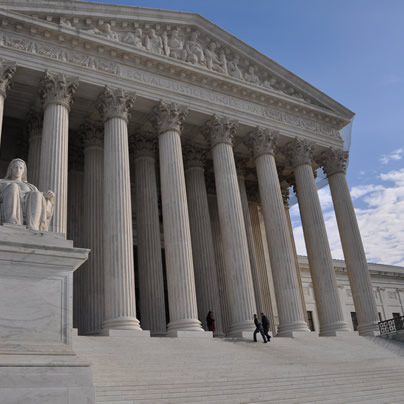
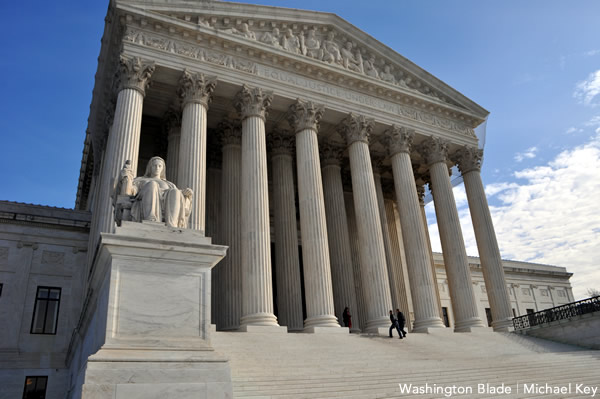
The U.S. Supreme Court has denied a stay on Utah same-sex marriages (Washington Blade file photo by Michael Key).
The U.S. Supreme Court approved on Monday a stay request on same-sex marriages in Utah, prohibiting gay couples from continuing to wed in the Beehive State as litigation proceeds throughout the courts.
According to the court order, justices ruled to grant the application of stay filed last week by attorneys for Utah Gov. Gary Herbert and Attorney General Sean Reyes in the case of Kitchen v. Reyes.
“The permanent injunction issued by the United States District Court for the District of Utah, case No. 2:13-cv-217, on December 20, 2013, is stayed pending final disposition of the appeal by the United States Court of Appeals for the Tenth Circuit,” the order states.
The vote of the full court indicates U.S. Associate Justice Sonia Sotomayor, who’s response for stay requests in the Tenth Circuit, referred the matter to the entire to the entire court instead of deciding the issue for herself. How each justice voted on the matter isn’t disclosed, but at least five justices must have voted in the affirmative to grant a stay.
The district court that ruled in favor of marriage equality in Utah on Dec. 20 and the U.S. Tenth Circuit Court of Appeals had already denied stay requests from Utah. But as the highest court in the country, the U.S. Supreme Court has the final word on the stay, so same-sex couples have no further recourse in the matter.
State officials asked the Supreme Court to halt the same-sex marriage in Utah on the basis their continuation would cause financial harm to the state and the couples themselves if their unions were deemed invalid at at a later time. Private attorney Monte Stewart, a Utah-based lawyer and known opponent of same-sex marriage, had signed on to the brief as counsel of record.
Although the Supreme Court has granted the stay request, the litigation that brought marriage equality to Utah hasn’t been resolved and is pending before the Tenth Circuit.
The appellate court has agreed to take up the issue on an expedited basis. State officials’ opening brief must be filed by Jan. 27. The response from attorneys for gay couples is due Feb. 18, and state officials have a chance to respond to that filing by Feb. 25.
James Magleby, one of the attorneys at Magleby & Greenwood PC representing the three plaintiff couples in the lawsuit, said the decision by the Supreme Court was “obviously disappointing,” but predicted in the end the Tenth Circuit would bring justice to same-sex couples seeking to marry.
“This temporary stay has no bearing on who will win on appeal,” Magleby said. “We look forward to defending Judge Shelby’s decision in the Tenth Circuit. We were confident when we filed the case in 2013, we were confident when we presented the arguments to the district court, and we remain equally – if not more – confident about our defense of marriage equality before the Tenth Circuit.”
LGBT advocates also expressed disappointment with the decision by the Supreme Court, but said they believe it would be only temporary.
Chad Griffin, president of the Human Rights Campaign, said in a statement the stay in Utah same-sex marriages is “disappointing,” but predicted marriage equality would prevail in the end.
“We still live in two Americans where full equality is within reach in one, and another where even basic protections are non-existent,” Griffin said. “As the marriage equality map expands, history is on our side and we will not rest until where you live is not a barrier to living your dreams.”
John Mejia, legal director of the American Civil Liberties Union of Utah, said in a statement Utah should continue to recognize same-sex marriages already performed in the state as valid.
“The huge response that we have seen since the federal court’s ruling shows how important the freedom to marry is in the state of Utah,” Mejia said. “Though future marriages are on hold for now, the state should recognize as valid those marriages that have already been issued, and those couples should continue to be treated as married by the federal government.”
But at least one advocate against same-sex marriage was happy with the decision.
Brian Brown, president of the anti-gay National Organization for Marriage, praised the Supreme Court as he took a swipe at U.S. District Judge Robert Shelby for issuing the ruling in the first place.
“The actions of this activist judge are an affront to the rule of law and the sovereign rights of the people of Utah to define marriage,” Brown said. “Shelby has attempted to twist what the Supreme Court ruled in the Windsor decision – that states have the right to define marriage – and turn it into the exact opposite conclusion. It’s gratifying that the US Supreme Court has decided to stop this nonsense and allow the state of Utah the time to reverse it on appeal.”



Brazil
Lula, Flávio Bolsonaro to face off in second round of Brazilian presidential election
Neither man received at least 50 percent of the vote on Sunday
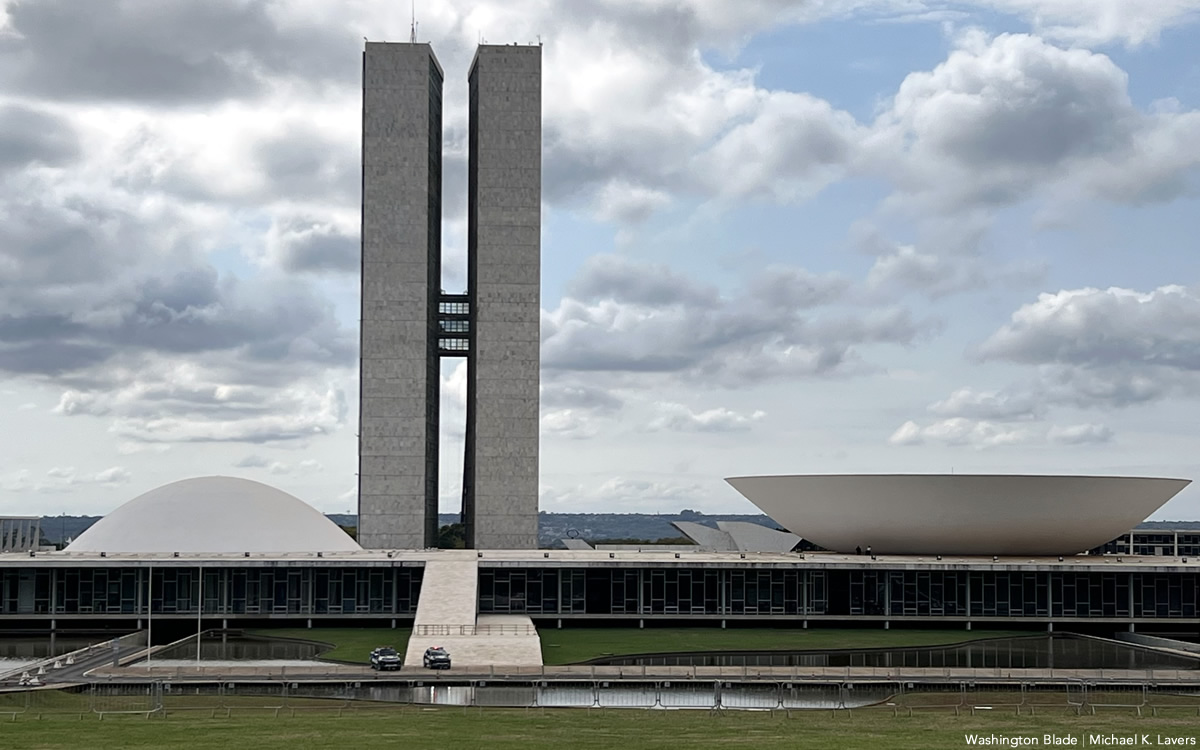
SÃO PAULO — President Luiz Inácio Lula da Silva will face off against Sen. Flávio Bolsonaro in the second round of Brazil’s presidential election on Oct. 25 after neither man received more than 50 percent of the vote on Sunday.
Bolsonaro was ahead of Lula by a 47.50-44.61 margin with 96.78 percent of the vote counted.
Lula in 2022 defeated Bolsonaro’s father, then-President Jair Bolsonaro, in that year’s presidential election.
The Brazilian Supreme Court last year sentenced Bolsonaro — who repeatedly targeted LGBTQ Brazilians and other groups while in office — to more than 27 years in prison for his role in an attempted coup that saw thousands of his supporters storm the Congress, presidential palace, and the Supreme Court itself on Jan. 8, 2023. Bolsonaro is currently serving his sentence at his home in Brasília, the country’s capital, because of his poor health. His son has pledged to pardon him if he becomes the country’s next president.
Lula, who leads Brazil’s leftist Workers’ Party, was Brazil’s president from 2003-2010.
Sergio Moro, a judge who Jair Bolsonaro later tapped as his government’s Justice and Public Security Minister, in 2017 sentenced Lula to 9 1/2 years in prison after his conviction on money laundering and corruption charges that stemmed from Operation Car Wash.
The Supreme Court in November 2019 ordered Da Silva’s release.

VoteLGBT, an organization that seeks to increase LGBTQ representation in Brazilian politics, noted 529 openly LGBTQ candidates ran in this year’s election. More than 100 of them are either transgender or travesti.
The Washington Blade will cover the results of these races when they become available.
U.S. Federal Courts
Renee Good’s family files two federal lawsuits
ICE officer killed lesbian mother of three in Minneapolis in January

The family of lesbian woman who a U.S. Immigration and Customs Enforcement killed in Minneapolis in January have filed two federal lawsuits.
The Associated Press notes Renee Good’s partner, Becca Good, and her brother, Brent Ganger, in the lawsuits accuse the Trump-Vance administration and ICE officer Jonathan Ross of “unjustified and excessive use of force.”
Renee Good was a 37-year-old mother of three.
Ross on Jan. 7 shot and killed her in Minneapolis.
The shooting took place during the Trump-Vance administration’s so-called Operation Metro Surge that targeted Somalis and other immigrant groups in Minneapolis. U.S. Customs and Border Protection agents on Jan. 24 shot and killed Alex Pretti, a 37-year-old nurse who worked for the U.S. Department of Veterans Affairs, in Minneapolis.
Both shooting sparked outrage across the U.S. and around the world.
“Every morning, she is my first thought. I think about how the kids are growing up without their mama, and how I will grow old without the love of my life. I think about how we should have had 40 more years together. But I also think about what she would have wanted after all of this,” said Becca Good in a statement the Human Rights Campaign released after she and her partner’s family announced the lawsuits.
“As we have tried to navigate our own massive loss, I am also devastated by how many other lives have been destroyed in this darkest of times. So many other families are dealing with the loss of their loved ones; to everyone who has had to witness it — the pain of this moment extends far beyond our family,” added Becca Good. “What happened to us should never happen to any family. No child should grow up without a parent because of it. No one should lose their sister or their daughter. No one should have to live without their soulmate. Accountability — real accountability — is the only way to make sure that no other family has to go through what we have.”
HRC President Kelley Robinson in her own statement said the Good family “is one of our own — and today, the Human Rights Campaign joins them in demanding justice.”
“It has been eight months and 24 days since Renee was shot and killed by an ICE agent, and the United States government has failed to take responsibility for its actions,” said Robinson. “Her partner, Becca, and brother Brent, have made the brave and bold decision to hold the government accountable, and we stand with them. Like every person murdered by ICE, Renee should be alive today. The Goods were robbed of what every American family deserves: to be together.”
Turkey
House Democrats urge White House to confront Turkish government over anti-LGBTQ crackdown
More than 60 lawmakers signed letter to Secretary of State Marco Rubio

More than 60 House Democrats on Thursday called upon the Trump-Vance administration to confront the Turkish government over its anti-LGBTQ crackdown.
Turkish authorities last month detained dozens of people during raids that targeted the country’s LGBTQ community, advocacy groups, and HIV/AIDS service organizations. Journalists were among those taken into custody outside an Istanbul courthouse on Sept. 15 during a protest against the raids that are part of the government’s “My Family Is Safe” campaign.
Council for Global Equality is among the groups that organized a protest outside the Turkish Embassy in D.C. on Sept. 18.
View on Threads
U.N. High Commissioner for Human Rights Volker Türk on Sept. 21 during a U.N. LGBTI Core Group event that took place on the sidelines of the U.N. General Assembly specifically referenced Turkey.
The Core Group is a group of U.N. member states that have pledged to support LGBTQ and intersex rights.
The U.S. withdrew from the Core Group after the Trump-Vance administration took office. The White House has not publicly commented on Turkey’s anti-LGBTQ crackdown.
“These developments warrant an urgent diplomatic response from the United States to protect the rights of freedom of expression, association, and assembly for all Turkish citizens, regardless of their sexual orientation or gender identity,” reads the letter the lawmakers sent to Secretary of State Marco Rubio. “We therefore urge you to use all available channels to raise these concerns directly with the Turkish government; press for the immediate release of those arrested and detained for their legitimate human rights activities; and ensure that the U.S. Embassy in Ankara closely monitors related judicial proceedings.”
“We further urge the Department to press Turkish authorities to cease efforts to criminalize LGBTQI+ organizations and advocacy and to affirm the right of all people to peacefully assemble,” it adds.
Arizona Congresswoman Yassamin Ansari and U.S. Rep. Dina Titus (D-Nev.) spearheaded the letter. House Speaker Emerita Nancy Pelosi (D-Calif.); House Foreign Affairs Ranking Member Gregory Meeks (D-N.Y.); Del. Eleanor Holmes Norton (D-D.C.); Delaware Congresswoman Sarah McBride, and U.S. Rep. Mark Takano (D-Calif.), who chairs the Congressional Equality Caucus, are among the 65 House Democrats who signed the letter.
“The United States must be a leader in defending human rights and what is happening in Turkey demands an urgent diplomatic response. It’s absolutely appalling to see LGBTQI+ people and the organizations that stand up for their rights be targeted by the (President Recep Tayyip) Erdogan regime,” said Ansari in a press release. “I stand proudly with the LGBTQI+ community here and abroad and will continue to fight for their right to live openly, freely, and without fear, anywhere and everywhere.”
The press release notes the Human Rights Campaign, the Council for Global Equality, and the Planned Parenthood Federation of America support the letter.
“Turkey’s attacks on its LGBTQI+ community are a disturbing reminder that the fight for equality and human rights does not stop at our borders. No one should be silenced or detained for simply being who they are or peacefully demanding dignity and freedom,” said HRC Government Affairs Senior Director Jennifer Pike Bailey. “We are grateful to Representatives Ansari and Titus for recognizing that the fight for LGBTQI+ equality is global and that, even amid the many challenges facing our community here at home, we cannot turn our backs on LGBTQI+ people facing persecution abroad.”
A State Department spokesperson on Friday told the Washington Blade that “as a matter of policy, we do not comment on congressional correspondence.”

Lula, Flávio Bolsonaro to face off in second round of Brazilian presidential election

The financial realities facing LGBTQ+ first-time buyers

‘Merrily’ is for Sondheim super fans, the uninitiated, and anyone in between

Engrossing ‘Tip Toe’ delivers tension and an ominous warning

Eliot Glazer’s new book an engaging collection of essays

Ana Brnabić becomes world’s first openly lesbian head of state

Meet the LGBTQ candidates running for U.S. House, Senate

Vote now! Best Of LGBTQ DC readers’ choice awards

Gay Va. couple hopeful voters will enshrine marriage equality in state constitution

Victory Fund board investigates former staffers’ allegations against CEO Evan Low
-

 Serbia4 days ago
Ana Brnabić becomes world’s first openly lesbian head of state
-
2026 Midterm Elections4 days ago
Meet the LGBTQ candidates running for U.S. House, Senate
-
Arts & Entertainment4 days ago
Vote now! Best Of LGBTQ DC readers’ choice awards
-
Virginia3 days ago
Gay Va. couple hopeful voters will enshrine marriage equality in state constitution