Local
Ricardo Martinez dies at 71
Economist, former D.C. resident worked for development bank
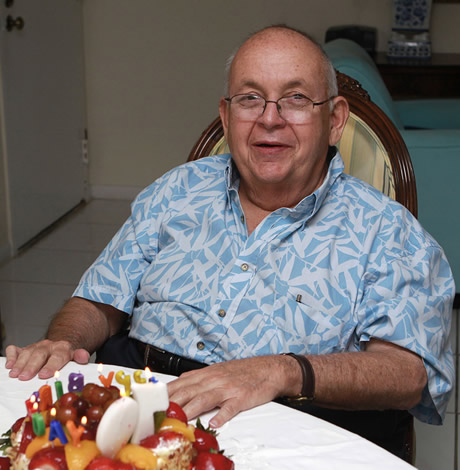
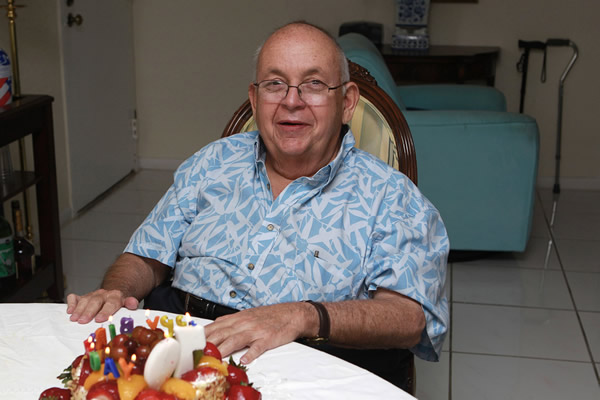
Ricardo C. Martinez (Photo courtesy of Richard Viola)
Ricardo C. Martinez, a senior economist with the D.C.-based Inter-American Development Bank (IDB) for more than 20 years and a well-known figure in the gay communities of Washington and Fort Lauderdale, Fla., died August 15 at a hospice in Fort Lauderdale from complications associated with a stroke. He was 71.
Friends and colleagues note that he worked for years traveling extensively to countries in Latin America and the Caribbean on behalf of the IDB to assess and make recommendations on those countries’ needs for economic development loans.
The friends from Washington and the Fort Lauderdale-Miami area, where Martinez moved after taking early retirement at the age of 55, say his retirement enabled him to devote more time to his lifelong passion for the performing arts, especially opera.
“Sometimes he saw his own life in terms of the grand opera he so adored,” said George Jackson, one of his longtime Washington friends.
Martinez was born and raised in Havana, Cuba. He told friends he completed high school there just as the uncertainty and turmoil that followed the assumption of power by Fidel Castro prompted many Cubans to flee to the U.S.
As an only child, he told friends his parents arranged for him to abruptly depart his homeland by himself and arrive in Miami in 1960 as part of the Catholic Church operated “Peter Pan” program, through which thousands of unaccompanied Cuban children and teenagers were dispatched to the U.S. in the early 1960s.
According to his friend Richard Poms, Martinez said his parents arrived in the U.S. the following year and the family settled in Northern Virginia. A short time later, Martinez began his studies in economics at Catholic University in D.C. through an academic scholarship.
After receiving a bachelor’s degree in economics at Catholic University he studied economics on the graduate level at the University of Virginia in Charlottesville.
He taught courses in intermediate level macroeconomic theory and principles of economics and economic systems at George Mason University in Fairfax, Va., from 1968 to 1970. He next joined the staff of the Brookings Institution in Washington as a research assistant from 1970 to 1974, according to his curriculum vitae.
Martinez began his tenure at the Inter-American Development Bank in 1974 as an economist with the bank’s Country Economic Division. He assumed the position of senior economist at the bank’s General Studies Division in 1981 and assumed additional responsibilities in 1989 as senior economist with the Country Economics Division.
As someone fluent in English and Spanish, he wrote over 40 chapters during his tenure at the IDB for the annual publication Economic and Social Progress in Latin America. Among the countries he visited and for which he made loan related assessments and recommendations were Barbados, Suriname, Venezuela, El Salvador, Mexico and Costa Rica.
Upon his retirement in 1998 Martinez moved from his longtime residence in Arlington, Va., to Miami Beach before settling later in Fort Lauderdale.
According to friends, he shared his passion for the opera with a longstanding interest in European history and the European nobility.
“He loved European nobility,” said Poms. “He was an expert on the kings and the queens going back all the way. He knew who was married to whom – what family this, what family that.”
Before and after retirement his love for opera prompted him travel to opera houses in the U.S. and Europe, including regular trips to the Metropolitan Opera in New York, where he boasted of crossing paths and socializing with famed Metropolitan Opera conductor and music director James Levine at Manhattan nightspots after the performances.
“I remember his love for good cuisine and how he wouldn’t eat dinner until the sun had set,” said Tom Hardy, a friend from Washington. “He went to all the best restaurants, and he loved company and he loved to tell us about history and of course ancestry and the European monarchs.”
Martinez is predeceased by his parents, Ricardo, Sr., and Hilda Martinez, of Arlington, Va., and his longtime friend Jack Keegel of Washington.
He is survived by an uncle in Jacksonville, Fla., Orlando Acosta, a cousin in Los Angeles, and many friends in Washington and Fort Lauderdale, including Richard Poms, Richard Viola, Steven Frias Rodriquez, Tom Hardy, Carl Spier, Larry Smelser, George Jackson, David Cox, Emilio Cueto, and this reporter, among many others.
Poms said plans would be announced soon for memorial services in Fort Lauderdale and D.C. He said plans were being made for interment of Martinez’s ashes at Columbia Gardens Cemetery in Arlington, Va., near the gravesite of his parents.


District of Columbia
How Pepper the courthouse dog helps victims of abuse
Reshaping how the legal system balances compassion with procedure
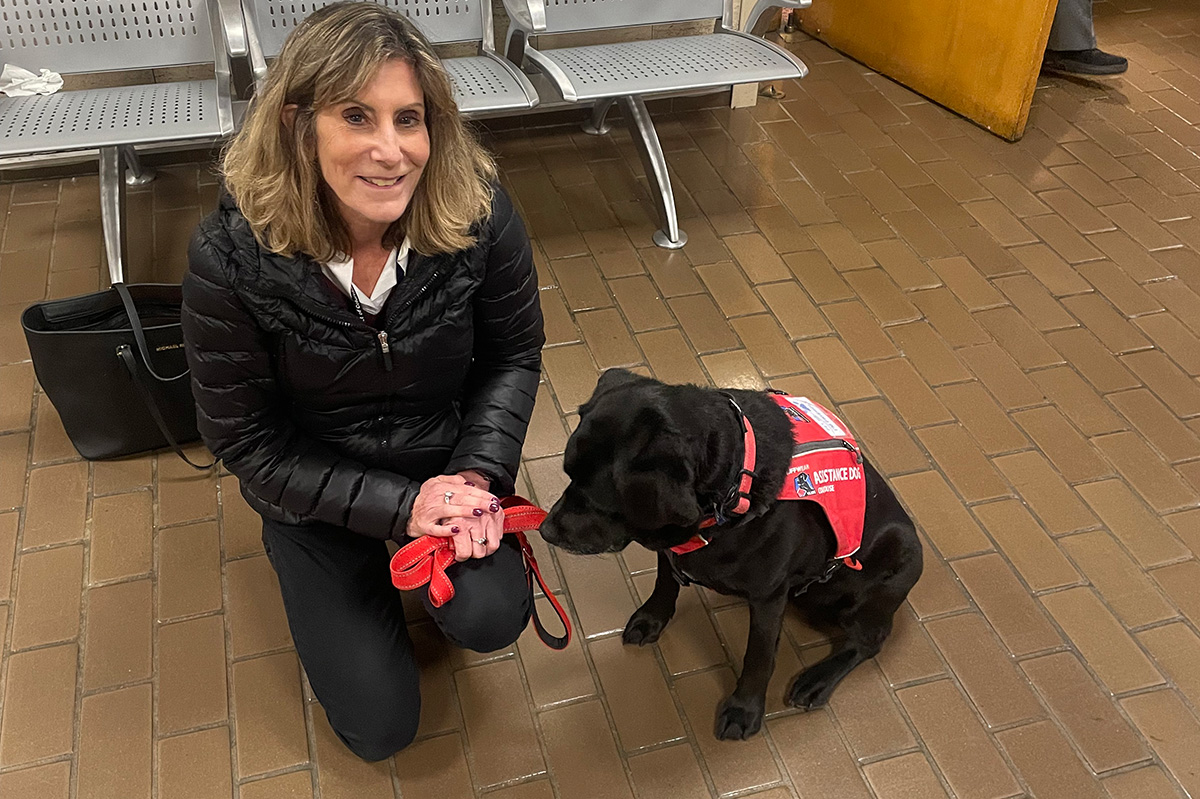
Deborah Kelly’s blind husband, Alton, was dragged for blocks to his death by a hit-and-run driver who had already plowed into her on Alabama Ave., S.E., in June 2024.
But her trauma had only just begun. It took 10 months before the driver, Kenneth Trice, Jr., was arrested, and another six months before he was sentenced to just six months behind bars.
As she heaved and sobbed in the courtroom in November, Kelly had a steady four-legged presence by her side: Pepper the Courthouse Dog, as the black Labrador retriever is known in D.C. Superior Court.
Abby Stavitsky, a former federal prosecutor who now serves as a victims’ advocate, is the owner and handler of nine-year-old Pepper. She says that one of the things that has made Pepper such a great asset in the court in the past six years is the emotional support and comfort she provides to victims.
“She absorbs all of the feelings and the emotions around her, but she’s very good at handling it,” Stavitsky said.
Pepper and Stavitsky started working in Magistrate Judge Mary Grace Rook’s courtroom — and now works in Magistrate Judge Janet Albert’s — to provide support for youth who suffer trauma, especially young survivors of commercial sexual exploitation.
These specially trained dogs offer emotional support to trauma victims of all ages. Courthouse dogs can reduce victims’ and witnesses’ anxiety and stress, making it easier for them to provide clear statements in the courtroom, according to a 2019 report in the Criminal Justice Review.
“Having something to pet and interact with is a distraction that results in victims being calmer when testifying in court,” says Stavitsky. “This gives them an extra level of comfort.”
What brought Stavitsky and Pepper together
Stavitsky, who spent 25 years as an assistant U.S attorney, handled a lot of victim-based crimes, mostly domestic violence and sex offenses. She was also a dog lover, and once she learned about courthouse dogs and their use, she was inspired.
In 2019, Pepper was given to Stavitsky by a Massachusetts-based organization, NEADS, formerly known as the National Education for Assistance Dog Services. Although Pepper was originally trained to be a service dog, evaluators determined her character was best suited for a courthouse dog.
Pepper now works regularly in various treatment court cases involving juveniles, many of whom have experienced trauma or are involved in the child welfare system. She also sits with victims while they are testifying in a trial.
“She loves people, especially children,” Stavitsky said. “She loves that interaction.”
Courthouse dogs have a long history
In courthouses across the U.S. specially trained “facility dogs” are becoming an important part of how the justice system supports vulnerable victims and witnesses.
Since the late 1980s, these dogs were used to help trauma survivors and anxious children during testimonies and interviews. The first dog to make an appearance in a courtroom was Sheba, a German shepherd who assisted child sexual abuse victims in the Queens (N.Y.) District Attorney’s Office. Courthouse dogs help them communicate more clearly, especially in these settings that make them anxious and stressed.
Unlike service dogs, courthouse facility dogs are professionally trained through accredited assistance dog organizations and work daily alongside prosecutors, victim advocates, and forensic interviewers. For example, courthouse dogs can have more social interaction, unlike service dogs.
Courthouse dogs’ growing use has prompted state laws and professional guidelines to recognize the dogs as a trauma-informed tool that helps victims participate in the justice process without compromising courtroom fairness.
As more jurisdictions adopt these programs, courthouse dogs are reshaping how the legal system balances compassion with procedure, ensuring that victims’ voices can be heard in environments that might otherwise silence them.
Pepper makes it easy to see why.
“I really love people, especially kids, and can provide emotional support and comfort during all stages of the court process,” reads the business card Stavitsky hands out with Pepper’s picture. “I’m calm, quiet and can stay in place for several hours.”
(This article was written by a student in the journalism program at Bard High School Early College DC. This work is part of a partnership between the Washington Blade Foundation and Youthcast Media Group, funded through the FY26 Community Development Grant from the Office of D.C. Mayor Muriel Bowser.)
Rehoboth Beach
Women’s FEST returns to Rehoboth Beach next week
Golf tournament, mini-concerts, meetups planned for silver anniversary festival
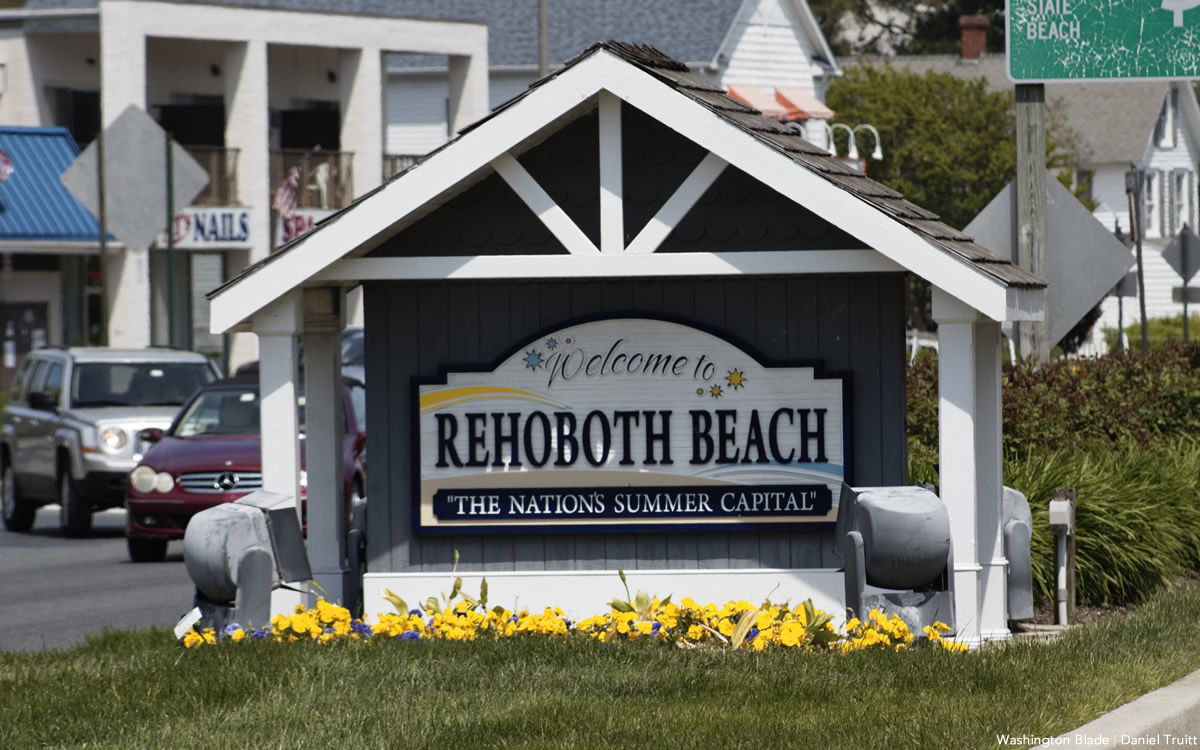
Women’s+ FEST 2026 will begin on Thursday, April 9 at CAMP Rehoboth Community Center.
The festival will celebrate a remarkable milestone in 2026: its silver anniversary. For 25 years, Women’s+ FEST has brought fun and entertainment for all those on the spectrum of the feminine spirit. There will be a variety of events including a golf tournament, mini-concerts and happy hour meetups.
For more information, visit Camp Rehoboth’s website.
District of Columbia
How new barriers to health care coverage are hitting D.C.
Federally qualified health centers bracing for influx of newly uninsured patients
Washington, D.C. has the second-lowest rate of people who lack health insurance in the country, but many residents are facing new barriers to health care due to provisions of the sweeping federal law passed in July, which threatens access for thousands.
Changes to insurance eligibility and the rising cost of premiums, which kicked in for some in October and others more recently, are expected to leave many more patients uninsured or unable to afford medical care. Federally qualified health centers, including D.C.’s Whitman-Walker Health, where 10 to 12 percent of patients are uninsured, are bracing for an influx of newly uninsured patients while facing their own financial challenges.
Even in D.C., where uninsured rates have been among the lowest in the country, changes brought on by the passage of the Republican mega bill (known as the “Big Beautiful Bill”) will have major effects.
The changes from the bill affect Medicaid, which is free to low-income patients, and subsidies for insurance that people buy on the health insurance exchanges that were started under the Affordable Care Act, which were allowed to expire on Dec. 31.
Erin Loubier, vice president for access and strategic initiatives at Whitman-Walker Health, says some Whitman-Walker Health patients have received notices about premium increases, including several who say the increases are up to 1,000 percent more than they were paying.
“That is like paying rent,” she says. “We live in an expensive city, so any increases are going to be really, really hard on people.”
Whitman-Walker Health and other healthcare providers are expecting the changes to have multiple effects — some patients may not be able to afford coverage or may avoid going to the doctor and allow health conditions to worsen because they can’t afford care, and many more will be seeking care who don’t have insurance.
“I’m worried that we’re going to not just have people who can’t get care, but that they delay care until they’re really sick, and then the care is not as effective because they might have waited too long, and then we may have a less healthy population,” Loubier says.
Loubier says delaying care, and serving more people without insurance has major implications for Whitman-Walker Health and other health centers serving the community.
“There’s going to be a lot of pressure on us to try to find and raise more money, and that’s going to be harder, because I think all organizations who provide health care are going to be facing this,” she says.
The U.S. health care system is the most expensive in the world, and has much higher out-of-pocket costs for individuals. But in other countries like the United Kingdom, Australia, Canada, and many others, health care is much less expensive — or even free.
Even though the U.S. has a high-priced healthcare system, critics say there are still ways to bring down costs by forcing insurance and pharmaceutical companies to absorb more of the costs, rather than transferring the costs to patients.
“In the U.S., they end up trying to cut costs at the person’s level, not at the level of the different corporations or structures that are making a lot of money in healthcare,” said Loubier. “Our system is so complicated and there is probably waste in it, but I don’t think that that cost and waste is at the ‘people’ level. I think it’s higher up at the system level, but that is much, much harder to get people to try to make cuts at that end.”
Ultimately at Whitman-Walker Health, healthcare providers and insurance navigators are planning to help with everyday necessities when it comes to healthcare coverage and striving to provide healthcare in partnership with patients, said Loubier.
“The key here is we’re going to have a lot of people who may lose insurance, and they’re going to rely on places like Whitman-Walker Health and other community health centers, so we have to figure out how we keep providing that care,” she said.
(This article was written by a student in the journalism program at Bard High School Early College DC. This work is part of a partnership between the Washington Blade Foundation and Youthcast Media Group, funded through the FY26 Community Development Grant from the Office of D.C. Mayor Muriel Bowser.)

How Pepper the courthouse dog helps victims of abuse

Women’s FEST returns to Rehoboth Beach next week

Belarusian lawmakers approve bill to crackdown on LGBTQ rights

Calendar: April 3-9

How new barriers to health care coverage are hitting D.C.

‘Out for McDuffie’ event held at D.C. gay bar

Thousands attend ‘No Kings’ protests in D.C.

Ghanaian president welcomed to Philadelphia amid backlash over anti-LGBTQ bill

PHOTOS: ‘No Kings’ rally and march