News
Biden Foundation sets up advisory councils for women, LGBT rights
Initiative launched amid speculation of 2020 run
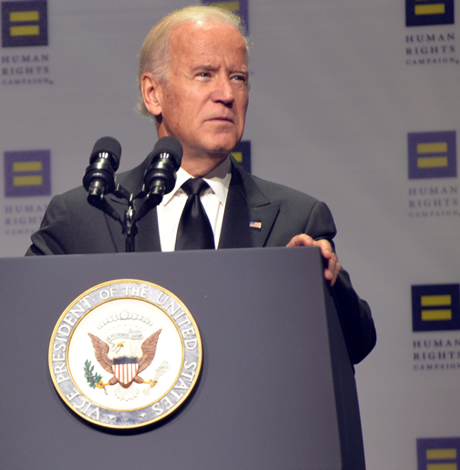
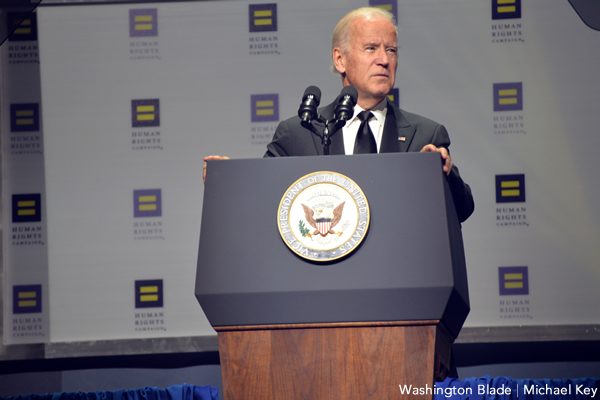
Former Vice President Joe Biden</strong> has created advisory councils for women and LGBT rights.
(Washington Blade file photo by Michael Key)
Former Vice President Joseph Biden, among the potential Democratic candidates for the 2020 presidential election, announced on Monday the creation of two new advisory councils for his foundation: One to advance LGBT rights, the other to end violence against women.
Members of both councils are made up of prominent advocates on women’s and LGBT issues, many of whom are supporters of the Democratic Party.
Individuals named to the LGBTQ Equality Advisory Council include singer Cyndi Lauper, former NBA player Jason Collins, transgender activist Sarah McBride, Judy Shepard, marriage equality advocate Evan Wolfson and former U.S. ambassador to Romania Michael Guest.
Biden said in a statement members of the councils “have devoted their lives to that creed, and we’re lucky to have them lend their expertise to this mission.”
“By working together, we can do more to protect the rights of all people, expand access to opportunity and give every American a chance at a middle-class life,” Biden said. “I am eager for what we will accomplish together.”
According to a statement from the Biden Foundation, the advisory councils will recognize the power of public-private initiatives, serve as ambassadors for the Biden Foundation and guide strategic partnerships to create societal change.
Louisa Terrell, executive director of the Biden Foundation, said in a statement each council member “has made it their life’s work to protect and advance the rights of the most vulnerable.”
“We’re honored to have them volunteer their knowledge to the Foundation as we work together to build a more just society,” Terrell added.
Biden has a record of highlighting the issue of violence against women. As a U.S. senator, he was author of the Violence Against Women Act, a law that was reauthorized in 2013 when he was vice president to include LGBT-specific protections.
On LGBT issues, Biden was also at the forefront. The vice president famously came out for same-sex marriage days before former President Obama and called transgender issues the “civil rights issue of our time” and was active in championing international LGBT human rights.
Lauper, co-founder of the True Colors Fund, highlighted the issue of LGBT youth homelessness in a statement on her membership of the LGBT council.
“In America, up to 1.6 million youth experience homelessness each year. 40 percent of them identify as LGBTQ, compared to the seven percent of the general youth population that is LGBTQ. The True Colors Fund is working hard to change that,” Lauper said. “As a lifelong ally and advocate, Vice President Biden gets it — and today, I’m proud to join the Biden Foundation as we work to make equality a reality.”
The full roster of both advisory councils follows.
LGBTQ Equality Advisory Council
Cyndi Lauper, Singer, Songwriter, Actress, Activist; Founder, True Colors Fund
Sara Ramírez, Tony Award–winning Actress and Activist
Jason Collins, Professional Basketball Player (retired), National Basketball Association
Sarah McBride, National Press Secretary, Human Rights Campaign
Phillip Picardi, Chief Content Officer, Them and Teen Vogue
Judy Shepard, President, Matthew Shepard Foundation
Evan Wolfson, Founder and Former President, Freedom to Marry
Marsha Aizumi, Author, Speaker, Educator, Advocate Member, PFLAG National Board of Directors
Dr. Eliza Byard, Executive Director, Gay, Lesbian, and Straight Education Network
Ambassador Michael Guest, Former U.S. Ambassador to Romania
Mara Keisling, Founder and Executive director, National Center for Transgender Equality
Dr. Caitlin Ryan, Director and Co-Founder, Family Acceptance Project
Rev. Jasmine Beach-Ferrara, Founding Executive Director, Campaign for Southern Equality; Minister, United Church of Christ
Jacob Tobia, Writer, Producer, Author
Amit Paley, Chief Executive Officer and Executive Director, Trevor Project Precious Davis, Activist, Educator, Public Speaker
Ending Violence Against Women Advisory Council
Justin Baldoni, Actor, filmmaker and activist
Karma Cottman, Founder, Ujima: The National Center on Violence Against Black Women; Executive Director, DC Coalition Against Domestic Violence
Jess Davidson, Managing Director, End Rape on Campus
Venkayla Haynes, Regional Advisor, It’s On Us
Rosie Hidalgo, Senior Director of Policy, Casa de Esperanza; Senior Advisor, National Resource Center on Domestic Violence
Olivia Hinerfeld, Activist
Vivian Huelgo, Chief Counsel, Task Force on Human Trafficking and Commission on Domestic & Sexual Violence of the American Bar Association
Neil Irvin, Executive Director, Men Can Stop Rape
Demetra Lambros, Appellate attorney, U.S. Department of Justice
Zerlina Maxwell, Director of Progressive Programming, SiriusXM
Victoria Nourse, Professor, Georgetown Law School
Nancy Schwartzman, Director, Producer, Mobile App Developer; CEO, Tech 4 Good
Patti Seger, Executive Director, End Domestic Abuse Wisconsin
Susan Sorenson, Professor, University of Pennsylvania
Andrew Sta. Ana, Director of Legal Services, Day One
Ebony Tucker, Advocacy Director, National Alliance to End Sexual Violence




Rehoboth Beach
Women’s FEST returns to Rehoboth Beach next week
Golf tournament, mini-concerts, meetups planned for silver anniversary festival

Women’s+ FEST 2026 will begin on Thursday, April 9 at CAMP Rehoboth Community Center.
The festival will celebrate a remarkable milestone in 2026: its silver anniversary. For 25 years, Women’s+ FEST has brought fun and entertainment for all those on the spectrum of the feminine spirit. There will be a variety of events including a golf tournament, mini-concerts and happy hour meetups.
For more information, visit Camp Rehoboth’s website.
Belarus
Belarusian lawmakers approve bill to crackdown on LGBTQ rights
Country’s president known as ‘Europe’s last dictator’

Lawmakers in Belarus on Thursday approved a bill that would allow the government to crack down on LGBTQ advocacy.
The Associated Press notes the bill would punish anyone found guilty of “propaganda of homosexual relations, gender change, refusal to have children, and pedophilia” with fines, community labor, and 15 days in jail.
The House of Representatives, the lower house of the Belarusian National Assembly, last month approved the bill. The Council of the Republic, which is the parliament’s upper chamber, passed it on Thursday.
President Alexander Lukashenko is expected to sign it.
Belarus borders Poland, Ukraine, Russia, Latvia, and Lithuania. Lukashenko — known as “Europe’s last dictator” is a close ally of Russian President Vladimir Putin.
Kazakhstan is among the countries that have enacted Russian-style anti-LGBTQ propaganda laws in recent years.
Vika Biran, a Belarusian LGBTQ activist, is among those arrested during anti-Lukashenko protests that took place in 2020 after he declared victory in the country’s presidential election.
District of Columbia
How new barriers to health care coverage are hitting D.C.
Federally qualified health centers bracing for influx of newly uninsured patients

Washington, D.C. has the second-lowest rate of people who lack health insurance in the country, but many residents are facing new barriers to health care due to provisions of the sweeping federal law passed in July, which threatens access for thousands.
Changes to insurance eligibility and the rising cost of premiums, which kicked in for some in October and others more recently, are expected to leave many more patients uninsured or unable to afford medical care. Federally qualified health centers, including D.C.’s Whitman-Walker Health, where 10 to 12 percent of patients are uninsured, are bracing for an influx of newly uninsured patients while facing their own financial challenges.
Even in D.C., where uninsured rates have been among the lowest in the country, changes brought on by the passage of the Republican mega bill (known as the “Big Beautiful Bill”) will have major effects.
The changes from the bill affect Medicaid, which is free to low-income patients, and subsidies for insurance that people buy on the health insurance exchanges that were started under the Affordable Care Act, which were allowed to expire on Dec. 31.
Erin Loubier, vice president for access and strategic initiatives at Whitman-Walker Health, says some Whitman-Walker Health patients have received notices about premium increases, including several who say the increases are up to 1,000 percent more than they were paying.
“That is like paying rent,” she says. “We live in an expensive city, so any increases are going to be really, really hard on people.”
Whitman-Walker Health and other healthcare providers are expecting the changes to have multiple effects — some patients may not be able to afford coverage or may avoid going to the doctor and allow health conditions to worsen because they can’t afford care, and many more will be seeking care who don’t have insurance.
“I’m worried that we’re going to not just have people who can’t get care, but that they delay care until they’re really sick, and then the care is not as effective because they might have waited too long, and then we may have a less healthy population,” Loubier says.
Loubier says delaying care, and serving more people without insurance has major implications for Whitman-Walker Health and other health centers serving the community.
“There’s going to be a lot of pressure on us to try to find and raise more money, and that’s going to be harder, because I think all organizations who provide health care are going to be facing this,” she says.
The U.S. health care system is the most expensive in the world, and has much higher out-of-pocket costs for individuals. But in other countries like the United Kingdom, Australia, Canada, and many others, health care is much less expensive — or even free.
Even though the U.S. has a high-priced healthcare system, critics say there are still ways to bring down costs by forcing insurance and pharmaceutical companies to absorb more of the costs, rather than transferring the costs to patients.
“In the U.S., they end up trying to cut costs at the person’s level, not at the level of the different corporations or structures that are making a lot of money in healthcare,” said Loubier. “Our system is so complicated and there is probably waste in it, but I don’t think that that cost and waste is at the ‘people’ level. I think it’s higher up at the system level, but that is much, much harder to get people to try to make cuts at that end.”
Ultimately at Whitman-Walker Health, healthcare providers and insurance navigators are planning to help with everyday necessities when it comes to healthcare coverage and striving to provide healthcare in partnership with patients, said Loubier.
“The key here is we’re going to have a lot of people who may lose insurance, and they’re going to rely on places like Whitman-Walker Health and other community health centers, so we have to figure out how we keep providing that care,” she said.
(This article was written by a student in the journalism program at Bard High School Early College DC. This work is part of a partnership between the Washington Blade Foundation and Youthcast Media Group, funded through the FY26 Community Development Grant from the Office of D.C. Mayor Muriel Bowser.)

Women’s FEST returns to Rehoboth Beach next week

Belarusian lawmakers approve bill to crackdown on LGBTQ rights

Calendar: April 3-9

How new barriers to health care coverage are hitting D.C.

Kenyan advocacy groups launch LGBTQ voter mobilization campaign

‘Out for McDuffie’ event held at D.C. gay bar

‘Jonah’ an undeniably compelling but unusual memory play

The Oscar-losing performance that’s too good to miss

Thousands attend ‘No Kings’ protests in D.C.