State Department
Blinken, Russian counterpart speak about Brittney Griner
Call took place after public acknowledgment of deal to secure U.S. citizens release
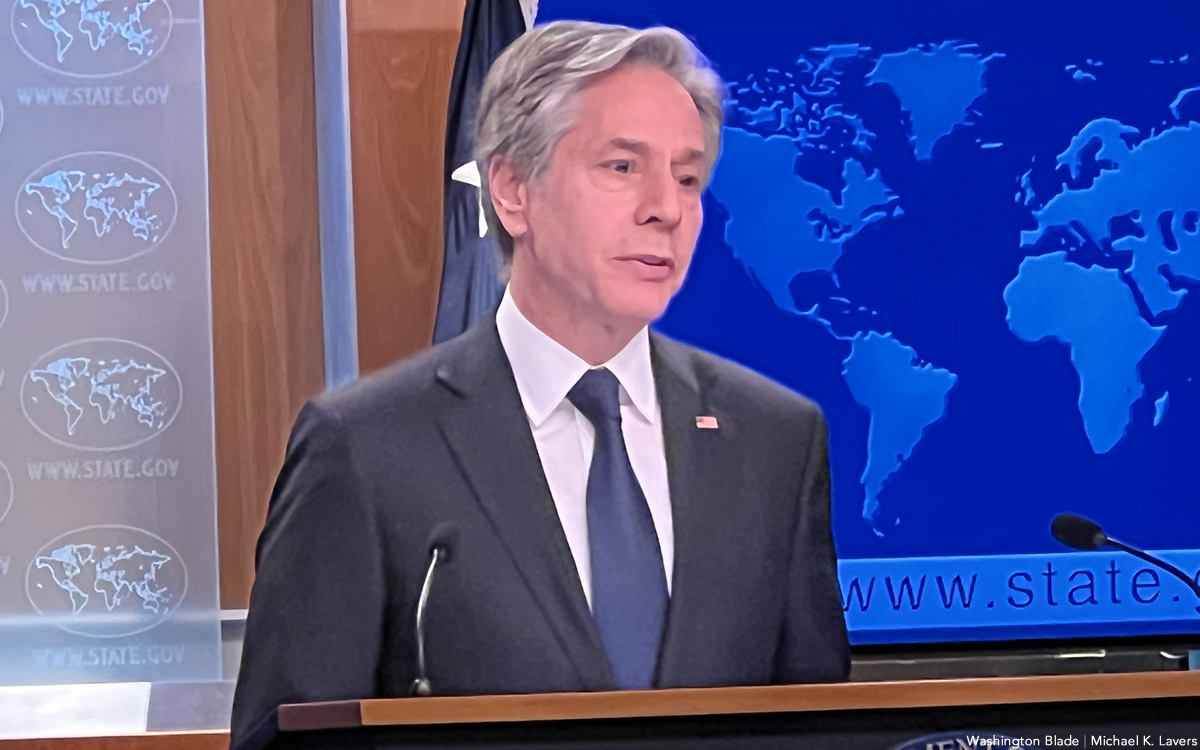
Secretary of State Antony Blinken on Friday spoke with his Russian counterpart about efforts to secure the release of WNBA star Brittney Griner and Paul Whelan.
The Associated Press reported Blinken urged Russian Foreign Minister Sergey Lavrov to accept a deal to obtain the release of Griner and Whelan, an American citizen who is serving a 16-year prison sentence after his conviction for spying. American officials have reportedly expressed a willingness to release Viktor Bout, a Russian arms dealer who is serving a 25-year prison sentence in the U.S., as part of a prisoner swap.
Blinken, according to the AP, described the call with Lavrov as a “frank and direct conversation.”
“I urged Foreign Minister Lavrov to move forward with that proposal,” said Blinken. “I can’t give you an assessment of whether that is any more or less likely.”
Officials at Moscow’s Sheremetyevo Airport in February detained Griner — a Phoenix Mercury center and two-time Olympic gold medalist who is a lesbian and married to her wife, Cherelle Griner, — after customs inspectors allegedly found hashish oil in her luggage. The State Department has determined that Russia “wrongfully detained” her.
Brittney Griner’s trial began in Moscow on July 1.
It continues to take place, even though she had pleaded guilty to charges that she smuggled drugs in Russia. Brittney Griner faces up to 10 years in prison if she is convicted.
Friday’s call took place two days after Blinken for the first time publicly acknowledged the U.S. has offered Russia a deal to secure the release of Brittney Griner and Whelan.
“We are determined to bring her home along with Paul (Whelan) and for that matter, any and every American who is being unjustly detained anywhere in the world,” said Blinken on June 15 during a roundtable with LGBTQ and intersex journalists in which the Washington Blade participated. “It’s something that I am personally focused on, and I want to leave it at that because it is obviously an ongoing issue. But just know that this is a matter of intense focus for us.”





State Department
Democracy Forward files FOIA request for State Department bathroom policy records
April 20 memo outlined anti-transgender rule
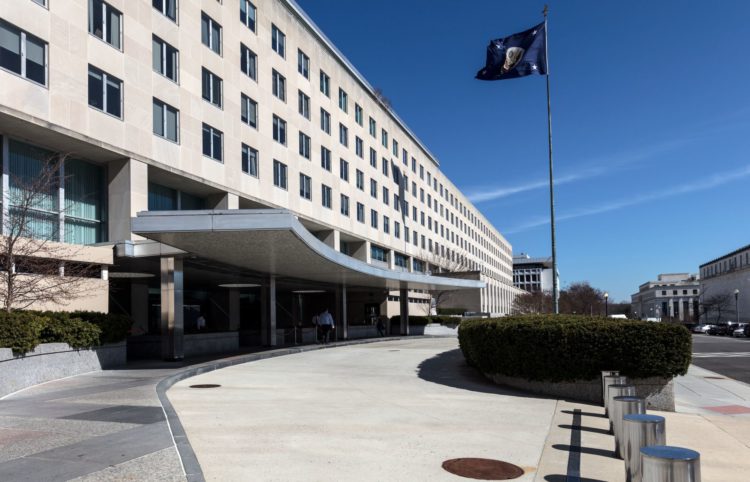
Democracy Forward on Tuesday filed a Freedom of Information Act request for records on the State Department’s new bathroom policy.
A memo titled “Updates Regarding Biological Sex and Intimate Spaces, Including Restrooms” that the State Department issued on April 20 notes employees can no longer use bathrooms that correspond with their gender identity.
“The administration affirms that there are two sexes — male and female — and that federal facilities should operate on this objective and longstanding basis to ensure consistency, privacy, and safety in shared spaces,” State Department spokesperson Tommy Piggot told the Daily Signal, a conservative news website that first reported on the memo. “In line with President Trump’s executive order this provides clear, uniform guidance to the department by grounding policy in biological sex as determined at birth.”
President Donald Trump shortly after he took office in January 2025 issued an executive order that directed the federal government to only recognize two genders: male and female. The sweeping directive also ordered federal government agencies to “effectuate this policy by taking appropriate action to ensure that intimate spaces designated for women, girls, or females (or for men, boys, or males) are designated by sex and not identity.”
Democracy Forward’s FOIA request that the Washington Blade exclusively obtained on Tuesday is specifically seeking a copy of the memo that details the State Department’s new bathroom policy. Democracy Forward has also requested “all” memo-specific communications between the State Department’s Bureau of Global Public Affairs and the Daily Signal from April 1-21.
State Department
State Department implements anti-trans bathroom policy
Memo notes directive corresponds with White House executive order
The State Department on April 20 announced employees cannot use bathrooms that correspond with their gender identity.
The Daily Signal, a conservative news website, reported the State Department announced the new policy in a memo titled “Updates Regarding Biological Sex and Intimate Spaces, Including Restrooms.”
The State Department has not responded to the Washington Blade’s request for comment on the directive.
“The administration affirms that there are two sexes — male and female — and that federal facilities should operate on this objective and longstanding basis to ensure consistency, privacy, and safety in shared spaces,” State Department spokesperson Tommy Piggot told the Daily Signal. “In line with President Trump’s executive order this provides clear, uniform guidance to the department by grounding policy in biological sex as determined at birth.”
President Donald Trump shortly after he took office in January 2025 issued an executive order that directed the federal government to only recognize two genders: male and female. The sweeping directive also ordered federal government agencies to “effectuate this policy by taking appropriate action to ensure that intimate spaces designated for women, girls, or females (or for men, boys, or males) are designated by sex and not identity.”
The Daily Signal notes the new State Department policy “does not prohibit single-occupancy restrooms.”
State Department
Report: US to withhold HIV aid to Zambia unless mineral access expanded
New York Times obtained Secretary of State Marco Rubio memo
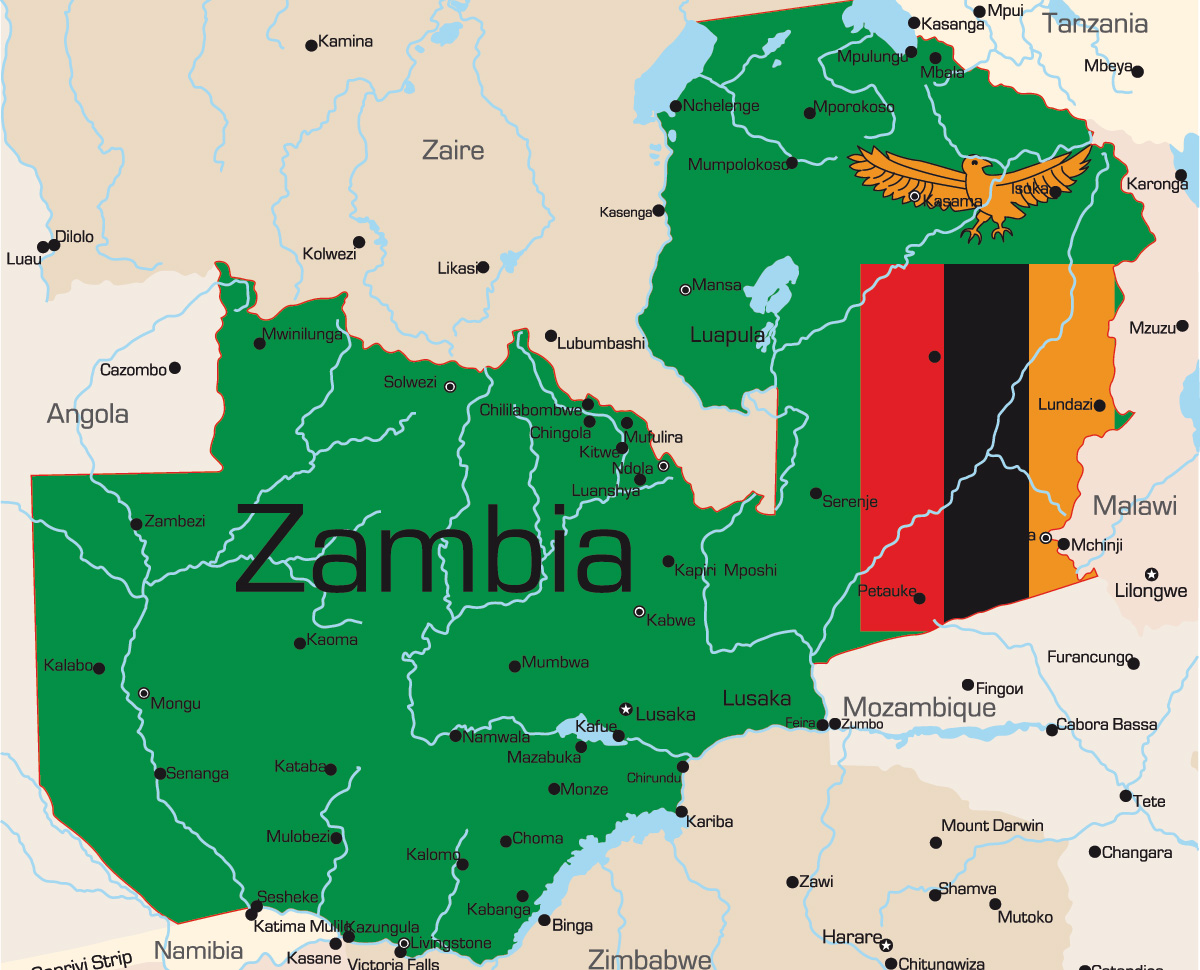
The State Department is reportedly considering withholding assistance for Zambians with HIV unless the country’s government allows the U.S. to access more of its minerals.
The New York Times on Monday reported Secretary of State Marco Rubio in a memo to State Department’s Bureau of African Affairs staffers wrote the U.S. “will only secure our priorities by demonstrating willingness to publicly take support away from Zambia on a massive scale.” The newspaper said it obtained a copy of the letter.
Zambia is a country in southern Africa that borders Tanzania, Malawi, Mozambique, Zimbabwe, Botswana, Namibia, Angola, and the Democratic Republic of Congo.
The Times notes upwards of 1.3 million Zambians receive daily HIV medications through PEPFAR. The newspaper reported Rubio in his memo said the Trump-Vance administration could “significantly cut assistance” as soon as May.
“Reports of (the) State Department withholding lifesaving HIV treatment in return for mining concessions in Zambia does not make us safer, stronger, or more prosperous,” said U.S. Sen. Jeanne Shaheen (D-N.H.), the ranking member of the Senate Foreign Relations Committee, on Tuesday. “Monetizing innocent people’s lives further undermines U.S. global leadership and is just plain wrong.”
The Washington Blade has reached out to the State Department for comment.
Zambia received breakthrough HIV prevention drug through PEPFAR
Rubio on Jan. 28, 2025, issued a waiver that allowed PEPFAR and other “life-saving humanitarian assistance” programs to continue to operate during a freeze on nearly all U.S. foreign aid spending. HIV/AIDS service providers around the world with whom the Blade has spoken say PEPFAR cuts and the loss of funding from the U.S. Agency for International Development, which officially closed on July 1, 2025, has severely impacted their work.
The State Department last September announced PEPFAR will distribute lenacapavir in countries with high prevalence rates. Zambia two months later received the first doses of the breakthrough HIV prevention drug.
Kenya and Uganda are among the African countries have signed health agreements with the U.S. since the Trump-Vance administration took office.
The Times notes the countries that signed these agreements pledged to increase health spending. The Blade last month reported LGBTQ rights groups have questioned whether these agreements will lead to further exclusion and government-sanctioned discrimination based on sexual orientation and gender identity.

529 openly LGBTQ candidates running in Brazilian election

Lesbian Bar Project co-founder: purity politics could destroy our remaining spaces

HRC report: LGBTQ students face ‘far greater challenges’ in non-supportive states

HRC National Dinner 2026: A night of music, activism, LGBTQ history

Trump asks Supreme Court to allow restrictions on gender-affirming care in prisons

‘Star Trek: Strange New Worlds’ star Celia Rose Gooding breaks down that finale time travel twist

Center for Black Equity’s annual gala to take place Oct. 3

Grace Meng sharply criticizes DOJ over hospital settlements

Tyler Clementi Foundation to host fundraiser in Rehoboth

Former Capital Pride board member reiterates sexual harassment allegation
-

 Television5 days ago
‘Star Trek: Strange New Worlds’ star Celia Rose Gooding breaks down that finale time travel twist
-
 District of Columbia5 days ago
Center for Black Equity’s annual gala to take place Oct. 3
-
New York5 days ago
Grace Meng sharply criticizes DOJ over hospital settlements
-
Out & About5 days ago
Tyler Clementi Foundation to host fundraiser in Rehoboth