European Union
USAID administrator meets with Hungarian LGBTQ activists
Meeting with Samantha Power took place on Feb. 10 in Budapest
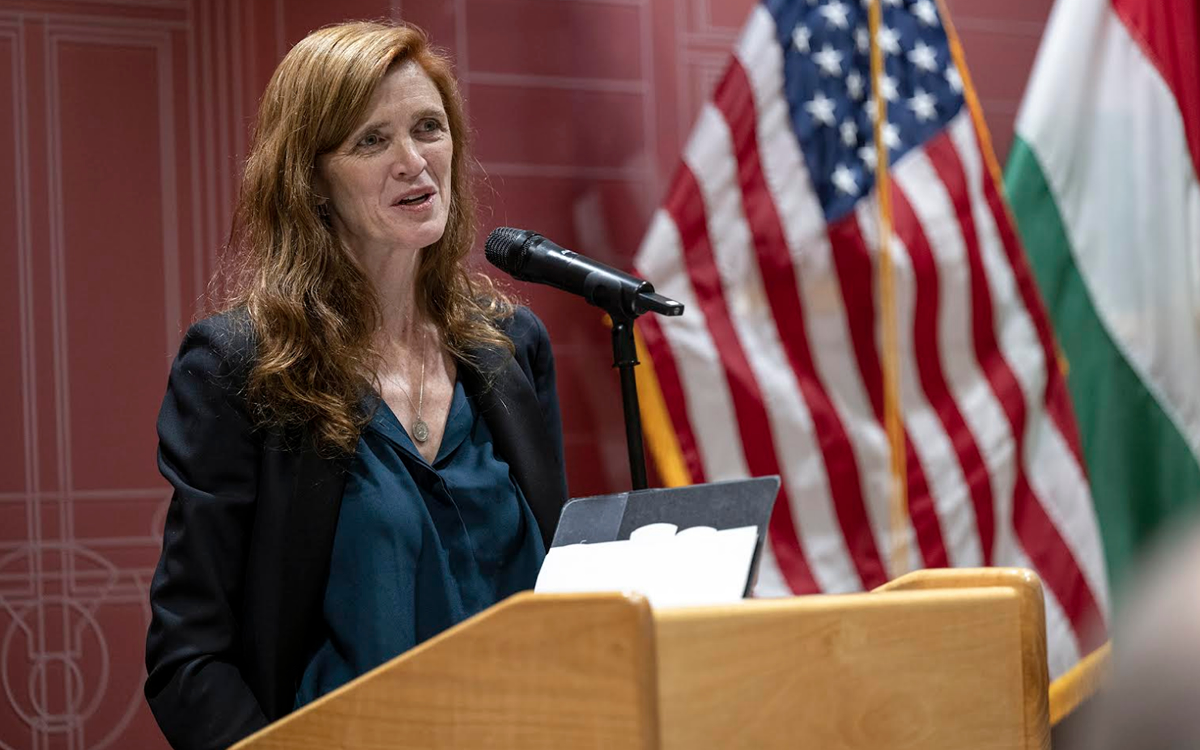
U.S. Agency for International Development Administrator Samantha Power on Feb. 10 met with three LGBTQ and intersex activists in the Hungarian capital of Budapest.
Budapest Pride President Viktoria Radvanyi and Hungarian Helsinki Committee Head of Advocacy András Léderer are two of the activists who met with Power.
USAID spokesperson Jessica Jennings in a press release said the activists “discussed the experiences of LGBTQI+ people in Hungary and their efforts to increase understanding, support marginalized groups and improve the lives of LGBTQI+ people in Hungary” with Power.
“The administrator (Power) emphasized that the United States will continue to stand as an ally with LGBTQI+ people and all marginalized groups in their struggle for equality,” noted Jennings.
The meeting took place against the backdrop of Prime Minister Viktor Orbán’s crackdown on LGBTQ and intersex rights in Hungary.
Radvanyi on Monday noted to the Washington Blade it is “impossible to change your gender legally in Hungary” because of a 2020 law that “banned legal gender recognition of transgender and intersex people.”
An anti-LGBTQ propaganda law that Radvanyi said was “copy and pasted” from Russia took effect in 2021. Hungarian MPs in 2020 effectively banned same-sex couples from adopting children and defined marriage in the country’s constitution as between a man and a woman.
The European Commission last July sued Hungary, which is a member of the European Union, over the country’s propaganda law.
President Joe Biden in 2021 signed a memorandum that commited the U.S. to promoting LGBTQ and intersex rights abroad as part of his administration’s overall foreign policy. David Pressman, the U.S. ambassador to Hungary, is openly gay.
Jennings in the USAID press release did not say whether Pressman attended the meeting with the activists, but it did note he met with Power before she left Budapest. Radvanyi said the activists who attended “were all very honored that Administrator Power had a dedicated meeting just about the Hungarian LGBTQ community and LGBTQ issues.”
“We know that she has a very, very busy schedule,” Radvanyi told the Blade. “We really appreciated that she treated the case of our community as such a high priority.”
Léderer described the meeting as a “very honest, sincere conversation on the situation of the Hungarian LGBT+ community.”
“In addition to how the community as a whole carries on amidst growing homo- and transphobic government policies and statements, she also wanted to know how individual members of the community, including those fighting for equal treatment and human rights, are coping with the hostile environment,” Léderer told the Blade, referring to Power. “We were happy to share great examples of resilience, including the successful campaign led by civil society organisations last year to invalidate the homo- and transphobic referendum initiated by the government by casting purposefully spoiled ballots.”






European Union
Poland’s top court rejects recognition of same-sex marriages from other EU countries
Ruling sets up potential clash with bloc

Poland’s top court this week rejected the recognition of same-sex marriages legally performed in other EU countries.
The EU Court of Justice in Luxembourg last November ruled in favor of a same-sex couple who challenged Poland’s refusal to recognize their German marriage. Poland’s Supreme Administrative Court in March reaffirmed the decision.
The couple, who lives in Poland, brought their case to Polish courts in 2019. The Supreme Administrative Court referred it to the EU Court of Justice.
The Polish government in May announced it will recognize same-sex marriages legally performed in other EU countries. Polish President Karol Nawrocki on July 17 vetoed bills that would have extended rights to same-sex couples.
The Constitutional Tribunal ruling, which it issued on July 28, was unanimous and final. It also sets up a potential clash between it and the EU Court of Justice.
European Union
European Commission says all EU countries should ban conversion therapy
Recommendation ‘an important step forward for LGBTI rights across Europe’

The European Commission on Wednesday said all European Union countries should ban so-called conversion therapy.
The recommendation comes weeks after the European Parliament voted in favor of prohibiting the widely discredited practice across the EU. More than 1.2 million people signed a campaign in support of the ban that ACT (Against Conversion Therapy) LGBT launched in 2024 through the EU’s European Citizens Initiative framework.
“We warmly welcome today’s commitment from the European Commission to a recommendation on ending conversion practices, an important step forward for LGBTI rights across Europe,” said ILGA Europe in a statement.
Seven EU countries — Belgium, Cyprus, France, Malta, Norway, Portugal, and Spain — have banned conversion therapy outright.
Greece in 2022 banned the practice for minors. German lawmakers in 2020 passed a law that prohibits conversion therapy for minors and for adults who have not consented to undergoing the widely discredited practice.
ILGA Europe said the European Commission’s recommendation “highlights how much work remains to be done.”
“Ending conversion practices cannot stop at symbolic commitments or fragmented national approaches,” stressed the advocacy group. “We need coordinated EU action, proper training for professionals, and survivor-centered support systems that recognize the serious harm these practices cause.”
“More than one million people supported the European Citizens’ Initiative calling for change,” added ILGA Europe. “The message is clear: conversion practices are not therapy or belief, they are a form of violence that Europe can and should end.”
European Union
European Parliament backs EU-wide conversion therapy ban
More than 1.2 million people backed campaign
The European Parliament on Wednesday voted in favor of banning so-called conversion therapy across the European Union.
ACT (Against Conversion Therapy) LGBT in 2024 launched a campaign in support of the ban through the EU’s European Citizens Initiative framework. More than 1.2 million people ultimately signed it.
The proposed ban had the support of 405 MEPs. The European Commission is expected to formally respond to it by May 18.
Seven EU countries — Belgium, Cyprus, France, Malta, Norway, Portugal, and Spain — have banned conversion therapy outright.
Greece in 2022 banned the practice for minors. German lawmakers in 2020 passed a law that prohibits conversion therapy for minors and for adults who have not consented to undergoing the widely discredited practice.

Debbie Allen shares on loss, love, and the power of speaking out

Baltimore’s oldest gay bar to reopen this week

Dr. Fauci ‘honored to be part of’ LGBTQ history

Factors to consider when hiring an interior designer

PHOTOS: HRC National Dinner

Caso Karlina: Una sentencia histórica contra las terapias de «conversión»

Colombia withdraws from Equal Rights Coalition

Writing a play about Lincoln leads down a rabbit hole to a closet

Trump-appointed judge restores White House TV pool access

Philadelphia event to launch 2026 LGBT History Month
-

 Ecuador5 days ago
Caso Karlina: Una sentencia histórica contra las terapias de «conversión»
-
Colombia4 days ago
Colombia withdraws from Equal Rights Coalition
-
a&e features4 days ago
Writing a play about Lincoln leads down a rabbit hole to a closet
-
White House4 days ago
Trump-appointed judge restores White House TV pool access