Politics
Dianne Feinstein dies at 90
Calif. Democrat elected to U.S. Senate in 1992
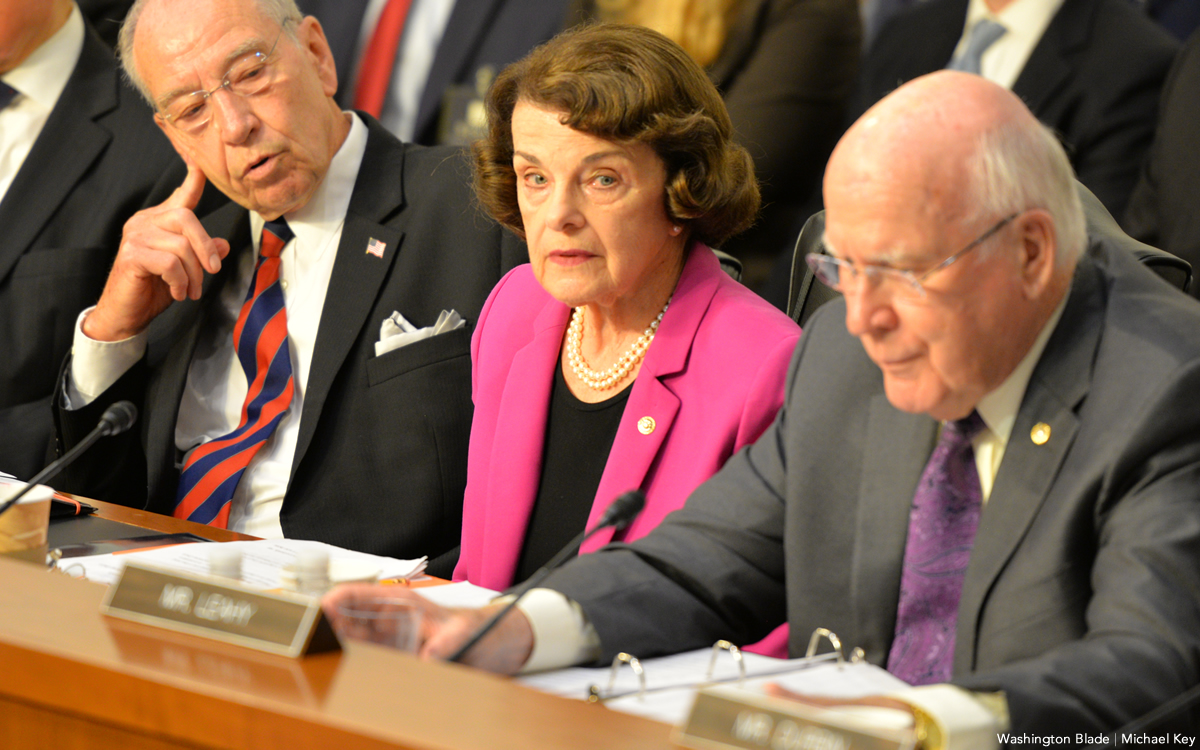
U.S. Sen. Dianne Feinstein (D-Calif.) has died at the age of 90.
Her office in a statement said the California Democrat, who has served in the U.S. Senate since 1992, passed away at her Washington home on Thursday night.
Feinstein in 1978 became San Francisco’s mayor after the assassination of Mayor George Moscone and openly gay Supervisor Harvey Milk.
“Her passing is a great loss for so many, from those who loved and cared for her to the people of California that she dedicated her life to serving,” reads the statement that Feinstein’s office released.
“Senator Feinstein never backed away from a fight for what was just and right,” it added. “At the same time, she was always willing to work with anyone, even those she disagreed with, if it meant bettering the lives of Californians or the betterment of our nation.”
President Joe Biden, who served alongside Feinstein in the Senate from 1992 to 2009, released a statement calling her “a pioneering American,” “a true trailblazer,” and “for Jill and me, a cherished friend.”
“In San Francisco, she showed enormous poise and courage in the wake of tragedy, and became a powerful voice for American values. Serving in the Senate together for more than 15 years, I had a front row seat to what Dianne was able to accomplish. It’s why I recruited her to serve on the Judiciary Committee when I was Chairman – I knew what she was made of, and I wanted her on our team.
“There’s no better example of her skillful legislating and sheer force of will than when she turned passion into purpose, and led the fight to ban assault weapons. Dianne made her mark on everything from national security to the environment to protecting civil liberties. She’s made history in so many ways, and our country will benefit from her legacy for generations.
“Often the only woman in the room, Dianne was a role model for so many Americans – a job she took seriously by mentoring countless public servants, many of whom now serve in my Administration. She had an immense impact on younger female leaders for whom she generously opened doors. Dianne was tough, sharp, always prepared, and never pulled a punch, but she was also a kind and loyal friend, and that’s what Jill and I will miss the most.
As we mourn with her daughter Katherine and the Feinstein family, her team in the Senate, and the people of California, we take comfort that Dianne is reunited again with her beloved Richard. May God Bless Dianne Feinstein.”
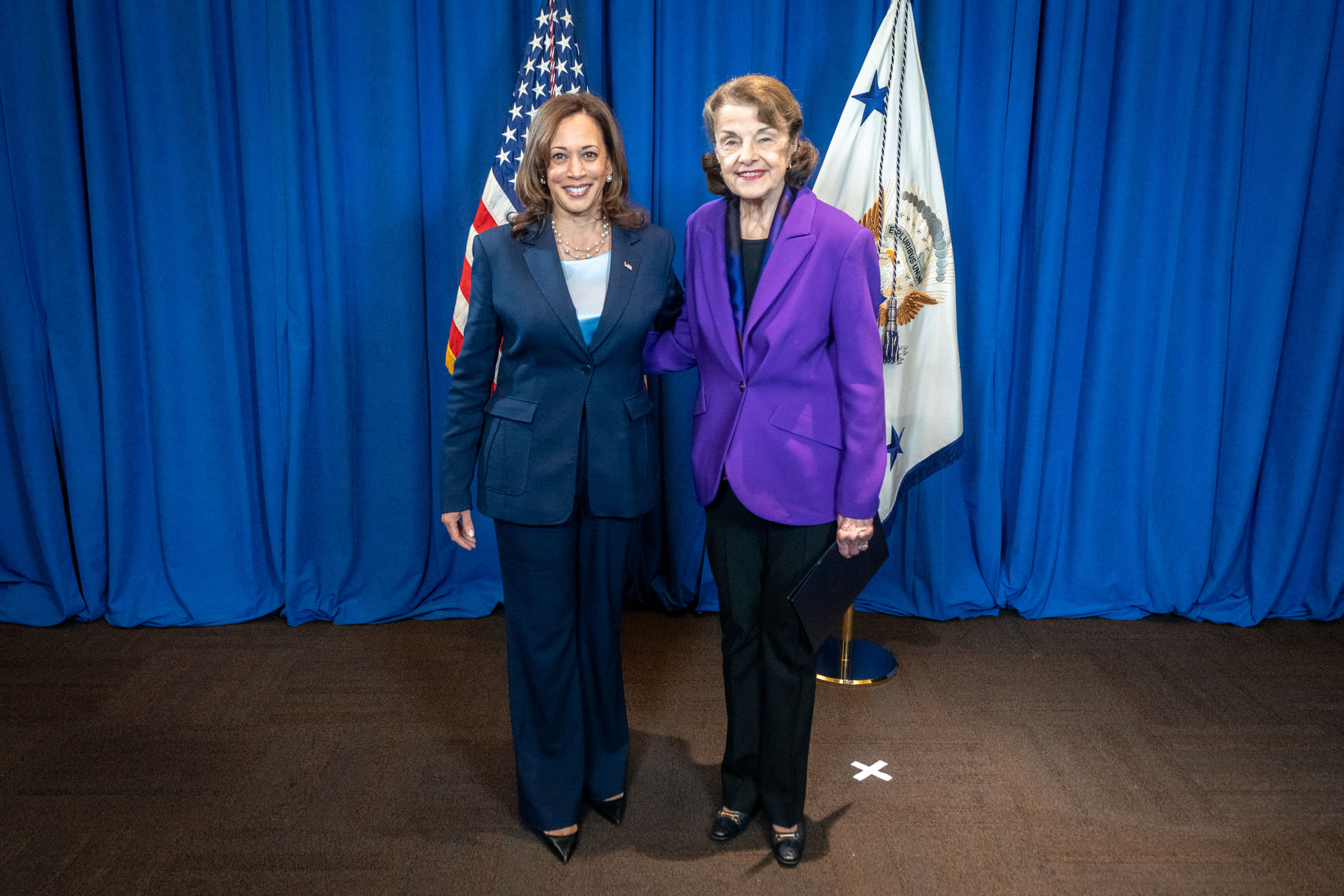
Vice President Kamala Harris, who served alongside Feinstein as U.S. Senator for California from 2017 to 2021 and, previously, was California attorney general and San Francisco district attorney, issued the following statement:
“Senator Dianne Feinstein was one of the greatest public servants that California and our nation has ever known.
“As the first woman president of the San Francisco Board of Supervisors, the first woman to serve as mayor of San Francisco, and the longest-tenured woman to serve in the United States Senate, Dianne Feinstein broke barriers, inspired generations of women to run for office, and improved the lives of millions of Americans through her vision, courage, and leadership.
“From her work to help pass the Assault Weapons Ban in 1994, to her work to safeguard California’s public lands, and her longstanding advocacy for reproductive rights, marriage equality, and LGBTQ+ rights, Senator Feinstein helped build a better America.
“For years, I witnessed Senator Feinstein’s leadership, when the cameras were on and when they were off. In 2008, when I was re-elected District Attorney of San Francisco, it was Senator Feinstein who swore me in. As a United States Senator, it was my honor to serve the people of California alongside Senator Feinstein.
“On the Senate Intelligence Committee, we spent a great deal of time together—in classified, bipartisan briefings and hearings—working on issues critical to America’s national security and the stability of the world. Senator Feinstein and I shared a fundamental belief in the importance of strong American leadership. And I saw firsthand how she worked courageously to ensure that our leadership was guided by our nation’s values.
“In the tradition of so many great Senators from California, she was not only a leader for our state, but for our nation and our world. Through her long career, Senator Feinstein worked across the aisle to help our nation live up to its promise.
“Doug and I send our prayers to Senator Feinstein’s family.”
California Gov. Gavin Newsom shared a statment on X.
Governor @GavinNewsom's statement on the passing of U.S. Senator Dianne Feinstein. pic.twitter.com/9EBazueURA
— Office of the Governor of California (@CAgovernor) September 29, 2023
Addressing the Senate floor on Friday, California Sen. Alex Padilla (D) said, “long before being able to serve together here in the Senate, Diane gave me one of my first jobs in politics in her Los Angeles office. At a time early in my career, when I was looking to make a difference for my community, and for our state. It’s in part thanks to her groundbreaking career that a Latino son of immigrants could one day not just work for her but work alongside her to keep up the fight for the American dream.”
Padilla also shared an anecdote about how Feinstein showed him a photograph, from her archives, of the AIDS Walk San Francisco in 1987, which she had inscribed with a handwritten note.
Also speaking from the floor in tribute to their late colleague following an address from the Senate Chaplain and a moment of silence were Senate Majority Leader Chuck Schumer (D-Calif.), Senate Minority Leader Mitch McConnell (R-Ky.), Senate President Pro Tempore Patty Murray (D-Wash.), Sen. Susan Collins (R-Maine), Senate Majority Whip Dick Durbin (D-Ill.), and Sens. Lisa Murkowski (R-Alaska), Maria Cantwell (D-Wash.), Amy Klobuchar (D-Minn.), Sheldon Whitehouse (D-R.I.), and Mazie Hirono (D-Hawaii).
The statement by U.S. House Speaker Emerita Nancy Pelosi (D-Calif.) touched on the senator’s early career in Democratic politics: “Dianne was a pioneering woman leader, who served as San Francisco’s first female Mayor with unmatched courage, poise and grace. Standing strong amid horror and heartbreak – from the brutal murders of Harvey Milk and George Moscone to the deadly HIV/AIDs epidemic – she offered our City a beacon of strength and hope.”
“Personally, it was a great honor to serve alongside Dianne for decades – from the hilly streets of San Francisco to the hallowed halls of Congress,” Pelosi said. “We were not only colleagues, but neighbors and friends.”
She added, “My daughter, Nancy Corinne, has long been an admirer and devoted friend of Senator Feinstein, and we were all close friends with her and her late husband, Richard.”
LGBTQ groups issue statements on Feinstein’s passing
“Senator Dianne Feinstein’s passing is a loss for us all,” tweeted Human Rights Campaign President Kelley Robinson. “Her steadfast support for the LGBTQ+ community and the fight for justice will be remembered. We carry her legacy forward in our relentless pursuit of equality without exception.”
Equality California, the nation’s largest statewide LGBTQ+ civil rights organization, released a statement from Executive Director Tony Hoang on Friday. “Senator Feinstein devoted her life to serving the people of California and our nation, championing LGBTQ+ civil rights, reproductive freedom, gun safety reform and democracy throughout her remarkable career. Senator Feinstein stood with our community back when few others did, fighting for funding and action to combat the AIDS crisis when most elected officials chose to look away.”
“On the Board of Supervisors and then as Mayor, she played a crucial role in uniting San Francisco after the horrific assassinations of Supervisor Harvey Milk and Mayor George Moscone, demonstrating exceptional leadership and compassion at a time when our LGBTQ+ community needed it most,” the group wrote.
“Her role in American history is unmistakably intertwined with LGBTQ+ history and the assassination of Supervisor Harvey Milk,” Brian K. Bond, CEO of PFLAG National, said. “She had been a constant and strident advocate for LGBTQ+ rights ever since, supporting marriage equality, military service for LGBTQ+ people, the Equality Act, and so much more.
“PFLAG families in California and across the country mourn the loss of this stalwart advocate who worked to make our laws just and equitable so every LGBTQ+ person could live with dignity and respect.”
“Harvey Milk’s nephew Stuart Milk posted “After the assassination of Uncle Harvey – Senator Feinstein rose to national attention – determined, unwavering champion on women’s rights, gun control & eventually a consistent supporter of LGBTQ inclusion,” Stuart Milk, co-founder and president of the Harvey Milk Foundation, posted on X. “She is the patron of the USNS Harvey Milk -deep condolences Godspeed Dianne,” he wrote, referring to the U.S. Navy ship named for the late gay rights pioneer.
National LGBTQ Task Force Executive Director Kierra Johnson said, “The loss of Senator Feinstein’s voice as an advocate and champion is immeasurable. Our hearts are with her family during this time. She was a champion for those who call California home and those seeking justice everywhere.”
“She was a trailblazer who paved the way for so many. Her deep roots in the queer community, forged as a city councilmember in San Francisco and shaped by her relationship with Harvey Milk, contributed to her unwavering supporting for LGBTQ people,” Johnson said.
She added that Feinstein was “a leader who took risks. She was an original cosponsor of the Equality Act and a key champion for legislation like the Violence Against Women Act. She is succeeded by and undoubtedly inspired a deep bench of congress people like Tammy Baldwin who are bold and unapologetic freedom fighters who are unrelenting in their quest for freedom and justice for all! She will be deeply missed.”
A look back at Feinstein’s career
A native San Franciscan born in the city on June 22, 1933, she first attended San Francisco public schools and then graduated from the Convent of the Sacred Heart High School in 1951.
She earned her degree at Stanford University in Palo Alto in 1955 and became actively involved in government service first serving as a member of the California Women’s Board of Terms and Parole 1960-1966.
In her first foray into city politics she won a seat on the San Francisco Board of Supervisors representing the Marina neighborhood, serving from 1970-1978, and as president 1970-1971, 1974-1975, 1978.
In 1978 Feinstein was thrust into the state and national political spotlight when on November 27, 1978 she became the mayor of San Francisco, after disgruntled former city supervisor Dan White entered City Hall and assassinated Mayor George Moscone after Moscone refused to appoint White back into his seat he had resigned from days before. White then also murdered openly gay city supervisor Harvey Milk who had sparred with White over gay rights and had opposed White getting his seat back.
Feinstein served as mayor for ten years from 1978-1988 then she served on the board as a director of the Bank of California 1988-1989 at which point she made an unsuccessful run as a candidate for Governor of California in 1990.
After losing that race for governor in 1990, Feinstein later won a special election on November 3, 1992, as a Democrat to the U.S. Senate. The special election was triggered by the resignation of Pete Wilson, who had defeated her in the 1990 gubernatorial election. She took office on November 4, 1992, and was subsequently reelected in 1994, 2000, 2006, 2012, and again in 2018 for the term ending January 3, 2025.

Feinstein’s record on LGBTQ+ rights was mixed
Senator Feinstein’s record on LGBTQ+ rights was mixed as reported on by San Francisco’s LGBTQ+ newspaper The Bay Area Reporter’s Assistant Editor John Ferrannini who noted:
Earlier in that campaign [1979] she’d faced some opposition from members of the LGBTQ community after she made remarks to Ladies’ Home Journal perceived as homophobic, but later won community support after gay candidate David Scott endorsed her in a runoff against independent Quentin Kopp. Scott endorsed Feinstein after she committed to appoint a gay person to the police oversight panel, which Feinstein followed through on with her appointment of lesbian Jo Daly.
Feinstein’s veto of city employee benefits for domestic partners led to a recall effort in 1983, though she won 81% to 18%.
[…]
In the Senate she was one of the few Democratic members who voted against the Defense of Marriage Act in 1996, which had been supported by then-senator and current President Joe Biden (D). The last vestiges of DOMA were formally repealed in December when Biden signed the Respect for Marriage Act. DOMA had key provisions struck down by the U.S. Supreme Court in 2013 (Section 3, U.S. v. Windsor) and 2015 (Section 2, Obergefell v. Hodges).
Feinstein was never without controversy though, and in 2004 upset more progressive Democrats when she said then-mayor and now Governor Gavin Newsom’s decision to order San Francisco officials to issue marriage licenses to same-sex couples was “too much, too fast, too soon.”
[…]
She was criticized in 2020 when she said U.S. Supreme Court Justice Amy Coney Barrett’s confirmation hearing was “one of the best” and hugged Senator Lindsay Graham (R-South Carolina), then the chair of the Senate Judiciary Committee. Barrett’s vote last June on the Supreme Court was key for the overturning of Roe v. Wade, which had protected abortion as a constitutional right, a key issue for Feinstein.
In 2017 the Senator openly criticized then President Trump’s ban on trans military service.
Feinstein in February announced her decision to retire at the end of her term. “I am announcing today I will not run for reelection in 2024 but intend to accomplish as much for California as I can through the end of next year when my term ends,” she said in a statement.
Out gay California state Senator Scott Wiener (D-San Francisco) wrote on Twitter:
“Dianne Feinstein has been a trailblazer for more than 50 years,” he stated. “Her accomplishments are legion. We’re so proud of her in San Francisco & grateful for her service to our city & our state.”
Dianne Feinstein has been a trailblazer for more than 50 years. Her accomplishments are legion. We’re so proud of her in San Francisco & grateful for her service to our city & our state.
— Senator Scott Wiener (@Scott_Wiener) February 14, 2023
Equality California released a statement from Hoang:
“Throughout her storied political career, Dianne Feinstein has been a champion for LGBTQ+ rights – from her early days on the San Francisco Board of Supervisors serving alongside Harvey Milk, to her historic service as the first woman Mayor of San Francisco and the first woman to represent California in the United States Senate.
“From being one of only 14 Senators to oppose the discriminatory Defense of Marriage Act (DOMA) in 1996 to being the lead Senate sponsor on the recently-signed Respect for Marriage Act, which repealed DOMA, Senator Feinstein has worked tirelessly to improve the lives of not only her constituents, but all LGBTQ+ Americans.
“She has supported landmark federal hate crime legislation, fought for access to life-saving treatment for people living with HIV, sponsored the Equality Act, spoken out in support of LGBTQ+ service members before and after ‘Don’t Ask, Don’t Tell’, and has stood up for our community – even before it was popular to do so and when it presented significant political risks. Senator Feinstein has also been a leading champion in the fight against gun violence, recently reintroducing legislation to ban high-capacity magazines in the wake of deadly mass shootings like those at Club Q – an LGBTQ+ nightclub in Colorado. Equality California has been proud to call her a friend and ally –we are eternally grateful for her service and will continue to work with her as she finishes out her term.”
Additional reporting by Michael Lavers and Brody Levesque





2026 Midterm Elections
Trump uses anti-trans slur against Democratic Senate candidate
President mocked Annie Andrews

President Donald Trump used an anti-trans slur against Democratic South Carolina Senate candidate Annie Andrews on Monday as he sought to rally support for Republicans in the state’s Senate race.
In a post on Truth Social, Trump attacked Andrews three times, referring to her as “trannie” while promoting U.S. Sen. Darline Graham (R-S.C.)’s campaign.
Andrews is running against Graham for a Senate seat in the solidly Republican state.
Earlier this year, Graham was specially appointed to the seat following the death of her brother, Lindsey Graham, who represented South Carolina in the Senate from 2003 to 2026.
Andrews, the Democratic nominee from the state, is a pediatrician that lives in Charleston with her three children. She told NBC News that she will “work with anyone to put South Carolina first.”
“As a mom and a pediatrician, I’m in this race to fight for my patients, my three kids, and South Carolina,” Andrews said, adding that “lowering costs and making life better for families across our state is going to take all of us working together.”
Andrews used the attention from the president’s attack to emphasize what she described as a focus on policy issues rather than the culture wars that have dominated much of the political debate.
“If you care more about your bills than the politics in Washington, this campaign is for you,” she added.
Trump’s remarks have drawn criticism from leaders on both sides of the aisle.
Senate Minority Leader Chuck Schumer (D-N.Y.) condemned Trump’s words Monday night on social media, calling his attacks on Andrews “despicable.”
“Annie Andrews is a mom and pediatrician who’s always put her community first — and she’s exactly who South Carolina needs representing them in the Senate,” Schumer said on X.
Former South Carolina Gov. David Beasley, a Republican, also criticized the president’s attack on Andrews, urging voters to “reject politics based on division and hate.”
“This is abhorrent. Elections don’t have to be about cruelty and lies. South Carolina deserves better,” Beasley wrote Monday night on X.
South Carolina has not elected a Democratic senator in nearly three decades.
Andrews’s campaign website does not mention her positions on LGBTQ issues.
The Washington Blade reached out to Andrews’s campaign for comment on Trump’s attack and her positions on transgender rights but did not hear back by time of publication.
2026 Midterm Elections
Meet the LGBTQ candidates running for U.S. House, Senate
Pappas would become first out gay man elected to upper chamber

The midterm elections are often seen as a report card for the party in power, giving voters an opportunity to weigh in on the direction of the country after two years of unified control of the federal government. With Republicans controlling the White House, Congress and the Supreme Court, the 2026 elections could reshape the balance of power in Washington and determine what the next two years of federal policy will look like.
Among the candidates looking to shape that future are a large number of openly LGBTQ politicians running for federal office. All of the candidates listed below openly identify as members of the LGBTQ community and are running as Democrats, seeking seats in both the U.S. House of Representatives and the U.S. Senate. (See below for a list of LGBTQ incumbents.)
The New Candidates
U.S. Senate:
Chris Pappas — NH
The United States House of Representatives:
Cait Conley — NY-17
Jeremy Moss — MI-11
JoAnna Mendoza — AZ-06
Marni von Wilpert — CA-48
Scott Wiener — CA-11
Chris Gallant — NY-1
JD Ford — IN-5
Janelle Sarauw — U.S. Virgin Islands
If all of these candidates running for federal office win their seats, this would make the federal government the queerest legislative term for Congress ever.
Chris Pappas would become the first openly gay male senator if he wins the race against Republican John E. Sununu. Pappas is currently leading early polls 50% to Sununu’s 42%, and is seen as a fairly centrist Democrat with a slew of accomplishments passed through the House since his election in 2018 that make him a desired candidate for the purple “Granite State.”
Cait Conley is fighting to take two-term incumbent Republican Mike Lawler’s seat for New York’s 17th district, covering parts of Westchester, Rockland, Putnam and Dutchess counties. Conley has a long history of working as a public servant through her extensive military service, which includes six overseas deployments with the Army and work with the National Security Council. Current polling shows she has an advantage over her opponent, 64% to his 36%, making this one a race to watch.
Jeremy Moss is running for election in Michigan, after quickly rising in the ranks within the Great Lake state. Moss, who was elected to his city’s city council, then to the state House, then to state Senate has had a lengthy connection with state politics for someone so young. He also served as the state’s first gay president pro tempore. He is running in the Detroit suburbs, including Oakland County. Nearly all polling puts Moss in the lead with some already giving him 99%.
JoAnna Mendoza is a veteran of the U.S. Navy and U.S. Marine Corps running for a House seat for the Tucson and southeastern Arizona area. She has been outspoken about how the cost of everyday necessities under the current leadership of President Trump and Republicans in Congress has made people in her state less safe. She is currently locked in a tight race with her Republican counterpart, leading Juan Ciscomani 47% to 45%.
Marni von Wilpert is running to represent northern San Diego County. She has experience representing the area as a San Diego City Council member, former prosecutor, and Obama workers’ rights attorney. Von Wilpert holds a narrow lead over Republican Jim Desmond, 45% to 42%.
Scott Wiener is looking for a chance to take former House Speaker Nancy Pelosi’s seat in the San Francisco area. Weiner holds a narrow lead over the Pelosi-endorsed San Francisco supervisor Connie Chan. A New York Times poll has him leading 45% to Chang’s 40%.
Chris Gallant has a slew of federal accomplishments under his belt, from working as an FAA air traffic controller to serving in the U.S. Army and New York Army National Guard, including as a Black Hawk helicopter pilot, and is a volunteer firefighter on Long Island. Despite all of this dedication to public service, he’s running in a solidly red district with recent predictions favor LaLota 81 to 26.
JD Ford is fighting to represent the northern Indianapolis suburbs and north-central Indiana against Republican incumbent Victoria Spartz. He was the first and only openly LGBTQ person elected to the Indiana Legislature, running his campaign on making living more affordable. Polling puts him slightly behind Spartz 48% to 46%.
Janelle Sarauw is trying to win the U.S. Virgin Island’s seat in the U.S. Congress. While there is no voting power, the seat can participate in debates. Sarauw is likely to win the seat after sweeping the primary earlier this year, and will face off against Shelley Moorhead, an independent, in November.
The Incumbents
Becca Balint — VT-At Large
Emily Randall — WA-06
Eric Sorensen — IL-17
Mark Pocan — WI-02
Mark Takano — CA-39
Ritchie Torres — NY-15
Robert Garcia — CA-42
Sarah McBride — DE
Sharice Davids — KS-03
Becca Balint is running for reelection to represent all of Vermont, making her one of the few candidates on this list who represents an entire state rather than a congressional district. Balint, a former teacher and Vermont state senator, has made housing affordability, mental health, and protecting democracy central parts of her platform. Recent polling gives Balint a substantial lead over Republican challenger Gerald Malloy, 60% to Gerald’s 30%.
Emily Randall is running for reelection in Washington’s 6th Congressional District, which includes the Olympic Peninsula and parts of the Kitsap Peninsula across Puget Sound from Seattle. Randall, who previously served in the Washington state Senate, has made expanding access to affordable health care a major part of her platform. She appears to be in a relatively strong position for reelection where she won 60% of the vote in Washington’s August top-two primary, while her Republican opponent Teresa Fox received about 25%.
Eric Sorensen is running for another term representing western Illinois. The former television meteorologist has centered his congressional work on lowering costs for working families. There is no public polling in the race, but a current nonpartisan forecast gives Sorensen 59% of the vote compared to Republican Dillan Vancil, with 40%.
Mark Pocan is seeking to continue representing Madison and south-central Wisconsin. Pocan, who has served in Congress since 2013, has focused on issues including health care affordability, workers’ rights and LGBTQ+ equality. There is no public polling of the race, but the current field has no Republican candidate, and a nonpartisan forecast gives Pocan more than a 99% modeled chance of winning.
Mark Takano is running for reelection in California’s 39th congressional district, which includes Riverside and portions of the Inland Empire east of Los Angeles. Takano has made health care and veterans’ issues major parts of his congressional work. There is no public polling of the race, but in his primary he came in first with 61% of the vote compared to Republican Steve Manos’s 39%.
Ritchie Torres is running for another term representing New York’s 15th congressional district in the Bronx. Torres, who previously served on the New York City Council, has made housing, economic development, education, and public safety major parts of his platform. There is no current public polling of the race, but multiple prediction sites have it squarely his to win.
Robert Garcia is seeking another term representing California’s 42nd congressional district, which includes Long Beach and southeastern Los Angeles County. Garcia, the former mayor of Long Beach, has focused on issues including infrastructure, transportation, education, and LGBTQ+ rights while in Congress. There is no public polling of the race, but forecasting has Garcia winning the seat over Republican Brian Burley 99% to 1%.
Sarah McBride, is running for reelection to represent Delaware’s sole congressional district, meaning she represents the entire state. McBride, who made history as the first openly transgender member of Congress, has centered her campaign on lowering health care costs, protecting reproductive health care, and strengthening workers’ rights. There is no public polling of the general election, but a current nonpartisan forecast gives McBride a 99.1% modeled chance of winning against Republican Joseph Arminio.
Sharice Davids is seeking another term representing Kansas’ 3rd Congressional District, which covers the Kansas side of the Kansas City metropolitan area. Davids, a former White House fellow and attorney, has made agriculture, lowering costs, and health care central parts of her platform. There is no current public polling of the race, but prediction polling shows she has a 94% chance of winning her race.
White House
Trump-appointed judge restores White House TV pool access
Judge called in to question president’s justification of the ban

A federal judge ordered the White House to restore West Wing press credentials to three news organizations after President Donald Trump attempted to bar their access for unfavorable reporting.
Early Thursday morning, Trump-appointed U.S. District Judge Timothy Kelly granted a temporary restraining order brought by POLITICO, CNN, and MS NOW as part of a joint lawsuit. The lawsuit cites the imperative role of a “free press” and ordered the 78 journalists’ credentials returned to the three outlets for at least the next two weeks as litigation plays out.
In the eight-page ruling, the judge goes over a slew of laws that Trump may have violated in banning the three media groups — from stepping on their First Amendment rights to a free press to the Fifth Amendment right to due process.
The judge also questioned Trump’s justification for removing the outlets, originally saying it was a matter of national security.
“The court is skeptical — at least on this record — that defendants’ interest in safeguarding national security is the actual motivation for, or is even advanced by, the revocation of plaintiffs’ hard passes,” Kelly wrote in an 8-page ruling issued just before 1 a.m. ET.
“Nothing in the record that predates this suit suggests that the revocation of plaintiffs’ hard passes was motivated by national security concerns. Certainly, that is not what President Trump said when he announced that he was ‘banning’ plaintiffs from the White House — instead, he focused on the alleged lack of truthfulness and negativity of plaintiffs’ reporting,” the judge added.
The Washington Blade reached out to the White House press office asking if the administration would file an appeal to keep the journalists out of the West Wing but did not hear back before publication time.

Physician: addiction doesn’t always look the way you think it does

Calendar: October 9-15

ICC unseals arrest warrants for Taliban officials accused of persecuting LGBTQ people, women

Bet Mishpachah participates in D.C. Oct. 7 commemoration ceremony

Man charged in Mall of America shooting plot inspired by Pulse massacre: report

PHOTOS: Winchester Pride

Evan Low is not the leader the Victory Fund needs at this moment

Transgender woman elected to Brazilian Chamber of Deputies

Bowser, Office of LGBTQ Affairs announce LGBTQ+ History Month events

Alianza para la Inclusión fortalece la defensa de derechos LGBTQ en Centroamérica
-

 Photos4 days ago
PHOTOS: Winchester Pride
-
Opinions5 days ago
Evan Low is not the leader the Victory Fund needs at this moment
-
Brazil5 days ago
Transgender woman elected to Brazilian Chamber of Deputies
-
District of Columbia4 days ago
Bowser, Office of LGBTQ Affairs announce LGBTQ+ History Month events