Movies
A Sondheim masterpiece ‘Merrily’ rolls onto Netflix
Embracing raw truth lurking just under the clever lyrics
It’s been long lamented by fans of the late Stephen Sondheim – and they are legion – that Hollywood has hardly ever been successful in transposing his musicals onto the big screen.
Sure, his first Broadway show – “West Side Story,” on which he collaborated with the then-superstar composer Leonard Bernstein – was made into an Oscar-winning triumph in 1961, but after that, despite repeated attempts, even the most starry-eyed Sondheim aficionados would admit that the mainstream movie industry has mostly offered only watered-down versions of his works that were too popular to ignore: “A Little Night Music” was muddled into an ill-fitted star vehicle for Liz Taylor, “Sweeney Todd” became a middling entry in the Tim Burton/Johnny Depp canon, “Into the Woods” mutated into a too-literal all-star fantasy with most of its wolf-ish teeth removed, and we’re still waiting for a film version of “Company” – not that we would have high hopes for it anyway, given the track record.
Of course, most of those aficionados would also be able to tell you exactly why this has always been the case: erudite, sophisticated, and driven by an experimental boldness that would come to redefine American musical theater, Sondheim’s musicals were never about escapism; rather, they deconstructed the romanticized tropes and presentational glamour, turning them upside down to explore a more intellectual realm which favored psychological nuance and moral ambiguity over feel-good fantasy. Instead of pretty lovers and obvious villains, they showcased flawed, complicated, and uncomfortably relatable people who were just as messed-up as the people in the audience. Any attempt to bring them to the screen inevitably depended on changes to make them more appealing to the mainstream, because they were, at heart, the antithesis of what the Hollywood entertainment machine considers to be marketable.
To be fair, this often proved true on the stage as well as the screen. Few of Sondheim’s shows, even the most acclaimed ones, were bona fide “hits,” and at least half of them might be considered “failures” from a strictly commercial point of view – which makes it all the more ironic that perhaps the most purely “Sondheim” of the stage-to-screen Sondheim efforts stems from one of his most notorious “flops.”
“Merrily We Roll Along” was originally conceived and created more than 40 years ago, a reunion of Sondheim with “Company” book-writer George Furth and director Harold Prince, based on a 1934 play by George Kaufman and Moss Hart. Telling the 20-year story of three college friends who grow apart and become estranged as their lives and their goals diverge, it wasn’t ever going to be a feel-good musical; what made it even more of a “downer” was that it told that story in reverse, beginning with the unhappy ending and then going backward in time, step by step, to the youthful idealism and deep bonds of camaraderie that they shared in their first meeting. On one hand, getting the “bad news” first keeps the ending from becoming a crushing disappointment; but on the other hand, the irony that results from knowing how things play out becomes more and more painful with each and every scene.
The original production, mounted in 1981, compounded its challenging format with the additional conceit of casting mostly teen and young adult actors in roles that required them to age – backwards – across two decades; though the cast included future success stories (Jason Alexander and Giancarlo Esposito, among them), few young actors could be expected to convey the layered maturity required of such a task, and few audiences were capable of suspending their disbelief while watching a teenager play a disillusioned 40-year old. This, coupled with a minimalist presentation that left audiences feeling like they were watching their nephew’s high school play, turned “Merrily We Roll Along” into Sondheim’s most notorious Broadway flop – despite raves reviews for the show’s intricately woven score and the stinging candor of its lyrics.
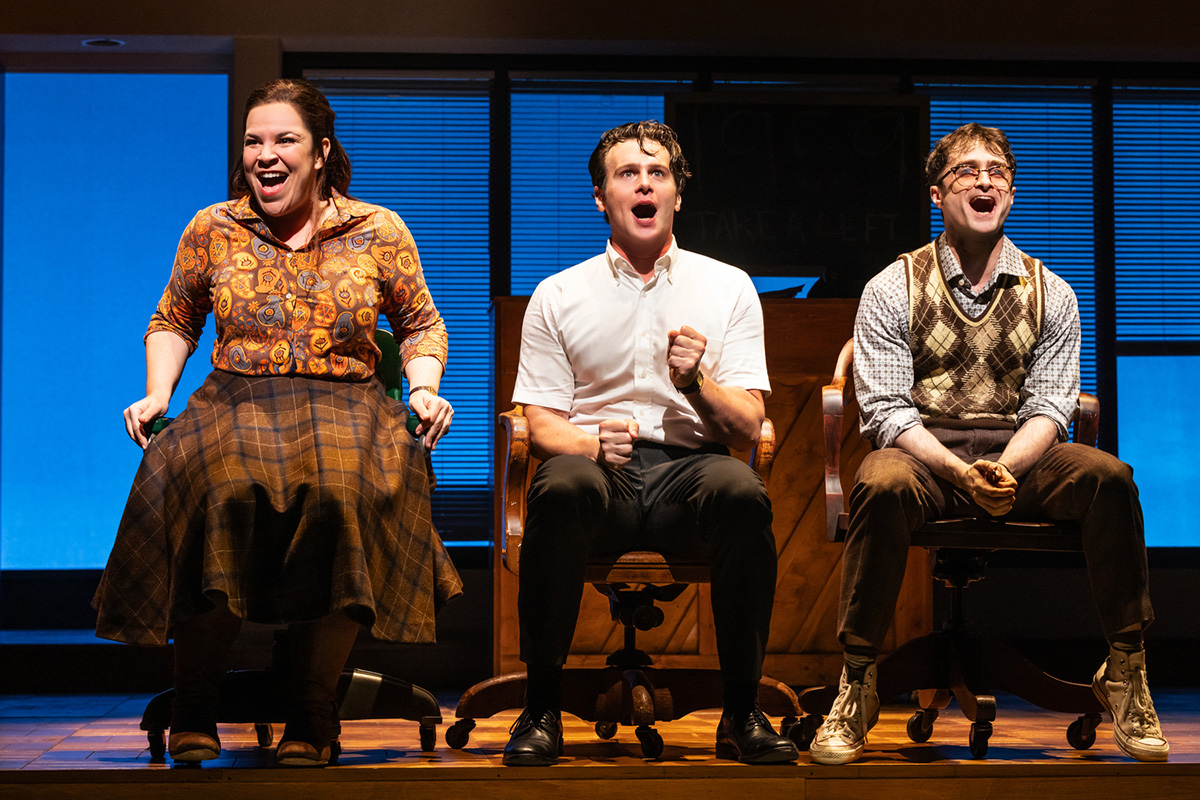
Fast forward to 2022, when renowned UK theater director Maria Friedman staged a new revival of the show in New York. In the interim, “Merrily” had undergone multiple rewrites and conceptual changes in an effort to “fix” its problems, abandoning the concept of using young performers and opting for a more “fleshed-out” approach to production design, and the show’s reputation, fueled by a love for its quintessentially “Sondheim-esque” score, had grown to the level of “underappreciated masterpiece.” Inspired by an earlier production she had helmed at home a decade earlier, Friedman mounted an Off-Broadway version of the show starring Jonathan Groff, Daniel Radcliffe, and Lindsay Mendez – and suddenly, as one critic observed, Sondheim’s biggest failure became “the flop that finally flew.” The production transferred to Broadway, winning Tony Awards for Groff and Radcliffe’s performances, as well as the prize for Best Revival of a Musical, in 2024.
Sondheim, who died at 91 in 2021, participated in the remount, though he did not live to see its premiere, nor the success that officially validated his most “problematic” work.
Fortunately, we DO get the chance to see it, thanks to a filmed record of the stage performance, directed by Friedman herself, which was released in limited theaters for a brief run last year, but which is now streaming on Netflix – allowing Sondheim fans to finally experience the show in the way it was designed to be seen: as a live performance.
Embracing the conventions of live theatre into its own cinematic ethos, this record of the show gives viewers the kind of up-close access to its performances that is impossible to experience even from the front-row of the theatre – and they are impeccable. Groff’s raw and deeply deluded Frank Shepard, the ambitious composer who sells out his values and alienates his friends on the road to success and wealth; Radcliffe’s mawkishly loyal Charlie Kringas, who remains committed to the dream he shared with his best friend until he just can’t anymore; and Mendez’ heartbreaking perfection as Mary Flynn, the wisecracking good-time girl who rounds out their trio while concealing a secret passion of her own – each of them bring the kind of raw and vulnerable honesty to their roles that can, at last, reveal both the deep insights of Sondheim’s intricate lyrics and the discomforting emotional conflicts of Furth’s mercilessly brutal script.
Yes, it’s true that any filmed record of a live performance loses something in the translation. There’s a visceral connection to the players and a feeling of real-time experience that doesn’t quite come through; but thanks to unified vision that Friedman shepherded and instilled into her cast – including each and every one of the brilliant ensemble, who undertake the show’s supporting characters and embody “the blob” of show-biz hangers-on who are central to its cynical theme – what does come through is more than enough.
Honestly, we can’t think of another Sondheim screen adaptation that comes close to this one for embracing the raw truth that was always lurking just under the clever lyrics and creative rhyme schemes. For that reason alone, it’s essential viewing for any Sondheim fan – because it’s probably the closest we’ll ever get to having a “real” Sondheim film that lives up to the genius behind it.





Movies
‘The Stranger’ queers an existentialist classic
‘Gay male gaze’ anchors film’s visual aesthetic

When Albert Camus published “L’etranger” (“The Stranger”) in 1942, he was living in Nazi-occupied France, so it’s no surprise that it became one of the most celebrated “existential” novels of all time. A fascist regime is great for inspiring thoughts of an indifferent and meaningless universe.
It wasn’t his first experience with authoritarianism. Born to a working-class white European family in then-French Algeria, he grew up observing the harsh treatment of the native North Africans by the colonists who governed them. It was this personal history, amplified by the spread of European fascism, that found its voice in “The Stranger.” Short, terse, and shrouded in a cloak of ennui, it was his first novel – novella, really – but its impact was seismic.
Naturally, its influence has run through the world of cinema, and, it has been translated to the screen three times — most recently by French filmmaker François Ozon, whose screen version won acclaim at last year’s Venice Film Festival, and is now available for on-demand streaming in the U.S.
Ozon’s vision is captured in gleaming black-and-white, blending the luster of modern-day faux-vintage fashion photography with the nostalgic flavor of classic era “arthouse” and European cinema, and it maintains a largely faithful connection to Camus’s novel, at least in terms of plot. It’s the story of Meursault (Benjamin Voisin), a French settler living in the capital city of Algiers, who receives word that his mother has died. He takes time off from work, traveling to the nursing home – where he had sent her three years before – in order to attend her funeral, but remains seemingly emotionless throughout, prompting members of the staff and other residents to mark his apparent lack of customary grief.
When he returns to Algiers, he encounters Marie (Rebecca Marder), a former co-worker, and after spending the day together, the two become romantically involved. Their relationship continues over the next few weeks, while they also associate with Meursault’s neighbor Raymond (Pierre Lottin) – a suspected pimp who, after beating his Arab mistress, is being followed and harassed by her brother (Abderrahmane Dehkani) and his friends. After a skirmish with the Arabs, Meursault encounters the brother alone during a walk on the beach, and shoots the young man dead with a pistol given to him for protection by Raymond. On trial for murder, he offers no defense and expresses no remorse. He is convicted and sentenced to death, facing it all with emotional detachment, and seeming to find liberation in the recognition that none of it matters, anyway.
Though it’s a tale that includes romance, murder, and courtroom drama, it feels like a story in which nothing really happens – which is, of course, the perfect effect to emphasize the point of Camus’s philosophical viewpoint; but while that might satisfy the kind of viewers drawn to a film of a Camus novel, Ozon’s movie probably won’t hold much appeal for audiences seeking action, suspense, feel-good sentiment, or easy answers to the moral dilemmas that come hand-in-hand with being alive. Camus was interested in the opposite effect, a confrontation with existence which leaves no room for comfortable denials, and Ozon’s inflection on the original’s themes makes no effort to soften the blow.
What it does, however, is introduce – without having to adjust the narrative provided by Camus – an element of queerness that lends the whole story a new layer of subtext through what can only be described as the “gay male gaze” that anchors the film’s visual aesthetic.
It’s in the way the camera – aimed by Ozon and cinematographer Manu Dacosse – remains fixated on its star, the exquisitely beautiful Voisin, lingering on his face, his frame, or his body in swim trunks. There’s a sensuality in the way the director shows us female beauty, too, but it’s never framed as the “object” of desire; and in the narrative’s key scene – the killing by the sea – there’s an inescapable element of repressed homoeroticism, born perhaps by associations with the mid-20th-century queer aesthetic of writers like Jean Genet or artists like George Quaintance, or pretentiously artsy commercials for high-end men’s cologne, or just from real-life memories of cruising on the beach. On the surface, Meursault gives no sign of queerness; but the emphasis that Ozon brings to the story – almost purely through visual suggestion – lends the character, already an outsider to the world of “normal” human experience in the first place, an even deeper sense of “otherness.”
As to that, Voisin’s performance is effective for reasons beyond his model-esque physical perfection; there’s a vast inner life happening under that pretty face, and the actor conveys it with a “less-is-more” approach that aligns perfectly with the character’s dissociation from conventional humanity. He’s compelling enough to engage us, and intelligent enough in his expression of Camus’ ideas to help us grasp them even as he makes us feel them – and frankly, that’s saying a lot.
The rest of the cast is effective, as well, though most of them serve primarily as a foil to reflect Voisin and his character. Marder brings a relatably savvy-yet-romantic presence as Marie, and Lottin gives Raymond a kind of louche charisma that evokes a brand of appealing-but-toxic masculinity. Swann Arlaud also stands out as the prison priest who attempts to convert Meursault on the eve of his execution, bearing the full brunt of Camus’ existentialist arguments in a scene that somehow taps into transgressive homoerotic fantasies even as its characters discuss impending death.
Camus, for his part, did not see himself as an existentialist; instead, he embraced and promoted a viewpoint in which human life is defined by its relationship with what he called “The Absurd” – the gap between reality and our assumed expectations about it, where our circumstances and behavior become obviously ridiculous – and believed that, in a meaningless universe, we are free to find our own meaning. An essay he published around the same time (“The Myth of Sisyphus”) posited that finding happiness in the struggle was perhaps the most logical response to facing an unfeeling world, and the Absurdist movement he helped to define used humor – albeit often the dark and sardonic variety – as a means to expose the madness of trying to impose sense on a nonsensical world. In the end, his writings reveal him as a deeply humanistic thinker, whose acceptance of objective reality served only to deepen his dedication to the ideal of a better mankind.
Whether or not any of that comes across in Ozon’s artful film, which emphasizes the immediacy of experience – the beach, the sea, the sun, the visceral responses we get from sex or violence – over the intellectual arguments that Camus would elucidate throughout his life, probably depends on one’s own grasp of Existentialist thinking and its offshoots. In any case, while Ozon’s “The Stranger” might fall short in the challenge to convey its philosophical arguments, it more than succeeds as a stylish piece of international art cinema, and it just might – hopefully – inspire audiences to go on a deeper dive into the mind of Albert Camus.
And even if it doesn’t, it’s still pretty to look at.
Movies
Quest for fame becomes an obsession in entertaining ‘Lurker’
Psychological thriller explores the dynamics of power and control

It was nearly 60 years ago when über-queer icon Andy Warhol pronounced to the world his prediction that “in the future, everyone will be famous for 15 minutes.” While it may have been an overstatement, we’re now experiencing the future he was talking about; and though it remains statistically impossible for “everybody” to achieve fame, that doesn’t mean that we can’t all “feel” like we’re famous. If social media has delivered any gift to the human race, that might just be it.
In the real-life dystopia that is 2026, Warhol’s 1967 quip has become a kind of cultural mantra: influencers are more famous than movie stars, podcasters can shape political policy, and anybody with a “hot take” can change the way we perceive even the most fundamentally held opinions. Whether or not this is progress is probably a moot point; it’s the reality we live in, and we have a government full of “cosplaying” charlatans to prove it.
That’s why Alex Russell’s “Lurker” – a 2025 Sundance favorite that’s now streaming on HBO Max after a limited theatrical run last summer – cuts so close to the quick. A psychological thriller exploring the dynamics of power and control within the entourage of a rock star, it strikes some uncomfortably familiar chords for an era when “bootlicking” seems to have become a national pastime.
It centers on Matthew (Théodore Pellerin), a young Angeleno who lives in his grandmother’s apartment and works in a trendy designer boutique on Melrose Avenue. When rising pop musician Oliver (Archie Madekwe) brings his entourage to the store one afternoon, Matthew sees a chance to make an impression; plugging his phone into the shop’s sound system, he plays a song that he knows the pop star admires – and minutes later, he’s been given a backstage pass to Oliver’s next concert and invited to hang out with the star himself.
Their relationship continues to develop quickly at the show. Though he’s met at first with some discomfortable hazing from members of the entourage, by the end of the evening he’s on his way to becoming part of the inner circle. Chosen by Oliver to become his “official documentarian,” he’s soon a fixture in the entourage himself, sparking jealousy from members higher in the “pecking order” than he is; but Matthew is better at the game than they suspect, and despite their attempts to keep him in his place, he uses his proximity to Oliver – and a few surgically precise acts of sabotage – to rise quickly to the top.
Staying there, however, is not so easy. Within the volatile social politics of the entourage, he must always be on guard, and his efforts to thwart others from displacing him become increasingly ruthless. Eventually, he crosses a line, resulting in a fall from Oliver’s grace and his ejection from the group; but being close to fame leads to its own kind of fame, and Matthew has worked too hard to give it up so easily – even if it means using his Machiavellian powers to go after Oliver himself.
Slick, stylish, and as hypervisual as any viral pop music video you can imagine, Russell’s sardonically amoral exploration of fame – or rather, the desire for it – is as much a satire as it is a psychological drama, but it plays like a horror movie. Matthew is a protagonist cut from the same cloth as the title character of “The Talented Mr. Ripley,” a schemer whose endearingly awkward appearance masks a devious purpose and a diabolical mind. Oliver, whose creativity seems more about his “vibe” than his actual music, is charismatic but aloof, beneficent but mercurial, and seemingly blind to the massive ego that hides beneath his “chill” persona. There’s a kind of tension between these two characters that feels distinctly romantic, even homoerotic, and though it’s expressed only through subtext, it provides a palpable edge that makes their relationship feel dangerous – as if this were a love story in which anyone who tries to come between them is likely to get hurt.
As to what they actually feel about each other, “Lurker” keeps quiet about it. Matthew “reads” like a queer character, but his inner life is never revealed to us save through the conclusions we can draw from his behavior, and Oliver seems so much in love with himself that nobody else can compare; even so, there’s something between them that plays as much more intimate than the enthusiastic “bro”-ish affection that they exhibit together.
In the end, however, the “love story” here is not about romance, nor even sex; it’s about fame. Matthew, even if his own creative talents may be more solid than Oliver’s, is enamored primarily with fame; perhaps he longs for importance, for a life of more excitement and opportunity than his thankless existence as a low-level retail employee, and as the movie proceeds it becomes clear that he is willing to go as far as he has to go in order to achieve it. For Oliver, maybe it’s about the longing of the famous for something more than sycophantic lip-service, for finding the adulation of his fans personified in an authentic, tangible, and individual form. Whatever it is, there’s very little love involved.
Of course, there’s an unavoidable comparison to be made between the mentality on display in “Lurker” with the prevailing trend in our American consciousness, in which performative loyalty and opportunistic friendship feel like the order of the day; from the fickleness of “fan culture” to the escalation of outrage-baiting on social media to the barely-concealed cutthroat narcissism on daily display in our very government, the message that comes through loud and clear is a chilling throwback to the Reagan-era “greed is good” philosophy: loyalty, feelings, and friendship are for suckers, and the most vicious player is the winner who takes it all.
As usual in a character-driven piece like this one, it’s ultimately the actors who make it work; Pellerin (a Canadian actor who won his country’s equivalent of an Oscar for “Family First” in 2018) is the lynch pin, and he delivers such an endlessly fascinating portrait of obsessively determined duplicity that we find ourselves rooting for him even as we recoil from the coldness of his tactics; Madekwe (“Saltburn”) captures the vapid pretension of a pop artist who has faked his way to success, but infuses Oliver with enough well-meaning sincerity that we can still feel a little bit sorry for him. In a smaller role, Hannah Rose Liu (“Bottoms”) makes an impression as the manager who keeps Oliver’s life running, offering an anchor of relative sanity in a sea of madness.
Russell’s taut and tantalizingly opaque screenplay manages to capture all these things and more into a compact narrative that keeps us engaged while weaving its observations seamlessly into the plot, and his direction – which somehow yields an expansive scope through an intimate and sometimes frenetic focus – reinforces the unpredictable instability of fame, status, power, and the social hierarchy that governs them all. There are occasionally twists that feel a bit too convenient to be believable, but all in all, it’s a solid piece of cinematic workmanship.
Movies
‘Spaced out on sensation’: a 50-year journey through a queer cult classic
Excellence of ‘Rocky Horror’ reveals itself in new layers with each viewing

Last week’s grab of nine Tony nominations for the new Broadway revival of “The Rocky Horror Show” – coming in the midst of the ongoing 50th anniversary of the cult-classic movie version – seems like a great excuse to look back at a phenomenon that’s kept us “doing the Time Warp” for decades.
It’s a big history, so instead of attempting a definitive conclusion about why it matters, I’ll just offer my personal memories and thoughts; maybe you’ll be inspired to revisit your own.
First, the facts: Richard O’Brien’s campy glam-rock musical became a London stage hit in 1973; that success continued with a run at Los Angeles’s Roxy Theatre in 1974, and a Broadway opening was slated for early 1975. In the break between, the movie was filmed, timed to ride the presumed success of the New York premiere and become a mega-hit – but it didn’t happen that way. The Broadway show closed after a mere handful of performances, and the movie disappeared from theaters almost as soon as it was released.
This, however, was in the mid-1970s, when “cult movies” had become a whole countercultural “scene,” and the film’s distributor (20th Century Fox) found a way to give “The Rocky Horror Picture Show” another chance at life. It hit the midnight circuit in 1976, and everybody knows what happened after that.
When all of this was happening, I was still a pre-teen in Phoenix, and a sheltered one at that. It wasn’t until 1978 – the summer before I started high school – that it entered my world. Already a movie fanatic (yes, even then), I had discovered a local treasure called the Sombrero Playhouse, a former live theater converted into an “art house” cinema; my parents would take me there and drop me off alone (hey, it was 1978) for a double feature. I remember that place and time as pure heaven.
It was there that “Rocky Horror” found me. The Sombrero, like so many similar venues across the country, made most of its profits from the midnight shows, and “The Rocky Horror Picture Show” was the star attraction. I saw the posters, watched the previews, got my first peeks at Tim Curry’s Frank, Peter Hinwood’s Rocky, and all the rest of the movie’s alluringly “freaky” cast; when I came out of the theater after whatever I had watched, I would see the fans lining up outside for the midnight show. I could see their weird costumes, and smell the aroma I already knew was weed, and I knew this was something I should not want to have any part of – and yet, I absolutely did.
After I started high school and found my “tribe” with the theater kids, I was invited by a group of them – all older teenagers – to go and see it. I had to ask my parents’ permission, which (amazingly) they granted; they even let me ride with the rest of the “gang” in our friend’s van – with carpeted interior, of course – despite what I could see were their obvious misgivings about the whole situation.
It would be over-dramatic to say that night changed my life, but it would not be wrong, either. I was amazed by the atmosphere: the pre-movie floor show, the freewheeling party vibe, the comments shouted at the screen on cue, the occasional clatter of empty liquor bottles falling under a seat somewhere, and that same familiar smell, which delivered what, in retrospect, I now know was a serious contact high.
As for the movie, I had already been exposed to enough “R” rated fare (the Sombrero never asked for ID) to keep me from being shocked, and the gender-bent aesthetic seemed merely a burlesque to me. I was savvy enough to see the spoof, to laugh at the lampooning of stodgy 1950s values under the guise of a retro-schlock parody of old-school movie tropes; I “got it” in that sense – but there was so much about it that I wasn’t ready to fully understand. Because of that, I enjoyed the experience more than I enjoyed the film itself.
I’m not sure how many times I saw “Rocky Horror” over the next few years, but my tally wasn’t high; I drifted to a different friend group, became more active in theater, and had little time for midnight movies in my busy life. I was never in a floor show and rarely yelled back at the screen (though I did throw a roll of toilet paper once), and I didn’t dress in costume. Even so, I went back to it periodically before the Sombrero closed permanently in 1982, and as I gradually learned to embrace my own “weirdness,” I came to connect with the weirdness that had always been calling me from within the movie. Each time I watched it, I did so through different eyes, and they saw things I had never seen before.
That process has continued throughout my life. I’ve frequently revisited “Rocky” via home media (in all its iterations) and special screenings over the years, and the revelations keep coming: the visual artistry of director Jim Sharman’s treatment; the dazzling production design incorporating nods to iconic art and fashion that I could only recognize as my own knowledge of queer culture expanded; the incomparable slyness of Tim Curry’s unsubtle yet joyously authentic performance; the fine-tuned perfection of Richard O’Brien’s ear-worm of a song score. The excellence of “The Rocky Horror Picture Show” revealed itself in new layers with every viewing.
There were also more intimate realizations: how Janet was always a slut and Brad was always closeted (I related to both), and how Frank’s seduction becomes the path to sexual liberation for them both; how Rocky was the “Über-Hustler,” following his uncontrolled libido into exploitation as a sex object while only desiring safety and comfort (I related to him, too), and how the “domestics” were driven to betray their master by his own diva complex (I could definitely relate to both sides of that equation). How Frank-N-Furter, like the tragic Greek heroes that still echo in the stories we tell about ourselves, is undone by hubris – and anybody who can’t relate to that has probably not lived long enough, yet.
The last time I watched (in preparation for writing this), I made another realization: like all great works of art, “The Rocky Horror Picture Show” is a mirror, and what we see there reflects who we are when we gaze into it. It’s a purely individual interaction, but when Frank finally delivers his ultimate message – “Don’t dream it, be it” – it becomes universal. Whoever you are, whoever you want to be, and whatever you must let go of to get there, you deserve to make it happen – no matter how hard the no-neck criminologists and Nazi-esque Dr. Scotts of the world try to discourage you.
It’s a simple message – obvious, even – but it’s one for which the timing is never wrong; and for the generations of queer fans that have been empowered by “The Rocky Horror Picture Show,” it probably feels more right than ever.

Time travelers from the AIDS era

Ghanaian lawmakers approve anti-LGBTQ bill

‘The Stranger’ queers an existentialist classic

Nine Russian LGBTQ groups deemed ‘extremist’ banned

D.C. Pride flag raising ceremony set for June 1

Peppermint made her mark on ‘Drag Race.’ Now, her advocacy is front and center

From Media Matters to massive queer ragers: the rise of Tara Dikhof

Bree Fram’s congressional campaign ends but her fight continues

Why this Black Pride, I ranked Janeese Lewis George #1 for D.C. mayor

Kenyan High Court issues landmark transgender rights ruling
-

 Celebrity News5 days ago
Peppermint made her mark on ‘Drag Race.’ Now, her advocacy is front and center
-
a&e features5 days ago
From Media Matters to massive queer ragers: the rise of Tara Dikhof
-
2026 Midterm Elections4 days ago
Bree Fram’s congressional campaign ends but her fight continues
-
Opinions5 days ago
Why this Black Pride, I ranked Janeese Lewis George #1 for D.C. mayor