Sports
Sports leagues lend a hand in fight for LGBT rights
Arizona, Indiana efforts boosted by NFL, NCAA
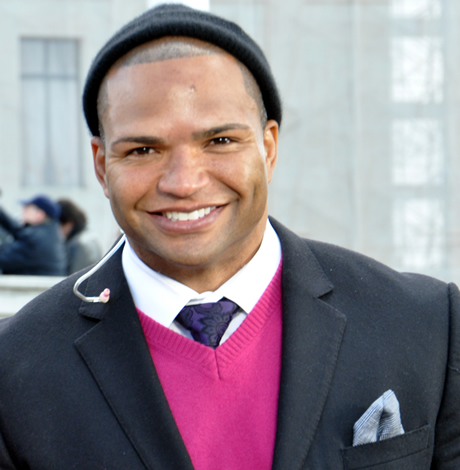
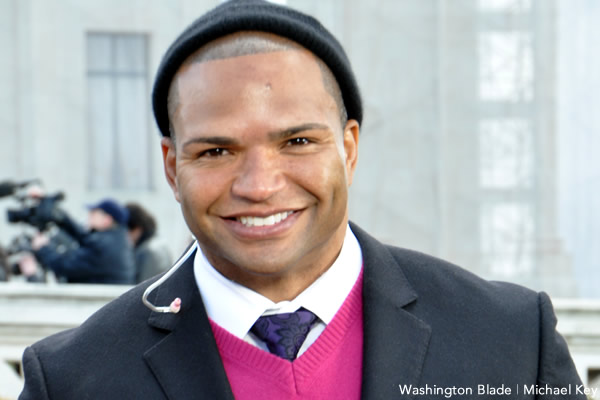
Former Ravens player Brendon Ayanbadejo is among high-profile pro athletes who’ve endorsed LGBT rights in recent years. He served as guest editor of the Blade Sports Issue two years ago. (Washington Blade photo by Michael Key)
As the LGBT community faces new challenges, including religious freedom measures seen to enable anti-LGBT discrimination, advocates have found a new ally in their fight: sports teams and related organizations.
In the past two years, professional and collegiate sports organizations helped derail measures that would have undermined LGBT rights in Arizona and Indiana. By speaking out, their statements aided efforts to combat the proposals.
Sarah Kate Ellis, president of GLAAD, said, “We’re seeing the sports landscape change” in terms of support for the LGBT movement.
“We’re seeing more and more professional leagues, and collegiate sports, actually take a stand for LGBT fans and players,” Ellis said.
In Arizona last year, the state legislature sent to Gov. Jan Brewer’s desk SB 1062, a controversial bill that would have enabled businesses and individuals to discriminate against LGBT people in the name of religious freedom.
Brewer vetoed the bill after a media firestorm and opposition from Republicans like Mitt Romney, Newt Gingrich, John McCain and Jeff Flake. Key opposition came from the National Football League, which at the time was planning to host Super Bowl XLIX in Scottsdale, Ariz.
As controversy over the measure intensified, the Arizona Super Bowl host committee issued a statement saying it disagreed with the bill and voiced concerns about its impact on America’s economy.
“On that matter we have heard loud and clear from our various stakeholders that adoption of this legislation would not only run contrary to that goal, but deal a significant blow to the state’s economic growth potential,” a committee spokesperson said. “We do not support this legislation.”
Catherine Alonzo, co-chair of Equality Arizona, said the contributions from the NFL and sports teams were “really important” in defeating SB 1062.
“It really was this diverse upsurge of people…who weren’t necessarily traditionally involved in the movement, but stood up and said, ‘This is wrong,'” Alonzo said. “The sports teams were part of this overwhelming diverse response.”
Alonzo said it’s “difficult to know” if Brewer would have vetoed the bill anyway without help from the Super Bowl organizers, but she maintained the support of the NFL “can’t be overstated.”
The situation repeated itself this year in Indiana with SB 101, except this time the firestorm didn’t emerge until after Indiana Gov. Mike Pence signed the measure into law. The controversy that later ensued prompted him to sign a fix clarifying the law won’t enable LGBT discrimination in the state in most situations.
Among the critics of the initial law was Mark Emmert, president of the National Collegiate Athletic Association, which is based in Indianapolis and was planning on hosting the Men’s Final Four basketball tournament in Indiana that year.
“We will work diligently to assure student-athletes competing in, and visitors attending, next week’s Men’s Final Four in Indianapolis are not impacted negatively by this bill,” Emmert said. “Moving forward, we intend to closely examine the implications of this bill and how it might affect future events as well as our workforce.”
Another critic of the Indiana measure was retired basketball star Charles Barkley, who called the law “unacceptable” and said officials should move the Final Four out of the state. Moving the tournament would have resulted in a loss of an estimated $70.8 million in revenue from Indiana.
David McFarland, founder of the Los Angeles-based United for Equality in Sports & Entertainment, said the events in Arizona and Indiana demonstrate the power of sports to influence people on LGBT rights.
“What we saw play out in Indiana and Arizona is how sport can act as a universal language and a common denominator that has the ability to break down walls and barriers to create social impact and change that can help violations against LGBT people,” McFarland said.
Before Arizona and Indiana, sports teams haven’t been overtly opposed to LGBT rights, but support from those organizations in fights against religious freedom measures stand out because they provided a crucial element of support when LGBT rights were in danger.
Other efforts on behalf of LGBT rights include NFL players Chris Kluwe and Brendon Ayanbadejo filing briefs in support of litigation against California’s Proposition 8 before the Supreme Court in 2013. The four major men’s sports leagues — the NFL, the MLB, the NHL and the NBA — have enacted sexual orientation non-discrimination protections for players and workers (although gender identity protections remain omitted from those polices). WNBA enacted a similar policy.
Five major sports leagues — the NFL, the MLB, the NHL, the NBA and the WNBA — are among the organizations that coordinate with GLAAD for Spirit Day, an annual event each on Oct. 15 that encourages individuals to wear purple to express opposition to anti-LGBT bullying.
McFarland said the atmosphere within the sports world, however, is another matter entirely for LGBT people.
“Even though America’s cultural, social and political climate is becoming increasingly accepting of LGBT Americans, competing and participation in sports is still considered to be an unsettling environment for many LGBT people,” McFarland said. “In fact, many Americans believe homophobia and transphobia are more common in sports than in the rest of society.”
But just as sports organizations have helped the general public become more accepting of LGBT rights, LGBT advocates have pushed the sports community.
One example is the public transition this year of Caitlyn Jenner, the transgender athlete and TV personality who won the Olympic decathlon title in 1976 and this year won the Arthur Ashe Courage Award at ESPN’s annual ESPY awards show.
Ellis, who was in attendance during the ceremony, said Jenner’s speech helped change the hearts and minds of audience members at the high-profile award show.
“It turned those people you could see were uncomfortable and might be leaning over talking to their seat mates and sort of giggling and whatever people do when they feel discomfort [and] silence them,” Ellis said. “And I thought that was a pretty profound momentum in sports for this year, for this decade.”
LGBT advocates also continue pressing for openly LGBT players in the major leagues to enhance LGBT visibility.
Robbie Rogers, a Major League Soccer player for LA Galaxy, is currently the only openly LGBT player for a major sports team in the United States. Jason Collins, who came out as gay in 2013, played for a year with the Brooklyn Nets, but then retired. Michael Sam was drafted into the NFL, but never saw time on the field.
Just this week, David Denson, a first baseman with the Milwaukee Brewers minor league affiliate in Helena, Mont., came out as gay, but no active player in Major League Baseball is openly gay.
McFarland said having more openly LGBT players would have “tremendous impact” on visibility for the LGBT community, but acknowledged sports organizations aren’t yet in that place.
“Unfortunately, for too many LGBT young people the built in safety nets of support, acceptance and caring do not exist fully in sport,” McFarland said.
Another opportunity for the sports world to support the LGBT community may come in Houston, where LGBT advocates are fighting to pass an LGBT-inclusive non-discrimination ordinance at the ballot in November and the NFL is planning to host Super Bowl LI in 2017.
Ellis said the NFL has a similar opportunity to speak out in favor of the Houston Equal Rights Ordinance just as it came out against the Arizona religious freedom measure.
“I’m hoping that we’ll see the NFL again take a stand like they did in Arizona and send a message that the Super Bowl doesn’t belong in a place where there’s anti-LGBT discrimination allowed,” Ellis said.
The NFL didn’t respond to a request for comment this week on whether it would support HERO as it prepares for Super Bowl LI.
Alonzo said the ability of a sports team to carry a message of LGBT inclusivity to an audience that might otherwise not hear it will be important for any effort for LGBT advocates going forward.
“This is a fight that we’re all in together, and this is something that we’re all affected by whether it is a part of your daily life or not,” Alonzo said. “Sports teams have been really important in bringing that message to their fans and will continue to be.”



Sports
2 former NBA players launch cheap anti-trans stunt to exploit WNBA rules
Enes Kanter Freedom and Royce White are attempting to extend their finished sports careers through vague gender eligibility policy in the WNBA.

As transgender sports policy continues to make headlines, two former NBA players are attempting to use vague WNBA wording on players’ gender identity to extend their finished professional sports careers.
Enes Kanter Freedom and Royce White, two male former professional basketball players who have aligned themselves with the ‘far-right’ political spectrum, have announced that they plan to self-identify as transgender in order to meet the requirements to declare themselves eligible for the WNBA draft.
Freedom last played for the NBA in 2022, while White played his last professional game in 2018.
Both players have explicitly stated that this choice is an attempt to exploit the policy currently in place in the WNBA — one that assumes those who say they identify as transgender women are women — unlike what these two have done.
The WNBA’s collective bargaining agreement states that “only players who are women are eligible to play in the WNBA,” but it does not include more specific language about gender identity or sex assigned at birth, according to The Athletic, The New York Times’s sports publication.
Neither Freedom nor White has previously made any statements about being trans.
“If simply declaring who you are is all that’s required, then I meet every single requirement necessary to compete in the WNBA,” Freedom wrote on X. “Based on the current guidelines, I can and am officially declaring my eligibility for the upcoming WNBA draft in April 2027.”
Hours later, White made a similar statement to Fox News, emphasizing that this was solely an attempt to exploit the policy — an attempt at inclusion — and use it as a loophole to stay relevant in the sport he left in 2018.
“I’m transgender. I’m a woman. I identify as sometimes identifying as a woman for purpose of basketball, professional basketball, so I’ll be declaring for the WNBA draft in 2027 as well,“ White told Fox News. “I think I’d be unstoppable. But I’m a team-first guy. I’m a pass-first kind of player. I do the little things. I led my team in all five major stat categories at Iowa State University, so I do a little bit of everything. I’ll do whatever the coach needs me to do. I’ll do whatever the girls need me to do.”
White also said that he would be open to suing the WNBA if he were not allowed to be a part of the draft, while making transphobic comments about genitalia in the same breath.
“I think the WNBA could come out and make a definitive statement about guys with a pair of balls playing in the Women’s Association,“ White said, saying he doesn’t “want to be discriminated against.”
“I want fair treatment,” White continued while also using the opportunity to promote his run for the U.S. Senate seat in Minnesota. “I’m a young Black, hopefully United States Senator that would like a fair chance to participate as a sometimes-identifying-as-a-transgender-woman athlete.”
“We’re gonna have to have a huge legal battle about discrimination if I can’t play,” he added.
White has made multiple failed attempts to run for office as a Republican since leaving the NBA, with statements surrounding conspiracy theories and his support for Trump coming under fire.
He has faced court actions after falling behind on court-mandated child support payments and has faced family repercussions for his political activities.
White’s grandfather has distanced himself from White, stating: “There’s no way I can support my grandson supporting the GOP, and in essence, Trump.”
In response to Freedom’s X post and White’s announcement, the Women’s National Basketball Players’ Association, the players’ union for the WNBA, released a statement doubling down on its commitment to inclusivity in the sport.
“We embrace justice, equity, diversity, and inclusion. Those are the values that unite this Union and allow it to protect women’s sports while creating transformational change,” the statement said in a post on Instagram.
“Hate, abuse, and demonization of any person or group of people, including transgender people, only fuel fear, division, and harm. We will continue to have hard conversations,” the post continued. “But we will not be used as political pawns.”
The statement comes just days after WNBA Commissioner Cathy Engelbert sent a memo to teams attempting to address ongoing discussions around transgender athletes in women’s basketball.
“I know many of you have received questions in recent weeks regarding transgender athlete participation in women’s basketball, and I expect this topic will continue to receive significant attention,” Engelbert wrote in the memo, which was sent Friday afternoon and published in the Associated Press. “I wanted to reach out to share how we are approaching these conversations at the league office and to thank those of you who have responded to questions from the media with thoughtfulness and professionalism.”
“We recognize that this is a complex and nuanced topic, and we will continue to have important conversations with all of you and the Players Association in the weeks and months ahead,” Engelbert said. “We also plan to convene additional discussions and offer listening sessions for any team leaders who would like to participate. Your perspectives and feedback are invaluable, and I appreciate those who have already reached out to share their thoughts.”
The memo, which does not clarify whether the league’s stance on gender eligibility will change or what the ongoing conversations have looked like, comes as political figures — particularly those on the right — continue to fuel debates over transgender participation in women’s sports across the country and across sports.
Republican Florida Gov. Ron DeSantis also commented on the ongoing eligibility meetings the WNBA is holding, using the issue to criticize transgender participation in women’s sports.
“WNBA meeting to decide whether 2+2=4 or 2+2=5,” Desantis wrote on X on Saturday.
Indiana Fever player Sophie Cunningham voiced support for barring transgender girls and women from girls’ and women’s sports. Cunningham’s comments sparked small rallies and protests in Seattle and Portland when the Fever were on the road last week.
Despite the loudest voices — and those being covered by non-LGBTQ outlets — highlighting negative takes on transgender inclusion on female sports teams, multiple WNBA members have voiced their support for transgender women participating in sports.
Seattle Storm center Stefanie Dolson and Minnesota Lynx coach Cheryl Reeve have used their platforms to continue their vocal support for transgender women participating in sports.
“We need to protect trans kids,” Reeve said on Aug. 1. “To me, it’s a human rights issue. Every kid has a right to sports.”
A source familiar with the league told the Blade that the WNBA is not taking Freedom and White’s announcements seriously and is not entertaining what the source characterized as bad-faith efforts to demonize the transgender community. The source emphasized that there are no serious or immediate eligibility issues involving the two men and said their attempts to enter women’s sports do not represent an effort to protect women’s sports.
“The WNBA will not allow bad-faith publicity stunts designed to mock or demean others to dictate serious conversations about league policy,” the source told the Blade on Tuesday. “There are no immediate eligibility issues affecting the WNBA.”

Iran and Egypt on Friday faced off during the World Cup’s “Pride Match” in Seattle.
Iran is among the handful of countries in which consensual same-sex sexual relations remain punishable by death. Discrimination and persecution based on sexual orientation and gender identity is commonplace in Egypt.
Friday’s match coincided with Pride weekend in Seattle. The Egyptian Football Association and the Football Federation Islamic Republic of Iran both objected to playing in the “Pride Match.”
Egypt and Iran tied 1-1.
FIFA, for its part, allowed Pride flags inside the stadium during the match.
“The FIFA World Cup 2026 is an inclusive event that welcomes people from all backgrounds,” a FIFA spokesperson told the Washington Blade in a statement. “Fans of all sexual orientations and gender identities are welcome at matches and events. General statements of human rights, including rainbow flags and other flags representing sexual orientation and gender identity, are permitted under the FIFA World Cup 2026™ Stadium Code of Conduct and may be displayed inside stadiums provided they are used in a manner consistent with the code.”
Human Rights Watch welcomed FIFA’s decision to allow Pride flags inside the stadium. Outright International, a global LGBTQ and intersex rights group, distributed Pride flags in Seattle on Friday, which was Pride Match Day.
“Visibility matters,” said Outright International Executive Director Maria Sjödin. “Pride is now being celebrated in more than 100 countries, including this weekend in Seattle. For many LGBTIQ people, seeing a Pride flag in public is a reminder that they are not alone, and that their rights and dignity are recognized.”
FIFA President Gianni Infantino earlier this year told Die Weltwoche, a Swiss magazine, that “there will be no ‘Pride Match’ at the (FIFA) World Cup.”
“There will be a FIFA World Cup match in Seattle, and on the same day, events organized by external organizations will be taking place in the city,” said Infantino. “But that has nothing to do with the match itself.”
Peter Tatchell, a long-time LGBTQ activist from the U.K. who is director of the Peter Tatchell Foundation, was among those who traveled to Seattle for Friday’s match. Tatchell accused FIFA of not vetting World Cup teams — specifically Iran, Egypt, Saudi Arabia, Ghana, Senegal, Qatar, Tunisia, Morocco, Iraq, Uzbekistan, and Algeria — over whether they would allow gay players.
“FIFA is protecting LGBT+ visibility in the stands while failing to protect LGBT+ players on the pitch,” said Tatchell.
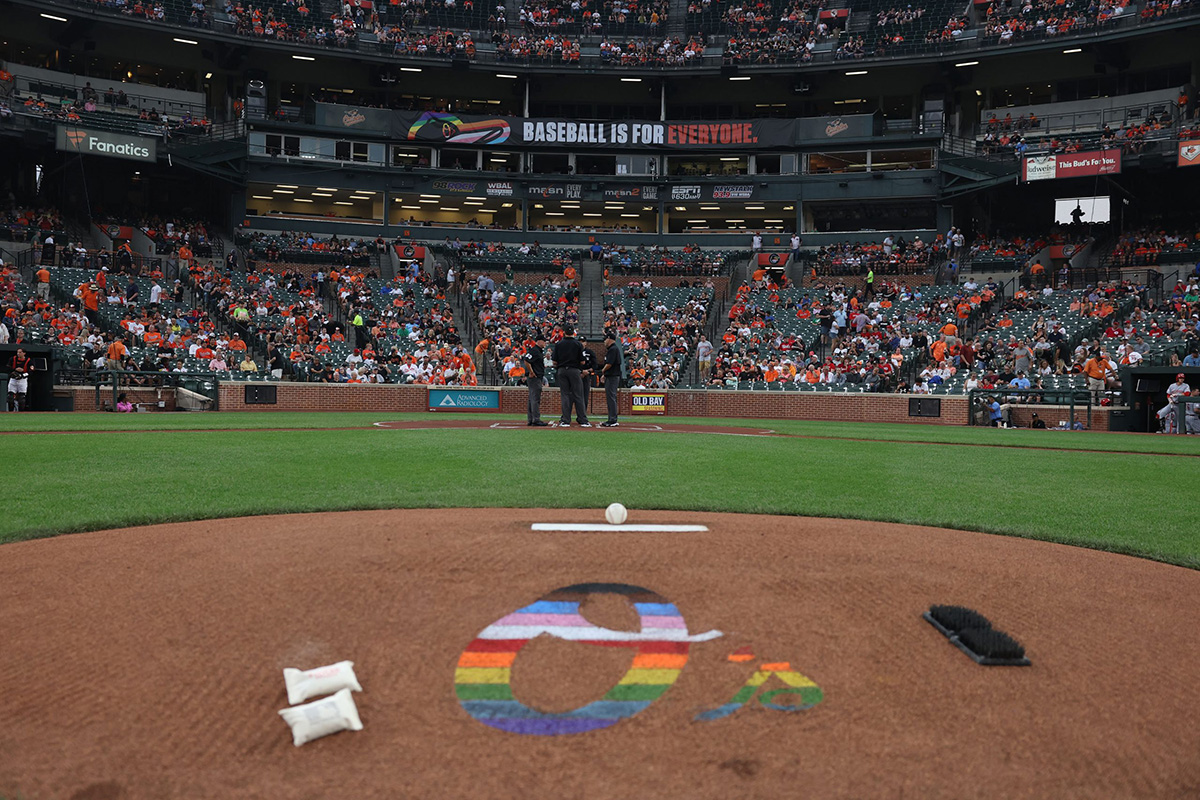
The Baltimore Orioles will take on the Washington Nationals on Friday, June 26 at 7 p.m. for Pride Night at Oriole Park.
The first 15,000 fans will receive an exclusive Pride Night Orioles jersey. The Washington Blade is a media sponsor of this event.
To purchase tickets, visit Orioles.com/Tickets.

White House press pool pushes back after Trump bars three outlets

PHOTOS: Shenandoah Valley Pride

Long-time DignityUSA executive director announces retirement

PHOTOS: Walk and 5K to End HIV

PHOTOS: Wanda Alston Foundation Fall Reception

Gun reform is an LGBTQ rights issue

All the queer things to watch this fall

Parties, dinners, concerts and more on tap for fall nightlife

Jeremy Moss looks to bring LGBTQ advocacy from Lansing to Capitol Hill