National
Cain ignites firestorm with remarks on gays
Surging in polls, pizza magnate says homosexuality a choice
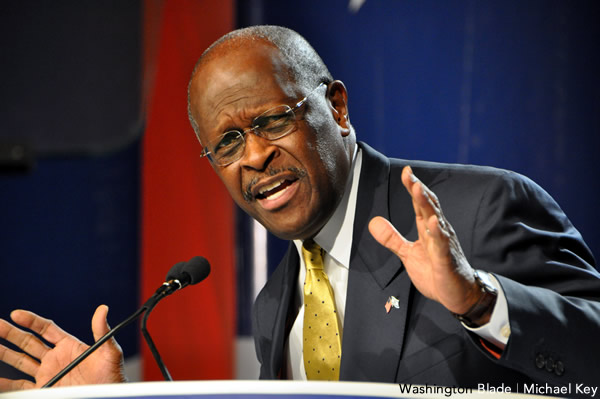
Herman Cain (Washington Blade photo by Michael Key)
Republican presidential candidate Herman Cain made headlines this week, after saying that homosexuality is a choice, just as a new poll showed him moving into a tie for second place for the GOP nomination.
Cain, former CEO of Godfather’s Pizza, came under fire from LGBT advocates for indicating on Tuesday he believes people can choose their sexual orientation.
During an appearance on ABC’s “The View,” when asked by host Joy Behar whether he believes being gay is a choice, Cain replied, “Yes.”
“Well, you show me the science that it’s not and I’ll be persuaded,” Cain said. “Right now it’s my opinion against the opinions of others who feel differently. That’s just a difference of opinions.”
Cain’s remarks ignited a firestorm among many LGBT groups who called on the presidential hopeful — as well as other GOP candidates — to repudiate his remarks.
Joe Solmonese, president of the Human Rights Campaign, said in a statement that Cain’s remarks are “frankly, jaw-dropping and certainly unbecoming of a presidential hopeful.”
“Leading medical organizations, including the American Psychological Association, the American Medical Association and the American Psychiatric Association, all speak with a loud and clear voice — implying that someone’s sexual orientation can be chosen or changed is dangerous,” Solmonese said.
Solmonese said HRC is eager to connect Cain with medical professionals at these association to guide him through the basic science he said he seeks.
Jack Drescher, a distinguished fellow of the American Psychiatric Association and a member of the DSM-5 Workgroup on sexual and gender identity disorders, said he’s willing to meet with Cain to talk about the medical aspects of the issue.
“Herman Cain’s opinion that being gay is a choice has no basis in current scientific thinking,” Drescher said. “Not only is homosexuality ‘not a choice,’ as most efforts to try and change a person’s sexual orientation fail, but some attempts to change can cause harm and damage to an individual’s well-being.”
LGBT groups representing conservative and Republican interests had different takes on Cain’s remarks.
R. Clarke Cooper, executive director of Log Cabin Republicans, also criticized Cain and said the organization would be happy to show him the science proving sexual orientation isn’t a choice.
“An individual’s orientation is no more a choice than the color of his skin or whether he is left-handed, and too many people have been hurt because of failed attempts to change the way they were born,” Cooper said.
But Chris Barron, chair of GOProud, defended Cain and said his remarks don’t reflect the candidate’s true position on LGBT issues.
“The attacks levied by the gay left and their allies at Log Cabin against Mr. Cain are despicable,” Cain said. “My partner and I have sat down with Herman Cain and talked with him about issues that are important to gay people, and I can tell you first hand that anyone or any organization that claims that Herman Cain is anti-gay is simply lying or doesn’t know the man at all.”
The attacks on Cain come as a new Washington Post/ABC News poll published Tuesday finds him gaining ground among the GOP candidates, with former Massachusetts Gov. Mitt Romney once again at the head of the pack.
Among responders who leaned Republican, Romney led the pack with 21 points and Cain was tied with Texas Gov. Rick Perry at 14 points. Among all registered voters, Romney led with 20 points while Cain and Perry both had 15 points.
Once the front-runner upon his entry into the race, Perry is now tied for second-place with Cain. The Washington Post reported Perry’s slide comes after “several uneven performances” in presidential debates and in response to renewed media emphasis on immigration policies in his state. In Texas, colleges allow the children of illegal immigrants to pay in-state tuition rates.
Sean Theriault, a gay political scientist at the University of Texas, Austin, dismissed a reading of the poll as showing new strength for Romney.
Theriault noted Romney’s numbers hadn’t changed since earlier polling and the Massachusetts governor is only ahead now because of falling numbers for Perry.
“Perry is not doomed,” Theriault said. “Quite the contrary. A strong debate performance, a couple of good weeks of positive news and he’d be back on top. Romney’s numbers have been at 25 since the day he dropped out of the Republican primary in 2008. That’s a pretty strong ceiling effect.”
In related news, two high-profile Republicans who were thought to be possible entries in the presidential race officially announced they wouldn’t seek the nomination in 2012.
Former Alaska Gov. Sarah Palin, the GOP vice-presidential nominee in 2008, announced in a letter to supporters on Wednesday that she wouldn’t seek the nomination for the White House in 2012.
“I believe that at this time I can be more effective in a decisive role to help elect other true public servants to office from the nation’s governors to congressional seats and the presidency,” Palin said.
New Jersey Gov. Chris Christie also announced this week that he wouldn’t join the pack of Republican candidates seeking to oust President Obama from the White House.
“Now is not my time,” said Christie at a news conference in Trenton, N.J., adding, “New Jersey, whether you like it or not, you’re stuck with me.”
Christie is reviled by many LGBT rights supporters for having pledged to veto any legislation that would legalize same-sex marriage in New Jersey.
But in January, Christie signed into law one of the nation’s strongest anti-bullying bills. The law was inspired by the death of Rutgers University student Tyler Clementi, who committed suicide after his roommate secretly recorded a sexual encounter he had with another man.






2026 Midterm Elections
Chris Pappas wins NH Democratic Senate primary
Gay congressman running to succeed retiring U.S. Sen. Jeanne Shaheen

New Hampshire Congressman Chris Pappas on Tuesday won the Democratic primary in the race to succeed retiring U.S. Sen. Jeanne Shaheen (D-N.H.) in the U.S. Senate.
Pappas defeated Karishma Manzur, who was his primary challenger, by a 61.8-36.1 percent margin.
The gay congressman will face off against former U.S. Sen. John E. Sununu, who defeated former U.S. Sen. Scott Brown in the Republican primary.
“Tonight’s victory sends a clear message that voters are looking for leaders who will fight for their rights, their freedoms, and to be treated with dignity and respect,” said Human Rights Campaign President Kelley Robinson in a statement.
She campaigned for Pappas in Manchester, New Hampshire’s largest city, on Aug. 30.
“Chris Pappas has delivered results, stood up for equality, and showed up for the people he serves,” said Robinson in her statement. “HRC was proud to mobilize Equality Voters across New Hampshire to help power this win. We don’t have a second to waste between now and November. We look forward to continuing our work with Rep. Pappas as he drives toward victory in November so he can help return a pro-equality majority to the United States Senate.”
A poll the University of New Hampshire Survey Center released on Aug. 26 showed Sununu ahead of Pappas by a 45-43 percent margin if they were to face off in the general election. The margin of error is +/-2.1 percent.
Pappas would become the first openly gay man elected to the U.S. Senate if he were to win in November.
Georgia
Everton Blair makes history as first openly gay congressman from Ga.
Former Gwinnett County Board of Education member to serve remainder of David Scott’s term
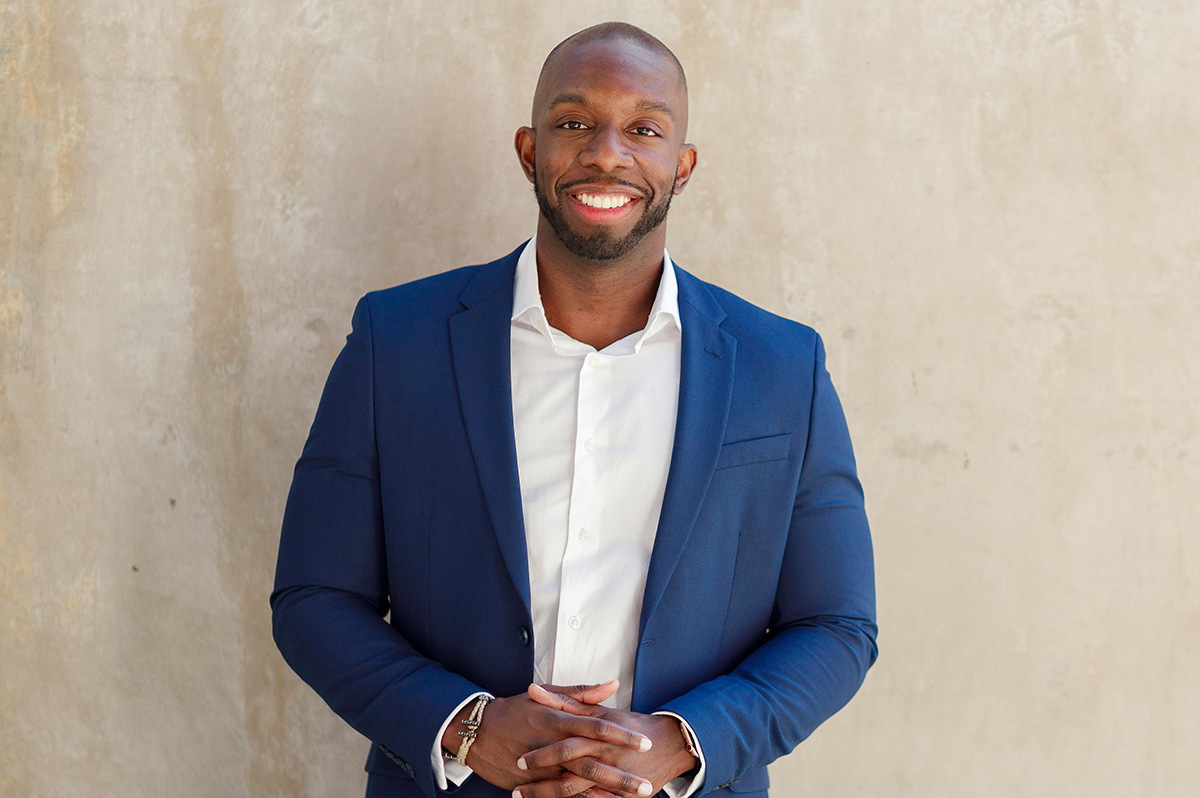
Georgia made history last week when Everton Blair, Jr., was sworn into the U.S. House of Representatives, becoming the state’s first openly LGBTQ member of Congress and the latest LGBTQ addition to the chamber.
Blair, who represents Georgia’s 13th Congressional District, was sworn in on Sept. 1 after winning a special election to fill the vacancy left by the late-Congressman David Scott. Blair defeated Marcye Scott, the late congressman’s daughter, in the Aug. 25 runoff, winning 53.2 percent of the vote to Scott’s 46.8 percent.
He will serve the remainder of Scott’s term through Jan. 3, 2027. Blair is not running in the November general election for a full term.
Blair brings a progressive platform to Congress.
The 34 year-old supports Medicare for All, a Green New Deal, raising the minimum wage, and universal gun background checks. His campaign platform also included positions on LGBTQ rights, reproductive freedom, workers’ rights, climate, and gun violence.
Since joining the House, Blair has joined the Congressional Black Caucus and Congressional Progressive Caucus. He is also a co-chair of the Congressional Equality Caucus.
Before joining the House, Blair served on the Gwinnett County Board of Education, where he became the first Black member and youngest-ever member elected to the board, as well as its first openly gay member. He was later unanimously selected as chair.
Blair also served as a fellow in President Barack Obama’s White House Initiative on Educational Excellence that focused on improving academic outcomes and expanding opportunities for minority students.
The son of Jamaican immigrants, Blair was born and raised in Georgia’s 13th Congressional District. He earned a bachelor’s degree in applied mathematics from Harvard University, a master’s degree in policy, organization, and leadership from Stanford University, and a Doctor of Education Leadership degree from Harvard.
Blair’s campaign received endorsements from a number of organizations, including the LGBTQ+ Victory Fund and progressive Democratic groups such as Future Democrats.
The Equality PAC, a political action committee dedicated to electing openly LGBTQ candidates to office, celebrated Blair’s victory and provided a statement to the Washington Blade about the historic nature of his election.
“This is a historic election for Georgia, the South, and our entire country,” Equality PAC said in an email. “Everton Blair brings a strong record of public service and a deep commitment to making government work for working families.”
The group said Blair would “fight to lower costs, expand access to quality health care, create economic opportunity, and ensure every community has a voice in Washington.”
“At the same time, Everton understands the importance of standing up for equality and defending the rights and freedoms of LGBTQ Americans and every community facing discrimination,” Equality PAC said. “His historic election as Georgia’s first openly LGBTQ Member of Congress and the first openly LGBTQ man elected from the South is a powerful reminder of how far our country has come — and how much work remains.”
Equality PAC said it was “proud to welcome Everton to the House” and looked forward to working with him.
U.S. Military/Pentagon
Pentagon expands testosterone screening as trans troops face hormone therapy restrictions
Defense Department says updated guidelines to be issued shortly

The Pentagon has announced that new clinical guidance will be released establishing mandatory testosterone deficiency screening for active-duty and reserve cisgender male service members ages 30 and older, advancing a policy that expands hormone-related care for cisgender troops.
The Defense Department said the existing clinical guidelines, which are not currently available on the Defense Health Agency’s website, are being updated and that the final guidance will be issued shortly.
The announcement comes amid a wave of anti-transgender policies from both the DoD and the Trump-Vance administration, which continue to prohibit trans men from receiving the same treatment.
Under the forthcoming guidance, men ages 30 and older will be forced to undergo testosterone blood tests as part of their medical care. Younger male service members will be tested if they request screening or if clinicians identify warning signs of low testosterone.
The new guidelines formalize a screening program Defense Secretary Pete Hegseth announced in July, when he said the Pentagon would begin testing service members to ensure that “you have the right testosterone levels to operate at your absolute best.”
“Taking care of your long-term health means ensuring you remain strong, resilient, and capable — not just for your next deployment, but for the rest of your life, so you can thrive long after you take off the uniform,” Hegseth said at the time.
The Defense Health Agency’s clinical guidance says the program is intended to address “hormonal and energy-availability issues.” Hegseth said in July that testosterone replacement therapy would remain voluntary for service members if treatment is recommended.
The Food and Drug Administration is also scheduled to hold a meeting later this month with experts to discuss the medical use of testosterone.
The Pentagon’s push to routinely test testosterone levels runs counter to current medical guidance, which generally recommends considering testosterone therapy only for men who have symptoms consistent with low testosterone and have documented low hormone levels on two separate blood tests.
Testosterone is a sex hormone naturally produced by people of all sexes. It plays a role in regulating muscle mass, bone density, and sex drive. Testosterone levels in men naturally decline with age and have been associated with symptoms including erectile dysfunction, low libido, mood changes and weight gain, although experts continue to debate when testosterone therapy is medically appropriate.
The policy has drawn scrutiny from LGBTQ advocates because the Pentagon and Hegseth have simultaneously cited hormone therapy as part of the rationale for removing trans service members from the military.
Under President Donald Trump’s 2025 executive order, “Prioritizing Military Excellence and Readiness,” the military has moved to bar trans people diagnosed with gender dysphoria from serving and has begun formal administrative separation proceedings against trans personnel.
The Pentagon continues to pursue implementation of the trans military ban as litigation over the policy proceeds. As a result, some trans service members have had their gender-affirming hormone therapy halted even as the Pentagon expands testosterone screening and potential treatment for cisgender service members.
SPARTA Pride, a nonpartisan nonprofit organization made up of trans service members, veterans and their allies, criticized the disparity to the Washington Blade when Hegseth first announced the screening program.
“If hormone therapy helps warfighters perform at their best, then it cannot simultaneously be used as evidence that transgender service members are unfit to serve,” said Kara Corcoran, executive director of SPARTA Pride. “The same class of evidence-based medical treatment cannot be characterized as readiness-enhancing for one group and readiness-destroying for another.”
On June 1, the U.S. Court of Appeals for the D.C. Circuit ruled that trans service members already serving in the military could continue to do so while allowing the armed services to continue refusing to enlist new trans recruits.
The Blade reached out to the Pentagon when the testosterone screening program was first announced in July, asking why cisgender service members could receive testosterone therapy while transgender service members could not. The Pentagon did not respond.

Report: 90 percent of LGBTQ groups around the world have lost funding since 2025

PHOTOS: SUNFESTIVAL

Gloria Steinem’s life of substance and consequence

Nominate your favorites for the Blade’s 25th annual Best Of LGBTQ DC Awards

Grindr settles UK lawsuit over claims it shared users’ personal information

‘Here the Whole Time’ delivers queer coming-of-age comedy

Blade Foundation to host fundraiser in Rehoboth on Sept. 12

Actress takes on bisexual ‘Ma’ Rainey in new Round House production

New book examines fashionista Audrey Smaltz’s fabulous life

Iceland implements gender-neutral blood donor rules
-

 Movies4 days ago
‘Here the Whole Time’ delivers queer coming-of-age comedy
-
Out & About3 days ago
Blade Foundation to host fundraiser in Rehoboth on Sept. 12
-
Theater3 days ago
Actress takes on bisexual ‘Ma’ Rainey in new Round House production
-
Books3 days ago
New book examines fashionista Audrey Smaltz’s fabulous life