National
Gay N.J. activist: Sandy left behind ‘massive destruction’
Superstorm brought widespread devastation to both New Jersey and New York
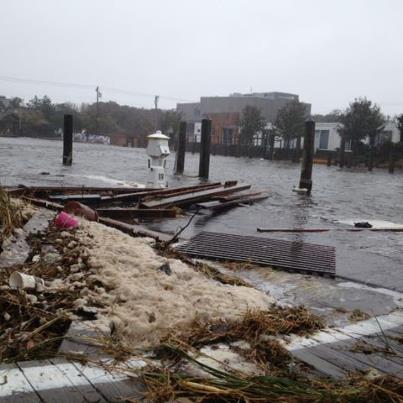
Bay water inundates the harbor in Fire Island Pines, N.Y., on Oct. 29 (Photo courtesy of Karen Boss)
The head of New Jersey’s statewide LGBT advocacy organization on Wednesday said Superstorm Sandy devastated his state.
“Hurricane Sandy has left massive destruction in her aftermath,” said Garden State Equality Chair Steven Goldstein in a YouTube video shot on a street in Teaneck in Bergen County with down trees and power lines in the background.
Goldstein urged his organization’s members and supporters to keep in regular contact with the elderly, young people and those with disabilities directly impacted by the storm who may need someone to pick up their prescriptions or buy them other basic supplies.
“On behalf of our entire Board of Directors, I extend to you our love, our prayers and most profound gratitude for being there for one another during this time of need.”
Sandy’s storm surge inundated large swaths of the New Jersey coastline, New York City, the South Shore of Long Island and Fire Island as it made landfall near Atlantic City, N.J., on Monday night. The storm killed at least 90 people in the United States and dozens of others in the Caribbean.
Villas, N.J., residents Vince Grimm and Will Kratz, whom the Washington Blade interviewed in August shortly after they celebrated their 51st anniversary, rode out Sandy in their bay front home north of Cape May. The couple lost power and water during the storm, but Grimm told friends in an e-mail he and Kratz have been able to run a generator and their gas-powered fireplace.
The storm did not damage the couple’s home and property.
“Our beach is a disaster and we lost our sand fences, but the dune is intact considering we got hit [during] a high tide with a full moon,” said Grimm. “Actually our street, 11 blocks long, has virtually no damage considering we are sitting on a sand dune along the bay.”
Sandy’s winds ‘unlike anything I’ve heard’
The storm killed at least 37 people in New York City, while a fast-moving fire destroyed more than 100 homes in the flooded Breezy Point neighborhood of Queens late on Monday.
A record storm surge that nearly topped 14 feet in lower Manhattan inundated large swaths of the five boroughs, subway tunnels under the East and Hudson Rivers and the Queens-Midtown and High L. Carey Tunnels that link Manhattan with Queens and Brooklyn respectively.
A limited number of subway and commuter train lines are once again running in portions of the city and metropolitan area, but bus service below 23rd Street in Manhattan remains suspended at night because the lack of electricity has created dangerous driving conditions. More than a quarter of a million customers in Manhattan remained in the dark as of 4:30 a.m. on Thursday.
“It’s been a crazy, crazy few days here,” gay New York City Council candidate Corey Johnson told the Blade on Wednesday. His apartment on West 15th Street in Manhattan’s Chelsea neighborhood is close to the Eighth Avenue building that lost its facade during the height of the storm. “All I could hear was howling winds. It was unlike anything I’ve heard in my 12 years in New York.”
Cindi Creager, the former communications director of the LGBT Community Center in Greenwich Village, was inside her West Village apartment with her wife during the storm. The couple is currently staying with a friend who lives on Manhattan’s Upper West Side, but Creager told the Blade she feels fortunate she and her wife escaped the storm unscathed.
“The wind was howling and whipping [outside] the window. And it was scary,” she said. “We had power and we didn’t and it was total darkness outside the window. And that’s when it felt very scary. You just start to realize how fleeting life can be. We did very well considering.”
Cathy Renna of Renna Communications rode out Sandy in her centuries old farmhouse on Shelter Island between Long Island’s North and South Forks. She told the Blade local utility crews restored the electricity to her home roughly 24 hours after the worst of the storm had passed.
Sandy brought several large trees down across Shelter Island, but Renna stressed she feels she and her family “were really lucky.”
“I grew up on Long Island,” she said, noting her sister’s friend who lives in Lindenhurst along the Great South Bay in southwestern Suffolk County lost everything to the storm. “I have never, ever seen winds like that. It was terrifying, but it was only for a few hours.”
Storm devastates Fire Island, forces LGBT groups to close
Sandy caused widespread flooding and severe beach erosion throughout Fire Island. Dozens of oceanfront homes in Fire Island Pines sustained damage from the storm surge. The high tides also damaged bulkheads and bay front board walks in the hamlet and neighboring Cherry Grove.
The storm also forced the Empire State Pride Agenda, the National Gay and Lesbian Task Force, the Gay and Lesbian Alliance Against Defamation, the International Gay and Lesbian Human Rights Commission and other LGBT advocacy groups to close their lower Manhattan offices because of the power outage and in some cases flooding.
“Our New York-based staff members are safe and working from home with limited resources,” said GLAAD spokesperson Seth Adam on the organization’s website on Tuesday. “Today, our thoughts are with all those families affected by Hurricane Sandy, as well as first responders working to keep us safe.”
Officials cancelled the city’s annual Halloween parade in Greenwich Village. The storm also derailed Splash Bar and other lower Manhattan gay bars and clubs’ holiday festivities because of the blackout. Restaurants and other businesses in the Hell’s Kitchen neighborhood west of Times Square that did not lose electricity during Sandy remain open.
“Day 3 of no power,” said Gym Sports Bar, which is on Eighth Avenue in Chelsea, in a message to patrons. “Our thoughts are with you out there. As soon as our lights are back on we will be back on the field. Stay safe out there Gym peeps.”
Restoring power and full subway service remain New York City officials’ top priorities.
“The subway lines are really the veins, arteries and lifeblood of the city,” said Johnson. “People are basically stuck unless they’re going to work or are able to get on a bus.”
Lesbian New York City Council candidate Yetta Kurland, who said her building has run out of the water because of the lack of electricity, said the closure of New York University Langone Medical Center and Bellevue Hospital because of flooding has left lower Manhattan residents more vulnerable. Kurland also pointed out people with disabilities and others who are unable to leave their apartments are unable to obtain food, water and ice at Union Square and other distribution points.
“There’s a large relief effort,” she said. “The city’s doing a great job at this point, but there are a lot of homebound people who cannot get to Union Square.”
Gay City Councilmember Daniel Dromm said the situation in his Queens district that includes the neighborhoods of Jackson Heights and Elmhurst “is pretty much okay” outside of downed trees. Overcrowded subway stations and gas shortages have become a problem, but Dromm said the gay bars and other businesses along bustling Roosevelt Avenue that were closed during the storm have since re-opened.
“Everything is back up and operational in Jackson Heights itself,” said Dromm. “We were very lucky.”
Gay New Yorkers persevere in spite of Sandy
Congregation Beit Simchat Torah, which is the country’s largest LGBT synagogue, will hold its weekly Shabbat service by candlelight at a Manhattan church later on Friday. Its group for older congregants will meet at a nearby diner beforehand for dinner.
Elmo, a restaurant on Seventh Avenue in Chelsea, on Wednesday served drinks in spite of the lack of electricity.
Even as New Yorkers try to return to some sense of normalcy, they continue to reflect upon the storm that devastated their city.
“You go from this thriving city uptown to just a ghost town downtown, which is really scary,” said Creager, who briefly returned to her apartment on Wednesday to pick up more clothes and other belongings. “There was a lot of traffic yesterday going up and down the West Side Highway because there’s no subway. There’s that feeling in the air, even on the Upper West Side like something major has happened.”
Dromm, who taught in the city’s public schools for 25 years until his 2009 election to the City Council, said he has “never seen anything like” Sandy “in my life in Queens.” He also applauded New York Gov. Andrew Cuomo for raising the issue of climate change during the storm’s aftermath.
“It’s a very important question,” said Dromm. “It’s really scary when you think about lower Manhattan—areas of lower Manhattan being flooded out like that. Government wasn’t even able to really operate in this storm. It’s very, very scary.”





Federal Government
988 restores crisis services for LGBTQ youth

The lifesaving 988 call-in number to help people experiencing mental health crises or suicidal thoughts has once again restored its specialized services for LGBTQ youth.
The lifeline, which used to have the option to “press 3” to be directly sent to specialized services for LGBTQ youth facing mental health crises or suicidal thoughts, was returned on Wednesday following an over-year-long battle with the Trump-Vance administration, which removed the service in May 2025.
The Press 3 option rolled out as a pilot program in 2022 through a government contract with the Trevor Project, a suicide prevention and crisis intervention organization for LGBTQ people.
Then, in June 2025, the federal government announced that the lifeline would be eliminated within a month. By July 2025, 988 Lifeline’s “Press 3” services were terminated.
Openly gay U.S. Sen. Tammy Baldwin (D-Wis.) helped lead Congress in reversing the removal of the lifesaving resource from American phones. As a member of the Senatw Labor-HHS Appropriations Subcommittee, she started the process of securing $535 million for 988 — a $15 million increase — as well as dedicated funding for LGBTQ youth specialized services.
Then, in September 2025, Baldwin, along with U.S. Sen. Lisa Murkowski (R-Alaska), introduced bipartisan legislation in the Senate, the 988 LGBTQ+ Youth Access Act, to codify the 988 Lifeline’s specialized services for LGBTQ young people.
At the same time, U.S. Rep Raja Krishnamoorthi (D-Ill.) introduced the legislation in the House of Representatives alongside U.S. Reps. Michael Lawler (R-N.Y.) Sharice Davids (D-Kan.) Brian Fitzpatrick (R-Pa.) and Seth Moulton (D-Mass.)
The Senate passed Baldwin’s bipartisan funding bill in January 2026, funding the Department of Health and Human Services with explicit language mandating the return of 988’s LGBTQ youth specialized services.
In February 2026, Congress passed legislation mandating that the previously eliminated “Press 3” specialized services be restored and funded with $33,100,000 — but it was unclear if the Press 3 option would still be allowed under current executive orders, namely Executive Order 14168, or “Defending Women From Gender Ideology Extremism and Restoring Biological Truth to the Federal Government.”
Despite the securing of federal funding for the Press 3 resource, the battle to get the 988 LGBTQ+ Youth Access Act through Congress is ongoing — and would provide codafied protection from this removal ever happening again.
According to data on the Trevor Project’s website, LGBTQ young people are more than four times as likely to attempt suicide than their peers.
Baldwin’s office touts the immense help the lifeline provides to LGBTQ people in their moments of greatest need. The press release on the reinstatement of Press 3 highlighted the continued demand for the service:
“The volume of calls, texts, and chats 15 percent higher than a year earlier and nearly 50 percent higher than two years ago. Since the lifeline launched, it has received over 27 million contacts, including over 18 million calls, 4 million texts, and 3 million chats.”
Advocates for LGBTQ rights and mental health awareness have agreed with the increasing numbers and hailed the return as a win for everyone.
“Suicide and mental health struggles touch every community across our state, and that’s why creating the 988 crisis lifeline to make sure help is there for everyone is one of my proudest accomplishments,” said Baldwin said in a statement. “But, last year, the Trump administration decided to make these real struggles a political football and ripped away the specialized line that helped LGBTQ children. This was a deliberate choice. The Trump administration chose to put children’s lives on the line to score some political points.
“I’ve fought tooth and nail to restore this lifesaving resource. When I realized the Trump administration was not going to do it on their own, I wrote it into federal law to require them to restore the Press 3 option,” the Wisconsin senator said. “This lifesaving resource never should have gone away in the first place, but I am glad the lifesaving support Press 3 provides is once again there for people who need it.”
“I’m proud that we secured the funding to restore this lifesaving LGBTQ+ crisis line and successfully pressured the Trump administration to bring the program back,” Krishnamoorthi said. “When an LGBTQ+ young person reaches out for help in a moment of crisis, they deserve to reach a counselor trained to understand and support them. This program should never have been taken away, and now we need to make sure it stays available for every young person who needs it. I’m grateful to the Trevor Project, NAMI Chicago, Equality Illinois, the American Foundation for Suicide Prevention, and all the advocates and young people who worked alongside us to bring these services back.”
Jaymes Black, CEO of The Trevor Project who works with the SAMHSA, in their press three operations celebrated the return of the resource.
“We are grateful to see that the 988 Suicide & Crisis Lifeline’s ‘Press 3’ specialized services for LGBTQ+ youth have been restored. Resuming this national resource will be critical in addressing the public health crisis of suicide among LGBTQ+ young people, and supporting the estimated more than 1.8 million LGBTQ+ youth who seriously consider attempting suicide in the U.S. each year,” Black said via a statement. “We are thankful for the large coalition of bipartisan lawmakers, mental health advocates, allies, and supporters who fought tirelessly for this restoration. We will monitor the launch and usage of these important services to ensure all LGBTQ+ youth are supported with clinically best standards.”
If you or someone you know needs mental health resources and support, please call, text, or chat with the 988 Suicide & Crisis Lifeline or visit 988lifeline.org for 24/7 access to free and confidential services. Trans Lifeline, designed for transgender or gender-nonconforming people, can be reached at (877) 565-8860. The lifeline also provides resources to help with other crises, such as domestic violence situations. The Trevor Project Lifeline, for LGBTQ+ youth (ages 24 and younger), can be reached at (866) 488-7386. Users can also access chat services at TheTrevorProject.org/Help or text START to 678678.
California
Calif. governor signs 6 pro-LGBTQ bills, vetoes 1
Gavin Newsom rejected measure he claimed is legislative overreach

Last week, California Gov. Gavin Newsom signed and vetoed a slew of bills into state law. Among them were seven pertaining to California’s LGBTQ community. Newsom signed six while vetoing one. His actions drew applause and scorn from advocacy groups in the state.
The six signed bills:
Assembly Bill 1775 allows transgender veterans, who were banned from service last year by the Trump-Vance administration, to access housing assistance, use California’s discharge upgrade assistance program, and get support for gaining employment.
Assembly Bill 1930 strengthens privacy protections for healthcare patients and providers by creating clear guidelines for California agencies, individuals, and corporations to respond to out-of-state subpoena requests relating to abortion or gender-affirming care. This includes a requirement to contact the California Attorney General at least seven days prior to responding to the subpoena or providing legal documents. This should add additional protection to those residing in California from investigations in states where abortion or gender-affirming care has more restrictions.
Senate Bill 934 targets conversion therapy in California and increases the amount of time a patient has to bring a medical malpractice lawsuit against a provider for attempting to change the patient’s sexual orientation or gender identity. The bill takes aim at the widely debunked practice that treats queerness as a mental disorder that could be cured through psychotherapeutic methods. Conversion therapy has been illegal in California since 2012; however, a recent Supreme Court decision threw the ban into question, prompting lawmakers to write this new bill that legally defines it as medical malpractice.
Senate Bill 1023 expands access to PrEP, a medication that protects people from contracting HIV. The bill requires insurers to cover the drug through the medical benefit and the pharmacy benefit pathways, allowing for more providers to give patients PrEP.
Senate Bill 1114 strengthens privacy protections for voluntary self-identification data about sexual orientation and gender identity. The bill limits when California government agencies can share this data and bars it from being disclosed outside of the state government, with few exceptions.
Senate Bill 1328 expands support for LGBTQ students and staff in California colleges. The bill requires any institution of higher education to designate an employee at any campus, satellite campus, branch campus, or outreach center to support the needs of LGBTQ individuals.
Equality California, the largest statewide LGBTQ civil rights group in the country, commended the governor for his support of legislation that protects and supports the queer community amid escalating threats, attacks, and rollbacks from the federal government.
Executive Director Tony Hoang said in a written statement, “California is once again demonstrating that when LGBTQ+ people are targeted, our state will respond with action,” adding, “We are grateful to Gov. Newsom for signing these measures.”
The vetoed bill:
Assembly Bill 2164 would have banned California from extraditing anyone residing in California for providing abortions or gender-affirming care in another state. Newsom vetoed this bill despite agreeing with its principles, claiming in a written statement that “extradition is an exclusively executive function” and that he did not want to limit the “executive authority of an incoming governor.”
This bill was created in response to Louisiana’s attempt to extradite a California physician for allegedly sending abortion pills in the mail to a Louisiana woman. Newsom responded forcefully to the extradition request, publicly denying it and stating, “We will not allow extremist politicians from other states to reach into California and try to punish doctors based on allegations that they provided reproductive health care services.”
In a written statement responding to the veto, Lizzy Hinkley, the legal director of the bill’s lead sponsor, Abortion Coalition for Telemedicine, criticized Newsom, stating, “[the] outgoing governor’s principled stance is cold comfort to Californians living and working in the real world post-Dobbs. A high-brow, academic justification for refusing to codify legal protections only reveals an ignorance for the lived reality of patients and providers — and does nothing to help them.”
National
HRC report: LGBTQ students face ‘far greater challenges’ in non-supportive states
Survey finds anti-LGBTQ school harassment, bullying highest in 17 states
The Human Rights Campaign Foundation, the educational arm of the national LGBTQ advocacy organization Human Rights Campaign, has released a report showing LGBTQ public school students are more likely to face bullying, harassment, and “other barriers” in states that have less overall supportive LGBTQ laws and policies.
The report is based on the HRC Foundation’s National Educator Survey of School Climate and Bullying, which was released on Sept. 17.
“The report finds that harassment, bullying, and other barriers to LGBTQ+ inclusion are more prevalent in states with limiting policies, where educators report widespread restrictions on LGBTQ+ resources, visible expressions of support, and assistance for transgender students,” a statement released by HRC says.
“As just one example,” the statement adds, “while 59 percent of educators in states with limiting policies report restrictions on supporting their transgender students, just 6 percent to 8 percent of educators in states with supportive policies report the same, underscoring the impact of these policies on school climate, student well-being, and the stakes of the upcoming midterm elections for LGBTQ+ youth and inclusive classrooms.”
The report says the survey consisted of responses by 826 educators in 42 states who worked as teachers, principals, counselors, administrators, and others who worked in support services. All worked at schools with students from pre-kindergarten to 12th grade, most being public schools and a smaller number being charter schools, the report says.
It says the survey was conducted between April 15 and May 21, 2026, and included a survey questionnaire with about 55 questions covering a wide range of LGBTQ related school issues.
According to the report, its classification of LGBTQ supportive and non-LGBTQ supportive states is based on a detailed analysis of the LGBTQ related laws and policies of all 50 states, D.C., and U.S. territories conducted by the Movement Advancement Project, or MAP, which describes itself as an “independent, nonprofit thinktank.”
The report includes a chart consisting of 51 boxes representing the 50 states and D.C., with 32 plus D.C. colored as blue and said to have overall LGBTQ supportive policies. The 17 boxes colored in red are said to have overall non-LGBTQ supportive policies and laws, Each of the boxes has the initial of a state or D.C. printed inside it.
In addition to D.C., the chart shows Maryland, Virginia, New York, California, and Massachusetts as among the supportive states. Florida, Texas, West Virginia, and Ohio are among the states shown to be non-LGBTQ supportive.
The HRC statement includes these “key” findings from the survey:
- In states with restrictive LGBTQ+ inclusion policies, 59 percent of educators report restrictions on supporting transgender students, compared to just 6-8 percent of educators in states with supportive LGBTQ+ inclusion policies.
- In states with restrictive policies, nearly 50 percent of educators reported restrictions on LGBTQ+ books or resources, compared to just 7 percent of educators in states with supportive policies.
- Roughly 32 percent of educators in states with restrictive policies reported anti-LGBTQ+ harassment was a moderate or serious problem, compared with 11 percent of educators in states with supportive LGBTQ+ inclusion policies.
- In states with restrictive LGBTQ+ inclusion policies, 29 percent of educators were very worried about anti-LGBTQ+ harassment, compared to 15 percent in states with supportive LGBTQ+ inclusion policies.
- In states with restrictive LGBTQ+ inclusion policies, 36 percent of educators witnessed anti-LGBTQ+ student bullying, compared to 27 percent in states with supportive LGBTQ+ inclusion policies.
- In states with supportive LGBTQ+ inclusion policies, 75 percent of educators reported no restrictions on LGBTQ+-supportive displays, highlighting a substantially more supportive school environment than in states with restrictive policies.
- Educators in states with restrictive LGBTQ+ inclusion policies also reported significant harassment of students based on appearance (57 percent), race or ethnicity (43 percent), sexual orientation (42 percent), and gender identity or expression (39 percent). (No direct comparison figure from supportive-policy states is provided in the data above.)
“Every young person deserves to feel safe and supportive at school, but this report makes clear that for too many LGBTQ+ students, especially transgender youth, are being failed by policies designed to exclude them,” said HRC President Kelley Robinson in the HRC statement.
“We know that when students feel seen, supported, and affirmed, they are more likely to thrive, but when schools become places of exclusion or hostility, young people pay the price through lower engagement, missed opportunities to learn, and poorer mental and physical health,” Robinson said.
The HRC statement notes that the survey findings come at a time when a growing number of states have passed laws targeting LGBTQ students and the school officials and teachers who support them. It says that for the first time, the survey found that “educators themselves are also experiencing anti-LGBTQ+ harassment, highlighting the growing impact of these policies on school staff as well as students.”
The full survey findings and report can be accessed here:

988 restores crisis services for LGBTQ youth

To school to homeschool to school again

Ryan Murphy’s ‘Monster’ vilifies the lesbian

The right to be an ordinary transgender man

LGBTQ community must vote in big numbers

PHOTOS: HRC National Dinner

What’s frightening is also funny in ‘Venus’

I’m 66, he’s 27. Is it love or am I being played?

The LGBTQ real estate map is being redrawn