a&e features
Martick’s faces demolition in Baltimore
Early gay gathering spot played host to artists before advent of gay bars
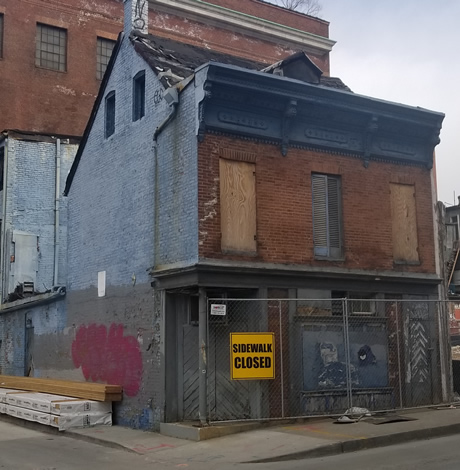
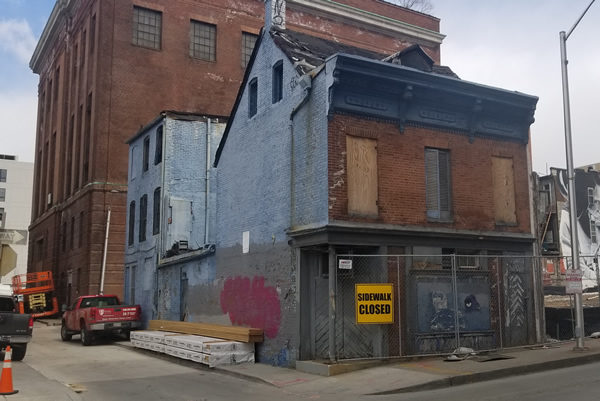
One of Baltimore’s early gay gathering spots has been threatened with demolition.
The former Martick’s Restaurant Français, the endangered building, is well known locally as one of the first places where Baltimoreans were introduced to French cuisine.
It housed a speakeasy during the Prohibition era. It has been a magnet for artists and performers, including Billie Holliday, Leonard Bernstein and, more recently, filmmaker John Waters. It’s one of Baltimore’s few remaining buildings that was constructed before the Civil War.
But Martick’s, which is now vacant, was also a place where gay people felt comfortable and came together, long before the advent of gay bars and nightclubs.
According to former employees and patrons, it had a following in the 1950s and 1960s that included not only gay men and women but other members of what is now called the LGBTQ+ community, including bisexuals, crossdressers and people undergoing sex change operations by Johns Hopkins Hospital physician John Money.
“It was one of the first places where gay people felt comfortable coming,” said Jimmy Rouse, an employee from 1974 to 1981, in recent testimony before Baltimore’s preservation commission. “They had people from the Sun papers, the artistic community, the gay community and the jazz community, all coming there during the 50s and 60s.”
The Martick’s building at 214 W. Mulberry St. is endangered because a local developer, Christopher Janian of Vitruvius Development Company and Park Avenue Partners LLC, proposed this year to tear it down and use the land as part of a larger project, a six-story, $30 million apartment building planned for the block.
Janian has appeared before Baltimore’s Commission for Historical and Architectural Preservation (CHAP) twice in the past three months seeking approval to raze the entire building, and twice he has been rebuffed by the preservation panel.
This week he is coming back to CHAP with a compromise plan: He has proposed to save the front third of the Martick’s building in exchange for permission to tear down the rest and make the land part of the residential development.
The demolition proposal is coming at a time when some gay bars and meeting places around the country are being recognized and preserved as cultural landmarks. The best-known example is the Stonewall Inn in New Year City, the site 50 years ago of riots during which patrons protested a police raid on the bar.
The Stonewall riots are considered a key event leading to the gay liberation movement and the fight for gay and lesbian rights in the United States. The Stonewall Inn, still open, has been added to the National Register of Historic Places and designated a New York City landmark specifically because of its association with an LGBT-related event.
In Baltimore, Martick’s restaurant closed in 2008 and the building has been vacant since then. Former owner Morris Martick, who lived in the building for most of his life, died in 2011.
CHAP is involved and holding public hearings on Janian’s plans because the Martick’s building is within the city’s Howard Street Commercial Historic District, and any changes to buildings in the district must be approved by the preservation panel.
At the two previous appearances, Janian’s proposal to tear down the entire building drew strong opposition from former patrons and employees. They argued that the building should be preserved for its historical significance as a rare pre-Civil War structure, for its association with Morris Martick, and for its cultural significance as a magnet for a wide range of people. Seven hundred people have signed a petition to save the building.
At a CHAP hearing in February, several of the speakers noted the building’s significance as a gathering spot for the city’s gay community, at a time when there were few others and many businesses were less tolerant.
Rouse, who is a son of the legendary developer James W. Rouse, waited on tables and tended bar at Martick’s from 1974 to 1981. He said Martick’s role as a hub for the arts community and for gay people came before it was converted to a French restaurant in 1970.
During the 1950s and 1960s, he explained, it was a beatnik bar and jazz club, and that made it a center for the arts community.
It was also integrated, he said. “Very few bars in Baltimore were integrated at that time. Because of jazz music, Billie Holliday would sing there. It developed a kind of regular clientele of what Morris used to refer to as artists-slash-alcoholics…It was almost a rite of passage for anyone who was interested in art to work at Martick’s.”
In his seven years at Martick’s, Rouse said, he worked closely with the owner and got to know him well. He described Martick as a colorful, cantankerous character who put a doorbell on the front door that diners had to ring in order to be let in.
Rouse recalled that when first-time diners asked Martick what he recommended, he would reply, “I recommend you try another restaurant.”
If diners wouldn’t leave after that, Rouse said, he assured them that there are hospitals nearby in case they get sick. “If you choose to stay, we’re in a very good location,” he would tell the customers, Rouse said. “Hopkins Hospital is to the east and the University of Maryland Hospital is to the west.”
Rouse said he thought one reason Martick’s became a magnet for gay people is because Martick, who never married, had gay friends, and that made other gay people feel welcome there.
In the 1950s, Rouse said, Martick “experimented with being gay, and that’s part of the reason he attracted gay people. But in the 60s and 70s, he was heterosexual, totally.”
Martick’s drew writers from The Baltimore Sun, Rouse said, largely because Morris Martick’s sister Rose dated Sun theater and film critic R. H. “Hal” Gardner, and he spent a lot of time there.
Beyond that, Rouse said, Martick was non judgmental, and that carried over to his employees and clientele.
For the wait staff, there wasn’t a strict dress code like there was at Marconi’s several blocks away, he said.
“It was so relaxed. You could do your own thing there. There weren’t strict rules about how you approached the table. It was much freer about how you interacted with the customers. You didn’t have to say your name, I am your waiter. You didn’t have to do that.”
Martick’s approach was reassuring to people who may have felt uncomfortable elsewhere, agreed Ruth Turner, a Baltimore native who worked there in the 1980s and now owns a boutique in Hampden called Caravanserai on the Avenue.
Turner said the same non-judgmental attitude that was appealing to the Jewish community and the arts community was appealing to members of the LGBT community, and that included gay African Americans and transgender people.
“It was exclusively inclusive,” she said. “He allowed anyone who wanted to come in to come in. No questions asked. It was very inclusive. It was a melting pot. Some people were flamboyant. Some weren’t. Morris was accepting of everyone. There were no divisions. We were all just people.”
In terms of human sexuality, Baltimore was a center of experimentation and medical advances, she noted. And the heyday of Martick’s as a jazz club predated places such as Leon’s, the Drinkery and the Hippo.
“This was the beginning of the whole transgender movement and the sex change operations at Hopkins. There was a lot going on. That’s when [sex change pioneer] John Money was at Hopkins.”
At Martick’s, “you weren’t defined by your sexuality or your skin tone,” she said. “You were defined by your character and your behavior. … He looked at people on a one-on-one level…He made it clear that being different and being eccentric is not a problem, it’s an asset.”
Tom DiVenti, another former employee, echoed Turner’s sentiments in an article he wrote for Splice Today entitled “Morris Martick: Last of a Breed.” He called the place a “sanctuary” and said “Morris was the father many of us never had.”
DiVenti recalled that at one dinner party for John Waters, Martick “carved miniature penises out of carrots and whipped up a creamy white sauce appetizer for the guest of honor.” He described Martick as “an original Baltimore character who gave others the freedom to be characters too.”
Martick’s was “a place of tolerance and acceptance for all kinds of people,” DiVenti wrote. “No one was ever judged or criticized for beliefs or non-beliefs. No one was ever bullied because of gender or sexual preference. Restaurants in Baltimore today could take a cue from his old school finesse.”
Will Janian’s partial demolition proposal satisfy the preservationists?
The Baltimore Heritage preservation advocacy group testified against Janian’s plans in February; the board has not taken a position on the latest proposal and was slated to meet this week to discuss it.
Visit washingtonblade.com for updates on this week’s hearing, scheduled for March 12. Email correspondence about the proposal can be sent to CHAP planner Stacy Montgomery at [email protected].


a&e features
Tickets on sale for chef Patrick O’Connell’s book launch event
Sept. 18 kickoff to feature José Andrés, Tom Sietsema

Acclaimed chef Patrick O’Connell is preparing to publish his new memoir, “Main, Middle & Gay” in September and he’s launching the book with an event on Sept. 18 at 6 p.m. at Lisner Auditorium featuring Chef José Andrés and former Washington Post food critic Tom Sietsema.
Tickets for the event go on sale Tuesday, July 21 at Ticketmaster; prices start at $55.
O’Connell, who’s gay, is the pioneering Michelin-starred chef and longtime proprietor of the Inn at Little Washington. He spoke with the Blade about the September event and the launch of his first memoir.
“I’ve known [Andrés and Sietsema] for more than 25 years and I have great respect for them,” O’Connell said. “I felt that it would allow us to add a different dimension rather than just have an interviewer. The chemistry will be fun and lively and unpredictable and exciting. I think we’re all different personalities and we’ll compliment each other.”
O’Connell has published cookbooks but this is his first memoir. The event will feature a short film that will highlight his work and the Inn.
“What I hope to do with the event is bring the book to life visually,” he said. “So we’re producing a short film that will be part of it. Most of the audience will not have read the book so it’ll give them a visual flavor of the book. It parallels the evolution of American cuisine over 50 years. It’s a rare perspective to be in the trenches for that long.”
The book’s title refers to the location of the garage on the corner of Main, Middle, and Gay streets in Washington, Va., where he launched his restaurant that became an international culinary destination.
The Blade will publish the rest of its wide-ranging interview with O’Connell in September in conjunction with the book’s release.
a&e features
The queer Asian comics building collective joy in D.C.
Spotlighting chaotic ways family, romance, identity take shape in their lives
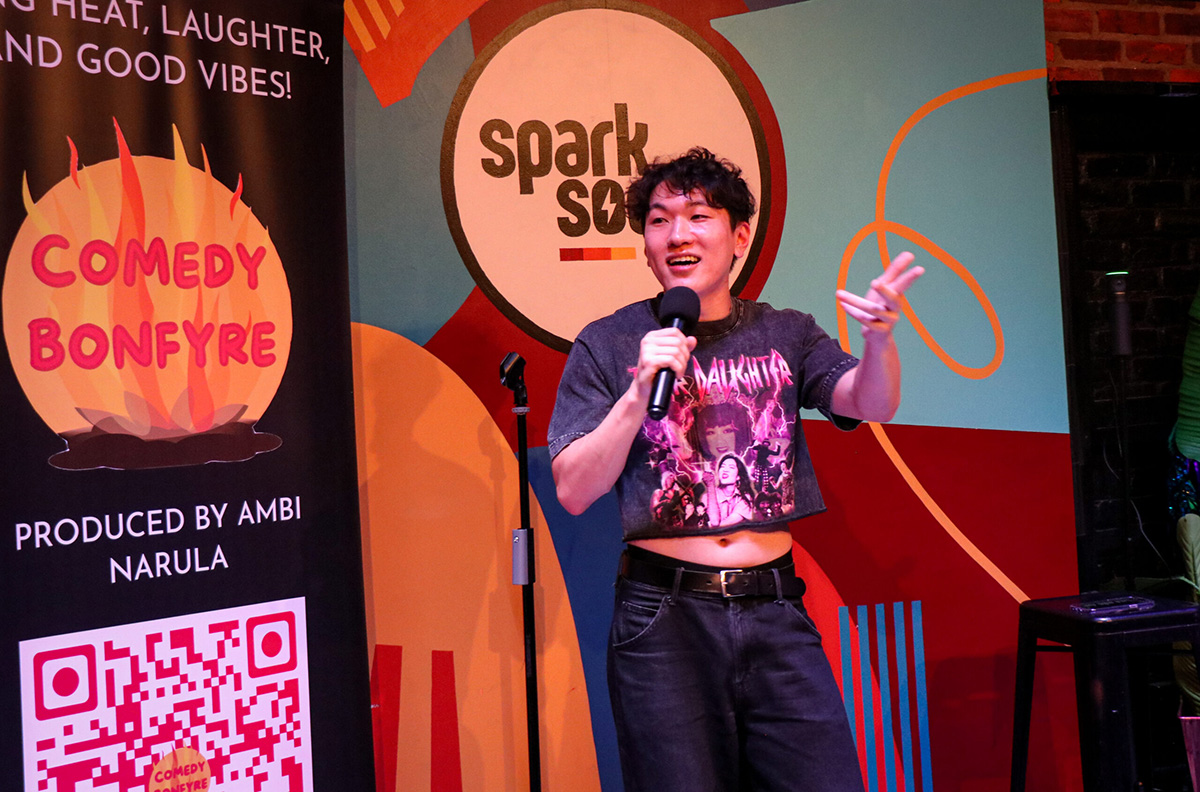
Kevin Chen’s family tombstone has room for four: him, his parents and his boyfriend. The arrangement might prove to be a little awkward.
“My boyfriend is 100% white, and my parents are 100% disappointed,” Chen confessed.
Jokes about family traditions and the untraditional ways they’re practiced earned a burst of laughs at the bar where Chen was opening for the Pride Comedy Special. The D.C. stand-up event, produced by Comedy Bonfyre last month, spotlighted queer Asian comics who shared the chaotic ways family, romance and identity take shape in their lives.
From candid oral sex takes to top surgery hypotheticals like “Where do the boobs go?”, the night highlighted the loud camaraderie of the queer Asian experience — one that sounds like a cacophony of snorts, cackles and belly laughs. While the comics say they are not quite a community, there’s more than enough shared material to bring them together.
“It was such a magical experience. I loved performing in a queer API lineup. It feels so validating,” Chen said after the show. “I’m wondering, ‘Is this how white men feel all the time?’”
Each performance evoked queer Asian joy through a medium that could use more of its presence.
According to Chen, who is based in D.C., it’s hard to say whether there is a true queer Asian comedy presence in his city. There are only a scattered “handful” of Asian comics, and people of color are underrepresented in queer comic circles, he said.
When Tarunika Anand, a nonbinary lesbian comic, first entered the mainstream D.C. comedy scene, they mostly encountered straight white men, describing the experience as “a culture shock.”
“I feel like sometimes a lot of queer spaces are really white, and then a lot of Asian spaces are really straight,” Anand said. “I don’t feel like I fit into either.”
But feeling marginalized didn’t stop these comics from honing their craft and creating spaces for others like them. Alex Kim, who headlined the special and is based in Brooklyn, runs the queer Asian comedy group Boba Gays, which began on WhatsApp and has since made its way to Lincoln Center.
Every Wednesday, Anand co-produces a free comedy show called Funny Side Up. The queer-led group focuses on inclusivity and showcasing new talent.
“It’s really beautiful to speak about your experience and your existence in a way that’s uplifting,” Anand said.
Family is a major throughline of their comedic repertoires.
Chen, for instance, shared that he identifies with jokes about having Asian immigrant parents and the expectations they pass down.
“You see me, you know this part about me, you know this experience intimately, and I can see the truth that you’re trying to wrap a joke around,” he said. “That hits even harder because that’s my truth too. I think that’s what makes good comedy.”
Anand had the audience at the special howling when they explained that their parents’ be-more-like-them comparisons didn’t end when they came out. Instead, the expectations took on a new form.
“Now, my parents want me to be the best gay,” Anand said. “They’re like, ‘Do you know Ellen DeGeneres?’”
Kim said he’s been trying to unlearn things from his Christian Korean mom. Yet he described a moment when he was getting ready for the club and realized he looked just like his mother getting ready for church.
“I’ve been finding it hard to escape her,” Kim said.
Mutual recognition also radiates through the different ways queer love can take shape. From singlehood to death-do-us-part commitments, the comics cover just about every corner.
Anand is holding out hope for settling down with “a nice, pretty, Indian girl.” They recently went through a breakup and said they felt they dodged a bullet.
“As a person of color, I just don’t think I should be with a Swiftie,” they said.
Chen, touching on what it’s like to be in a queer interracial relationship, said that meeting his white boyfriend’s baby nephew for the first time felt like he was forced to participate in a diversity, equity and inclusion training.
“The dad was like, ‘Please welcome Kevin. Be curious about his culture, his history, his foods,’” Chen joked.
Laughter is not the only reward for the comics.
To Anand, comedy is a space where they can say whatever they want. “It gives me a voice,” they said.
Nik Narain, a North Carolina-based trans and nonbinary South Asian comic who performed at the special, said meeting older trans comedians and taking the stage helped him feel reassured in his identity during his transition.
“Stand-up was a really cool way to process that onstage,” he said. “[It] became a way for me to repackage my thoughts.”
Queer Asians are still figuring out their place in the greater D.C. comedy scene. The group is small in numbers and many are still working toward a full-time comedy career. But Narain feels he’s already made it.
Narain is reluctant to pin it all on one moment. He feels that success is already peeking through in milestones — opening for celebrities, traveling to performances and self-producing shows.
“As long as I can keep doing this, I’m super happy,” he said.
This story was produced as part of the AAJA VOICES fellowship program, a student journalism project of the Asian American Journalists Association (AAJA).
a&e features
Mr. Henry’s celebrates 60 years of proud inclusivity
Capitol Hill staple remains ‘a caring community’
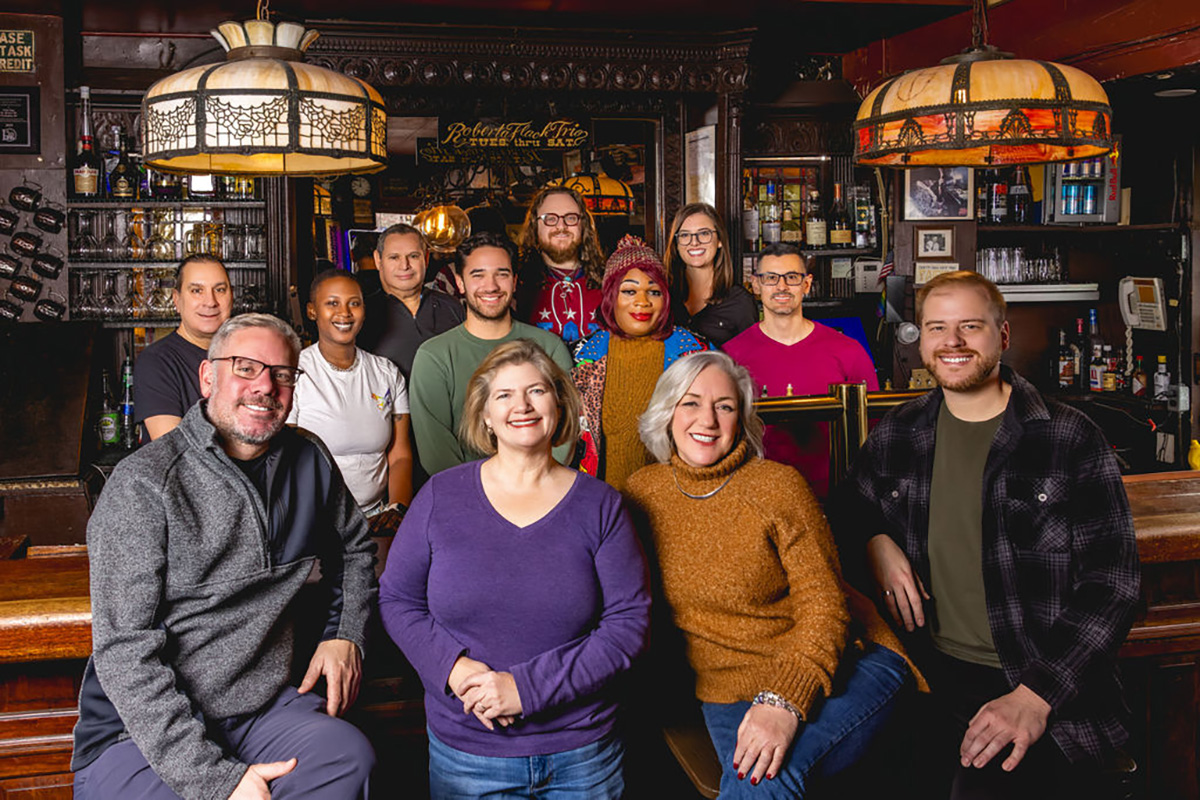
America’s 250th isn’t the only milestone birthday D.C. is celebrating this year.
Beloved D.C. restaurant Mr. Henry’s, that Capitol Hill staple, celebrates its Diamond Jubilee all year long. Named for its original owner Henry Yaffe, the restaurant opened on a warm day 60 years ago in the summer of 1966 and has never looked back.
Yaffe took over what was then a country western restaurant, renovated the interior to his liking, and created an institution. Yet Yaffe had another goal. As a gay man, “he created Mr. Henry’s to be a place where everyone felt welcome — not easy in 1966 — and he succeeded,” says current owner Mary Quillian.
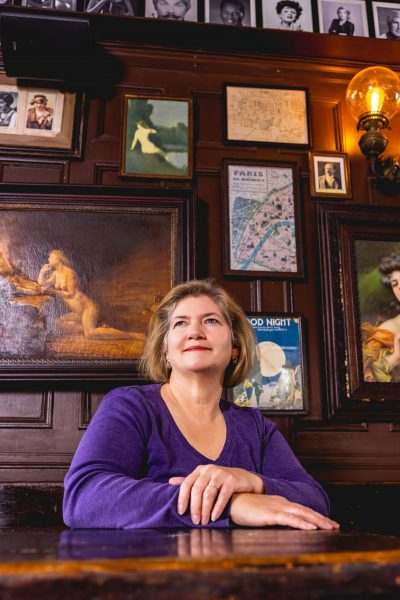
“Mr. Henry’s has long been a place the LGBTQ community has supported because they felt and still feel welcomed,” says Quillian. Even in the current administration, “the gay community and the diversity-minded community continue to come.”
Since then, Mr. Henry’s has changed hands, opened and closed its second floor, welcomed famed musical acts, and played host to politicians, date nights, breakups, and birthdays. But it still feels like home (and has a note in the National Trust for Historic Preservation) at 601 Pennsylvania Ave., S.E.
Its wood-paneled, Victorian-inspired art-filled décor in the downstairs dining room and bar serves American pub fare for lunch and dinner daily, with brunch on weekends (and a dog-friendly patio). Upstairs, Mr. Henry’s hosts live jazz performances and special events most nights, continuing a musical tradition that has defined the venue for decades. That upstairs bar has played host to names like Roberta Flack and Woody Allen.
Musician Kevin Cordt said that, “Mr. Henry’s has been a part of my life for more than 30 years. I started as a customer, then became a bartender and server, and now I have the good fortune to play trumpet at one of the best live music venues in Washington, D.C.”
Aaron Myers, executive director of the D.C. Commission on the Arts and Humanities, is also a supporter. “Not many cities can sport venues that have consistently served the community in the space of culture for more than 50 years, let alone can brag as the birthplace of culture defining talent.”
From the start, Yaffe promoted a rare yet celebrated combination of locals’ bar and soulful nightlife venue. Mr. Henry’s has attracted a diverse crowd at a time when such spaces were – and perhaps still are – uncommon, a diversity that is credited with helping protect the pub during the 1968 D.C. riots.
Longtime customer Evelyn Branic said, “Mr. Henry’s has been my ‘Cheers’ hangout since my wife and I moved to the Hill in 1987. I’ve experienced many iconic moments meeting politicians, reporters, civic activists, and neighbors engaging in spirited conversations. Whether political, LGBTQ, historians, neighbors, or out-of-towners, everyone could find a special place to be greeted as a friend.”
Its welcoming tables come dabbed with a bit of tea: In 1971, in a moment that has since become part of Capitol Hill lore, Yaffe lost the pub in a poker game to Larry Quillian. The Quillian family, recognizing the special role Mr. Henry’s played in the neighborhood, took over ownership, and committed to preserving its spirit. Today, Larry’s daughter Mary owns the bar, having given it a bit of a facelift for the bar’s 50th birthday, bringing in new tables and some fresh menu items.
For example, the menu has some of those dishes that regulars would riot if they disappeared. The Reuben and the hamburgers, the chili and in-house roasted turkey have never departed the menu. Dishes do evolve, says Quillen: they added wings about two decades ago.
In 2026, the restaurant is hosting monthly ticketed “decades” parties, celebrating each of the 10-year periods the restaurant’s been open, plus there were specials in June for Pride. The official 60th anniversary gala takes place Aug. 29, featuring performers, beverages, timeless favorite foods, swag – and the unveiling of a new cocktail.
Inclusive, eccentric, eclectic, Mr. Henry’s is looking forward to maintaining its centrality to diverse crowds in Capitol Hill. Battling inflation, rising menu prices, changing tastes, and thin margins, Quillian says that Mr. Henry’s has — and will always be — “a caring community for so many different folks. And THAT is why I am committed to keeping us going. Society needs places like Mr. Henry’s, now more than ever.”

Tickets on sale for chef Patrick O’Connell’s book launch event

Remembering Victoria Cruz, Stonewall veteran and beloved trans activist

Wanda Alston Foundation announces passing of founding executive director Brian Watson

Beloved local master gardener Frank Asher dies at 69

DOJ seeks to dismiss some claims in gay FBI employee’s bias lawsuit

Calendar: July 17-23

Whitman-Walker to host legal services workshop

30 years on, ‘The Birdcage’ remains a landmark

Comings & Goings