Health
Md. advocates should now focus on health care
A new fight and focus after marriage victory

By LESLIE CALMAN & SUZANNE SCHLATTMAN
Two recent developments provide the opportunity for LGBT Marylanders to achieve equality.
The first is obvious: After a hard-fought battle and with the help of innumerable straight allies, marriage equality is now law of the land in Maryland. Although the federal Defense of Marriage Act continues to bar a number of benefits to married LGBT people, state-level benefits are now fully available.
This means that many more Marylanders will be able to qualify for health insurance coverage. What’s the connection? Many more people will be able to access health insurance through their spouses. And Maryland is ahead of the curve on implementing President Obama’s Affordable Care Act. The new insurance exchanges and reduced rates the ACA mandates are sure to expand coverage to more than 300,000 previously uninsured state residents — including many lesbian, gay, bisexual and transgender Marylanders.
To maximize the benefit of both of these major policy changes, it’s important for LGBT Marylanders to get informed and get engaged.
LGBT Marylanders are more likely than heterosexual people to be uninsured. LGBT people are more likely to be self-employed, to earn less or to work for employers who don’t offer health insurance. For an American woman, the best predictor of whether she has health insurance is if she is married — a status previously denied to LGBT women.
Marriage equality and the Affordable Care Act confront these inequities in many tangible ways that increase coverage, improve quality and help build a better system to ensure that all Marylanders can get the healthcare they need free from unnecessary administrative burden or prejudicial judgment.
First, for people with low incomes, the ACA makes health insurance available for free or at reduced rates. Individuals earning up to about $15,000 per year will be able to get free coverage through the expanded Medicaid program starting Jan. 1, 2014.
Other single Marylanders earning up to $44,680 can get tax credits to subsidize their coverage through our new Maryland Health Connection. Plans sold in the Connection will provide robust benefits at affordable rates by encouraging competition and making it easier for consumers to compare and shop for insurance.
Qualifying small businesses can also get tax credits of up to 35 percent of the business’ health care costs if they provide health insurance for their employees.
There are many other provisions in the law that can make it an even greater win for LGBT Marylanders. For example, the state will set a benchmark, or minimum standards of medical treatments to be guaranteed in the Maryland Health Connection. This is an opportunity to eliminate arbitrary exclusions based on sexual orientation and gender identity that currently create significant barriers to care, particularly for transgender people. There are a number of insurance plans that deny coverage for any services or medications related to sex transformation — and that can apply to denial of vital screenings, like mammograms or pap tests, for a person born female but has since become a transgender man.
The ACA also creates a unique opportunity to learn more about the different experiences of LGBT Marylanders in our healthcare system: how does the experience of being stigmatized affect health and access to health care? Are LGBT people less likely to get recommended cancer screenings? More likely to suffer stress? More likely to smoke? Collecting data on sexual orientation and gender identity can be a way to better understand and address inequities and injustice in health and in our health care system that disproportionately affects LGBT patients.
Finally, the ACA also creates a Navigator program that can empower trusted service providers in the LGBT community to conduct education and enrollment work and ensure that state marketing efforts cater to LGBT people and direct them to brokers or community-based organizations that understand unique health care considerations in the community and help them find coverage that best suits their needs.
It is important for those advocates who were engaged in the successful campaign for marriage equality to now turn their attention and efforts to make sure that Maryland’s implementation of the Affordable Care Act goes as far as it possibly can to guarantee meaningful access to quality, affordable health care for LGBT Marylanders.
Leslie Calman is executive director of the Mautner Project. Suzanne Schlattman is community outreach and development director of the Maryland Health Care for All coalition.





Health
AIDS Healthcare Foundation announces 3 million people globally in its care
Los Angeles-based group lauded ‘historic milestone’

The AIDS Healthcare Foundation, a Los Angeles-based nonprofit group founded in 1987 that has become the world’s largest HIV/AIDS organization, has announced it has three million people in care around the world.
In a statement released on May 26, the organization, known worldwide as AHF, said the latest accomplishment reflects its global commitment to HIV prevention, care, and treatment. It says the accomplishment comes at a time when AHF marks the 25th anniversary of its first global programs launched in South Africa and Uganda in early 2001.
The statement says the three million people in care milestone also comes while the group approaches the 40th anniversary of its founding in 1987.
“Today, AHF provides lifesaving services in 50 countries across Africa, the Americas, Asia, and Europe, supporting millions of people living with HIV through a network of 1,056 global clinics, 79 healthcare centers in the U.S., 67 pharmacies, 96 wellness centers, 26 Out of the Closet thrift stores, outreach programs, and community partnerships,” the statement says.
“This accomplishment is far more than a number — it represents 3 million individuals whose lives have been touched by compassion, commitment, and the belief that healthcare is a human right,” Condessa M. Curley, the AHF board chair, said in a statement. “We extend our deepest gratitude to every member of the AHF team whose dedication made this milestone possible,” Curley said.
The AHF website notes the organization was founded in 1987 in Los Angeles as a network of hospices committed to “fighting for the living and caring for the dying” at a time when there was no effective treatment for HIV/AIDS. A statement on the website says since that time AHF has greatly expanded, converting its hospices into healthcare centers “and building a new paradigm for HIV care both in the United States and around the world.”
The statement adds, “Under the leadership of president and co-founder Michael Weinstein, AHF has grown from a group of friends dedicated to creating dignified hospice care to the largest AIDS organization in the world.” It says Weinstein “has been at the forefront of creating cutting-edge healthcare and advocacy programs and continues to drive the organization forward with the aim of saving more lives around the world.”
The statement announcing the milestone has also come at a time when more than 40 million people worldwide are living with HIV, “while hundreds of thousands continue to die annually from AIDS-related illnesses despite the availability of effective treatment.”
It says AHF’s response has included an expansion of its prevention and public health programs worldwide. In 2025 alone, according to the statement, AHF and its affiliated programs provided nearly five million free HIV tests globally and distributed more than 54 million free condoms, “underscoring the organization’s continued emphasis on both prevention and treatment.”
In D.C. AHF operates health care centers at 1701 K St., N.W., Ste. 400 [202-293-8680], 650 Pennsylvania Ave., S.E., Ste. 310 [202-350-5000], and 1647 Benning Road, N.E., Ste. 300 [202-350-5000].
Cannabis Culture
LGBTQ people, weed, and mental health: what you need to know
Community uses marijuana at much higher rates than general population

Uncloseted Media published this story on May 7.
By SPENCER MACNAUGHTON | In 2025, the global cannabis market size was valued at nearly $103 billion. By 2034, that number is expected to explode by roughly 1,400 percent to more than $1.43 trillion.
In short, as an increasing number of countries legalize marijuana use, everyone is starting to consume a lot more weed. And LGBTQ people tend to use cannabis at much higher rates than the general population. One study found that 55 percent of lesbian and 45 percent of gay young adults use marijuana, compared to about 33 percent and 37 percent, respectively, of their straight counterparts.
As LGBTQ people face a mental health crisis, the mainstream stereotypes that depict weed as an antidote for anxiety, panic and depression aren’t painting the full picture. And that could be exacerbating the mental health struggles so many queer people, and especially youth, face.
Here’s what the research demonstrates about marijuana and its effects on mental health:
- Multiple studies suggest a link between marijuana use and an increased risk of mental health disorders, including schizophrenia, depression and anxiety in individuals who are genetically predisposed.
- One study found that daily marijuana use, especially among younger people, makes some individuals seven times more likely to develop psychosis.
The increase in higher-potency strains of marijuana could pose unknown risks. In 1995, the average content of Tetrahydrocannabinol (THC) in confiscated marijuana was less than 4 percent. In 2022, it was more than 16 percent. Researchers don’t know the full extent of the impact that these higher concentrations can have on mental health and especially on younger people whose brains are still developing.
- A systematic review of studies published between 2013 and 2025 found damning results for the mental health of young cannabis users:
They were 51 percent more likely to experience depression, 58 percent more likely to experience anxiety, between 50 and 65 percent more likely to experience suicidal ideation and 80 to 87 percent more likely to have attempted suicide.
- While the above stats paint a grim picture, there is also some research that suggests benefits of cannabis use:
- A 2025 systematic review found that “medicinal” weed showed some efficacy in relieving withdrawal symptoms of opioid use disorder. THC use has been associated with improvement of post-traumatic stress disorder symptoms, bipolar symptoms and sleep quality.
- Other studies found that THC administered in a controlled setting was associated with a decrease of symptoms and adverse effects for a range of mental health disorders, including schizophrenia, psychotic symptoms, and anorexia nervosa.
Beyond what we pulled from academia, there is an astounding lack of information about the interplay between weed and mental health. As we dive deeper into Mental Health Awareness Month, I hope advocacy organizations, influencers and news outlets ramp up their coverage of this important topic that affects the countless LGBTQ weed smokers, many of whom are already struggling.
Health
UPDATED: Trans-led HIV clinic in Portsmouth struggles amid funding cuts
As states across the U.S. cut funding for HIV care this small clinic in Va, is still fighting

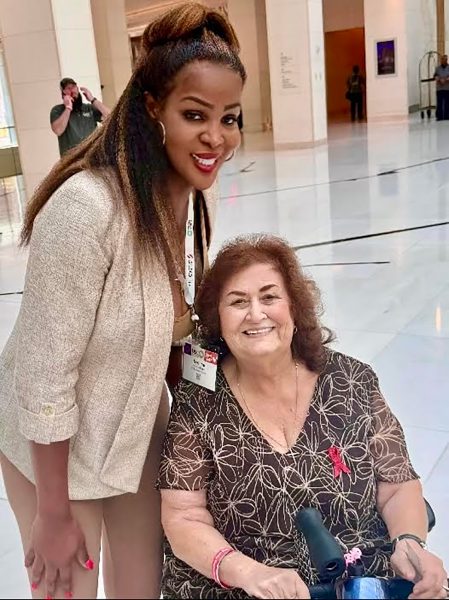
Two years ago, Nyonna Byers, a transgender woman from Portsmouth, Va., founded Ending Transmission of Sexual Infections (ETSI) Health Clinic to support a community she saw struggling with rising HIV rates. Now, as costs continue to climb and funding for HIV healthcare initiatives is being cut across the United States, Byers says her transgender identity has made it harder to secure the financial support her clinic needs to survive.
Portsmouth, with just under 100,000 people, is right across the Elizabeth River from Norfolk.
“We’re an HIV-led organization here in Portsmouth, providing services throughout the Hampton Roads area,” Byers told the Blade. “As a trans-led organization—with me as the founder and executive director—I’ve received a lot of rejection when it comes to funding. That’s one of the main reasons why we’re struggling to keep the clinic open. Without funding, we can’t provide HIV treatment or care, and then we’re just a theoretical organization—we can’t be impactful in the community we serve.”
She said the data clearly shows a need for increased investment in HIV care in Portsmouth, but the response from leadership has not matched the urgency of the crisis.
“Portsmouth is one of the smallest cities with one of the highest HIV rates, and there are very few HIV-led organizations or clinics here. The need is urgent, but the response doesn’t match it. We’re doing the work on the ground, but we’re not getting the support to sustain it. That disconnect is what’s hurting people the most.”
That need, Byers explained, continues to grow as ETSI struggles to meet the financial demands of the life-saving work it provides.
Portsmouth has one of the highest HIV prevalence rates in Virginia, with roughly 736.9 cases per 100,000 people—a rate that exceeds both state and national averages.
“Leaders like the mayor and city council don’t focus on public health or social health. They focus more on development—building the city up physically—rather than investing in the health of the people. I’ve applied for funding multiple times and been denied. Every time I’ve asked for resources, I’ve been turned away.”
When asked why, Byers said the answer felt clear to her.
“I honestly believe I was denied funding because I’m trans. I told the mayor I was going to go public with it, because it’s not fair. We’re on the ground doing the work to end HIV, and we’re still not getting the support we need. That’s not just frustrating—it’s harmful.”
While she said local support has been lacking, Byers noted that the state has stepped in—though the funding still falls short of what is needed to sustain the clinic long term.
ETSI Health Clinic was included as a recipient of funding in the Virginia 2027–2028 Senate budget, receiving $50,000 per year from the Virginia General Fund. Byers specifically credited State Sen. Lillie Louise Lucas with helping secure that funding, which she said did not come from city leadership.
Byers shared that she has given up a lot to keep ETSI afloat, but the costs just keep coming.
“I’ve worked a lot of contracts—jobs paying $30 to $40 an hour—and poured that money into my clinic. But the downside is that I’m struggling personally. I’ve lost cars, I’ve lost a house—I’ve lost a lot to keep this clinic going. This work has cost me almost everything.”
She added that the impact of federal policy shifts is also being felt locally. As the Trump-Vance administration continues to roll back what it has described as unnecessary “DEI” spending, Byers said those decisions are affecting clinics like hers.
There was a time when the clinic was able to receive funding from Sentara Cares, the philanthropic program of Sentara Health, a not-for-profit healthcare system based in Virginia and North Carolina, but now they can’t.
“We had funding from Sentara Cares for three years, and it helped keep us going. Then when DEI initiatives started getting rolled back, that funding stopped. I was told directly that because of federal policy changes, they couldn’t fund the clinic. I broke down during that meeting, because it felt like they were really saying they couldn’t support us because of who we are.”
That lack of funding is compounded by broader gaps in healthcare access in the region. Portsmouth—the ninth most populous city in Virginia—does not have a hospital.
“There’s very limited access to care in Portsmouth. We don’t even have a hospital—people have to be transported to Norfolk. We’ve had high rates of syphilis, and the health department is only open a few days a week. A lot of people don’t trust it, and that leaves entire communities without care.”
Byers made it clear that this is more than a passion project for her—it is her life’s calling, and she would do nearly anything to keep it going.
“To be honest, I would go back to sex work before I let my clinic close. This is something I built from the ground up. I built this clinic with money I earned myself. I’m not going to let it disappear without a fight.”
She also pointed to gaps in education and outreach, which she says exacerbate HIV rates despite the availability of preventive measures.
“There’s almost no marketing or education about PrEP in the Hampton Roads area. If you go to places like D.C. or Atlanta, you see billboards and campaigns—but here, you don’t see anything. If people don’t see it, they don’t know about it. That lack of awareness is putting people at risk.”
It is also a deeply personal fight, she explained.
“I’ve lost friends to HIV. People say you can’t die from HIV anymore, but you can if you’re not in care. I’ve seen it firsthand, and that’s what motivates me to keep going. HIV doesn’t have to be a death sentence—but without support, it can become one.”
The Blade reached out to Portsmouth Mayor Shannon E. Glover for comment.
Glover disputed Byers’ claims that her clinic was treated unfairly, including her allegation that her transgender identity played a role in funding decisions.
“There’s no issue with Miss—with her and her organization. We have been in discussion, and quite frankly, the claims that she made as it relates to ‘we’re not treating her equitably and fairly because of her [being] transgender’ that is totally untrue,” Glover told the Blade via phone call. “I’ve talked to Miss Nyonna on a number of occasions, and that is categorically not true.”
Glover added that the city provides funding to various organizations and said he had directed Byers to seek support elsewhere.
“So I’m not understanding what her issues are,” he said. “But in any event, you know, we have funding that we provide to organizations. I’ve recommended other organizations to her. I’ve recommended that she go to the state where they have more flexibility with their budget and they could help her. So that’s what I’m prepared to tell you today. I’m not going to answer any questions. I just wanted to respond that her claim that we are mistreating her, not treating her fair, is totally untrue.”
To donate to ETSI, visit their donation page at ESTIhcvas.org/donate

UN human rights chief sounds alarm over ‘comprehensive onslaught’ against LGBTQ rights

White House press pool pushes back after Trump bars three outlets

PHOTOS: Shenandoah Valley Pride

Long-time DignityUSA executive director announces retirement

PHOTOS: Walk and 5K to End HIV

Gun reform is an LGBTQ rights issue

All the queer things to watch this fall

Parties, dinners, concerts and more on tap for fall nightlife

Jeremy Moss looks to bring LGBTQ advocacy from Lansing to Capitol Hill