Arts & Entertainment
Channeling Channing
Broadway vet Opel a formidable presence in ‘Dolly’
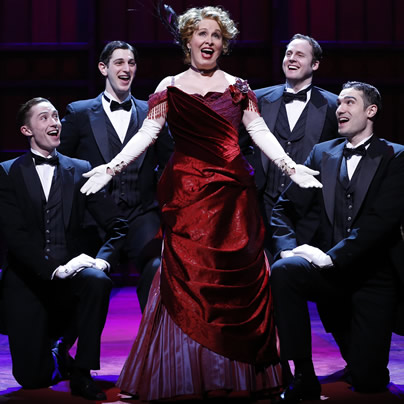
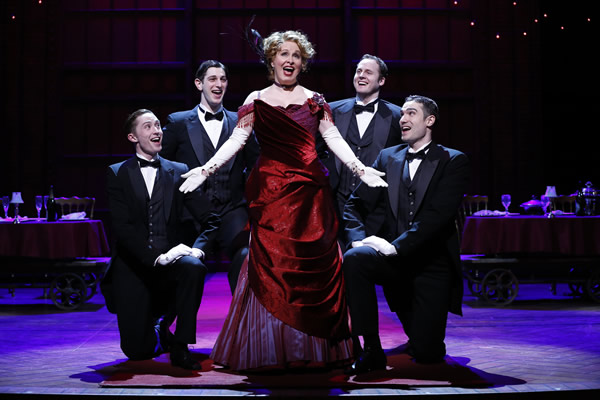
Nancy Opel, center, as Dolly Levi with (from left) Jp Qualters, Harris Milgrim, Kyle Vaughn and Alex Puette in the Ford’s/Signature co-production of ‘Hello, Dolly!’ (Photo by Carol Rosegg, courtesy Ford’s Theatre)
‘Hello, Dolly!’
Through May 18
Ford’s Theatre
511 Tenth Street, NW
$15-90
800-982-2787
fords.org
It feels hard to imagine the musical “Hello, Dolly!” without Carol Channing in the title role. After originating the part on Broadway in 1964 and starring in two revivals, she made the part her own.
Yet director Eric Schaeffer’s new version now playing at Ford’s Theatre puts the raspy voiced blonde out of mind almost entirely. OK, maybe once or twice, you might momentarily miss Channing’s googly eyed mugging and over-the-top entrances, but on the whole, this charm-filled production (presented by Ford’s and Signature Theatre) fares splendidly despite the absence of Channing’s star wattage.
As the ever-resourceful Dolly Gallagher Levi, Broadway veteran Nancy Opel delivers presence, an appealing voice and honed comedic skills best demonstrated when she’s happily bulldozing the bad-tempered half-millionaire Horace Vandergelder (played by an aptly grouchy Edward Gero) into a marriage he doesn’t yet know he wants. Opel’s Dolly is less loopy than Channing’s syrupy sweet yenta, but she’s definitely entertaining. Plus, her Dolly is a woman you might actually recognize.
Based on Thornton Wilder’s play “The Matchmaker,” “Hello, Dolly!” celebrates the possibility of happiness and new beginnings. It’s very American. Set in 1890s New York City and Yonkers, the musical (book by Michael Stewart; music and lyrics by Jerry Herman) follows the maneuvers of life-loving Dolly as she improves her circumstances and along the way brings a little joy to those around her. Among those benefiting from Dolly’s machinations is widowed milliner Irene Molloy (Tracy Lynn Olivera) who — with Dolly’s assistance — finds love with never-been-kissed shop clerk Cornelius Hackl played by boyish blonde actor Gregory Maheu. Olivera’s gorgeous rendition of “Ribbons Down My Back” is one of the show’s high points.
Similarly, Dolly bolsters love matches involving Irene’s young assistant Minnie Fay and Cornelius’ self-conscious co-worker Barnaby Tucker (Lauren Williams and Zack Colonna), as well as Vandergelder’s hilariously miserable niece Ermengarde (Carolyn Cole) and her artist boyfriend Ambrose (Ben Lurye).
Ford’s Hello Dolly trailer
When Jerry Herman came to Washington to receive a Helen Hayes Tribute in 2005, the famed gay composer shared that his goal has always been to make audiences happy. Herman’s score indeed does just that — filled with hummable, enduring classics like “Put on Your Sunday Clothes,” “Elegance,” “Hello, Dolly!” and the stirring “Before the Parade Passes By,” it has long been an audience favorite. Herman also wrote, among others, the scores for megahits “Mame” and “La Cage Aux Folles.”
Celebrated for streamlining big musicals, Schaeffer (who is gay) has pared down his “Dolly” to a comparably small cast of 16, concentrating more on the show’s story and strong characters rather than spectacle. Adam Koch’s set is a rust-colored train station, the well-used link from Yonkers to the city and back, and though his set is spare, it’s filled with many beautiful things like Wade Laboissonniere’s gorgeous period costumes — plaid suits, bowlers, corseted slim silhouettes, outlandishly large hats — all realized in mostly muted tones; Karma Camp’s inventive, athletic choreography performed by an ensemble of graceful, top-notch dancers; the melodic strains of an on point, eight-man band led by the show’s musical director and keyboardist James Moore; and a spirited cast featuring a lot of local talent.
Earlier this year on a broadcast of “Radio 360,” comedian Sandra Bernhard talked about seeing “Hello, Dolly!” when she was a little girl. Bernhard remembered feeling she should be part of the cast. Then and there, she was ready to get on stage with Carol Channing and the show’s other bigger-than-life characters. Now it’s time for the next generation to get inspired by Ford’s “Hello, Dolly!” and join the parade.



Movies
Queer team brings girl power to fully baked ‘The Wrong Girls’
Perfect film for anyone who loves stoner comedies
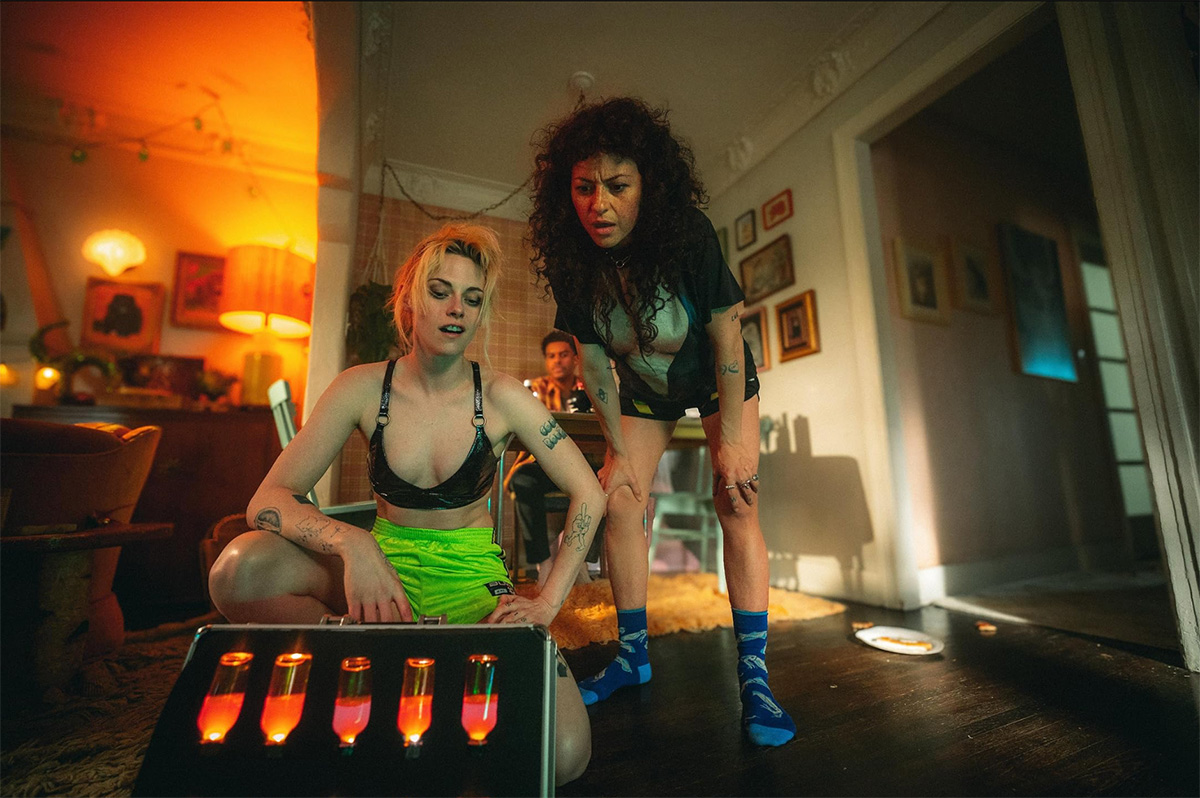
Generally speaking, the “Stoner Comedy” genre is aimed at an audience of “stoners,” and if you’re not one, you probably don’t get the appeal.
If you are, though, you’re likely to enjoy “The Wrong Girls,” the new indie from screenwriter Dylan Meyer in her directorial debut, which began a theatrical release on Aug. 14. The plot is ridiculous, the humor is lowbrow, and you won’t find any substance in it except for the ones that get consumed onscreen – but that’s exactly the reason why it’s pretty much perfect for anybody who loves stoner comedies, and the fact that everyone involved commits to it whole-heartedly might just makes it all the more so.
Starring Kristen Stewart (Meyer’s real-life spouse) opposite Alia Shawkat as a pair of broke, directionless best friends who share an L.A. apartment and spend an impressive amount of effort finding new and elaborate ways of consuming cannabis, it opens with them facing a financial crisis; Frankie (Stewart) is thousands of dollars in debt for a scholarship to Stanford – even though she failed out before graduating – and Molly (Shawkat), who dreams of being a professional chef, channels her creative cooking skills into creating off-the-wall recipes for cannabis-infused snacks. To make matters worse, rent is due, and – as usual – they are short.
Their situation gets a sudden surprise windfall when Frankie (through a freak case of mistaken identity) ends up in possession of a briefcase full of a mysterious liquid they assume is some kind of drug. Thinking they can sell it for rent money, they decide to try it for themselves, first, resulting in a pink-and-bubbly hallucinogenic experience in which they can hear each other’s thoughts (and their cats’ thoughts, too) – an effect that lingers even after the “trip” subsides.
Their plan to sell the substance hits a snag, however, when a cadre of gun-toting Euro-thugs in dark suits show up on the scene trying to get their hands on it. Forced to go on the run, they eventually learn that the substance they took is a top-secret experimental drug, developed by a scientist (Kate McKinnon) researching human consciousness – and that the Europeans work for a dangerous rival who wants the formula for his own nefarious purposes. Can two 20-something stoners successfully elude and overcome a team of international mercenaries on a mission? Probably not, but the superpowers they seem to be developing might improve their chances – if they can figure out how to use them, that is.
Cut from the same cloth as every weed-centric movie farce you’ve ever seen, “The Wrong Girls” leans into most of the genre’s usual formula points, first and foremost of which is that it doubles as a buddy comedy. From Cheech and Chong, through Jay and Silent Bob, to Harold and Kumar, these films have always relied on the goofy chemistry between two friends, and Mayer (who wrote as well as directed) makes a special point of following that blueprint – because it’s also where her film sets itself apart from most of the other examples within a traditionally male-dominated genre by making the buddies female instead.
It’s a simple switch, and it really doesn’t have any significant impact on the general “vibe” of the story; the dynamic is more or less the same familiar back-and-forth banter between two people who have spent years getting high together, and their antics are just as stupid. Even so, in another way, flipping the usual gender of its protagonists makes an essential difference, simply because we’re so accustomed to seeing it the other way around – but women also like to get high, so why shouldn’t we see them doing it in the movies? After all, the now-legendary Comedy Central series “Broad City” (to which “The Wrong Girls” also owes a debt of inspiration) brought a pair of stoner chicks to TV over a decade ago with the epic pairing of Ilana Glazer and Abbi Jacobson, so it’s high time (if you’ll pardon the pun) we see the same on our big screens, too.
There are other twists that spruce up the formula too – a boyfriend (Zack Fox) who sparks girl buddy jealousy by asking Molly to move in with him, the crashing of a party thrown by a corporate douchebag (Tony Hale) and provides a great target for the anti-establishment satire that’s almost obligatory for the genre, and a plot thread about giant squid biochemistry that adds an air of comedic mysticism while tapping into the “cephalopod awareness” trend that has wriggled its way into our cultural discourse around ethical seafood consumption. All of it is written and executed with a cleverness that makes it easy to laugh at all the “dumb” comedy without it feeling too much like a guilty pleasure.
Steward and Shawkat, needless to say, carry the film; they find just the right blend of authentic friendship and “train wreck” energy to make their relationship both wacky and relatable. LaKeith Stanfield brings an admirable seriousness to his role as the guy who delivers the briefcase to the wrong person before becoming a comic foil as he ends up being a reluctant ally; stoner movie veterans Seth Rogan and Kumail Nanjiani amusingly lend their voices to the girls’ two cats; but it’s McKinnon who raises the bar, entering the story late in the game to become the hands-down MVP in a comedy that is only improved by her proven gift for stealing every scene she’s in. It’s worth noting that Geena Davis turns up for a memorable appearance that feels like a nod to that grandmother of all girl-buddy films, “Thelma and Louise.”
It’s also worth mentioning the strong imprint of queer creativity that exudes from “The Wrong Girls,” which casts two queer stars in a queer-written-and-directed comedy that also features several other prominent cast members who are queer (or queer adjacent), despite not having any specifically queer story elements. Maybe it’s the camp sensibility, or the obvious lampooning of overtly toxic heterosexual “types,” or just a general feeling of irreverence and a sharply counter-cultural edge – but somehow, the whole thing comes across as an expression of queer perspective that manages to run circles around the banality that might otherwise easily have turned the movie into an unfunny slog through a territory we’ve all seen plenty of times before.
All that said, it’s important to return to the original point that stoner movies are not necessarily meant for everyone – and fresh as it might feel, “The Wrong Girls” is definitely a stoner movie. There’s a lot of humor (and we mean A LOT) that will fall flat for those who don’t “get it,” and a considerable amount of absurdity and excess which will probably only frustrate viewers without a natural taste for it. Like even the best of the genre, it’s not intended to be deep, or even coherent – it’s all just for the sake of mindless, feel-good fun for those with a taste for it. So be warned by that caveat if you think it applies to you – otherwise, we suggest you grab a pack of edibles and jump on board for the ride.
Out & About
UPDATE: Impulse Group’s ‘PrEP Pool Party’ cancelled
Organizers announce cancellation of event
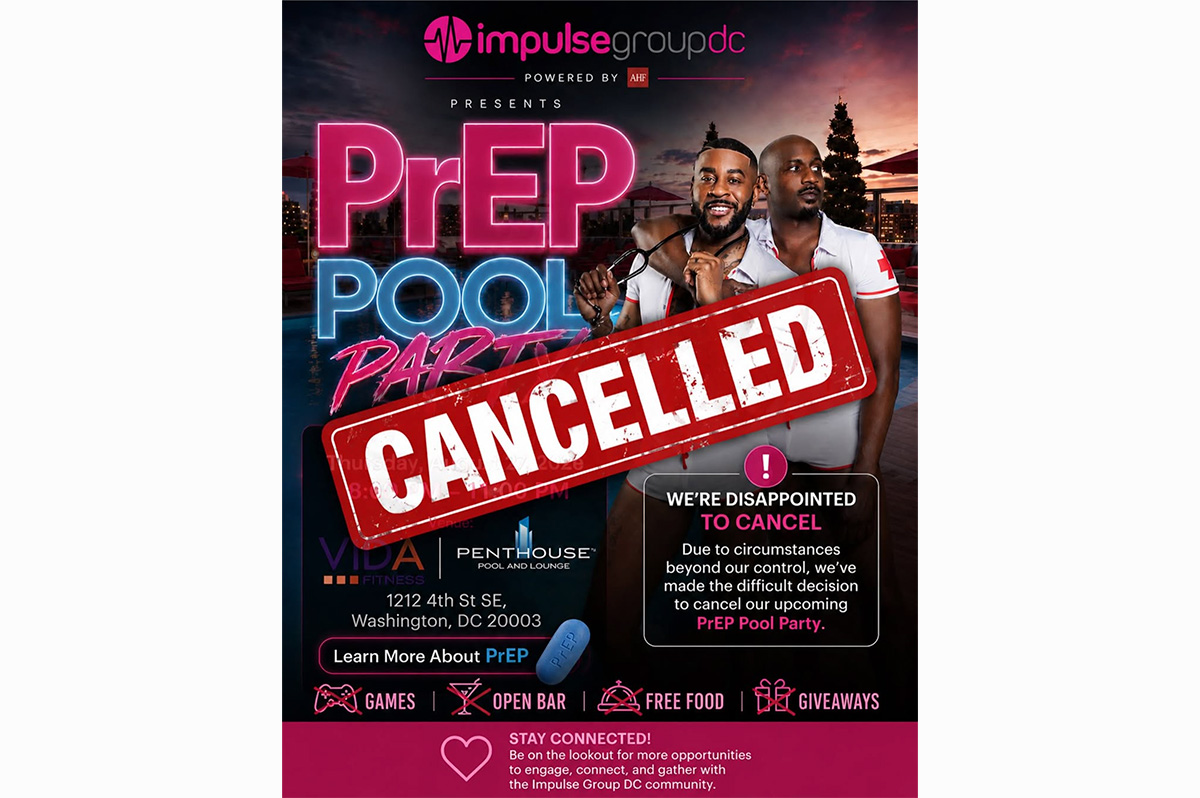
Impulse Group DC was to host a “PrEP Pool Party” on Thursday, Aug. 27 at 8 p.m. at Vida Fitness: Navy Yard. However, organizers have announced that the event has been cancelled.
Visit @impulsegroupdc on Instagram for information on future events for Impulse Group DC.
Friday, August 21
Go Gay DC will host “LGBTQ+ Community Happy Hour” at 7 p.m. at Uproar Rooftop. This is a chance to relax, make new friends, and enjoy happy hour specials at this classic retro venue. Attendance is free and more details are available on Eventbrite.
Trans and Genderqueer Game Night will be at 7:00p.m. at the DC Center for the LGBT Community. This is a relaxing, laid-back evening of games and fun. For more details, visit the DC Center’s website.
Saturday, August 22
Go Gay DC will host “LGBTQ+ Community Brunch” at 11 a.m. at Freddie’s Beach Bar & Restaurant. This fun weekly event brings the DMV area LGBTQ+ community, including allies, together for delicious food and conversation. Attendance is free and more details are available on Eventbrite.
Black Lesbian Support Group will be at 1 p.m. on Zoom. This is a peer-led support group devoted to the joys and challenges of being a Black lesbian. For more details, email [email protected].
Monday, August 24
“Center Aging: Monday Coffee Klatch” will be at 10 a.m. on Zoom. This is a social hour for older LGBTQ+ adults. Guests are encouraged to bring a beverage of choice. For more information, contact Adam ([email protected]).
Queer Book Club will be at 7 p.m. on Zoom. The Queer Book Club meets on the fourth Monday of the month to discuss books by queer authors. This month’s reading is “An Unkindness of Ghosts” by Rivers Solomon. For more details, visit the DC LGBTQ+ Community Center’s website.
Tuesday, August 25
Genderqueer DC will be at 7 p.m. on Zoom. This is a support group for people who identify outside of the gender binary, whether you’re bigender, agender, genderfluid, or just know that you’re not 100% cis. For more details, visit genderqueerdc.org or Facebook.
Wednesday, August 26
Job Club will be at 6 p.m. on Zoom upon request. This is a weekly job support program to help job entrants and seekers, including the long-term unemployed, improve self-confidence, motivation, resilience and productivity for effective job searches and networking — allowing participants to move away from being merely “applicants” toward being “candidates.” For more information, email [email protected] or visit thedccenter.org/careers.
Asexual and Aromantic Group will meet at 7 p.m. on Zoom. This is a space where people who are questioning this aspect of their identity or those who identify as asexual and/or aromantic can come together, share stories and experiences, and discuss various topics. For more details, email [email protected].
Thursday, August 27
The DC LGBTQ+ Community Center’s Fresh Produce Program will be held all day at the Center. People will be informed on Wednesday at 5 p.m. if they are picked to receive a produce box. No proof of residency or income is required. For more information, email [email protected] or call 202-682-2245.
Virtual Yoga Class will be at 7 p.m. on Zoom. This free weekly class is a combination of yoga, breath work and meditation that allows LGBTQ+ community members to continue their healing journey with somatic and mindfulness practices. For more details, visit the DC LGBTQ+ Community Center’s website.

Log Cabin Republicans remove transgender rights from mission

Not all trans people are the same

Queer team brings girl power to fully baked ‘The Wrong Girls’

Democrat Maureen ‘Mo’ Madden takes on longtime GOP stronghold in Delaware’s 38th

Comings & Goings

Russian LGBTQ rights group to shut down

Winsome Earle-Sears ‘Life and Marriage Tour’ to include Northern Va. stops

White House targets gender-affirming care funding, states fight back

Madonna nominated for 11 MTV VMAs

Man charged with anti-gay assault in D.C. accepts plea offer
-

 Russia5 days ago
Russian LGBTQ rights group to shut down
-
Virginia4 days ago
Winsome Earle-Sears ‘Life and Marriage Tour’ to include Northern Va. stops
-
White House4 days ago
White House targets gender-affirming care funding, states fight back
-
Celebrity News4 days ago
Madonna nominated for 11 MTV VMAs