News
Trend watch: gay Republicans for Congress
Innis seeks N.H. House seat in ‘historic’ year for GOP
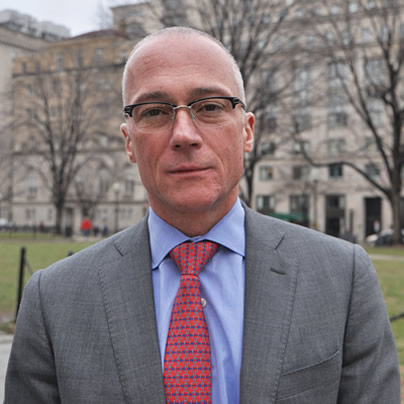
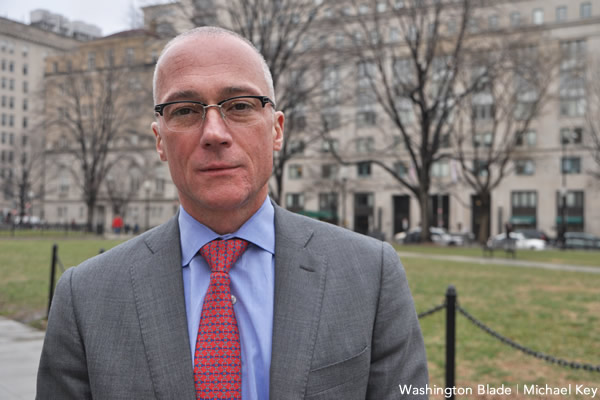
Dan Innis is running for Congress in New Hampshire (Washington Blade photo by Michael Key).
The New Hampshire Republican is one of three openly gay Republicans running in the congressional mid-terms along with Richard Tisei in Massachusetts and Carl DeMaio in San Diego.
The significance of the triumvirate of gay GOPers running for Congress at the same time isn’t lost on Innis, who spoke with the Washington Blade during a trip to D.C. last week between meetings on K Street.
“I think it’s an indicator of how far we have moved as a nation because 10 years ago, this wouldn’t be happening,” Innis said. “And we have really come a long way, and I think we will continue to move along this path. To me, it’s a real statement about our continued push for full equality.”
But it’s the Republican aspect of Innis’ candidacy that’s at the forefront of his mind as he seeks to oust incumbent Democrat Rep. Carol Shea-Porter from her seat representing New Hampshire’s 1st congressional district.
During his tenure since 2007 as dean of the College of Business and Economics at the University of New Hampshire, Innis said the young people with whom he works don’t see the world in the same way as he did when he was younger.
“I’ve been working with young people for 23 years in higher education,” Innis said. “I have three kids of my own, 13, 20 and 22. And the way that they see the world today is different from the way that I saw it. They don’t feel the same level of freedom, they don’t feel the same opportunities, they don’t feel that their future is as bright as I felt mine was.”
For Innis, the downward shift has its roots in Washington, and it’s time for New Hampshire to send representatives to Congress “who are not career politicians, who can help to turn things back around, and bring back that sense of optimism about the future.”
Innis earlier this month won an endorsement from the Gay & Lesbian Victory Fund, which has also endorsed Tisei in his bids for Congress. The Victory Fund has yet to endorse DeMaio.
“Dan Innis is a sensible and visionary leader, two qualities New Hampshire constituents deserve in a representative,” said Torey Carter, chief operating officer at the Victory Fund. “His unique combination of corporate and academic backgrounds has allowed him to address issues that affect others with careful consideration.”
Innis said he hasn’t sought an endorsement from the Human Rights Campaign. The Log Cabin Republicans are prohibited from making endorsements in the primary.
Even with the Victory Fund endorsement, the New Hampshire Republican said he doesn’t see LGBT issues as a priority for him if elected as much as the advancement of equality in general.
“I think, for me, it’s about equality for all, and those are the issues that I’ll always champion, so any issue that relates to equality — whether it’s related to gender, race, sexual orientation — those are values that I think all Americans hold, and those are things that I would always fight for,” Innis said. “It’s a broad-based equality mission for me.”
But among the pieces of legislation at the top of his list is the Employment Non-Discrimination Act, a bill that has languished in Congress for years that would prohibit bias against LGBT people in the workforce.
“It’s time that that come up for a vote, and there’s no reason it shouldn’t,” Innis said. “We’ve seen support for that on the Senate side, New Hampshire senators both supported it, Republican and Democrat, and I’m proud of that. And I believe the House will do the right thing.”
The legislation passed in the Senate late last year on a bipartisan vote of 64-32, but House Speaker John Boehner (R-Ohio) has said he opposes it and it hasn’t yet come up for a vote in the Republican-controlled chamber.
Even though his vote first in Congress would be for Republican leadership, Innis said he sees the ability for LGBT legislation to advance under a GOP-controlled House because he’d bring a different voice to the caucus.
“When they’re not there with you, you don’t see it the same way,” Innis said. “The minute I’m sitting down next to John Boehner or somebody else, I’m there, and that bill affects me, and that affects how they perceive that bill, and I think it will really change the way the Republican Party will move forward.”
Innis isn’t alone in his bid for the Republican nomination. Also running is Frank Guinta, a former member of the U.S. House who defeated Shea-Porter in 2010, but lost to her in the 2012 election. The primary is Sept. 9.
A recent WMUR Granite State Poll showed Guinta ahead of Shea-Porter, but Innis behind her. He attributed that discrepancy to name recognition, saying that would change as the campaign gets underway and Super PACs come to his aid.
Although significant gains for LGBT equality have been made under the Obama administration, Innis insisted credit for progress should be given to all who contributed.
“You know, we’ve seen previous presidents, the one before Obama, put an awful lot of money into AIDS research,” Innis said, “And I think that deserves credit. George W. Bush was phenomenal on that. He deserves credit. Any leader who’s taken a stand on these issues deserves credit regardless of party. To me, this is not a partisan issue; this is a human issue.”
Despite his support for LGBT rights, Innis stopped short of endorsing the idea of an executive order barring LGBT workplace bias against federal contractors. No Republican lawmaker or candidate has yet to endorse the order.
“I have some issues with executive orders,” Innis said. “I’m not a big fan of executive orders generally speaking, and I will say I haven’t given this one an awful lot of thought, but I think equality is always a good thing.”
Asked whether he was leaning in favor of supporting the executive order, Innis said he’d like to see an end to LGBT discrimination “done in a more open and participative way.”
Coming from a state where same-sex marriage was made legal in 2009 through the legislative process, Innis had a role in helping resist an effort from a Republican supermajority in the legislature to repeal the statute.
Innis acknowledged he didn’t have an active role in the legalization of same-sex marriage at that time because he had recently come out as gay and was still in his position at the university, but said he lent his voice as a Republican when the law was under threat.
“I guess I was on a brochure that went to all the legislators with my story,” Innis said. “I gave a couple of talks, some things in newspapers, and really I think represented equality in the state in that battle. It became very visible for me. I was featured in the Portsmith Herald on the front page the day after. It was a little more public than I wanted to be, but so be it.”
Innis said he faced criticism for his role in convincing the Republicans to drop efforts to repeal the law, but wouldn’t identify who was unhappy with him.
“I think it’s important to note that that was a Republican legislature that had a veto-proof majority in both houses. Think about that and equality was supported,” Innis said. “That’s New Hampshire. And we believe in equality and freedom for all.”
Innis said he hasn’t yet spoken to the other two gay Republican candidates running for Congress, but said he expects to talk to them soon. He’s also not a member of the joint fundraising committee formed by Tisei and DeMaio called the Equality Leadership Fund. Innis said he’s aware of the fund but remains focused on his campaign.
It should be noted all three openly gay Republicans seeking seats in the U.S. House are trying to oust incumbent Democrats.
Ray Buckley, who’s gay and chair of the New Hampshire Democratic Party, said Shea-Porter is the best candidate because New Hampshire voters expect elected officials “to stand up against injustice and support families of all varieties.”
“Instead, Dan Innis failed to fight for LGBT rights in New Hampshire as the legislature debated marriage equality,” Buckley said. “He failed them again during the fight for the Employee Non-Discrimination Act, in which strong Republican voices could have helped turn the tide, ending the ability to discriminate against someone in the workplace for simply being who they are. Meanwhile, Congresswoman Shea-Porter has consistently been on the right side of history, defending LGBT families and advancing civil rights. Dan Innis is the wrong candidate for families of all kinds in the state of New Hampshire.”
But Innis insisted that he’s the right candidate for the LGBT community because, unlike Shea-Porter, he’s lived the experience of being openly gay.
“I live it and understand it more thoroughly than she ever will. I’m LGBT; Carol Shea-Porter is not,” Innis said. “And though I appreciate her support of the community, I think the support coming from me is genuine and it’s part of me.”
It’s the new voices the gay Republican candidates are bringing to the fore that Innis said are making the campaigns valuable in and of themselves.
“I think we have three historic races,” Innis said. “Races that wouldn’t have taken place not that many years ago. And I think that in and of itself adds value for our community, and if we’re going to move equality forward, we’ve got to do it in every way possible – Republican, Democrat, Libertarian, independent, doesn’t matter — I think that if one or all of us wins, we’re that much closer to equality.”
CORRECTION: An initial version of this article incorrectly stated the Victory Fund endorsed Carl DeMaio. The Blade regrets the error.




Brazil
2026 International AIDS Conference to take place in Rio
US funding cuts have significantly impacted global HIV/AIDS fight

The 2026 International AIDS Conference will take place next week in Rio de Janeiro.
Francisco Ruiz, the former director of the White House Office of National AIDS Policy, and UNAIDS Executive Director Winnie Byanyima are among those scheduled to speak at the conference that will take place in the Brazilian city from July 26-31. Other scheduled speakers include Spanish Health Secretary Javier Padilla, World Health Organization Director-General Tedros Adhanom Ghebreyesus, South African Deputy Health Minister Mathume Joseph “Joe” Phaahla, and Alexus D’Marco of the United Caribbean Trans Network.
The International AIDS Society-organized AIDS 2026’s theme is “Rethink. Rebuild. Rise.”
AIDS 2026 will take place against the backdrop of U.S. funding cuts that have significantly impacted the global HIV/AIDS fight.
Secretary of State Marco Rubio shortly after the Trump-Vance administration took office issued a waiver that allowed PEPFAR and other “life-saving humanitarian assistance” programs to continue to operate during a freeze on nearly all U.S. foreign aid spending. HIV/AIDS service providers around the world with whom the Washington Blade has spoken say PEPFAR cuts and the loss of funding from the U.S. Agency for International Development, which officially closed on July 1, 2025, has severely impacted their work.
The International AIDS Society in a press release it issued on Tuesday noted PEPFAR “has saved more than 26 million lives” since President George W. Bush implemented it in 2003, “and changed the trajectory of the HIV pandemic.”
“PEPFAR was a success under the first Trump administration, with major progress toward the 95-95-95 goals,” it said.
The UNAIDS’s 95-95-95 goals are 95 percent of people with HIV knowing their status, 95 percent of people with HIV having access to antiretroviral therapy, and 95 percent of those receiving ART having suppressed viral loads by 2030.
“Since the start of the second Trump administration, however, it has undergone major disruptions,” added the International AIDS Society.
Eswatini is among the African countries that have received doses of lenacapavir, a groundbreaking HIV prevention drug that users inject twice a year, through PEPFAR since the Trump-Vance administration took office.
The White House last month announced it will end PEPFAR funding for South Africa.
President Ronald Reagan in 1985 implemented the global gag rule, also known as the “Mexico City” policy, that banned U.S. foreign aid for groups that support abortion and/or offer abortion-related services. The Trump-Vance administration earlier this year expanded the prohibition to include groups that promote “gender ideology” and support gender-affirming care and diversity, equity, and inclusion programs.
The International AIDS Society in its press release notes 52 percent of “all implementing partners had at least once terminated award,” while 77 percent of them “had been asked to restrict their work to comply with an additional U.S. policy.” The International AIDS Society notes 1,010 public health facilities, 325 “access points” and 126 “drop-in centers” around the world have closed because of U.S. funding cuts.
“Science is moving fast, giving us more powerful HIV prevention and treatment tools. But these advances cannot save lives if they never reach the people who need them,” said International AIDS Society President Beatriz Grinsztejn, who co-chairs AIDS 2026 and is the director of Rio de Janeiro’s Evandro Chagas National Institute of Infection Diseases’ HIV/AIDS Clinical Research Unit. “That requires robust, stable financing and steadfast political commitment.”
Congress
House blocks effort to codify transgender servicemember ban into law
Lawmakers approved two anti-trans NDAA amendments

The U.S. House of Representatives on Tuesday rejected an amendment to the National Defense Authorization Act that would have codified a ban transgender servicemembers in the military.
The bipartisan vote was 212-217.
The NDAA is for the 2027 fiscal year and sets policies for the Defense Department programs and activities and the national security programs of the Department of Energy.
U.S. Rep. Lauren Boebert (R-Colo.) proposed the amendment on July 21. It stated that all personnel are required to serve in accordance with their biological sex, citing military readiness and discipline.
Human Rights Campaign Senior Director of Government Affairs Jennifer Pike Bailey stated that she is grateful for the bipartisan vote that rejected President Donald Trump and Defense Secretary Pete Hegseth’s “dangerous and discriminatory policy that has kicked brave transgender servicemembers out of the military and weakened our national security.”
“Everyone who meets the same rigorous standards should be able to serve their country. We should honor that patriotism, particularly in this moment where we are witnessing brave servicemembers making the ultimate sacrifice for our country, instead of ending their careers and politicizing their existence. We’re grateful that a permanent extension of this ban failed, and we will keep fighting to reverse this senseless policy,” Bailey said.
Mark Takano, chair of the Congressional Equality Caucus, stated that he and his members put in countless hours of work to kill the amendment.
“When Americans know they or their families are going to be targeted by or not supported by the military, that leads them to avoid signing up to serve or staying in the service — making it harder to keep the ranks of the armed services full and our nation safe. My colleagues in the Equality Caucus and I will continue working to prevent these attacks on our servicemembers and their families from becoming law,” Takano said.
According to the Congressional Equality Caucus, two other bills could potentially be passed that would also target the transgender community, both of which were proposed by U.S. Rep. Nancy Mace (R-S.C.).
The first was a bill that would have prohibited gender-related medical care under TRICARE and to prevent TRICARE from covering certain gender-related medical procedures and treatments, which was approved in a vote of 219-208.
The second was a bill that would have prohibited male participation in female sports at DoDEA schools. DoDEA schools are Department of Defense Dependents Schools, which is a network of primary and secondary schools.
The amendment was approved in a vote of 221-203.
District of Columbia
D.C. Council approves increased funding for Mayor’s Office of LGBTQ Affairs
Increase attached to 2027 budget bill

The D.C. Council on July 14 gave final approval for the city’s fiscal year 2027 budget that includes an amendment calling for increasing the number and size of funding grants that the Mayor’s Office of LGBTQ Affairs provides for local organizations providing services for the LGBTQ community.
The amendment, called the “LGBTQ Community Grant Amendment Act of 2026,” was introduced earlier this year by D.C. Council member Zachary Parker (D-Ward 5), the Council’s only gay member.
The D.C. LGBTQ Budget Coalition called the Parker amendment “a historic measure that establishes the District’s most sustainable model for a vehicle for investing in LGBTQ communities.”
The Council approved the version of the FY 2027 budget bill with the attached Parker amendment in its first of two required votes on June 9. Shortly after voting unanimously to give final approval of an earlier version of the two-part budget measure on July 7 that includes the Parker amendment, the Council sent the bill to Mayor Muriel Bowser for her signature.
Bowser has expressed strong opposition to several provisions in the $22 billion budget measure passed by the Council that are unrelated to the Parker amendment regarding the Office of LGBTQ Affairs. The mayor has yet to say whether she will sign, veto, or choose not to sign the bill.
The latter option would allow the bill to become law if Congress does not choose to overturn it during its required 30-day legislative review period for all D.C. bills. Political observers believe the Council will vote to override a veto if Bowser chooses to veto the bill.
When contacted by the Washington Blade on July 22 to determine where the mayor stands on the budget bill, mayoral spokesperson Daniel Gleick said only, there was “no update on the budget just yet.”
Among other things, the Parker amendment calls for the Mayor’s Office of LGBTQ Affairs to issue a $980,000 grant in FY 2027 to a private, nonprofit organization in partnership with the office “for the purpose of supporting programs that promote the welfare of the lesbian, gay, bisexual, transgender, and questioning community.”
It says the organization selected would also initiate its own fundraising effort to expand the amount of funds beyond the amount the office would provide, enabling it to provide larger grants to a greater number of local LGBTQ organizations.
“The legislation arrives at a critical moment, as LGBTQ-serving organizations face unprecedented uncertainty,” the D.C. Budget Coalition said in its comment on the Parker amendment. “Growing demand for services is colliding with shrinking resources, federal attacks on LGBTQ programs, and ongoing threats to local funding streams,” the coalition’s statement says.
In what some observers have called a highly controversial action; the budget bill approved by the Council reverses and restores millions of dollars in budget cuts proposed by Bowser in the budget she submitted to the Council earlier this year.
Among other things, the Council’s budget preserves the current level of funding for housing vouchers, childcare, paid family leave, and other programs slated to be cut in the mayor’s proposed budget, according to a report by the Washington Post.
Bowser points out that the Council approved budget bill calls for using $150 million from the city’s reserve fund, which she and others have said could put the city in jeopardy in future years. The mayor has said the cuts were needed to prevent a major funding shortfall brought about by the action by Republicans in Congress to cut the city’s budget by over a billion dollars.

2026 International AIDS Conference to take place in Rio

Summer in D.C. brings sports, Restaurant Week, festivals, and more

Trump tries to scare Americans into not voting

No Pride without Disability Pride

House blocks effort to codify transgender servicemember ban into law

DOJ seeks to dismiss some claims in gay FBI employee’s bias lawsuit

PHOTOS: Vitamin C at JR.’s

Hot hatchbacks: Honda Civic, Subaru Impreza

PHOTOS: Rehoboth Beach Pride Festival