News
Abigail Shrier tapped by Republicans as witness for Equality Act hearing
Hearing will mark first-ever testimony on bill before Senate
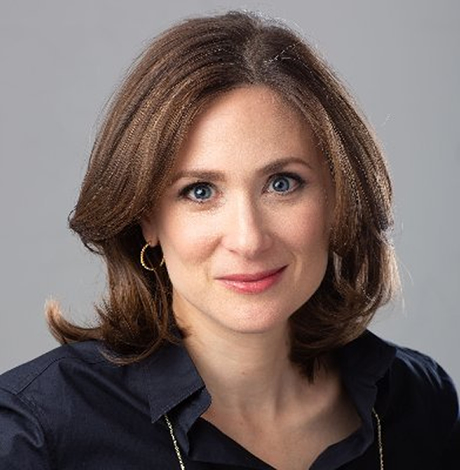
Abigail Shrier, who’s made activism against gender transitioning for transgender youth a personal crusade, has been tapped by Republicans as a witness for the upcoming the hearing on the Equality Act.
Shrier’s name appeared Tuesday on the names in the Senate Judiciary Committee’s website for the hearing on Wednesday. She’s has built a solid presence in conservative media as the author of “Irreversible Damage” and an expert on the harm she sees about medical practices allowing youth to transition,
Based on her past work, Shrier may discuss the Equality Act, which would expand the prohibition on discrimination against LGBTQ people under federal civil rights law, in terms of doctors having to provide transition-related care and parental consent for minors to undergo gender transition. Shrier didn’t immediately respond to a request to the Blade’s request comment on her upcoming testimony.
Meanwhile, the American Psychological Association last week adopted a new resolution opposing gender identity change efforts, also known as widely discredited conversion therapy for transgender youth. The APA also updated its resolution opposing efforts to change sexual orientation, originally adopted in 1997.
Shrier will take part in the second panel for the hearing, which consists of expert witnesses on the Equality Act. Joining Shrier as a Republican witness is Mary Rice Hasson, a fellow in Catholic Studies at the Ethics & Public Policy Center.
On the Democratic side, experts witnesses consist of Alphonso David, president of the Human Rights Campaign; Edith Guffey, a Kansas-based conference minister for the United Church of Christ; and Stella Keating, a transgender student from Tacoma, Wash.
David said in a statement the upcoming hearing will be “a historic opportunity to advance equality for all,” recognizing it will mark the first time the U.S. Senate has heard testimony on the Equality Act.
“The Equality Act is a unifying issue for our nation enjoying support from more than two-thirds of Americans and an unprecedented number of businesses who believe that not only is achieving equality the right thing to do but that it is also good business,” David added.
The first panel will consist of testimony of lawmakers on the Equality Act, including Rep. David Cicilline (D-R.I.) and Sen. Jeff Merkley (D-Ore.), the lead sponsors of the bill in their respective chambers of Congress.
Other Democrats who will testify are Sen. Tammy Baldwin (D-Wis.), the only out lesbian in the Senate, and Rep. Marie Newman (D-Ill.), who has a transgender son. Republicans who will testify are Rep. Vicky Hartzler (R-Mo.), Sen. Marsha Blackburn (R-Tenn.) and Sen. Cindy Hyde-Smith (R-Miss.).
The hearing before the Senate Judiciary Committee is set to begin Wednesday at 10 am.



News
Advocate, Out parent company adds Trump supporter to board, prompting outrage
Online backlash against EqualPride grows as Trump supporter joins its leadership team.
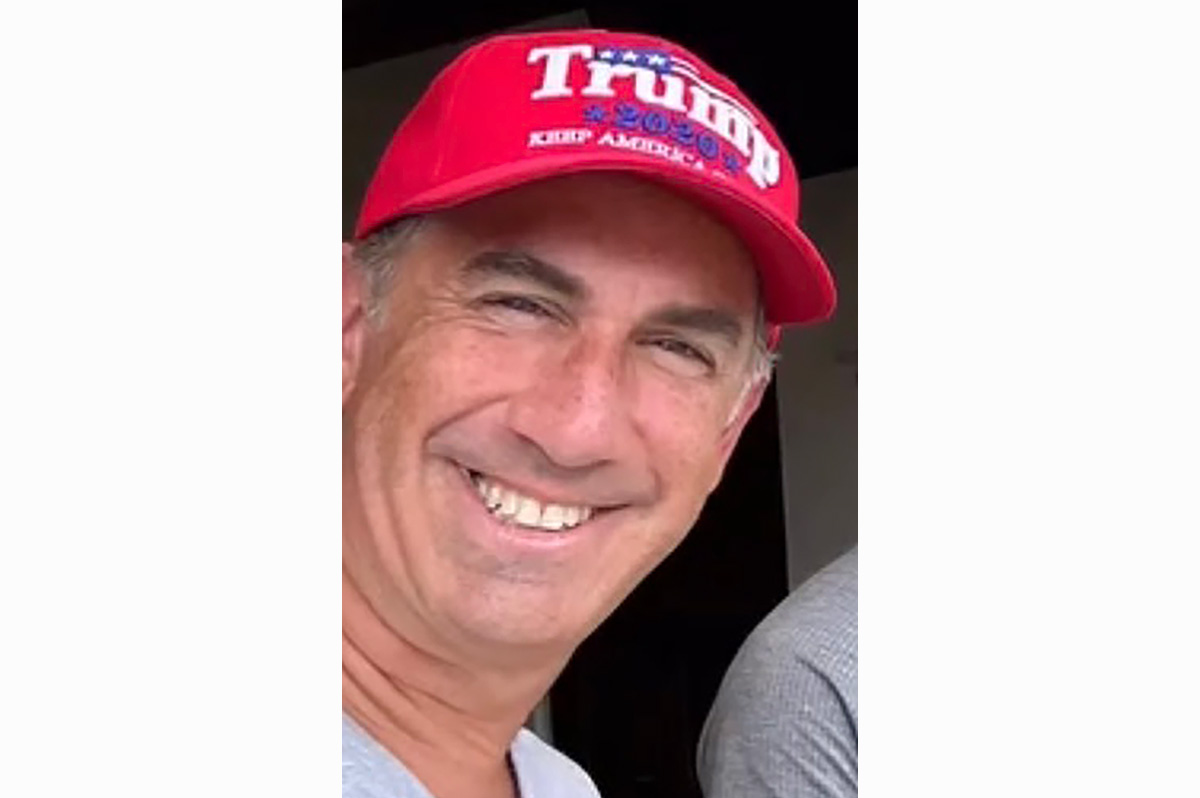
(UPDATE: Since this story was posted, EqualPride announced that Jay Katari has resigned from the board as of Tuesday afternoon. “I have decided to step down from the Board of Directors of equalpride,” Katari said in a statement shared by EqualPride CEO Mark Berryhill. “My intention was simply to volunteer my time and experience to support the incredible team and the important work they do for the LGBTQ+ community.”)
EqualPride, a prominent LGBTQ media company that owns the Advocate and Out magazines, has added a Trump supporter to its board of directors.
Jay Katari, an entrepreneur and investor who now serves as EqualPride’s “Strategic Advisor, Growth & Innovation,” also sits on its official leadership team.
EqualPride’s website describes his role as “focused on helping the company expand its reach, strengthen its commercial partnerships, and develop new sources of recurring revenue.”
This change in leadership has caused an outcry of concern from LGBTQ media consumers, people working at the outlets published under EqualPride, and LGBTQ advocates who seem unsure of how a Trump supporter will fare on the board of one of the most important LGBTQ media organizations in the country.
The story was first reported by Kevin Ortega-Rojas, a freelance writer and podcaster who specializes in covering social issues. His resume includes a number of connections to the world of LGBTQ media — particularly under EqualPride — including being a former rapid response reporter for GLAAD and host of “The Advocate Weekly,” a queer news podcast produced by The Advocate magazine.
Earlier this year, EqualPride laid off staff across its existing publications, including senior editors and writers. That move, followed by the addition of a Trump supporter to its board, has created concern among LGBTQ consumers.
According to his Instagram, Katari is married to a woman and still has posts showing him wearing Trump MAGA-branded merchandise. He also follows members of the Trump family, including President Donald Trump, his sons Donald Trump Jr. and Eric Trump, Lara Trump, and his daughter Ivanka Trump. He also follows an account with the username donaldtrump.hq titled “Donald Trump Fans.”
This apparent endorsement of Trump and MAGA politics, which includes restricting the rights of transgender people as well as rolling back protections for LGBTQ people more broadly, seems to be in direct conflict with EqualPride’s mission statement.
“Our mission is to provide content of inspiration, hope, community, equality and love through our platforms that reach a vast majority of the American LGBTQ+ audience every month and increasingly women and people of color,” a statement on EqualPride’s website from 2023 said. “We are a diverse community of storytellers, innovators, and influencers who believe in giving a voice to all people!”
The Washington Blade reached out to Christopher Wiggins, the politics and news editor at EqualPride, but was directed to the already publicly available joint statement made by editors of the largest publications represented by EqualPride.
In the Instagram post, the editorial teams of The Advocate, Out, Them, PRIDE.com, Out Traveler and Plus all co-signed the statement, assuring readers that Katari being on the board has not — so far — impacted any of their reporting and implying EqualPride needs to expand on what Katari’s role will be for the organization.
“Our editors became aware of concerning reports this morning that Jay Katari — one of the board members of our parent company, equalpride — may have espoused beliefs that are antithetical to the mission of our brands, per a new article from journalist Kevin Ortega-Rojas.
“The editorial teams only recently learned of Katari’s expanding role and had no information about his background or past political statements prior to this week.
“Please know that Katari’s position has not influenced our reporting.
“In an initial meeting today, we urged management to provide further clarification about Katarı and hıs role at equalpride, and are awaiting information.
As queer and trans journalists, we are committed to independent reporting that serves the LGBTQ+ community – and to getting answers on this critical matter.”
Nearly 200 comments were made online under a joint post made by multiple EqualPride publication accounts, including Them, The Advocate, and Out.
Gisselle Palomera, a Future of Queer Media fellow for The Advocate and former local news reporter at the Los Angeles Blade, commented under the post, questioning how much leadership actually knew about Katari.
“No one did any research on him prior to this moment? How did his political stance get past dozens of editors and reporters? I don’t buy it,” they said in the now most liked Instagram comment under the announcement, with 283 likes.
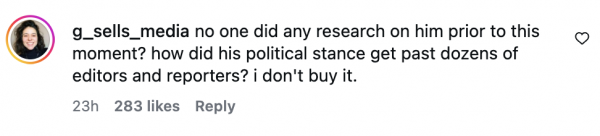
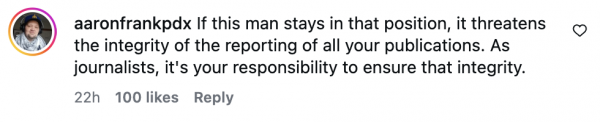
Another Instagram user, Aaron Frank Duncanson, who goes by the username aaronfrankpdx, pointed out how the situation looks and expressed fears for the future if Katari stays on the board.
“If this man stays in that position, it threatens the integrity of the reporting of all your publications,” Duncanson wrote. “As journalists, it’s your responsibility to ensure that integrity.”
The Blade reached out to Katari, and to Tony Morrison of Morrison Media Group— who is working with EqualPride, according to Wiggins— but did not hear back in time for publication.
EqualPride CEO Mark Berryhill issued a statement after Katari resigned.
“I want to clarify Jay Katari’s involvement with equalpride, which was limited to business growth, revenues and the company’s long-term sustainability,” said Berryhill. “Under our investment agreements, our lead investor group held the right to appoint two board members without separate votes or approval by the CEO or management. Jay joined the board through that process. Going forward, the investor group has provided me with the right to appoint future board members.”
Berryhill then noted Katari’s decision to resign and referred to his statement.
“Our focus now is on strengthening our brands, and continuing to support the stories of our LGBTQ community,” added Berryhill.
Indonesia
Indonesia’s top Muslim clerical body proposes criminalizing LGBTQ people, advocacy
Proposal underscores increased pressure against community
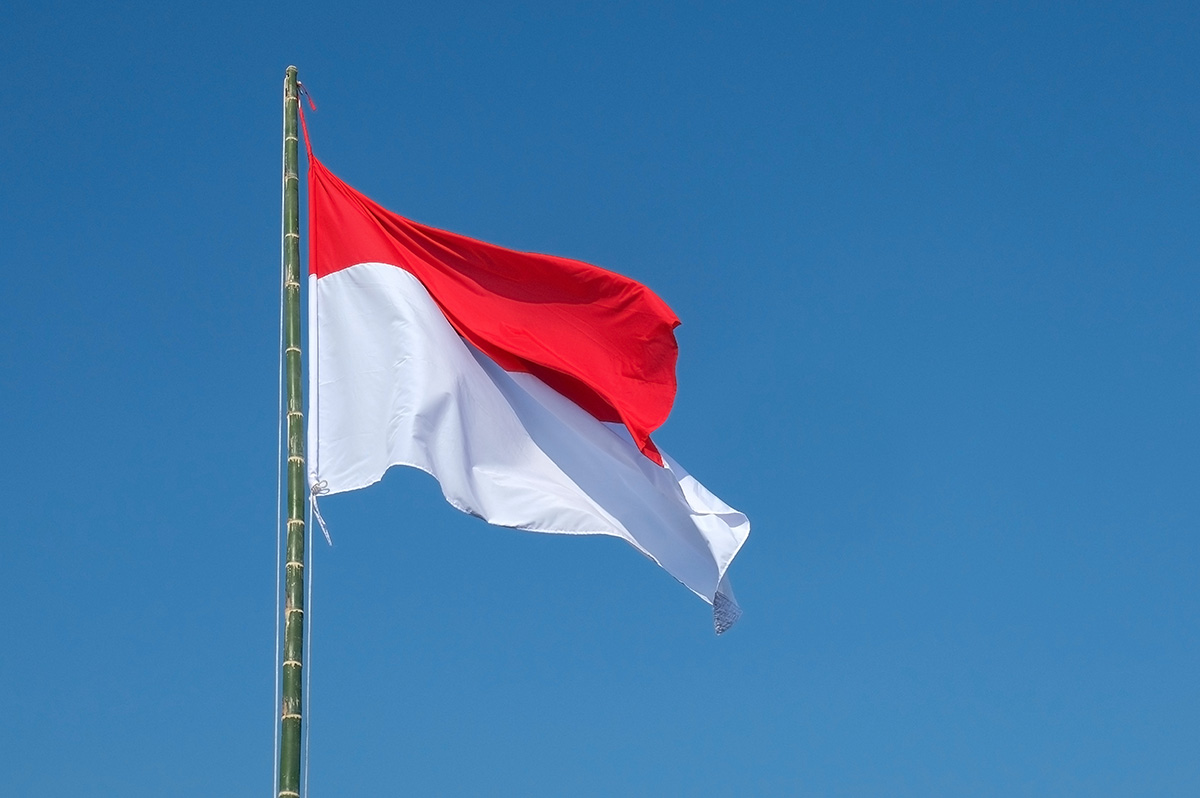
Indonesia’s top Muslim clerical body has proposed replacing the term “LGBT” with “LGSP,” grouping lesbian and gay people with sodomy and sexual abuse, as it prepares a proposed law that would criminalize conduct and advocacy it consideres prohibited.
Asrorun Niam Sholeh, head of the Indonesian Ulema Council’s Fatwa Commission, announced the proposal in Jakarta in late July, saying the council was preparing an academic paper and draft bill to submit to the government and MPs
The council in August also warned men against wearing women’s clothing during Independence Day festivities, despite a long-standing tradition in some Indonesian communities of men dressing in dresses and hijabs to play football as part of the annual celebrations. In a statement issued Aug. 7, the Fatwa Commission said such cross-dressing was “haram,” or forbidden under Islamic law, and linked the practice to what it described as a covert campaign by the “Lesbian, Gay, Sodomy and Obscenity (or LGSP) movement.
Indonesia on Aug. 17 marks its 1945 declaration of independence from the Netherlands with flag ceremonies, neighborhood gatherings, and a lively tradition of community competitions known as “lomba tujuhbelasan.” Children and adults take part in games ranging from sack races and cracker-eating contests to tug-of-war and “panjat pinang” — teams climb a greased pole to reach prizes at the top. Some communities also hold football matches in sarongs or “daster,” a loose-fitting house dress traditionally associated with women, turning the celebrations into an occasion for communal play and laughter.
The pressure extends beyond religious authorities.
In a report published in July, Human Rights Watch said attacks against LGBTQ university students had escalated during June’s Pride Month, while at least 10 public universities had recently adopted discriminatory regulations and curbed student media coverage and social media discussions about gender and sexual diversity. The rights group said the measures undermine freedom of expression and academic freedom.
Reacting to Pride Month celebrations, the Ulema Council called for “sexual deviation” to carry criminal penalties heavier than those for adultery and said it was preparing a draft law to criminalize LGBTQ conduct and campaigning.
President Prabowo Subianto in October 2025 signed Presidential Regulation No. 111 of 2025, which sets Indonesia’s General National Defense Policy for 2025–2029 and classifies the spread of LGBTQ culture as a non-military threat to the state. The provision places it among other perceived threats that include terrorism, radicalism, separatism, and the spread of prohibited ideologies.
The regulation drew public attention in July after Indonesian media reported on the provision, prompting Amnesty International Indonesia Executive Director Usman Hamid to warn that it could institutionalize discrimination against LGBTQ people.
“Amnesty International Indonesia unequivocally condemns these attacks and intimidation by both state and non-state actors based on perceived sexual orientation or gender identity,” said Amnesty International Indonesia. “We urgently call upon the Indonesian government to repeal this regulation and uphold its constitutional mandates and the international human rights treaties it has ratified.”
Indonesia on Jan. 2 began enforcing a new national criminal code, replacing the Dutch-era penal code that had governed the country for more than eight decades.
MPs had approved the 345-page code in December 2022 after years of debate and public protests over provisions concerning morality, religion, and individual rights. Among its new provisions is Article 411, which makes sexual intercourse outside marriage a criminal offense punishable by up to one year in prison.
Article 412 makes living together as husband and wife outside a legally recognized marriage punishable by up to six months in prison. The offenses can be prosecuted only after a complaint by a spouse, parent or child, but rights groups have warned that the provisions can disproportionately affect same-sex couples, whose relationships are not legally recognized in Indonesia.
Purba Widnyana, chairman of GAYa Nusantara, an Indonesian LGBTQ rights organization, told the Washington Blade that the situation for LGBTQ people in Indonesia has become increasingly worrying.
Widnyana told the Blade that the concern extends beyond increasing violence, pointing to stronger anti-LGBTQ sentiment in public spaces, on social media and within educational institutions, as well as in politics, including Presidential Regulation No. 111 of 2025.
“The impact is not always in the form of physical violence. Many LGBT+ people, especially trans women, that mostly work in entertainment or other informal jobs, beginning to lose job opportunities because they are considered to pose a ‘risk’ to the event organizers,” Widnyana said. “There are also concerns that the rising stigma and fear could deter people from accessing health services, including HIV test and STI, due to the fear that their identity or sexual orientation might be revealed.”
Widnyana said the changing environment has placed an additional burden on LGBTQ organizations; making spaces for gatherings, educational activities, and public information campaigns increasingly sensitive.
“We are constantly in alert mode,” he said, adding that since the previous wave of anti-LGBTQ sentiment in 2016, organizations have developed security and risk-mitigation plans before holding events. Previously, he said, the primary concerns were physical attacks, raids and threats that could force venues to cancel events. Now, organizations also have to account for online attacks, including WhatsApp hijacking and social media account hacking, as well as the possibility of an event or organization being targeted after going viral.
“It’s been limiting our movements,” he said.
Asked about the proposed LGSP framework and its decision to replace the term LGBTQ with a classification combining sexual orientation with sexual conduct, Widnyana said the council was conflating fundamentally different concepts.
“I really don’t know where to begin. They are definitely confused by mixing identities, in this case sexual orientation, with sexual behavior and actions that are understood as violations or offenses, that are sodomy and sexual indecencies,” he said.
Widnyana said the change should not be viewed as merely a change in terminology.
“The change shifts how Indonesians understand or perceive LGBT+ issues, moving from identities, rights and existence to behavior, morality, and criminality,” he told the Blade. “We also see it in the context of narrative that has been for so long evolving that frames LGBT+ as the ‘product of the West’ or ‘Western propaganda’,” he said. “In this framework, LGSP can be interpreted as their effort in rejecting how LGBT+ people define themselves and changing it with a category that is defined by those who oppose the existence of LGBT+ people.”
Widnyana also pointed to Indonesia’s long history of diverse gender identities and expressions, citing traditions such as the “bissu,” “calalai,” “calabai,” and “waria,” as well as artistic traditions in which men perform female characters. He cautioned against imposing modern LGBTQ categories on those traditions, but said gender and sexual diversity are not foreign to Indonesian history.
Widnyana said his main concern was the lack of clarity around terms such as “campaigning,” “promoting,” and “spreading LGBT+ culture,” which he said could be interpreted broadly enough to affect legitimate work in education, health care, human rights, and community services. He cited HIV and sexual health information, legal assistance for victims of violence, discrimination research, training on sexual orientation, gender identity and expression, and sex characteristics, and academic discussion as examples. Widnyana also questioned whether a gay man publicly saying he is gay and demanding to live safely, or a transgender woman speaking about discrimination she has experienced, could be deemed “campaigning” or “spreading LGBT+ culture.” Such legislation, he warned, could turn existing social stigma into a tool for systematically limiting the lives, expression, services and LGBTQ organizations.
“For me, the situation is becoming more difficult. And I think we need to look beyond just what the law says. Because sometimes, when we talk about Indonesia, people say, ‘Well, being LGBTQ+ is not generally criminalized under the national criminal law,’” said Arisdo, outreach representative of Pelangi Nusantara, an LGBTQ community group in Indonesia advocating for love, equality, and the right to live with dignity. “technically, that’s an important distinction. But that’s not really what people on the ground are experiencing. What we’re seeing is more pressure. More harassment. More public shaming. More people being targeted simply because they are perceived to be LGBTQ+.”
Arisdo told the Blade that transgender women are facing escalating violence, citing Pelangi Nusantara’s documentation of 10 attacks in Bogor between March and July 2026 involving 45 victim-survivors. He said the emergence of “Boti Hunter” groups was particularly alarming, reflecting a shift from anti-LGBTQ rhetoric toward actively targeting people. He added that fear of being outed or attacked prevents many victims from reporting violence, while doxxing and online harassment are increasingly forcing LGBTQ organizations to limit their visibility.
District of Columbia
Hands Off the Arts to form ‘human chain’ around Kennedy Center
Drag performer Tara Hoot among event organizers
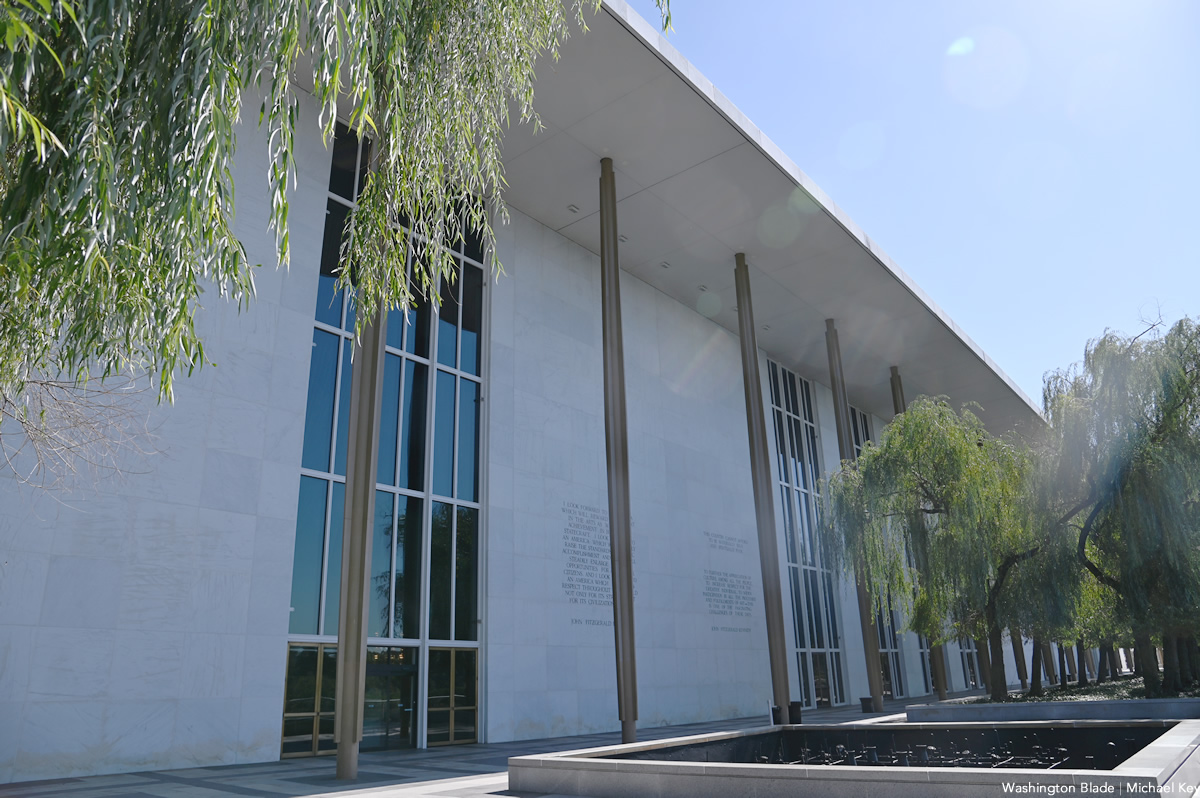
An organization called Hands Off the Arts has announced it is holding a protest on Friday, Sept. 18, in which between 400 and 800 participants are expected to create a “human chain” around the Kennedy Center to voice their strong objection to President Donald Trump’s call for possibly demolishing the Kennedy Center.
“Hands Off the Arts is organizing a rally Sept. 18 against the president’s defacing of JFK’s memorial, his removal and censorship of art, and the threat to demolish the center if he can’t remake the site in his image,” a statement released by the group says.
The statement says the event will start with a rally at 6:30 p.m. on the Kennedy Center steps and culminate with a “human chain” around the building. “There will be musical performances, testimonials from current and former employees, along with other special guest speakers,” it says
A separate announcement by the group says longtime D.C. drag performer Tara Hoot, who has performed at the Kennedy Center in past years, was among the organizers of the Sept. 18 protest.
The planned protest follows Trump’s decision last year to use his authority to replace the existing members of the Kennedy Center’s board of directors with new members loyal to him. Over the objection of longtime Kennedy Center supporters, the Trump-appointed board changed the name of the center, at Trump’s request, from the John F. Kennedy Memorial Center for the Performing Arts to the Donald J. Trump and the John F. Kennedy Center for the Performing Arts.
But following the threat of legal action by opponents who pointed out that the name change could not be legally made unless approved by Congress, the name change was cancelled, with Trump saying he would take steps to restore it later.
The Washington Post, meanwhile, reports in a Sept. 13 news story that because of negative publicity related to Trump’s actions, the Kennedy Center was facing “fiscal collapse” and possible bankruptcy and could be forced to shut down as early as this week.
According to the Post report, a 57-page document presented to the Kennedy Center’s board of trustees says the center was facing a financial and structural building crisis, with the recent collapse of part of the building’s inside ceiling, indicating the building was unsafe for employees and the public. Among other things, the document says the Kennedy Center may not be able to make payroll or pay for routine maintenance “within a matter of weeks,” the Post reports.
Some LGBTQ advocates were among those who joined others in boycotting the Kennedy Center to express their objections to Trump’s actions, including a statement by Trump that he objected to the Kennedy Center’s practice of hosting drag performances.
The Gay Men’s Chorus of Washington has been among the LGBTQ performing arts groups and artists that have performed at the Kennedy Center.
“With the future still very much uncertain, now more than ever, the Center needs you to stand up for freedom of expression and against authoritarian overreach into arts and culture institutions,” the Hands Off the Arts group says in its announcement of the Hands Around the Kennedy Center protest.
“You have the opportunity to make a difference — show up with Hands Off the Arts and show your power as part of Hands Around the Kennedy Center,” it says.
A spokesperson for the Kennedy Center couldn’t immediately be reached for comment.

Advocate, Out parent company adds Trump supporter to board, prompting outrage

78th annual Emmy Awards recapped

Indonesia’s top Muslim clerical body proposes criminalizing LGBTQ people, advocacy

Hands Off the Arts to form ‘human chain’ around Kennedy Center

LGBTQ issues, attacks on Democrats dominate unusual RNC midterm convention

Multi-billion-dollar 9/11 Victim Compensation Fund to continue until 2090

LGBTQ Military Happy Hour set for Sept. 15

Calendar: September 11-17

Comings & Goings