News
Biden seeks to ramp up money to beat HIV/AIDS in budget request
$267 million increase sought to end domestic epidemic
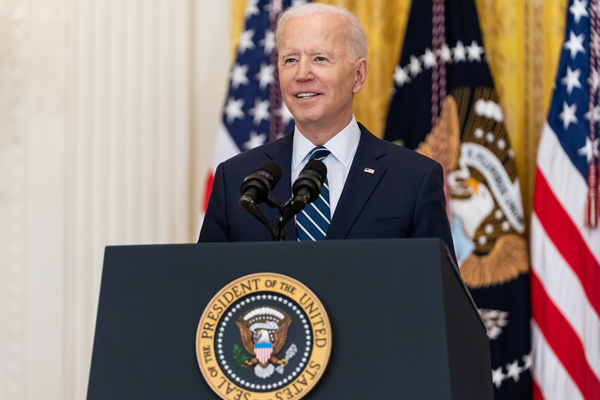
President Biden’s formal budget proposal for the U.S. government in the upcoming fiscal year has advocates in the fight against HIV/AIDS cheering over the commitment to increase funds to confront the domestic epidemic, although one group is criticizing the proposal for seeking to flat-fund international programs.
The fiscal year 2022 proposal, unveiled last Friday, would afford an additional $246 million for domestic HIV testing, prevention and treatment programs for the Ending the HIV Epidemic initiative, which seeks to end HIV by 2030, and would also provide a general boost of $46 million to Ryan White HIV/AIDS programs and $20 million for HUD’s Housing Opportunities for People with AIDS (HOPWA).
Carl Schmid, executive director of the HIV + Hepatitis Policy Institute, said in a statement Biden is “demonstrating his commitment to ending HIV in the United States” in the budget request to Congress.
“While it falls short of what is needed and the community has requested, if this funding is realized it will continue the momentum already created and make further progress in ending HIV in the U.S. Efforts to end HIV will help eradicate an infectious disease that we have been battling for the last 40 years and help correct racial and health inequities in our nation,” Schmid said.
The total $670 million requested by the White House for the Ending the HIV Epidemic initiative breaks down as follows:
- Centers for Disease Control & Prevention: $100 million in new money for a total of $275 million;
- Ryan White: $85 million in new money for a total of $190 million;
- Community Health Centers for PrEP: $50 million in new money for a total of $152 million;
- National Institues of Health: $10 million in new money for a total of $26 million;
- Indian Health Services: $22 million in new money for a total of $27 million.
Counterinituitively, each of those numbers is actually below what the Trump White House proposed in the previous administration’s final budget request, with the exception of the proposed increase in money for Community Health Centers for PrEP and flat-lining for money for Indian Health Services.
The requested increase in funds for the Ending the HIV Epidemic was expected. Biden had signaled he’d seek the additional $267 million in funding in the “skinny budget” issued by the White House in February that preceded the more formal and detailed request to Congress last week.
Biden requests the increase in funds after he campaigned on ending the domestic HIV epidemic by 2025, an ambitious goal many advocates in the fight against HIV/AIDS were skeptical about achieving.
Nick Armstrong, the AIDS Institute’s manager of advocacy and government affairs and co-chair of the AIDS Budget & Appropriations Coalition, said in a statement the time to ramp up efforts against HIV has come as the nation emerges from the coronavirus pandemic.
“Public health departments have made herculean efforts to battle COVID over the past year,” Armstrong said. “But now it is time to reinvigorate neglected efforts to end the HIV, opioid, and viral hepatitis epidemics. Congress must go above and beyond what the president has proposed to bolster our critical public health infrastructure to protect Americans against infectious disease.”
The budget now goes on to Congress, which has authority on whether or not to appropriate funds consistent with the president’s request. Congress could either meet, short fund or even exceed in money the request by Biden as part of that process.
Schmid said via email to the Blade he’s optimistic about getting an agreement from Congress for an increase in funds to fight HIV/AIDS based on the “strong bipartisan support the proposal has enjoyed in the past.
“We still have work to do with the Congress due to so many demands on the budget but I am fairly confident Congress will support it, they have been anxious to see what the Biden administration does with the program in his budget and we have the answers now,” Schmid said. “The Biden-Harris administration firmly supports ending HIV.”
Although Biden was lauded for the increase in funds in domestic HIV programs, international programs are a different matter. The White House has essentially flat-funded programs designed to fight the global HIV epidemic, including the President’s Emergency Plan for AIDS Relief, or PEPFAR, or the Global Fund to Fight AIDS, Tuberculosis & Malaria.
Matthew Rose, director of U.S. Policy and Advocacy at the New York-based Health GAP, said in a statement Biden’s budget proposal “displays a lack of bold leadership motivated to end the HIV pandemic.”
“If the U.S. had continued fully funding PEPFAR since 2003 instead of letting funding levels slip into a flat-line for more than a decade, the HIV pandemic would look remarkably different today,” Rose said. “This is not a budget to end AIDS – and it could have been. This is not a budget to end the COVID-19 pandemic – and it could have been. The unconscionable lack of political will in recent years has created a world in which people cannot get access to the life-saving services they need.”
Health GAP is calling on Congress to approve a budget with at least a $750 million increase for PEPFAR and $2.5 billion in increased funding over the next four years to scale up HIV prevention and treatment and mitigate harms to the HIV response done by the COVID-19 pandemic, the statement says.
Additionally, Health GAP is calling on Biden to name “a highly qualified nominee” to serve as the U.S. Global AIDS Coordinator, the statement says.

The Comings & Goings column is about sharing the professional successes of our community. We want to recognize those landing new jobs, new clients for their business, joining boards of organizations and other achievements. Please share your successes with us at [email protected].
The Comings & Goings column also invites LGBTQ+ college students to share their successes with us. If you have been elected to a student government position, landed an exciting internship, or are graduating and beginning your career with a new job, let us know so we can share your success.
Congratulations to Jaime Christopher Pierce on their appointment to serve as a member of the Virginia Governor’s LGBTQ+ Advisory Board. Pierce was sworn in on Sept. 3 by Greg Parks, clerk of the Alexandria Circuit Court.
Pierce currently serves as vice chair of the Alexandria City LGBTQIA+ Task Force and as a member of the Alexandria Pride planning committee. They previously served on the board of directors of Equality Virginia.
Upon being sworn in, Pierce said, “Public service has been a central part of my life for more than 30 years, and this appointment gives me an opportunity to serve the Commonwealth in a different and very personal way. My career has allowed me to work with people and communities throughout Virginia, and I hope to bring that experience, along with my own lived experience and my involvement in the LGBTQ+ community, to the work of the Board.” They added, “Having Greg administer the oath makes the occasion even more meaningful because of his own historic role as Virginia’s first openly gay elected circuit court clerk.”
Pierce also serves as Circuit Court Services Manager for the Department of Judicial Services, at the Office of the Executive Secretary of the Supreme Court of Virginia. They began their career in Virginia’s judiciary in 1994 as a deputy clerk with the Virginia Beach Circuit Court and have since held several professional and leadership positions within the court system. Pierce is a member of the National Association for Court Management (NACM) and the Mid-Atlantic Association for Court Management. At the national level, Pierce participated in the workgroup that developed the National Association for Court Management’s Diversity, Equity, and Inclusion Guide, a resource designed to help court professionals advance inclusive practices and strengthen access, fairness and belonging within the justice system.
Pierce earned a degree in Criminal Justice from Liberty University, and a certificate in Paralegal Studies from Norfolk State University.
National
Multi-billion-dollar 9/11 Victim Compensation Fund to continue until 2090
Eligibility for same-sex partner survivors remains unclear

As part of its commemoration of the 25th anniversary of the 9/11 terrorist attacks, the September 11th Victim Compensation Fund, a federally operated program, released information during the past week showing it has awarded more than $18 billion to over 77,000 9/11 victims and their families since 2011.
Officials with what’s now referred to as the VCF point out that it was created to provide compensation to individuals or to a court-approved personal representative of a deceased individual who were present at one of the three sites where the hijacked jetliners crashed.
Among those supported under the program are thousands of rescue workers, clean-up crews, and residents living near the World Trade Center Twin Towers destruction site who became ill, many of whom later died, by being exposed to the toxic fumes created by the fire and falling debris.
“Twenty-five years since that day, the September 11th Victim Compensation Fund has served tens of thousands of victims and their families, and we continue to receive over 750 new claims each month — a clear indication of the ongoing importance of our mission,” said Allison Turkel, VCF’s leader, who holds the title of Special Master.
In a Sept. 2 briefing for the news media in advance of the 9/11 anniversary commemoration, Turkel pointed out that the VCF operation was upgraded and expanded by separate laws passed by Congress in 2011 and 2019, with the 2019 law signed by President Trump providing full funding to “pay all eligible claims and extended the filing deadline to Oct. 1, 2090.”
LGBTQ advocacy organizations in New York and nationwide have reported that during the time shortly after the 9/11 attacks same-sex surviving partners of 9/11 victims learned they were ineligible for compensation benefits because their same-sex relationships were not legally recognized.
Nicole Nava, a VCF spokesperson, told the Washington Blade she would inquire into whether same-sex couple surviving partners were being supported under the VCF program in more recent years.
She said under long established VCF procedures, all applicants for benefit claims regarding a deceased person, whether same-sex or opposite sex, must be appointed as a Personal Representative of the deceased person by a state court. For D.C. residents, the probate division of the D.C. Superior Court appoints a Personal Representative.
“Claims for deceased victims (regardless of the cause of death) may be submitted only by the Personal Representative,” a statement on the VCF website says. “Each state has laws that define the process for appointment of the Personal Representative and the specific authority granted to that Personal Representative,” it says.
The Washington Blade couldn’t immediately determine the criteria for being approved as a Personal Representative by the D.C. Superior Court and various state courts, including whether a same-sex survivor partner would be eligible for such an appointment.
A spokesperson for the District of Columbia LGBTQ+ Bar Association, which includes many local attorneys who specialize in a wide range of specialized legal issues, couldn’t immediately be reached to find out if one or more of their members might be able to determine the same-sex partner eligibility for Personal Representative status.
In her news media briefing, VCF Special Master Turkel said detailed information about how best to file a claim for 9/11 victim compensation is available on the VCF website.
“Twenty-five years since the events of September 11th , 2001, we know it has become increasingly challenging for claimants to find documents needed to prove their presence at an eligible location, which is one of the key requirements to be eligible for compensation,” she said.
She was referring to the requirement that 9/11 surviving victims seeking a claim for support for injuries or illnesses related to the 9/11 attacks must prove they were present at the World Trade Center site, the Pentagon site, or the Shanksville, Pa. site where the hijacked jetliners crashed. Those requirements are separate from the less clearly defined criteria for same-sex couple victim survivor eligibility.
“Our team is committed to ensuring no claimant feels lost or overwhelmed when submitting a claim,” Turkel said at the briefing. “We have a great helpline with real live people who can answer or refer any questions that come in,” she added. “They engage in over 4,000 calls a month on average. We encourage folks to call 1-855-1555 with any questions.”
The VCF website, which has additional detailed information, can be accessed at www.vcf.gov.
Politics
Ind. prosecutor declines to press charges over false Buttigieg child welfare complaint
Former Biden-Harris Cabinet member declined to comment on decision

An Indiana prosecutor has declined to file criminal charges against a woman who made a false child welfare complaint against Pete Buttigieg.
Buttigieg, the former transportation secretary in the Biden-Harris administration, was accused in June of posing a threat to his children via an anonymous call to police that resulted in him being temporarily separated from his four-year-old twins.
Marshall County Prosecuting Attorney E. Nelson Chipman Jr. opted not to pursue charges against the Alabama woman who filed the false child welfare claim against the Democratic political figure while she was in Marshall County.
According to ABC 57, the television station in South Bend that published a letter from Michigan State Police to Indiana State Police, the 50-year-old woman, identified only as TJ of Alabama, was responsible for the “brief and intrusive investigation” into Buttigieg and his family.
In the letter to Indiana State Police, Michigan State Police described TJ’s documented alcoholism and other chemical dependencies, as well as hallucinations and delusional thinking. The prosecutor also noted that TJ has self-identified as God and claims to hear voices only she can hear.
The letter from Michigan State Police to Indiana State Police states:
“Your investigation reveals that TJ, 50 years old, has a documented history of alcohol abuse and has experienced numerous treatment facilities and programs for alcoholism and other chemical dependency over the years. Further, TJ has a long history of mental illness, manifested by hallucinations and delusional thinking which includes frequently responding to voices only she hears and grandiose ideation including self-identifying as God. She frequently reports she has enjoyed an evening meal with Barack and Michele Obama.
TJ is from Alabama. During her relatively short stay here, TJ was able to generate three separate police encounters that resulted in reports, one of which resulted in TJ’s arrest for domestic battery. I note her BAC in that case was reported at .323. I also note one of the three early reports was based upon TJ’s claim of herself being a victim of sexual abuse at the age of 3 by her mother some 47 years prior. Her explanation for such a delayed report was incoherent.
As you found out, TJ returned to Alabama and took up residence in a treatment facility only to be soon evicted for a rule violation. She currently resides in a half-way house near Alabama, with very limited mental health treatment options available. I note TJ’s abusive and harassing attitude has resulted in restricting only somewhat her access to a telephone, and that she continues to have access to computers at the facility. Obviously she may still have the ability to file additional complaints. No doubt a regrettable situation.
In light of the totality of circumstances, I am unable to conclude that TJ is capable of forming the requisite intent to support a criminal conviction for this offense. Accordingly, this office will not be filing a criminal case in this matter.
Thank you, as always, for a thorough investigation and cogent report.
Stay safe.
Best regards,
E. Nelson Chipman, Jr.
Marshall County Prosecuting Attorney”
When the situation first arose in June, Buttigieg opened up about the experience via his Substack, where he described the situation as one of the worst things that has ever happened to his family — one that resulted in him being separated from his twins, Joseph August “Gus” and Penelope Rose, for their safety.
“The caller said that he had spoken to a woman who claimed to have met me at a conference several years ago in Alabama, where she said I told her that I had committed unspeakable violent crimes, and the caller believed my children were still at risk,” Buttigieg wrote in a post he titled “A Terrible Thing Happened to My Family.” “I am a reasonable man. I try to keep as calm and low-key as possible. But I cannot describe the mix of rage and sadness that I feel at the idea that someone brought our children into this.”
A Buttigieg spokesman declined to comment on the prosecutor’s decision not to pursue charges, but did tell the Washington Post in a statement: “This has been a painful and infuriating situation for the family. They are in touch with Michigan authorities, seeking answers and accountability for what happened.”
In response to the story Buttigieg shared on his Substack, Kelley Robinson, president of the Human Rights Campaign, released the following statement:
“I know how I would feel if someone tried to come between me and my kids. This is truly bottom-of-the-barrel stuff. It takes an awful, hateful person to question someone’s fitness as a parent just because of who they are, who they love, or in Sec. Buttigieg’s case, perhaps even who he speaks out against politically. We’re thinking of Pete, Chasten, and their whole family in this moment — and we aren’t resting until all LGBTQ+ families have the kind of safety and justice every one of us deserves.”
The Washington Blade reached out to Michigan State Police after the story initially broke to ask if any disciplinary action would be imposed on the woman who made the false report, but was told to file a FOIA request to view the full report. After filing a FOIA request, the Blade was denied access to any additional information.

‘Thelma and Louise’ remains landmark of unspoken queer rebellion

Comings & Goings

LGBTQ Military Happy Hour set for Sept. 15

Calendar: September 11-17

Multi-billion-dollar 9/11 Victim Compensation Fund to continue until 2090

Nominate your favorites for the Blade’s 25th annual Best Of LGBTQ DC Awards

Md. groups receive state grants to fight hate crimes

Gloria Steinem’s life of substance and consequence

PHOTOS: SUNFESTIVAL