National
House defense committee to vote on anti-gay amendments
Measures would disrupt ‘Don’t Ask’ repeal, prevent same-sex marriages on bases
Amendments that could disrupt “Don’t Ask, Don’t Tell” repeal and mandate that marriages on military bases comply with the Defense of Marriage Act are set to see votes on Wednesday when a House defense panel takes up major Pentagon budget legislation.
Rep. Duncan Hunter (R-Calif.), a Marine Corps veteran of Iraq and Afghanistan and opponent of gays in the military, plans to introduce an amendment aimed at derailing “Don’t Ask, Don’t Tell” repeal by expanding the certification requirement to include input from the four military service chiefs.
In a statement Monday, Hunter announced he would introduce the amendment to expand the certification requirement during the House Armed Services Committee’s markup of the fiscal year 2012 defense authorization bill. The measure would interfere with the repeal law that President Obama signed in December, which allows for implementation of open service after 60 days pass following certification from the president, the defense secretary and the chair of the Joint Chiefs of Staff.
“The four military service chiefs are far more closely connected to the day-to-day realities facing each respective service branch than those who are currently required to sign off on the repeal — including the president,” said Hunter said. “The president, the secretary of defense and the chairman of the Joint Chiefs should all take part in the certification process, but excluding the service chiefs is a mistake.”
Hunter, who introduced standalone legislation earlier this year mirroring the planned amendment, added the military service chiefs may agree to enact repeal at the same time as the president, the defense secretary and the chair of the Joint Chiefs of Staff or they “may have other recommendations for implementation and timing.”
The Hunter amendment could be one among several amendments that could be introduced by opponents of gays in the military to disrupt the “Don’t Ask, Don’t Tell” repeal process. Informed sources said other measures could be an outright abrogation of the repeal measure that Congress passed and Obama signed last year as opposed to merely implementing a certification expansion.
Involving the military service chiefs in the “Don’t Ask, Don’t Tell” repeal certification process could disrupt or delay open service in the U.S. military because some uniform leaders of the military — notably Marine Corps Commandant Gen. James Amos — expressed opposition to passing repeal legislation last year. Amos has since said the Marine Corps would work to implement open service.
Despite the qualms that were expressed last year, each of the service chiefs testified in April that the process for enacting “Don’t Ask, Don’t Tell” repeal has been proceeding smoothly. Some service chiefs — including Chief of Naval Operations Adm. Gary Roughead — have said they oppose any effort to expand the certification requirement and they believe the defense secretary would adequately represent their views in the certification process.
Fred Sainz, vice president of communications for the Human Rights Campaign, said he thinks the Hunter amendment is an attempt at a “do over strategy” because Republicans didn’t get what they wanted when the last Congress passed legislation allowing for “Don’t Ask, Don’t Tell” repeal.
“It just seems like they didn’t like the outcome, so now they’re trying to get another bite at the apple,” Sainz said.
R. Clarke Cooper, executive director of Log Cabin Republicans, said those who worked for legislative repeal of “Don’t Ask, Don’t Tell” plan to send a letter in opposition to the Hunter measure and similar amendments before the committee markup.
“We’re simply going to members of the House Armed Services Committee saying don’t allow or take into consideration amendments that would be anything seen as repealing repeal,” Cooper said.
Despite efforts from advocates, if the Hunter amendment is supported in committee along party lines, the measure would likely pass because Republicans enjoy a majority on the panel by a margin of 35-27. After the defense authorization bill is reported to the House floor, a similar vote of approval could be expected on the House floor because Republican have control of the chamber. The bill could see a House floor vote as early as the week of May 23.
Aubrey Sarvis, executive director of the Servicemembers Legal Defense Network, said he fears the committee has sufficient votes to pass Hunter’s amendment.
“The reality is if the majority in the chamber want to move that amendment they can adopt it successfully,” Sarvis said.
But Cooper said he doesn’t think the support is present in committee to approve the Hunter amendment because defense officials have said the current repeal process is working.
“I don’t think the votes are there,” Cooper said. “I think it would be pretty short-sighted for some of those folks to actually take a vote on something that has had such positive reporting from the [Defense] Department.”
Even if House Republicans are successful in approving the expanded certification measure as part of their defense authorization bill, passing such a provision into law would be challenging because the Senate would agree to it during conference negotiations and Obama would have to sign the measure.
Further, defense officials have testified that certification could happen mid-summer, and the final version of the defense authorization will likely not reach the president’s desk until after that time, rendering Hunter’s provision useless.
Sarvis said the Senate schedule won’t allow for floor consideration of the defense authorization bill until July and the conference committee at the earliest would be in late September or October.
“If we have certification this summer, the 60 days may well have run before the September-October conference,” Sarvis said. “And, I think — the authors of some of these ‘delay-derail’ amendments — they know that.”
Sainz also noted that Republicans are going to have a problem in passing the amendment into law because it runs contrary to the previously stated Republican emphasis on economic issues during the 2010 election.
“This is a complete and total diversion from the American people’s priorities on the economy, jobs and dinner table issues,” Sainz said. “The American public does not believe that this issue needs to be considered once again, and we will make sure the people understand that this is a complete and total disconnect from what the priorities should be.”
Akin plans measure to prevent same-sex marriage at bases
Another planned amendment follows controversy in the wake of new Navy policy guidance stating that “Don’t Ask, Don’t Tell” repeal would enable same-sex marriage ceremonies to take place on military facilities and that Navy chaplains can officiate over these ceremonies.
Steve Taylor, a spokesperson for Rep. Todd Akin (R-Mo.), said his boss intends to introduce a measure that would rollback the new guidance issued by the Navy.
“He intends to offer an amendment Wednesday,” Taylor said. “It would say that marriages [are] allowed to be performed on bases when they comply with DOMA.”
According to the Navy memo, which is dated April 13 and signed by Chief of Navy Chaplains Rear Adm. Mark Tidd, the new guidance was issued after the Navy conducted legal review of the issue of same-sex marriages and questions emerged related to same-sex marriage during the initial course of Navy training for “Don’t Ask, Don’t Tell” repeal.
The guidance states that use of base facilities is “sexual orientation neutral” on the issue using base facilities for same-sex marriage.
“If the base is located in a state where same-sex marriage is legal, then base facilities may normally be used to celebrate the marriage,” the memo states.
Additionally, the memo says Navy chaplains are allowed to perform same-sex marriages in their official capacity if they chose to do so.
“Regarding chaplain participation, consistent with the tenets of his or her religious organization, a chaplain may officiate a same-sex, civil marriage: if it is conducted in accordance with the laws of a state which permits same-sex marriages or union; and if the chaplain is, according to applicable state and local laws, otherwise fully certified to officiate that state’s marriage,” the memo states.
The memo states that the guidance with regarding to having same-sex marriages on base is a change to earlier training, which stated that same-sex marriages aren’t permitted on federal property. According to the memo, the guidance for chaplains is not a change, but “a clearer, more concise and up to date articulation” of policy.
Following the emergence of the letter this week, Akin and 62 other Republican U.S. members wrote to Navy Secretary Ray Mabus in a letter dated May 6 stating the policy change doesn’t comply with DOMA.
“We find it difficult to understand how the military is somehow exempt from abiding by federal law,” the letter states. “Not only does this document imply recognition and support of same-sex marriages, but it also implies that the Navy will now perform these marriages so long as they do not violate state statutes.”
The letter adds that DOMA “protects the sanctity of the bond specifically between a man and a woman” and continues that “as defenders of the institution of marriage we agree with the vast majority of the American people that the preservation of marriage is critical to society’s stability and is in the best interest of American families.”
Despite the letter, several recent polls have found that a majority of the American public now supports marriage rights for same-sex couples. A poll last month from CNN found that 51 percent of American believes marriages between gay and lesbian couples “should be recognized by the law as valid” while 47 percent remain opposed.
Sarvis said the memo is being circulating on Capitol Hill by anti-gay activists seeking to invoke the more controversial debate on same-sex marriage in an attempt to disrupt to “Don’t Ask, Don’t Tell” repeal.
“The operative word in that letter is ‘may,'” Sarvis said. “They ‘may’ use the facilities. The chaplain ‘may’ elect to marry two gay service members on post if marriage is permitted by state law in that state.”
Sarvis added no chaplain is required to marry anyone — regardless of whether the marriage is same-sex or opposite-sex — if the chaplain has an objection to the union. Further, Sarvis said that no language in DOMA speaks to facilities on military installations.
However, Sarvis said the committee would pass the amendment if House Armed Services Committee Chair Buck McKeon (R-Calif.) characterizes it as a party-line vote for Republican committee members.
“If the chairman of the committee positions it as a party-line, then the numbers on the committee would indicate that such an amendment would likely pass by party-line, and, who knows, it could pick up a couple Democrats,” Sarvis said.




U.S. Military/Pentagon
4th Circuit rules against discharged service members with HIV
Judges overturned lower court ruling

A federal appeals court on Wednesday reversed a lower court ruling that struck down the Pentagon’s ban on people with HIV enlisting in the military.
The conservative three-judge panel on the 4th U.S. Circuit Court of Appeals overturned a 2024 ruling that had declared the Defense Department and Army policies barring all people living with HIV from military service unconstitutional.
The 4th Circuit, which covers Maryland, North Carolina, South Carolina, Virginia, and West Virginia, held that the military has a “rational basis” for maintaining medical standards that categorically exclude people living with HIV from enlisting, even those with undetectable viral loads — meaning their viral levels are so low that they cannot transmit the virus and can perform all duties without health limitations.
This decision could have implications for other federal circuits dealing with HIV discrimination cases, as well as for nationwide military policy.
The case, Wilkins v. Hegseth, was filed in November 2022 by Lambda Legal and other HIV advocacy groups on behalf of three individual plaintiffs who could not enlist or re-enlist based on their HIV status, as well as the organizational plaintiff Minority Veterans of America.
The plaintiffs include a transgender woman who was honorably discharged from the Army for being HIV-positive, a gay man who was in the Georgia National Guard but cannot join the Army, and a cisgender woman who cannot enlist in the Army because she has HIV, along with the advocacy organization Minority Veterans of America.
Isaiah Wilkins, the gay man, was separated from the Army Reserves and disenrolled from the U.S. Military Academy Preparatory School after testing positive for HIV. His legal counsel argued that the military’s policy violates his equal protection rights under the Fifth Amendment’s Due Process Clause.
In August 2024, a U.S. District Court sided with Wilkins, forcing the military to remove the policy barring all people living with HIV from joining the U.S. Armed Services. The court cited that this policy — and ones like it that discriminate based on HIV status — are “irrational, arbitrary, and capricious” and “contribute to the ongoing stigma surrounding HIV-positive individuals while actively hampering the military’s own recruitment goals.”
The Pentagon appealed the decision, seeking to reinstate the ban, and succeeded with Wednesday’s court ruling.
Judge Paul V. Niemeyer, one of the three-judge panel nominated to the 4th Circuit by President George H. W. Bush, wrote in his judicial opinion that the military is “a specialized society separate from civilian society,” and that the military’s “professional judgments in this case [are] reasonably related to its military mission,” and thus “we conclude that the plaintiffs’ claims fail as a matter of law.”
“We are deeply disappointed that the 4th Circuit has chosen to uphold discrimination over medical reality,” said Gregory Nevins, senior counsel and employment fairness project director for Lambda Legal. “Modern science has unequivocally shown that HIV is a chronic, treatable condition. People with undetectable viral loads can deploy anywhere, perform all duties without limitation, and pose no transmission risk to others. This ruling ignores decades of medical advancement and the proven ability of people living with HIV to serve with distinction.”
“As both the 4th Circuit and the district court previously held, deference to the military does not extend to irrational decision-making,” said Scott Schoettes, who argued the case on appeal. “Today, servicemembers living with HIV are performing all kinds of roles in the military and are fully deployable into combat. Denying others the opportunity to join their ranks is just as irrational as the military’s former policy.”
New York
Lawsuit to restore Stonewall Pride flag filed
Lambda Legal, Washington Litigation Group brought case in federal court
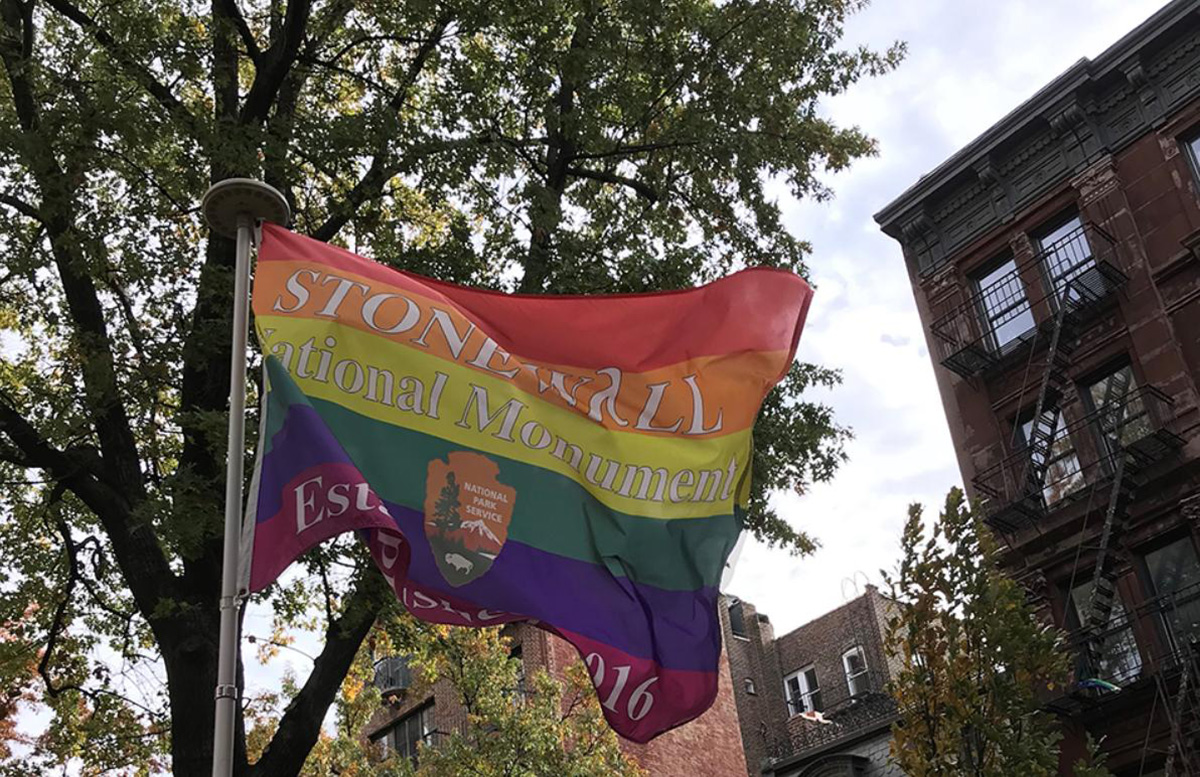
Lambda Legal and Washington Litigation Group filed a lawsuit on Tuesday, challenging the Trump-Vance administration’s removal of the Pride flag from the Stonewall National Monument in New York earlier this month.
The suit, filed in the U.S. District Court for the Southern District of New York, asks the court to rule the removal of the Pride flag at the Stonewall National Monument is unconstitutional under the Administrative Procedures Act — and demands it be restored.
The National Park Service issued a memorandum on Jan. 21 restricting the flags that are allowed to fly at National Parks. The directive was signed by Trump-appointed National Park Service Acting Director Jessica Bowron.
“Current Department of the Interior policy provides that the National Park Service may only fly the U.S. flag, Department of the Interior flags, and the Prisoner of War/Missing in Action flag on flagpoles and public display points,” the letter from the National Park Service reads. “The policy allows limited exceptions, permitting non-agency flags when they serve an official purpose.”
That “official purpose” is the grounds on which Lambda Legal and the Washington Litigation Group are hoping a judge will agree with them — that the Pride flag at the Stonewall National Monument, the birthplace of LGBTQ rights movement in the U.S., is justified to fly there.
The plaintiffs include the Gilbert Baker Foundation, Charles Beal, Village Preservation, and Equality New York.
The defendants include Interior Secretary Doug Burgum; Bowron; and Amy Sebring, the Superintendent of Manhattan Sites for the National Park Service.
“The government’s decision is deeply disturbing and is just the latest example of the Trump administration targeting the LGBTQ+ community. The Park Service’s policies permit flying flags that provide historical context at monuments,” said Alexander Kristofcak, a lawyer with the Washington Litigation Group, which is lead counsel for plaintiffs. “That is precisely what the Pride flag does. It provides important context for a monument that honors a watershed moment in LGBTQ+ history. At best, the government misread its regulations. At worst, the government singled out the LGBTQ+ community. Either way, its actions are unlawful.”
“Stonewall is the birthplace of the modern LGBTQ+ rights movement,” said Beal, the president of the Gilbert Baker Foundation. The foundation’s mission is to protect and extend the legacy of Gilbert Baker, the creator of the Pride flag.
“The Pride flag is recognized globally as a symbol of hope and liberation for the LGBTQ+ community, whose efforts and resistance define this monument. Removing it would, in fact, erase its history and the voices Stonewall honors,” Beal added.
The APA was first enacted in 1946 following President Franklin D. Roosevelt’s creation of multiple new government agencies under the New Deal. As these agencies began to find their footing, Congress grew increasingly worried that the expanding powers these autonomous federal agencies possessed might grow too large without regulation.
The 79th Congress passed legislation to minimize the scope of these new agencies — and to give them guardrails for their work. In the APA, there are four outlined goals: 1) to require agencies to keep the public informed of their organization, procedures, and rules; 2) to provide for public participation in the rule-making process, for instance through public commenting; 3) to establish uniform standards for the conduct of formal rule-making and adjudication; and 4) to define the scope of judicial review.
In layman’s terms, the APA was designed “to avoid dictatorship and central planning,” as George Shepherd wrote in the Northwestern Law Review in 1996, explaining its function.
Lambda Legal and the Washington Litigation Group are arguing that not only is the flag justified to fly at the Stonewall National Monument, making the directive obsolete, but also that the National Park Service violated the APA by bypassing the second element outlined in the law.
“The Pride flag at the Stonewall National Monument honors the history of the fight for LGBTQ+ liberation. It is an integral part of the story this site was created to tell,” said Lambda Legal Chief Legal Advocacy Officer Douglas F. Curtis in a statement. “Its removal continues the Trump administration’s disregard for what the law actually requires in their endless campaign to target our community for erasure and we will not let it stand.”
The Washington Blade reached out to the NPS for comment, and received no response.
Massachusetts
EXCLUSIVE: Markey says transgender rights fight is ‘next frontier’
Mass. senator, 79, running for re-election
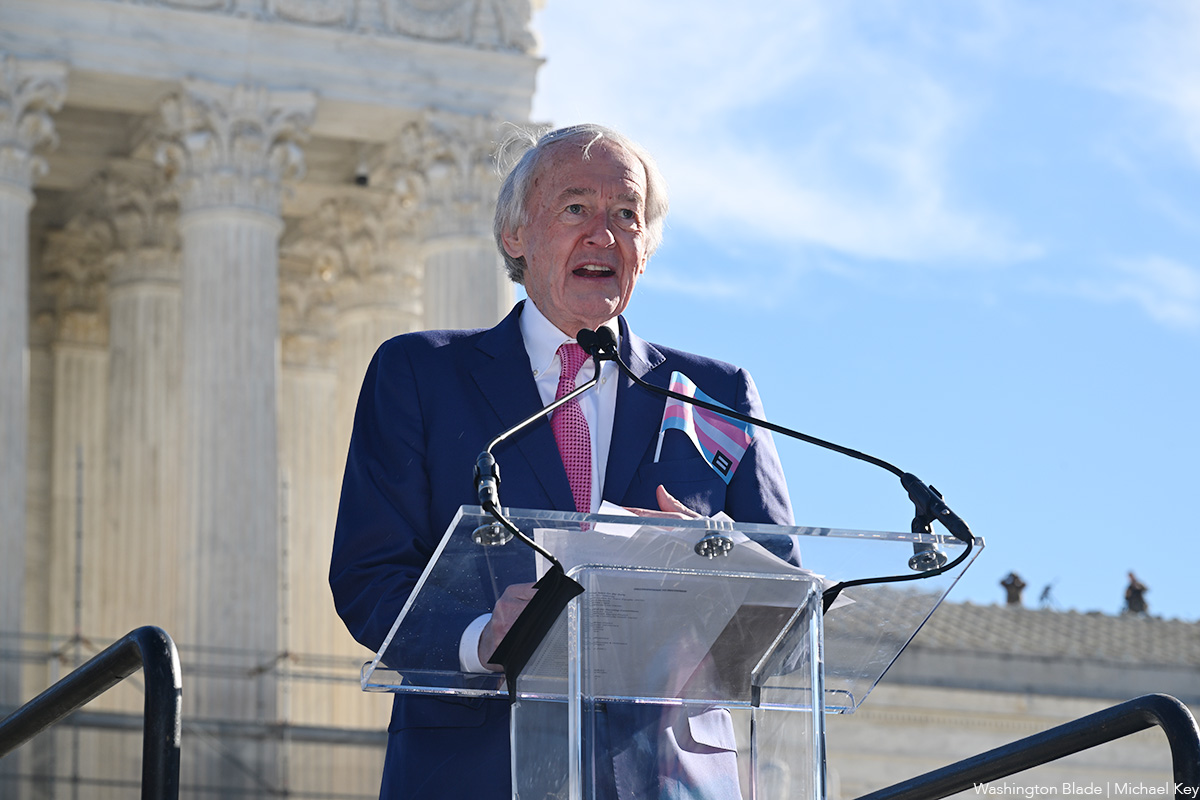
For more than half a century, U.S. Sen. Edward Markey (D-Mass.) has built a career around the idea that government can — and should — expand rights rather than restrict them. From pushing for environmental protections to consumer safeguards and civil liberties, the Massachusetts Democrat has long aligned himself with progressive causes.
In this political moment, as transgender Americans face a wave of federal and state-level attacks, Markey says this fight in particular demands urgent attention.
The Washington Blade spoke with Markey on Tuesday to discuss his reintroduction of the Trans Bill of Rights, his long record on LGBTQ rights, and his reelection campaign — a campaign he frames not simply as a bid for another term, but as part of a broader struggle over the direction of American democracy.
Markey’s political career spans more than five decades.
From 1973 to 1976, he served in the Massachusetts House of Representatives, representing the 16th Middlesex District, which includes the Boston suburbs of Malden and Melrose, as well as the 26th Middlesex District.
In 1976, he successfully ran for Congress, winning the Democratic primary and defeating Republican Richard Daly in the general election by a 77-18 percent margin. He went on to serve in the U.S. House of Representatives for nearly four decades, from 1976 until 2013.
Markey in 2013 ran in the special election to fill an open Senate seat after John Kerry became secretary of state in the Obama-Biden administration. Markey defeated Republican Gabriel E. Gomez and completed the remaining 17 months of Kerry’s term. Markey took office on July 16, 2013, and has represented Massachusetts in the U.S. Senate ever since.
Over the years, Markey has built a reputation as a progressive Democrat focused on human rights. From environmental protection and consumer advocacy to civil liberties, he has consistently pushed for an expansive view of constitutional protections. In the Senate, he co-authored the Green New Deal, has advocated for Medicare for All, and has broadly championed civil rights. His committee work has included leadership roles on Senate Foreign Relations Committee and the Senate Health, Education, Labor and Pensions (HELP) Committee.
Now, amid what he describes as escalating federal attacks on trans Americans, Markey said the reintroduction of the Trans Bill of Rights is not only urgent, but necessary for thousands of Americans simply trying to live their lives.
“The first day Donald Trump was in office, he began a relentless assault on the rights of transgender and nonbinary people,” Markey told the Blade. “It started with Executive Order 14168 ‘Defending women from gender ideology extremism and restoring biological truth to the federal government.’ That executive order mandates that federal agencies define gender as an unchangeable male/female binary determined by sex assigned at birth or conception.”
He argued that the executive action coincided with a sweeping legislative push in Republican-controlled statehouses.
“Last year, we saw over 1,000 anti trans bills across 49 states and the federal government were introduced. In January of 2026, to today, we’ve already seen 689 bills introduced,” he said. “The trans community needs to know there are allies who are willing to stand up for them and affirmatively declare that trans people deserve all of the rights to fully participate in public life like everyone else — so Trump and MAGA Republicans have tried hard over the last year to legislate all of these, all of these restrictions.”
Markey said the updated version of the Trans Bill of Rights is designed as a direct response to what he views as an increasingly aggressive posture from the Trump-Vance administration and its GOP congressional allies. He emphasized that the legislation reflects new threats that have emerged since the bill’s original introduction.
In order to respond to those developments, Markey worked with U.S. Rep. Pramila Jayapal (D-Wash.) to draft a revised version that would more comprehensively codify protections for trans Americans under federal law.
“What we’ve added to the legislation is this is all new,” he explained, describing how these proposed protections would fit into all facets of trans Americans’ lives. “This year’s version of it that Congresswoman Jayapal and I drafted, there’s an anti-trans bias in the immigration system should be eliminated.”
“Providers of gender affirming care should be protected from specious consumer and medical fraud accusations. The sexual and gender minority research office at the National Institutes of Health should be reopened and remain operational,” he continued. “Military discharges or transgender and nonbinary veterans and reclassification of discharge status should be reviewed. Housing assignments for transgender and nonbinary people in government custody should be based on their safety needs and involuntary, solitary or affirmative administrative confinement of a transgender or nonbinary individual because of their gender identity should be prohibited, so without it, all of those additional protections, and that’s Just to respond to the to the ever increasingly aggressive posture which Donald Trump and his mega Republicans are taking towards the transgender.”
The scope of the bill, he argued, reflects the breadth of challenges trans Americans face — from immigration and health care access to military service and incarceration conditions. In his view, the legislation is both a substantive policy response and a moral declaration.
On whether the bill can pass in the current Congress, Markey acknowledged the political hardships but insisted the effort itself carries as much significance as the bill’s success.
“Well, Republicans have become the party of capitulation, not courage,” Markey said. “We need Republicans of courage to stand up to Donald Trump and his hateful attacks. But amid the relentless attacks on the rights and lives of transgender people across the country by Trump and MAGA Republicans, it is critical to show the community that they have allies in Congress — the Trans Bill of Rights is an affirmative declaration that federal lawmakers believe trans rights are human eights and the trans people have the right to fully participate in public life, just like everyone else.”
Even if the legislation does not advance in this congress, Markey said, it establishes a framework for future action.
“It is very important that Congresswoman Jayapal and I introduce this legislation as a benchmark for what it is that we are going to be fighting for, not just this year, but next year,” he said when asked if the bill stood a legitimate chance of passing the federal legislative office when margins are so tight. “After we win the House and Senate to create a brand new, you know, floor for what we have to pass as legislation … We can give permanent protections.”
He framed the bill as groundwork for a future Congress in which Democrats regain control of both chambers, creating what he described as a necessary roadblock to what he views as the Trump-Vance administration’s increasingly restrictive agenda.
Markey also placed the current political climate within the longer arc of LGBTQ history and activism.
When asked how LGBTQ Americans should respond to the removal of the Pride flag from the Stonewall National Monument — the first national monument dedicated to recognizing the LGBTQ rights movement — Markey was unwavering.
“My message from Stonewall to today is that there has been an ongoing battle to change the way in which our country responds to the needs of the LGBTQ and more specifically the transgender community,” he said. “When they seek to take down symbols of progress, we have to raise our voices.”
“We can’t agonize,” Markey stressed. “We have to organize in order to ensure that that community understands, and believes that we have their back and that we’re not going away — and that ultimately we will prevail.”
Markey added, “That this hatefully picketed White House is going to continue to demonize the transgender community for political gain, and they just have to know that there’s going to be an active, energetic resistance, that that is going to be there in the Senate and across our country.”
Pam Bondi ‘is clearly part’ of Epstein cover up
Beyond LGBTQ issues, Markey also addressed controversy surrounding Attorney General Pam Bondi and the handling of the Epstein files, sharply criticizing the administration’s response to congressional inquiries.
“Well, Pam Bondi is clearly part of a cover up,” Markey said when asked about the attorney general’s testimony to Congress amid growing bipartisan outrage over the way the White House has handled the release of the Epstein files. “She is clearly part of a whitewash which is taking place in the Trump administration … According to the New York Times, Trump has been mentioned 38,000 times in the [Epstein] files which have been released thus far. There are still 3 million more pages that have yet to be released. So this is clearly a cover up. Bondi was nothing more than disgraceful in the way in which she was responding to our questions.”
“I think in many ways, she worsened the position of the Trump administration by the willful ignoring of the central questions which were being asked by the committee,” he added.
‘I am as energized as I have ever been’
As he campaigns for reelection, Markey said the stakes extend beyond any single issue or piece of legislation. He framed his candidacy as part of a broader fight for democracy and constitutional protections — and one that makes him, as a 79-year-old, feel more capable and spirited than ever.
“Well, I am as energized as I have ever been,” he said. “Donald Trump is bringing out the Malden in me. My father was a truck driver in Malden, Mass., and I have had the opportunity of becoming a United States senator, and in this fight, I am looking ahead and leading the way, affirming rights for the trans community, showing up to defend their rights when they are threatened from this administration.”
He continued, reiterating his commitment not only to the trans community but to a future in which progressive and proactive pushes for expanded rights are seen, heard, and actualized.
“Our democracy is under threat from Donald Trump and MAGA Republicans who are trying to roll back everything we fought for and threaten everything we stand for in Massachusetts, and their corruption, their greed, their hate, just make me want to fight harder.”
When asked why Massachusetts voters should reelect him, he said his age and experience as a 79-year-old are assets rather than hindrances.
“That’s exactly what I’m doing and what I’m focused upon, traveling across the state, showing up for the families of Massachusetts, and I’m focused on the fights of today and the future to ensure that people have access to affordable health care, to clean air, clean water, the ability to pay for everyday necessities like energy and groceries.”
“I just don’t talk about progress. I deliver it,” he added. “There’s more to deliver for the people of Massachusetts and across this country, and I’m not stopping now as energized as I’ve ever been, and a focus on the future, and that future includes ensuring that the transgender community receives all of the protections of the United States Constitution that every American is entitled to, and that is the next frontier, and we have to continue to fight to make that promise a reality for that beleaguered community that Trump is deliberately targeting.”

More than a dozen LGBTQ athletes medal at Olympics

Rob Jetten becomes first gay Dutch prime minister

US Embassy in Mexico issues shelter in place order for Puerto Vallarta

José Zayas brings ‘The House of Bernarda Alba’ to GALA Hispanic Theatre

2026: prices, pace, and winter weather

Judge rescinds order against activist in Capital Pride lawsuit

Trans activists arrested outside HHS headquarters in D.C.

Justicia reconoce delito de odio en caso de bullying en Instituto Nacional Mejía de Ecuador

US wins Olympic gold medal in women’s hockey

How do we honor Renee Good, Alex Pretti?
-

 District of Columbia4 days ago
Judge rescinds order against activist in Capital Pride lawsuit
-
District of Columbia4 days ago
Trans activists arrested outside HHS headquarters in D.C.
-
Ecuador5 days ago
Justicia reconoce delito de odio en caso de bullying en Instituto Nacional Mejía de Ecuador
-
Sports5 days ago
US wins Olympic gold medal in women’s hockey