News
Kenyan LGBT rights activist visits D.C.
Anti-LGBT violence remains pervasive in African nation
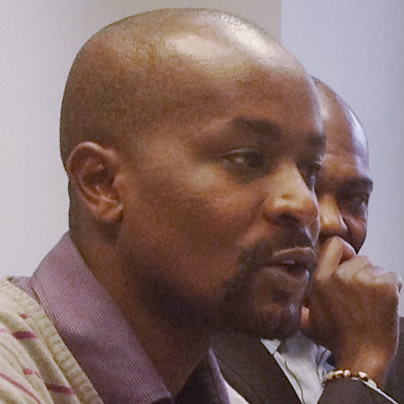
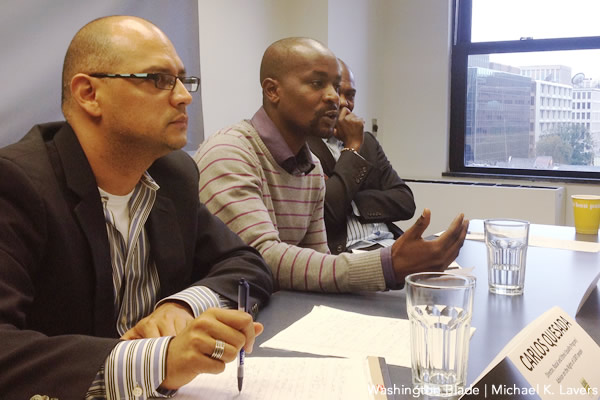
Eric Gitari of the National Gay and Lesbian Human Rights Commission of Kenya, center, speaks at Global Rights in D.C. on Oct. 11, 2013. (Washington Blade photo by Michael K. Lavers)
A leading Kenyan LGBT rights activist told the Washington Blade during a recent interview he feels his fellow advocates can learn a lot from their U.S. counterparts.
“They own their agenda and they drive it,” said Eric Gitari, executive director of the National Gay and Lesbian Human Rights Commission of Kenya. “I want to draw lessons on how we can get more people to own this equality agenda.”
Gitari spoke with the Blade after he appeared on a panel with Pastor Joseph Tolton of the Fellowship of Affirming Ministries at Global Rights in Northwest D.C. on Oct. 11. The activist also visited the Human Rights Campaign and Human Rights Watch and spoke at the Howard University School of Law and Columbia University in New York before he left the U.S.
Kenya’s colonial government in 1897 adopted India’s penal code that included the criminalization of same-sex sexual relations.
Those convicted under the law could face up to 14 years in prison, but Gitari noted there has never been what he described as “a successful prosecution” under it. He said during the panel that a coalition of groups that hope to repeal the pre-independence statute hope to implement a strategy similar to that used by those who challenged India’s sodomy law – judges on the Delhi High Court in 2009 found the country’s colonial-era statute unconstitutional.
“They are using parallels from the New Delhi case in India to engage their strategies,” Gitari said.
Gitari also noted homophobia, transphobia and anti-LGBT discrimination and violence remain pervasive in Kenya in spite of a new constitution the country adopted in 2010 that acknowledges human rights, equality and other universal values.
He said “ex-gay” programs remain common in Kenyan schools, and students as early as fifth grade are taught homosexuality is a “social deviance” that is comparable to drug activity and criminality. Gitari further noted a 2012 secondary education certification exam asked high school students to give 10 reasons why Kenyan Christians are “united against homosexuals.”
“This law is informing a lot of public policy positions and attitudes,” he said.
A mob in Mtwapa near the coastal city of Mombasa in 2010 doused four gay men whom they thought were about to attend a same-sex wedding with kerosene.
“This was instigated by religious leaders; religious leaders to the present walk scot free,” Gitari said. “[They] have never, ever been investigated in spite of efforts to push for such an investigation for such hate crimes.”
Kenya is among the 76 countries in which consensual same-sex sexual relations remain illegal. Sudan, Mauritania and a handful of other nations continue to impose the death penalty upon anyone found guilty of homosexuality.
Lawmakers in Uganda, which borders Kenya, have faced widespread criticism over a bill Parliamentarian David Bahati introduced in 2009 that sought to execute those convicted of repeated same-sex sexual acts.
President Obama in June spoke out against the criminalization of homosexuality during a press conference in Senegal, which is among the 38 African countries in which consensual same-sex sexual activity remains illegal.
Gitari noted the majority of Kenyans respect Obama because the president’s father was born in the country, but they criticized him over the comments he made while in Senegal.
“There were attempts by people, by propaganda machines within the conservatives to rob him of his African identity,” Gitari said. “They see Obama as a player in the spreading of that Western agenda of homosexuality.”
Advocates look to courts to expand LGBT rights
Gitari and his group hope to use the courts to gain legal protections for LGBT Kenyans that include the eventual repeal of the country’s sodomy law.
A three-judge panel on the High Court of Kenya in 2010 refused to legally recognize Richard Muasya, an intersex person who suffered abuse inside a maximum security prison. Muasya received 500,000 Kenyan shillings (or nearly $5,900) for the mistreatment inside the facility, but the judges said they found no evidence of anti-LGBT discrimination and human rights violations in the country.
The Kenyan Human Rights Commission in 2011 published a report that documented anti-LGBT discrimination. The Kenyan National Commission on Human Rights the following year released a second report that found widespread anti-LGBT discrimination in the country’s health care system.
The High Court of Kenya in June ruled in favor of a transgender woman who claimed police officers in a town outside of Nairobi, the country’s capital, stripped her naked in front of local reporters to determine her gender after they arrested her for assault in 2011. She also accused the officers of groping her breasts during the incident.
Gitari’s group also continues to seek formal recognition in the country.
“Our roadmap is informed by incremental litigation,” Gitari said.
Gitari traveled to D.C. less than a month after members of the Somali terrorist organization al-Shabab killed more than 60 people at a shopping mall in the Kenyan capital of Nairobi.
The East Africa Center for Law and Justice, which the American Center for Law and Justice that anti-gay televangelist Pat Robertson founded in 1990, is among the groups that continue to pose significant barriers to LGBT-specific advances in Kenya. In spite of this resistance, Gitari told the Blade he has not seen any homophobic rhetoric as a result of last month’s attack.
“The good thing that has emerged from it is that Kenyans are beginning to see that teaching extremism and using religion to justify hatred is no longer the way,” Gitari said. “It’s costing innocent lives and it’s not rational in a civilized world anymore.”



Netherlands
Tens of thousands take part in World Pride March
Event capped off two weeks of celebrations in Amsterdam.

AMSTERDAM — Tens of thousands of people on Saturday participated in the World Pride March in Amsterdam.
Outright International Executive Director Maria Sjödin and Paolo Rondelli, who in 2022 became the world’s first openly gay head of state when he became Captain Regent of San Marino, are among those who participated alongside Massachusetts state Rep. Jack Lewis and Olena Shevchenko, chair of Insight, an LGBTQ advocacy group in Ukraine, and others.
Members of D66, the centrist Dutch political party that Prime Minister Rob Jetten heads, also marched.
Jetten in February became the Netherlands’ first openly gay prime minister. He participated in the opening of the World Pride Human Rights Conference on Aug. 5 and spoke on a panel with Rondelli, former Irish Prime Minister Leo Varadkar, and other gay and lesbian current and former heads of government.
(Washington Blade video by Michael K. Lavers)
(Washington Blade video by Michael K. Lavers)
The march took place a week after hundreds of thousands of people lined Amsterdam’s canals for the city’s annual Amsterdam Pride Canal Parade.
A terrorist attack at Berlin’s Christopher Street Day on July 25 left one person dead and more than two dozen others injured.
The incident overshadowed World Pride, which began hours earlier and ended on Saturday.
Dutch authorities increased security measures in the aftermath of the July 25 attack. No incidents were reported during World Pride.
National
HRC condemns DoE removal of LGBTQ bullying data from federal survey
Organization cites rise in homophobic, transphobic policies, worse mental health outcomes

The Human Rights Campaign is slamming the White House — and the Department of Education — following their removal of some LGBTQ bullying data from federal data collection.
The Civil Rights Data Collection is a mandated survey of all public school districts that collects figures on a wide variety of statistics about students — including demographics that include race, ethnicity, sex, disability status, and English learner status; course-level enrollment data, such as how many students are enrolled in advanced placement or honors classes; and school climate information, such as rates of bullying, harassment, suspensions, and expulsions.
That data collection has been ongoing since 1968 — nearly six decades — but now has a major change in what questions are being asked, or not asked, that advocates are largely attributing to the Trump-Vance administration’s culture war fight on LGBTQ children in the country.
Changes to the 2025-2026 survey questions — approved by the Office of Budget and Management in July — eliminated a space for schools to report how many students identify as nonbinary, how often those students are victims of harassment and bullying, and whether school districts have policies prohibiting gender identity-based incidents.
K-12 Dive, a publication that focuses its reporting on news related to K-12 education, first published a list of these data collection changes from 2024-2025 to 2025-2026.
These questions, as well as others that included LGBTQ student topics on treatment in schools, were added to the CRDC under the Biden-Harris administration. By including these questions, policymakers hoped this would lead to increased investigations into discrimination complaints, initiate compliance reviews, and provide policy guidance to districts, according to Education Department documents.
The CRDC also eliminated the mention of “gender identity” from the definition of rape and sexual assault. The prior collection of data (before the Trump-Vance administration changed it) defined rape as something that could be done to “all students, regardless of sex, or sexual orientation, or gender identity.” Now, the new data collection questions say, “All students, regardless of sex, or sexual orientation can be victims of rape,” removing “gender identity” from the new definition.
By removing and changing definitions, this could have a real-world impact on some of the school’s most vulnerable students. According to CRDC data from 2021-2022, more than 1,800 school districts reported enrolling one or more nonbinary students.
Additional data also shows that the changes to data collection is harming public school students. U.S. Sen. Bernie Sanders (I-Vt.), the ranking member of the Senate Health, Education, Labor, and Pensions Committee released a report in April finding that the Trump-Vance administration’s efforts to all but close the Department of Education Office for Civil Rights has left students facing discrimination and harassment throughout the country without the federal recourse they are entitled to under federal law.
The Williams Institute, a think tank that collects data and conducts research on issues related to sexual orientation and gender identity, has data indicating the true number of nonbinary and transgender children is much higher — they estimate that for children ages 13 to 17, nearly 724,000 identify as nonbinary or trans.
This is in line with a slew of policies pushed by the Trump-Vance administration since their federal takeover. Within his first day in office, President Donald Trump signed Executive Order 14168, titled “Defending Women from Gender Ideology Extremism and Restoring Biological Truth to the Federal Government.” This directive attempts to make the federal definition of gender unchangeable, determined by sex assigned at birth alone.
Within his first month of his second term, Trump issued Executive Order 14187, titled “Protecting Children from Chemical and Surgical Mutilation.” The order directs federal agencies to restrict gender-affirming medical care — including puberty blockers, hormone therapy, and surgeries — for individuals under the age of 19.
He also pushed multiple anti-trans executive orders, including Executive Order 14201, “Keeping Men Out of Women’s Sports,” and Executive Order 14183, “Prioritizing Military Excellence and Readiness,” targeting trans athletes and military members, respectively.
These policies have a real-world impact on trans people.
The Trevor Project, a nonprofit dedicated to crisis and suicide prevention for LGBTQ people under 25, reported that, for the seventh year in a row, LGBTQ youth are at higher risk for suicide as a result of mistreatment and stigmatization.
Trevor Project data showed that nearly 60 percent of LGBTQ young people ages 13-17 said they were bullied in the past year, and that 36 percent of LGBTQ youth seriously considered suicide in the last year. The data shows a bigger discrepancy for trans youth, with that number hovering around 40 percent considering suicide.
HRC President Kelley Robinson issued a statement following the approval of the new data collection questions that leaves LGBTQ students’ bullying statistics under — if not completely unreported.
“If there was even a shadow of a doubt, this latest move by the Trump administration makes it abundantly clear they do not care about the safety of LGBTQ+ students, and trans students in particular,” Robinson said. “These are adults who should be protecting our kids. And instead, they are making sure bullying and harassment are not tracked. If they are not tracked, bullying and harassment cannot be prevented or stopped — which is exactly what the Trump administration wants. Parents deserve to know their kids are safe at school, and every single young person deserves dignity and safety at school. Anything less is plain evil.”
HRC has a “Welcoming Schools” initiative that they say is the “most comprehensive” bias-based bullying prevention program in the nation. The program includes LGBTQ and gender-inclusive resources for schools, help navigating special education and disability resources for LGBTQ-identifying students, and other tools to help schools become more inclusive.
This program has been in effect for nearly two decades and, according to HRC, reaches nearly 750,000 students.
The Washington Blade reached out to both the Department of Education and Office of Management and Budget for comment but did not receive a response by publication time.
Netherlands
Dutch PM: More needs to be done to defend trans rights
Rob Jetten on Friday was on World Pride Human Rights Conference panel

Editor’s note: International News Editor Michael K. Lavers and Photo Editor Michael Key will be on assignment in Amsterdam until Aug. 10.
AMSTERDAM — Dutch Prime Minister Rob Jetten on Friday said more needs to be done to defend transgender people and their rights.
“Everywhere in the Western world, it’s definitely the group that’s the most vulnerable in the moment and it’s rather well-picked also by our advisories,” he said during a panel at the World Pride Human Rights Conference in Amsterdam that Ying Xin and Diego García Blum of Global LGBTQI+ Human Rights Program at the Harvard Kennedy School’s Ryan-Carr Center for Human Rights Policy moderated. “They’ve chosen the smallest group within our broader community (trans people) to attack them, to ensure that we can strip their rights and if they’ve done with that, they’ll go after the next group within our community, so we shouldn’t be naïve about what’s behind it.”
“It’s very well-funded. It’s very well-organized and we have to organize as well to fight back and to win this fight,” added Jetten. “We also need to be more open in conversations that we are having within the community and also dive into it much deeper and maybe even have more difficult and annoying conversations.”
Jetten in February became the Netherlands’ first openly gay prime minister.
He appeared on the panel alongside former Irish Prime Minister Leo Varadkar, who in 2017 became his country’s first openly gay head of government, and former San Marino Captain Regent Paolo Rondelli, who was his country’s ambassador to the U.S. from 2007-2016.
Several other current former heads of government who are gay or lesbian also participated in the panel. They include former Icelandic Prime Minister Jóhanna Sigurðardóttir, former Luxembourgish Prime Minister Xavier Bettel, and Andorran Prime Minister Xavier Espot Zamora. California Congressman Mark Takano, who chairs the Congressional Equality Caucus, and LGBTQ+ Victory Fund CEO Evan Low were among those who attended.
Jetten in his remarks said he was “very surprised” to learn that “not only in the U.S. but also in some European countries that we’ve let them decide what the gay group looked like.” The Dutch prime minister further pointed out that conservatives began “to attack the debate on toilets or starting this debate about trans people in Olympic games.”
“That is, of course, a ridiculous debate to start, but we’ve got distracted because we were so busy having this debate on Olympians, and then we actually forgot the real fight was about access to healthcare, just being yourself, being able to enlist in the army, or being able to be a young trans boy or girl in school,” said Jetten. “We got distracted by some fresh meat that was thrown into the area by some very conservative people.”
“We have to open our eyes and have very in-depth conservations within our community, and come up with a much better strategy to win this fight and to protect all our trans brothers and sisters, dolls, whatever,” he added. “Because if we don’t win this fight for trans people, we’re going to lose the bigger fight for all LGBTQ people in the world.”
Varadkar noted Ireland in 2015 passed a law that allows people to legally change their gender without surgery or other medical interventions.
He conceded there was “a liberal wind blowing across the world at the time, and it was largely uncontested.”
“It would be harder now, quite frankly, to do that legislation,” said Varadkar.

Scottish lawmakers in 2022 passed the Gender Recognition Reform Bill, which lowered the age for anyone to legally change their gender without medical intervention from 18 to 16. Then-British Prime Minister Rishi Sunak’s government later blocked the measure from taking effect.
The U.K. Supreme Court in 2025 ruled the legal definition of a woman under the country’s Equality Act is limited to “biological women.” Author J.K. Rowling is among those who praised the decision that stemmed from a case that challenged the Scottish government’s decision to include trans women in its definition of women when it sought to increase the number of women on government boards.
The Trump-Vance administration on Jan. 20, 2025, the first day it was in office, issued a sweeping executive order that, among other things, declared the federal government would only recognize two genders: male and female. The White House earlier this year in its counterterrorism strategy said it “will also prioritize the rapid identification and neutralization of violent secular political groups whose ideology is anti-American, radically pro-transgender, and anarchist.”
“We have to stay united,” said Rondelli. “The strategy was, since the beginning, was a Nazi strategy to create groups, target groups, and to create maximum distractions to avoid discussion about some sort of policies.”
“Trans people are the target at the moment,” he added. “But after them it will probably be some others, so we have to stay united.”


PHOTOS: World Pride March

Tens of thousands take part in World Pride March

PHOTOS: Daddy Issues at Kiki

Something’s off about Dad. When is it time to step in?

New book chronicles gay man’s life in hippie commune

Dutch prime minister opens World Pride Human Rights Conference

Progressives score victory as El-Sayed wins Mich. Senate primary

Doug Ollivant to face Eugene Vindman in Va. 7th Congressional District

LGBTQ advocates optimistic about D.C.’s expected new mayor

Continue to engage in community after Pride month
-

 Netherlands4 days ago
Dutch prime minister opens World Pride Human Rights Conference
-
Michigan4 days ago
Progressives score victory as El-Sayed wins Mich. Senate primary
-
Virginia4 days ago
Doug Ollivant to face Eugene Vindman in Va. 7th Congressional District
-
District of Columbia4 days ago
LGBTQ advocates optimistic about D.C.’s expected new mayor