Local
UPDATE: Md. braces for close vote on marriage
House committee advances bill; GOP lawmaker announces support

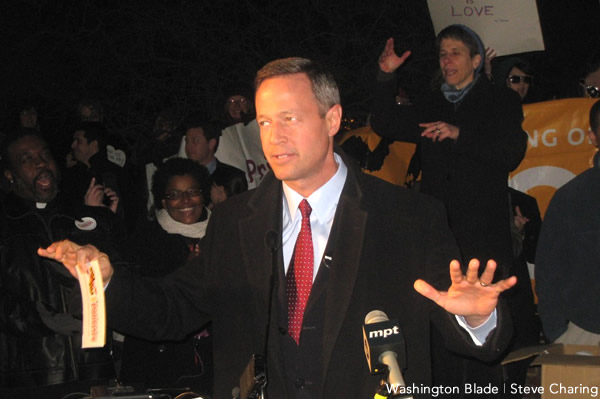
About 500 LGBT rights supporters turned out for the annual Lobby Day in Annapolis this week. For the first time, Gov. Martin O’Malley addressed the gathering. (Washington Blade photo by Steve Charing)
The Maryland House of Delegates is preparing for a close vote on a bill to legalize same-sex marriage on Friday.
The vote is expected just days after the measure was moved to the floor following approval by a joint committee on Tuesday.
Gov. Martin O’Malley introduced the Civil Marriage Protection Act as part of his legislative package. A similar measure passed the Senate but died in the House last year after supporters determined they didn’t have sufficient votes for passage in the lower chamber.
“Today’s vote on the Civil Marriage Protection Act is a significant step forward for the passage of this bill in Maryland,” O’Malley said in a statement after Tuesday’s committee vote. “Together, we will continue our work to ensure that our State protects religious freedom and provides equal protection under the law for all Marylanders.”
The Judiciary Committee and the Health & Government Operations Committee heard joint testimony last week on the marriage bill. The committees voted jointly over several hours late Tuesday afternoon. The vote was 25-18 in favor, with one abstention, Del. Sam Arora (D-Mont. Co.), a former supporter of the bill.
“We just took another step toward civil marriage equality becoming a reality in Maryland; the momentum is with us,” the group Marylanders for Marriage Equality said in a statement. “We thank all supportive Delegates for their leadership on this very important issue that will improve the lives of thousands of Maryland families and help put the state on the right side of history.”
Del. Kathleen Dumais (D-Montgomery County), who serves as vice chair of the Judiciary Committee, said the marriage bill was scheduled to be taken up on the House floor on Thursday for a second-reading vote following an informal first-reading of the bill on the floor on Wednesday. All bills are open to proposed amendments during the second reading. She said a final, third reading, debate and vote on the bill was expected to take place in the House on Friday.
“I feel positive that it will pass the House this year,” she told the Blade on Wednesday.
Although supporters hailed the joint vote by the two committees to approve legislation to legalize same-sex marriage, a breakdown of the vote shows that the bill lost among Judiciary Committee members by a vote of 11-10, with the one abstention by Arora. The vote breakdown shows that Health and Government Operations Committee members voted to approve the bill by a margin of 15-7, with one member absent.
The large margin of approval by the HGO Committee clearly put the bill over the top in the combined vote. The development confirms speculation that House Speaker Michael Busch (D-Anne Arundel County) gave the HGO Committee jurisdiction over the bill along with the Judiciary panel this year because he knew in advance that the Judiciary Committee lacked the votes to approve a marriage bill.
The Judiciary panel approved the bill last year by a one-vote margin, with Chairman Joseph Vallario (D-Calvert & Prince George’s County) voting for the bill. Vallario voted against the bill at Tuesday’s joint committee session. Arora also voted for the bill in committee last year but made it clear that he would not vote for it on the House floor.
His abstention this year highlights the surprise and disappointment among many LGBT activists in Maryland who supported Arora’s 2010 election campaign in which he ran on a platform of support for a same-sex marriage equality bill. Last year he initially signed on as a co-sponsor for the bill before he announced that based on religious beliefs he could no longer support the legislation.
No vote was taken in the joint committee session on a proposed constitutional amendment to ban same-sex marriage, but the joint panel voted down five proposed amendments to the Civil Marriage Protection Act, including:
• An amendment to eliminate all sex education in public schools, which failed 26-17;
• An amendment calling for parental consent before using materials that address “non-traditional families” in schools, which failed 27-16;
• An amendment to prohibit minors from marrying someone of the same sex, which failed 26-17;
• An amendment to change the effective date of the bill to Jan. 1, 2013, which failed 24-21;
• And an amendment to change the bill from marriage to civil unions, which failed 27-17.
In a related development, Del. Robert Costa, a Republican from Anne Arundel County, announced Tuesday that he will vote for the marriage bill.
“I think it’s not a state function to decide who can marry,” the Annapolis Capital quoted him as saying. “I do what I believe is right for people. I don’t think that matters. I represent constituents and not a party.”
The announcement drew quick praise from LGBT advocates.
“The fact that Del. Costa is going to support this bill publicly is really demonstrating the momentum for this and how quickly the momentum is growing,” Equality Maryland Executive Director Carrie Evans told the Blade. “It’s significant like Sen. Allan Kittleman’s vote was last year. We know it isn’t a partisan issue. We finally see evidence that it’s not. Del. Costa represents a fairly rural district and he’s with us.”
And in another development, a one-time supporter of the same-sex marriage bill who startled LGBT advocates last year by saying she was backing away from her support told the Blade that she has yet to decide how she will vote on the bill this year.
Del. Jill Carter (D-Baltimore) told the Blade last week that she’s concerned that some news media outlets incorrectly reported last year that she voted against the same-sex marriage bill in committee.
“In fact, I voted for it,” she said. “I’m not ready to say what I’ll do this year.” She voted for the bill in committee Tuesday.
Carter spoke to the Blade outside a House of Delegates hearing room in Annapolis on Feb. 10 in which two committees conducted a joint hearing on both the Civil Marriage Protection Act, which would allow same-sex couples to marry, and a separate bill calling for a state constitutional amendment to restrict marriage to a union only between a man and a woman.
Similar to last year, political pundits in the state believe the Maryland Senate is poised to pass the marriage bill and reject the proposed constitutional amendment.
But observers say the marriage bill’s prospects in the House of Delegates are uncertain. Supporters say they hope to persuade the small number of delegates that declined to back the bill last year and who are needed for the bill’s passage this year to change their minds and vote for it.



District of Columbia
SMYAL receives $25,000 award for ‘courageous acts’
D.C. group provides support services for LGBTQ youth
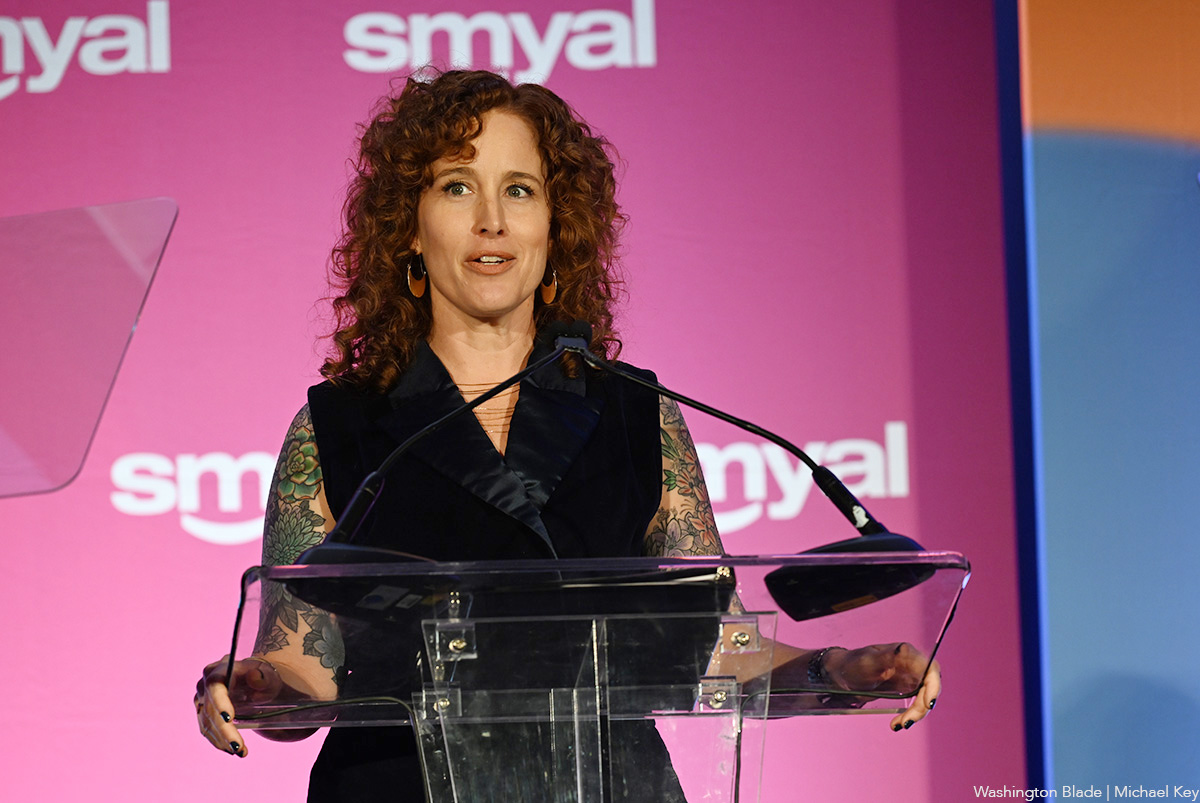
The D.C.-based organization SMYAL, which provides services for LGBTQ youth in the D.C. metro area, including housing for homeless LGBTQ youth, announced on June 30 that it received a $25,000 award for its “courageous acts” in support of the community it serves.
The award was a monetary grant from The Courage Project, which describes itself as a “national initiative investing in acts of courage and compassion that strengthens our communities and democracy.”
A statement on its website says it was launched in May 2025 and is funded and backed by leading national foundations in the U.S.
“At SMYAL, we are deeply grateful to receive support from The Courage Project and are inspired by their bold investment in LGBTQ+ youth at such a critical moment,” SMYAL CEO Erin Whelan said in a statement. “For queer and trans young people, simply showing up as themselves each day requires immense courage, and that courage is strengthened when organizations like The Courage Project stand behind them loudly, proudly, and without hesitation,” Whelan said.
In its statement announcing the award SMYAL says The Courage Project will recognize SMYAL and other awardees and their work on July 3 at the Washington National Cathedral as part of a special interfaith service marking the U.S. 250th anniversary.
“The Courage Project is a bold initiative honoring everyday acts of bravery – the quiet, often unseen acts of heroism that reflect the best of the American spirit and strengthen democracy at the community level,” the project states on its website.
Delaware
Delaware approves amendment protecting same-sex marriage
Measure must pass second vote in next year’s session

The Delaware General Assembly passed Senate Substitute 2 for Senate Bill 100 on the last day of the legislative session on Tuesday after being rescinded last week.
Senate Substitute 2 for Senate Bill 100 (SB-100) passed with 28 ‘yes’ votes, meeting the two-thirds threshold required for the bill to pass. Tuesday was the last day of the 153rd General Assembly.
The amendment would enshrine the right to same-sex and interracial marriage in the Delaware Constitution.
SB-100 was rescinded last week after it did not receive enough votes to pass. Democrats were short by three votes, with two Democratic members missing from the vote.
Rep. Josue Ortega (D-03) voted ‘no’ on SB-100 and Rep. Medinah Anton-Wilson (D-27) did not vote. However, both members voted ‘yes’ for Senate Substitute 2 for SB-100 on Tuesday.
Prime sponsor of SB 100, Rep. Claire Snyder-Hall (D-14), made the technical decision to change her vote last week from a ‘yes’ to a ‘no’ at the last minute to keep the bill alive.
Additionally, Republican Assemblyman Michael Smith (R-22) joined the Democrats with a ‘yes’ vote after voting ‘no’ on SB-100 last week.
In order for SB 100 to be enshrined into the state Constitution, it must be passed by two consecutive General Assemblies. Thus, the amendment will not be officially added to the Constitution unless it passes in the 154th General Assembly next year.
Rep. Snyder-Hall introduced the measure earlier this week.
“Just one week ago, we failed to pass this legislation. We failed the people of Delaware. But today, on the final day of the legislative session, the 153rd General Assembly affirmed that every Delawarean has the fundamental right to marry the person they love, regardless of race or gender,” said Snyder-Hall.
“Thank you to my colleagues for recognizing that the right to marry is a right worthy of protection and for voting yes on this important constitutional amendment.”
District of Columbia
Longtime Blade staffer Stephen Rutgers steps down after 14 years
Plans to focus on running Crush Dance Bar, other ventures

Longtime Washington Blade employee Stephen Rutgers announced he is stepping down after 14 years to focus on other ventures, including his part ownership of the popular Crush Dance Bar.
Rutgers was hired by the Blade in 2012 to help plan Pride festivities and over the years was promoted to director of sales and marketing. In addition to his broad set of responsibilities, Rutgers planned the annual Pride on the Pier celebration at the Wharf, which has exploded in popularity over the seven years since its launch.
“Watching Pride on the Pier grow from a new community event into one of D.C.’s signature Pride celebrations has been incredibly rewarding,” Rutgers said. “Expanding Pride on the Pier into a two-day festival for WorldPride in 2025 was definitely a career highlight. Seeing thousands of people come together to celebrate our community while supporting the Blade’s mission is something I’ll always be proud of.”

Rutgers described his biggest challenge as navigating the changing media landscape.
“More than ever, we’ve had to remind our community that local journalism matters and that it needs their support,” he said.
He added that he’s most proud of helping to ensure the Washington Blade is positioned to thrive for the next 50 years.
“I was fortunate to be part of the Blade during its 50th anniversary — a milestone that reflects its incredible history and impact,” Rutgers said. “The Blade has been an important voice for the LGBTQ community for more than five decades, and knowing I played a small part in helping its future is most important to me.”
Blade Publisher Brian Pitts praised Rutgers for juggling multiple responsibilities.
“We wish Stephen all the best,” Pitts said. “For the past 14 years, Stephen has been a vital part of the Blade, handling many things — marketing and advertising, sponsorships, and Blade signature events. We will all miss him.”
Blade Editor Kevin Naff thanked Rutgers for his years of service to the community.
“After 14 years, it’s hard to imagine the Blade without Stephen and his boundless energy and creativity,” Naff said. “He’s one of the hardest working and most dedicated people I’ve ever known and he will be missed. But change is the only constant and I know Stephen will move on successfully to new challenges and the Blade will expand on Stephen’s important work.”
As for what’s next for Rutgers, he said he plans to focus on Crush as well as his real estate business.
“I’ve always been someone who likes to stay busy,” Rutgers said. “For the past 12 years, I’ve balanced my work at the Blade and in real estate. Two years ago when I opened Crush, I never realized just how much time and energy it would take. The passing of my father earlier this year also gave me a new perspective. It reminded me that life is short and that it’s important to make time for the people and experiences that matter most. Stepping away from the Blade will allow me to focus on those ventures while also creating more balance in my life. After 14 incredible years, it feels like the right time for a new chapter.”
Naff said that for now Rutgers’s responsibilities will be divided between existing staff along with several new freelance contractors.
“The Washington Blade plays a unique role in our community’s fight for equality,” Rutgers said. “It’s the only LGBTQ news organization with White House credentials, giving it direct access to the people and institutions shaping policies that affect our community. The Blade continues to hold elected officials accountable, report on the issues that matter most to LGBTQ people, and tell the stories that often go uncovered by mainstream media.
“The Blade has been my family for most of my adult life. For 14 years, it has been part of my daily routine, so it’s going to feel very strange waking up and not logging on each morning.”

Turkish authorities refuse to allow gay cruise to dock in country

PHOTOS: Crush Dance Bar

In Trump’s divided America, Michael Weinstein’s AHF responds

When a church fears the rainbow

Under-the-radar Delaware beach towns smart buyers are targeting

Queen Camilla meets with JK Rowling

SMYAL receives $25,000 award for ‘courageous acts’

‘Transcendent’ a tough but important read
Under-the-radar Delaware beach towns smart buyers are targeting