Local
No LGBT group at Catholic U.
Announcement follows Notre Dame move to recognize similar org
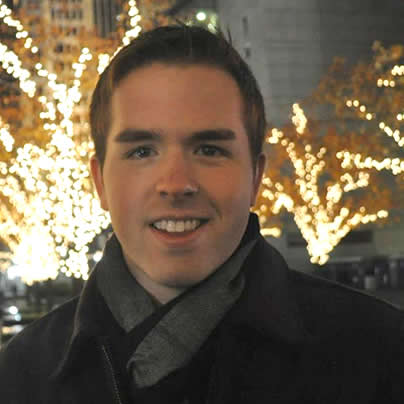
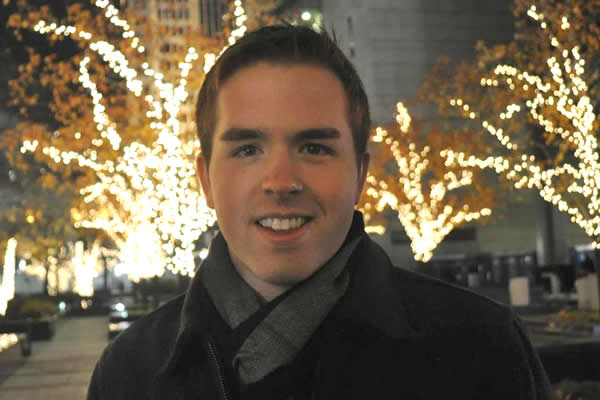
Ryan Fecteau spearheaded efforts to prompt Catholic University officials to recognize CUAllies. (Photo courtesy of Ryan Fecteau)
Catholic University of America announced last week it would not officially recognize an LGBT student organization.
Ryan Fecteau, a junior who is the first openly gay speaker of the D.C. campus’ Student Association General Assembly, told the Washington Blade that CUAllies submitted its proposal for formal recognition to administrators on Feb. 21. Dean of Students Jonathan Sawyer and Katie Jennings, director of campus activities, told Fecteau, who spearheaded the effort, in a Dec. 6 meeting the university had denied CUAllies’ request “out of fear that they would become an advocacy organization.”
“It is unfortunate the Catholic University of America is not providing space for gay, lesbian, bisexual, transgender, questioning of whatever to feel they are welcomed into the faith community on campus,” Fecteau said.
The university, which denied to officially recognize the group after it formed in 2009, told the Blade in a statement the two administrators who met with Fecteau “expressed their appreciation for the thoughtful and respectful way in which CUAllies had pursued its request for recognition.” According to the statement, the goal “articulated by CUAllies of fostering a safe and welcoming environment for all students is shared by the university.”
Catholic University President John Garvey on Dec. 6 met with 15 student leaders and seven administrators to “engage in dialogue with them on that topic and to share ideas about how the university can better demonstrate its support for all students, whether they identify themselves as heterosexual, gay or lesbian.” Fecteau stressed to the Blade that CUAllies did not discuss marriage rights for same-sex couples in their petition for formal recognition.
“In declining the request for official university recognition of CUAllies, the administrators indicated their belief that, in spite of the group’s stated intent to uphold Catholic Church teachings, it would be extremely difficult for that pledge to be honored over time,” the university’s statement read. “They pointed out that there is a fine line, easily crossed, between a group dedicated to education and support of individuals who identify themselves as homosexuals and one that engages in advocacy on behalf of a homosexual lifestyle.”
Catholic University’s decision to not recognize CUAllies came 24 hours after University of Notre Dame President Rev. John I. Jenkins accepted recommendations from the school’s Office of Student Affairs to expand support to LGBT and questioning students. This decision will include formally recognizing an LGBT student group as an on-campus organization.
“A lot of people were very, very shocked and I think that’s a very good thing,” Alex Coccia, a junior Africana and peace studies major at Notre Dame who prompted the effort, told the Blade. “It was definitely something that not many people were expecting.”
A handful of other Catholic universities have LGBT-specific clubs, student affairs offices and even resource centers. These include Georgetown University in D.C. and Loyola and DePaul Universities in Chicago.
“Despite the contradictory decisions announced last week, it is undeniable that progress is being made on religiously affiliated campuses across the country,” Shane Windmeyer, executive director of Campus Pride, said in a statement released after Catholic University administrators announced they would not formally recognize CUAllies. “Students at the University of Notre Dame and the Catholic University of America, among others, are doing incredible work to make higher education a more inclusive place for all. Campus Pride has worked over the years to assist these students and alumni to continually push forward and we are very proud to support them. We call on the Catholic University of America to recognize the value of these students’ efforts and the importance of ensuring their academic success, support, and safety on campus.”
Coccia also criticized the D.C. university’s decision.
“It’s really disappointing,” he said. “[CUAllies] essentially has the same purpose as what our group was and what the organization will be.”
As for CUAllies, Fecteau said the group and university officials have agreed to continue to discuss the possibility of formal recognition.
“We’re going to continue to have these conversations,” he said.





District of Columbia
Mayor Bowser signs bill requiring insurers to cover PrEP
‘This is a win in the fight against HIV/AIDS’

D.C. Mayor Muriel Bowser on March 20 signed a bill approved by the D.C. Council that requires health insurance companies to cover the costs of HIV prevention or PrEP drugs for D.C. residents at risk for HIV infection.
Like all legislation approved by the Council and signed by the mayor, the bill, called the PrEP D.C. Amendment Act, was sent to Capitol Hill for a required 30-day congressional review period before it takes effect as D.C. law.
Gay D.C. Council member Zachary Parker (D-Ward 5) last year introduced the bill.
Insurance coverage for PrEP drugs has been provided through coverage standards included in the Affordable Care Act, known as Obamacare. But AIDS advocacy organizations have called on states and D.C. to pass their own legislation requiring insurance coverage of PrEP as a safeguard in case federal policies are weakened or removed by the Trump administration, which has already reduced federal funding for HIV/AIDS-related programs.
Like legislation passed by other states, the PrEP D.C. Amendment Act requires insurers to cover all PrEP drugs approved by the U.S. Food and Drug Administration.
Studies have shown that PrEP drugs, which can be taken as pills or by injection just twice a year, are highly effective in preventing HIV infection.
“I think this is a win for our community,” Parker said after the D.C. Council voted unanimously to approve the bill on its first vote on the measure in February. “And this is a win in the fight against HIV/AIDS.”
District of Columbia
Blade editor to be inducted into D.C. Society of Professional Journalists Hall of Fame
Kevin Naff marks 24 years with publication this year
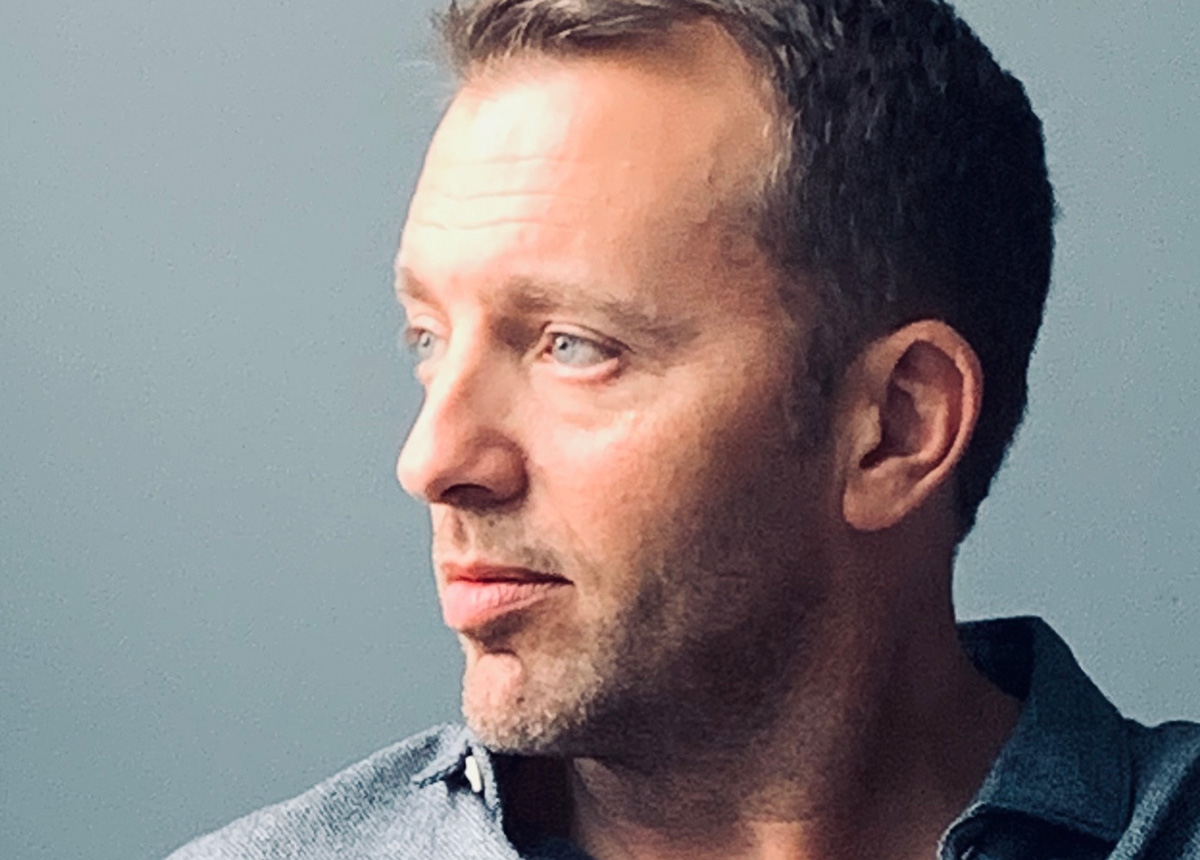
Longtime Washington Blade Editor Kevin Naff will be inducted into D.C.’s Society of Professional Journalists Hall of Fame in June, the group announced this week.
Hall of Fame honorees are chosen by the Society of Professional Journalists’ Washington, D.C., Pro Chapter. Naff and two other inductees — Seth Borenstein, a Washington-based national science writer for the AP and Cheryl W. Thompson, an award-winning correspondent for National Public Radio — will be celebrated at the chapter’s Dateline Awards dinner on Tuesday, June 9, at the National Press Club. The dinner’s emcee will be Kojo Nnamdi, host of WAMU radio’s weekly “Politics Hour.”
“I am tremendously honored by this recognition,” Naff said. “I have spent a lifetime in the D.C. area learning from so many talented journalists and am humbled to be considered in their company. Thank you to SPJ and to all the LGBTQ pioneers who came before me who made this possible.”
Naff joined the Blade in 2002 after years in print and digital journalism. He worked as a financial reporter for Reuters in New York before moving to Baltimore in 1996 to launch the Baltimore Sun’s website. He spent four years at the Sun before leaving for an internet startup and later joining the mobile data group at Verizon Wireless working on the first generation of mobile apps.
He then moved to the Blade and has served as the publication’s longest-tenured editor. In 2023, Naff published his first book, “How We Won the War for LGBTQ Equality — And How Our Enemies Could Take It All Away.”
Previous Hall of Fame inductees include luminaries in journalism like Wolf Blitzer, Benjamin Bradlee, Bob Woodward, Andrea Mitchell, and Edgar Allen Poe. The Blade’s senior news reporter Lou Chibbaro Jr. was inducted in 2015.
Maryland
Supreme Court ruling against conversion therapy bans could affect Md. law
Then-Gov. Larry Hogan signed statute in 2018
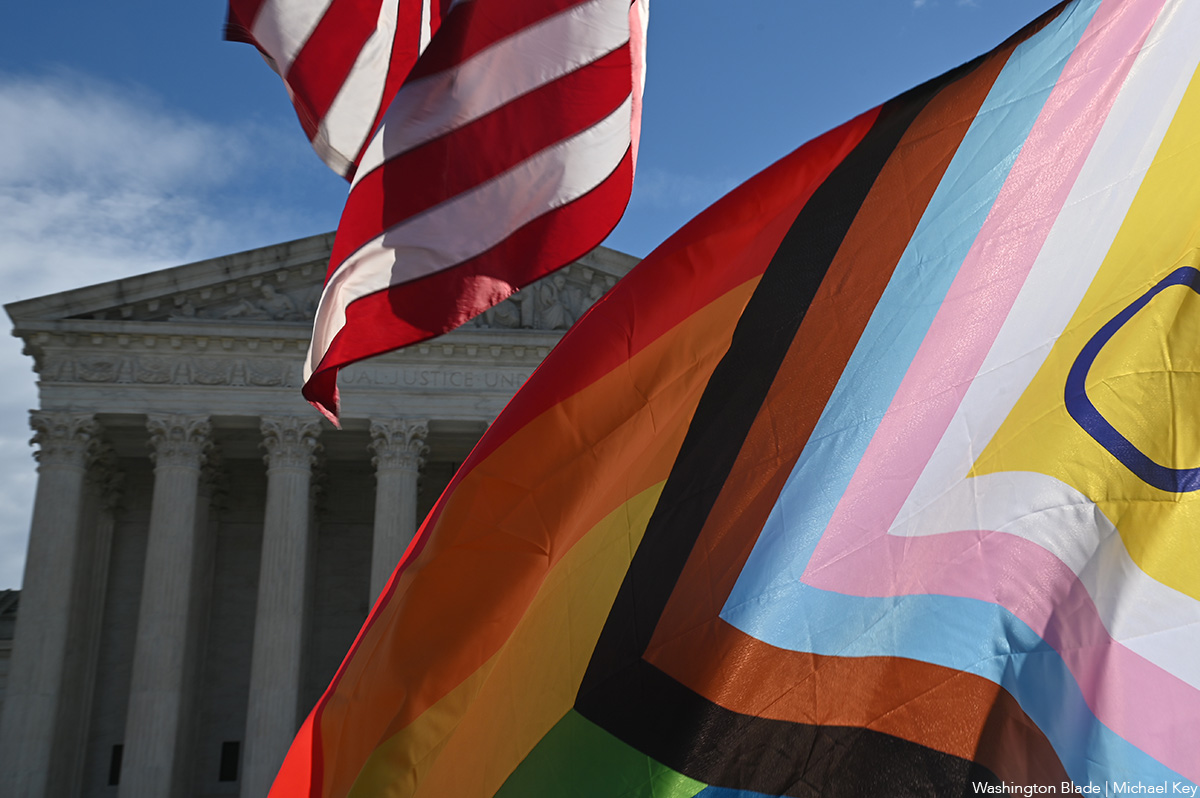
By PAMELA WOOD, JOHN-JOHN WILLIAMS IV, and MADELEINE O’NEILL | The U.S. Supreme Court on Tuesday ruled against a law banning “conversion therapy” for LGBTQ kids in Colorado, a ruling that also could apply to Maryland’s ban on the discredited practice.
An 8-1 high court majority sided with a Christian counselor who argues the law banning talk therapy violates the First Amendment. The justices agreed that the law raises free speech concerns and sent it back to a lower court to decide whether it meets a legal standard that few laws pass.
Justice Neil Gorsuch, writing for the court’s majority, said the law “censors speech based on viewpoint.” The First Amendment, he wrote, “stands as a shield against any effort to enforce orthodoxy in thought or speech in this country.”
The rest of this article can be read on the Baltimore Banner’s website.

Mayor Bowser signs bill requiring insurers to cover PrEP

JD Vance to travel to Hungary next week

Pam Bondi ousted as attorney general

VIDEO: Gay journalist detained for booing Trumps at ‘Chicago’ opening night

Idaho Gov. signs harshest anti-trans bathroom bill in the country

‘Out for McDuffie’ event held at D.C. gay bar

‘Jonah’ an undeniably compelling but unusual memory play

The Oscar-losing performance that’s too good to miss

Thousands attend ‘No Kings’ protests in D.C.