World
British House of Lords gives final approval to marriage bill
First same-sex weddings expected to take place in England and Wales in spring of 2014
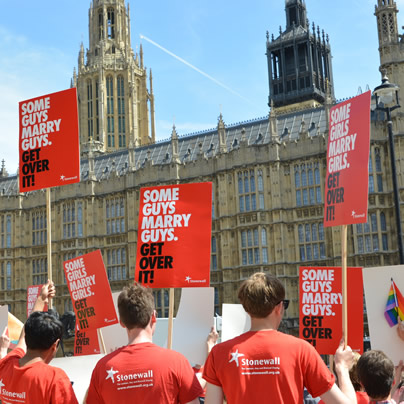
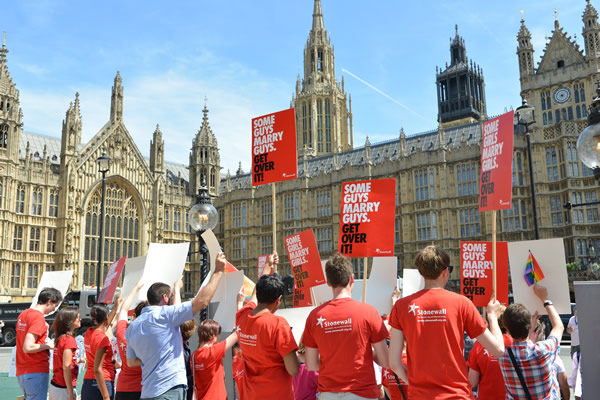
Same-sex marriage supporters gather outside the British House of Lords in London on Monday. (Photo courtesy of Simon Callaghan)
British lawmakers this week gave their final approval to a bill that would allow same-sex couples to marry in England and Wales.
The British House of Lords on Monday approved the measure on a voice vote after parliamentarians debated the measure for more than an hour. Same-sex marriage supporters and opponents also gathered outside Westminster Palace in central London as the House of Lords considered the bill.
“Judge us on the creation of the liberties we protect and extend,” Baron Waheed Alli, who is gay, said.
Baroness Tina Stowell of Beeston said she is a “firm believer in justice and fairness” as she described the same-sex marriage measure as “a force for good.” Baron Patrick Cormack of Grimsby urged those who support the bill to acknowledge opponents who feel it “does change the structure of society by changing the definition of marriage.”
“I understand that you feel euphoric today, but please have a thought for those who have different views,” he said.
Ben Summerskill, chief executive of Stonewall, a British LGBT advocacy group, applauded the vote.
“It’s impossible to express how much joy this historic step will bring to tens of thousands of gay people and their families and friends,” he said in a statement. “The bill’s progress through Parliament shows that, at last, the majority of politicians in both Houses understand the public’s support for equality – though it’s also reminded us that gay people still have powerful opponents.”
Sweden, Norway, Denmark, the Netherlands, Belgium, France, Iceland, Spain, Portugal, South Africa, Canada, Argentina, Mexico City and 11 states and D.C. currently allow same-sex marriage.
Gays and lesbians in Minnesota, Rhode Island, New Zealand and Uruguay will be able to tie the knot on August 1.
Brazil’s National Council of Justice in May ruled registrars in the South American country cannot deny marriage licenses to same-sex couples. A judge in neighboring Colombia last week said a gay couple in Bogotá, the country’s capital, who had sought legal recognition can enter into a civil marriage on July 24.
The U.S. Supreme Court last month found a portion of the Defense of Marriage Act unconstitutional and struck down California’s Proposition 8 that had banned same-sex marriage in the Golden State.
The Scottish government last month introduced a bill that would extend marriage rights to same-sex couples in Scotland.
The House of Commons, which approved it in May, granted its final approval to the measure late on Tuesday. Queen Elizabeth II is expected to sign it into law in the coming days through royal assent.
The first same-sex weddings are expected to take place in England and Wales sometime in the spring of 2014.





Hungary
Vance speaks at Orbán rally in Hungary
Anti-LGBTQ prime minister trailing ahead of April 12 vote
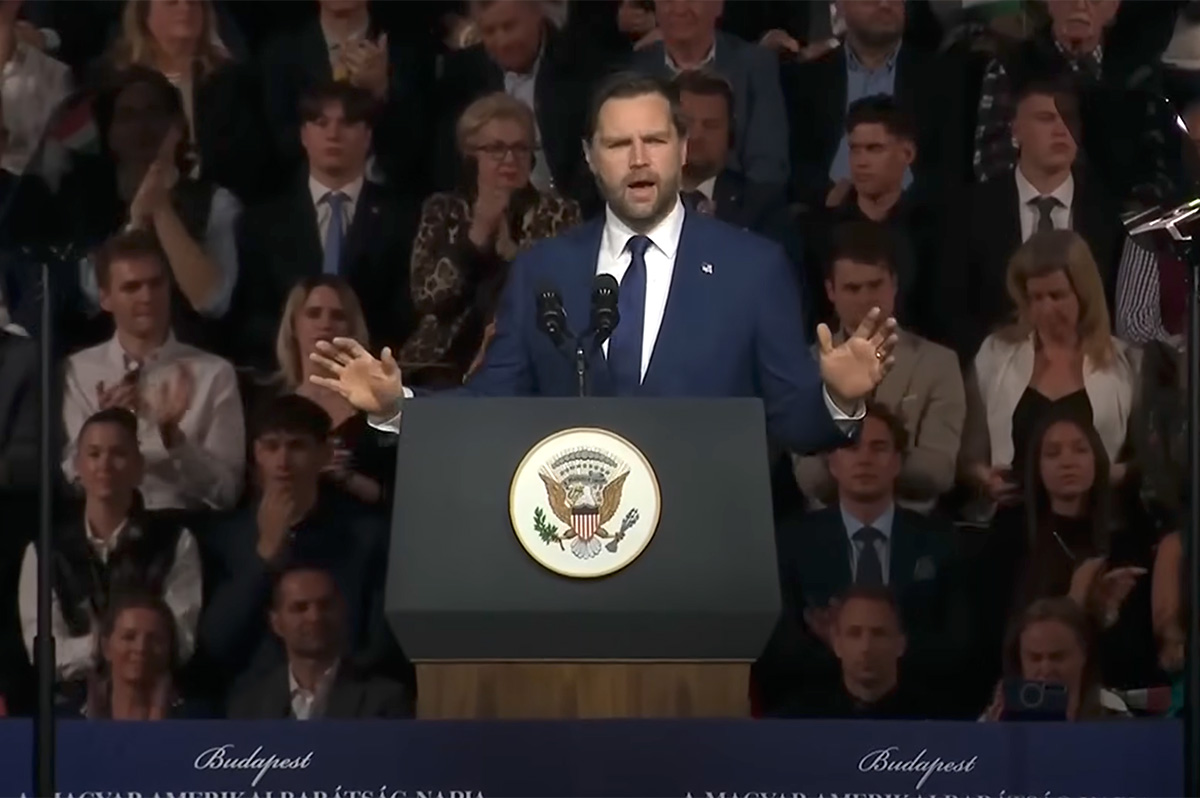
Vice President JD Vance on Tuesday urged Hungarians to support Prime Minister Viktor Orbán in the country’s April 12 elections.
“We have got to get Viktor Orbán re-elected as prime minister of Hungary,” Vance told Orbán supporters who gathered at Budapest’s MTK Sportpark.
Vance and Orbán on Tuesday met before they held a press conference in Budapest. Orbán also spoke at the rally.

The U.S. vice president after he took to the stage called President Donald Trump, who told the crowd he is “a big fan of Viktor” and is “with him all the way.” Vance, as he did during Tuesday’s press conference with Orbán, criticized the European Union.
“We want you to make a decision about your future with no outside forces pressuring you or telling you what to do. I’m not telling you exactly who to vote for, but what I am telling you is that the bureaucrats in Brussels, those people should not be listened to,” said Vance. “Listen to your hearts, listen to your souls, and listen to the sovereignty of the Hungarian people.”
Vance in his speech noted “across the West, we’ve got a small band of radicals” who, among other things, “condemn children to mutilization and sterilization in the name of gender care.” Vance also criticized a “far-left ideology given quarter in university circles, in the media, and in our entertainment industry, and increasingly among bureaucrats on both sides of the Atlantic.”
Vice President JD Vance speaks at MTK Sportpark in Budapest, Hungary, on April 7, 2026
Orbán has been in office since 2010. He and his Fidesz-KDNP coalition government have faced widespread criticism over its anti-LGBTQ crackdown.
A Hungarian activist with whom the Washington Blade previously spoke said it is “impossible to change your gender legally in Hungary” because of a 2020 law that “banned legal gender recognition of transgender and intersex people.” Hungarian MPs the same year effectively prohibited same-sex couples from adopting children and defined marriage in the country’s constitution as between a man and a woman.
The European Commission in 2022 sued Hungary, which is a member of the EU, over the country’s anti-LGBTQ propaganda law.
Hungarian lawmakers in March 2025 passed a bill that banned Pride events and allowed authorities to use facial recognition technology to identify those who participate in them. MPs later amended the Hungarian constitution to ban public LGBTQ events.
Upwards of 100,000 people last June defied the ban and marched in Budapest’s annual Pride parade.
Polls indicate Orbán is trailing Péter Magyar and his center-right Tisza party ahead of the April 12 election. Vance at Tuesday’s rally told Orbán supporters that he and Trump “want you to make a decision about your future with no outside forces pressuring you or telling you what to do.”
“I’m not telling you exactly who to vote for, but what I am telling you is that the bureaucrats in Brussels, those people should not be listened to,” said Vance. “Listen to your hearts, listen to your souls, and listen to the sovereignty of the Hungarian people.”
“Unlike some of the leadership of Brussels, I’m not threatening you or telling you that we’re going to withhold funds to which you’re legally entitled,” he added. “You will make the decision about Hungary’s future.”
Magyar on Tuesday appeared to dismiss Vance’s comments.
“No foreign country may interfere in Hungarian elections. This is our country. Hungarian history is not written in Washington, Moscow, or Brussels — it is written in Hungary’s streets and squares,” said Magyar on his X account.
A spokesperson for the Háttér Society, a Hungarian LGBTQ rights group, told the Blade that neither Magyar, nor his party have reached out to the organization.
The spokesperson said the group does not “campaign directly for them or for any other political party.” The Háttér Society, however, is encouraging LGBTQ Hungarians to vote.
“Ahead of election day, we will encourage everyone on our social media channels to go out and vote, as this is the only way we can act against a system that has been working against the LGBTQI community for many years,” said the spokesperson.
India
Amendments to India’s transgender rights law criticized
Lawmakers approved changes that narrow definition of trans person
India has enacted the Transgender Persons (Protection of Rights) Amendment Act, 2026, that will reshape the country’s legal approach to gender identity.
Both houses of parliament approved the legislation last month, and it received presidential approval on March 28.
The Transgender Persons (Protection of Rights) Amendment Act, 2026, narrows the definition of a trans person, removes the provision for self-perceived gender identity, and requires medical certification for legal recognition. These changes mark a shift from the framework established under a 2019 law.
The Transgender Persons (Protection of Rights) Amendment Act, 2026, replaces the earlier definition of a trans person — previously framed as someone whose gender does not align with the gender assigned at birth — with a set of specified categories. It further provides that the term does not include, and is deemed never to have included, people defined solely by their sexual orientation or by self-perceived gender identity.
The bill retains certain categories within its definition, including people with socio-cultural identities such as kinner, hijra, aravani, or jogta. It also includes people with variations in sex characteristics at birth, such as differences in primary sexual characteristics, external genitalia, chromosomes or hormones from the normative standards of male or female bodies.
The Transgender Persons (Protection of Rights) Amendment Act, 2026, removes certain categories from the definition, including a trans man or trans woman, irrespective of whether such a person has undergone sex reassignment surgery, hormone therapy, laser procedures, or other forms of medical intervention. It also excludes genderqueer people — a category that had been recognized under the earlier framework. The Transgender Persons (Protection of Rights) Amendment Act, 2026, however, includes eunuchs, as well as people compelled to assume a trans identity through mutilation, emasculation, castration, or other surgical, chemical or hormonal interventions.
The Transgender Persons (Protection of Rights) Amendment Act, 2026, also revises the process for legal recognition, requiring a trans person to apply to a district magistrate for a certificate of identity, which can now be issued only after the recommendation of a designated medical board. The law specifies that the board will be headed by a senior medical officer and may include other experts. It further provides that individuals issued such a certificate will be entitled to change their first name in official documents, including birth records and other government-issued identification.
The Transgender Persons (Protection of Rights) Amendment Act, 2026, also introduces stricter penalties for certain offences, including cases in which a person is forced to assume a trans identity through kidnapping, coercion or physical harm. Such offenses may attract imprisonment ranging from 10 years to life in prison, along with fines, depending on the severity and whether the victim is an adult or a child. The Transgender Persons (Protection of Rights) Amendment Act, 2026, further requires medical institutions to report gender-affirming surgeries to the district magistrate, and mandates that individuals obtain a revised certificate of identity following such procedures.
India’s 2011 Census recorded 487,803 trans persons, yet only 5.6 percent had applied for a trans identity card, according to the Washington Blade’s previous reporting. These identity cards, required to access government welfare programs, have remained difficult to obtain, with delays and administrative barriers limiting uptake.
The Transgender Persons (Protection of Rights) Amendment Act, 2026, revised the certification process, which introduces additional requirements for legal recognition. This change is against this backdrop of uneven access to identity documentation.
India’s Election Commission in 2009 directed states to modify voter registration forms to include an “other” category, allowing individuals who did not identify as male or female to register accordingly. The Supreme Court in National Legal Services Authority v. Union of India in 2014 recognized trans persons as a “third gender” and affirmed their right to self-identification.
Justice Kalavamkodath Sivasankara Radhakrishna Panicker said that “recognition of transgenders as a third gender is not a social or medical issue, but a human rights issue.” Parliament in 2019 approved the Transgender Persons (Protection of Rights) Bill, 2019.
An advisory committee the Supreme Court created that former Delhi High Court Justice Asha Menon has urged the government to withdraw the Transgender Persons (Protection of Rights) Amendment Act, 2026. The panel said the proposal to deny self-identification of gender is inconsistent with theNational Legal Services Authority v. Union of India ruling.
Menon on March 25 wrote to Social Justice Minister Virendra Kumar conveying the panel’s resolution. According to the Hindu newspaper, the committee described the amendment as a “great shock” and a “tremendous setback” to efforts to mainstream trans communities.
The Queer Hindu Alliance, an advocacy group that seeks to uphold the dignity of LGBTQ people within India’s cultural and constitutional framework, expressed concern over the Transgender Persons (Protection of Rights) Amendment Bill, 2026.
“We write not in the spirit of opposition, but in the spirit of samvad — dialogue — and with a sincere call for community consultation before this legislation proceeds further,” the group said in a statement. “The Supreme Court of India recognized the concerns of the transgender community in 2014. The National Legal Services Authority v. Union of India judgment affirmed that a person knows who they are. This bill seeks to reverse that. The Queer Hindu Alliance finds this troubling as a question of basic human dignity.”
The Queer Hindu Alliance added that India “is not a young civilization fumbling for answers on how to understand human identity.”
“This culture has contemplated the nature of the self more deeply, and for longer, than any legal system that has existed. This is not a foreign conversation imported from the West. It is a conversation Bharat (India) has always been capable of having, on its own terms,” the Queer Hindu Alliance said.
Harish Iyer, an LGBTQ rights activist who was among those who fought for marriage equality in the Supreme Court, told the Blade that the amendment is “not just a rollback, but a blatant, arrogant insult” to the Supreme Court.
“The NALSA judgment gave us the fundamental dignity of self-determination — the right to look in the mirror and say, ‘This is who I am.’ This amendment drags us right back into the dark ages, handing over our bodily autonomy to a bunch of sarkari babus (government officers) and medical boards,” said Iyer. “But here is the most absurd part: you simply cannot define if someone is trans through any physical test. How exactly are you going to diagnose a human mind? Are they only going to regard those who have had gender affirmation surgery as trans? Because that is fundamentally not the definition of being transgender; transition is a choice and a privilege, not a prerequisite for identity. Or are they going to look at someone born with ambiguous genitalia and label them trans? Because that is intersex, which is a completely different reality.”
“Forcing a trans person to undergo degrading physical scrutiny based on the government’s spectacular ignorance of basic gender science isn’t a legal process; it’s state-sponsored trauma,” he added. “We fought too hard for our dignity to let a bureaucratic tribunal demand that we strip down to prove our humanity.”
Iyer said the Transgender Persons (Protection of Rights) Amendment Act, 2026, goes beyond protection and instead imposes control.
“You don’t ‘protect’ a community by criminalizing the chosen families and allies who offer safe haven to trans youth fleeing abusive homes,” he said, referring to provisions in the law. “This bill is about regulation, policing and control. By gatekeeping who gets to be trans and punishing those who support us, the government isn’t acting as a guardian — it’s acting as a warden. It is a calculated attack on our existence.”
Iyer said the revised definition could exclude individuals who do not fall within the listed categories.
“It effectively writes them out of existence,” he said.
Iyer added the Transgender Persons (Protection of Rights) Amendment Act, 2026, could create an administrative “black hole” for gender-fluid individuals and nonbinary people who do not fit into the government’s rigid categories.
“If you are legally invisible, you don’t get access to gender-affirming healthcare, you don’t get legal protection, and you are entirely cut off from participating in society,” said Iyer. “They are trying to legislate us into non-existence because they are too lazy to understand us.”
Tensions between the U.S. and Cuba are rising again. This is not new, but the current moment feels different. Recent measures from Washington aim to further restrict the Cuban government’s financial channels, limit its sources of revenue, and apply pressure to key sectors of the economy. This is not symbolic. It is a deliberate policy.
From the U.S. perspective, the message is clear. The goal is to force change that has not happened in more than six decades. There is also a domestic political dimension, shaped by sectors of the Cuban exile community that have long demanded a tougher stance. All of this is part of the landscape.
But that is only one side.
On the Cuban side, the response follows a familiar script. The government speaks of external aggression, economic warfare, and a tightening embargo. Each new measure becomes an opportunity to reinforce that narrative and close ranks. There is no room for public self-criticism. The blame always points outward.
Meanwhile, life on the island follows a different logic.
The energy crisis Cuba is facing today did not begin with these recent measures. It has been building for years. The electrical system is deteriorated, poorly maintained, and increasingly unreliable. Blackouts are not new. What has changed is how severe and how constant they have become.
For years, oil entered Cuba, especially from Venezuela. There were supply agreements. There were resources. And yet, the daily life of ordinary Cubans did not improve. Electricity remained unstable. Fuel was rationed. Transportation was still a daily struggle.
So the question is not new.
If the oil was there, why didn’t anything change?
Where did those resources go?
Where is the money that was generated?
Today, restrictions on oil are often presented as the main cause of the current crisis. They are not. They make an already fragile situation worse, but they do not fully explain it.
There is a deeper, longer story that cannot be ignored.
The same applies to Cuba’s international medical missions.
For years, they were presented as acts of solidarity. And in many cases, they were. Cuban doctors worked in difficult conditions, saving lives and supporting health systems abroad. That is real.
But they also functioned as one of the Cuban state’s main sources of income.
Many of these professionals did not receive the full salary for their work. A significant portion was retained by the government. In some cases, they had little or no control over the money they generated.
And there is a harsher reality.
If a doctor chose not to return to Cuba, that income often did not reach their family. It was withheld.
Today, several countries are reevaluating or canceling these agreements. Once again, the official response is to point outward. But the same question remains.
Is this the loss of international cooperation, or the collapse of a system built on control over its own professionals?
Inside Cuba, the conversation sounds very different.
People are not speaking in geopolitical terms. They are talking about survival. About getting through the day. About blackouts, food shortages, transportation problems, and a life that keeps getting harder.
Some see the new U.S. measures as a form of pressure that could lead to change. Not because they want more hardship, but because they feel the system does not change on its own. There is a deep sense of stagnation.
But that sense of expectation exists alongside a harsh reality.
Sanctions do not hit decision-makers first. They hit ordinary people. The ones standing in line. The ones losing food during power outages. The ones who cannot move because there is no fuel.
That is the contradiction.
The Cuban government calls for international solidarity. And it receives it. Countries send aid. Organizations mobilize. Public voices defend the island.
But another question is also present.
Does that aid actually reach the people?
The lack of transparency in how resources are distributed is part of the problem. Because this is not only about what enters the country, but about what actually reaches those who need it.
Reducing Cuba’s reality to a dispute between two governments avoids the core issue.
There are shared responsibilities, but they are not equal.
The U.S. exerts external pressure with real economic consequences. That cannot be denied. But inside Cuba, there is a system that has had decades to reform, to respond, to open, and it has not done so.
That part cannot continue to be ignored.
I write this as a Cuban. From what I lived. From what I know. From the people who are still there trying to make it through each day.
Because at the end of the day, beyond what governments say or decide, the reality is something else.
Cuba today is under more pressure, yes. But it has also spent years carrying problems that no one has seriously confronted.
And as long as that remains the case, it does not matter what comes from outside. The problem is still inside.

Glisten’s 30th annual Day of Silence to take place April 10

D.C. Council member honored by LGBTQ homeless youth group

Vance speaks at Orbán rally in Hungary

White House ends protections for trans students in multiple school districts

Amendments to India’s transgender rights law criticized

Belarusian lawmakers approve bill to crackdown on LGBTQ rights

How new barriers to health care coverage are hitting D.C.

Calendar: April 3-9

Women’s FEST returns to Rehoboth Beach next week