News
Judge stays order requiring Ky. to recognize same-sex marriages
No recognition of out-of-state unions until action from Sixth Circuit

A judge has held off his order requiring Kentucky to recognize out-of-state same-sex marriages. (Image by Seth Ilys via Wikimedia Commons)
A federal judge who earlier ordered Kentucky to recognize same-sex marriages performed out-of-state has now stayed that decision pending further action from a higher court.
In a four-page order on Wednesday, U.S. District Judge John Heyburn, who struck down the state’s ban on same-sex marriage in the case of Love v. Beshear, said he’s staying his order until further action from the U.S. Sixth Circuit Court of Appeals.
“One judge may decide a case, but ultimately others have a final say,” Heyburn writes. “It is the entire process, however, which gives our judicial system and our judges such high credibility and acceptance. This is the way of our Constitution. It is that belief which ultimately informs the Court’s decision to grant a stay.”
Last month, Heyburn, following his ruling, ordered Kentucky to begin recognizing same-sex marriages performed elsewhere, but stayed that decision until March 20.
Following the order, Kentucky Attorney General Jack Conway announced he would no longer defend the marriage ban in court, although Kentucky Gov. Steve Beshear announced he would continue defending the law on his own. Beshear had requested a stay of the court’s order from the district judge pending a decision from the Sixth Circuit.
Explaining his reasoning to grant a stay, Heyburn places significant emphasis on the U.S. Supreme Court’s decision to issue a stay on same-sex marriages performed in Utah following a district court ruling striking down the ban in that state.
“It may be years before the appeals process is completed,” Heyburn writes. “Also, our case is different than Kitchen. Nevertheless, the Supreme Court has sent a strong message by its unusual intervention and order in that case. It cannot be easily ignored.”
Heyburn was confirmed to the federal bench in 1992 after being recommended to the bench by Sen. Mitch McConnell (R-Ky.) and nominated by former President George H.W. Bush.


District of Columbia
D.C. lesbian activist champions cause of common law marriage
Effort prompted by Medical Examiner refusal to release body of deceased partner

D.C. lesbian activist Jill Strachan says she and Jane Hoffman, her domestic partner of 30 years, had been advised by an attorney that their long-term committed relationship in which they jointly owned their apartment and shared powers of attorney provided a legal status to their relationship.
But Strachan says the stress she experienced from the unexpected death of her partner at age 62 on Nov. 3, 2025, initially of an unknown cause, was greatly heightened when the D.C. Office of The Chief Medical Examiner (OCME) took possession of Hoffman’s body to conduct an autopsy to determine the cause of death.
When the cause was found to be a heart attack and aortic aneurysm, the OCME refused to release Hoffman’s body to the funeral home Strachan retained on grounds that Strachan was not a legal next of kin under D.C. law because the two women were not married and had not registered with the city as domestic partners.
Although she and Hoffman believed their relationship was legally recognized as a common law marriage, Strachan said an official with the OCME told her common law marriage is not legally recognized under D.C. law and a partner in a common law marriage cannot be recognized as a legal next of kin to claim possession of the remains of their deceased partner.
When advised that Hoffman’s body could only be released to Hoffman’s legal next of kin, which was her then 85-year-old mother who lived in South Dakota, Strachan reached out to the mother, who agreed to release her legal kinship of her daughter, allowing Strachan to take possession of the body.
“And then the body was released to the funeral home, and everything proceeded,” Strachan told the Washington Blade. “But I just feel it was so wrong. I just feel so let down by my government,” she added, saying she believes her relationship with her partner should have had legal standing.
“Drawn up by lawyers, we had a will, power of attorney, power of health attorney, a trust,” Strachan said. She said she was in a common law marriage and that for a same-sex couple or any couple, it should have the same legal weight as marriage or a registered domestic partnership.
A longtime resident of D.C.’s Ward 6, Strachan said she contacted the office of D.C. Council member Charles Allen (D-Ward 6) to ask whether something could be done to correct what she believes to be unfair treatment of couples whose committed relationship is considered a common law marriage. She said she explained in full her encounter with the D.C. OCME and its initial refusal to release her partner’s body to her to one of Allen’s legislative staff members.
In response to an inquiry, Allen spoke to the Blade in detail over his plans to address the situation by introducing legislation to provide legally recognized support for common law marriage in D.C.
“I’ve known Jill for a long time,” Allen told the Blade. “She reached out to me. She wanted to share the experience of what happened and we talked about how to avoid this in the future,” he said.
After researching existing D.C. law, Allen said he and his staff confirmed that the OCME is bound by law to release the remains of a deceased person to the legal next of kin in a specific order defined by the law. The order establishes that the first person in line to have legal rights to the remains is the married spouse or registered domestic partner, Allen said. Next are the adult children followed by the deceased person’s parents and then siblings and relatives such as brothers, sisters, aunts, and uncles.
“And then last would be an adult friend or volunteer,” Allen said, noting that Strachan was in that last category but could not surpass her partner’s mother, who was first in line for possession of her daughter’s body.
“In the bottom line here, it seems cruel and downright inappropriate for the law to force someone who is in a long-term committed relationship with the deceased to have to reach out to that deceased person’s parents for approval to claim the remains,” he said. “It’s especially risky if those parents don’t support or approve of that committed relationship.”
Although in Strachan’s case her partner’s mother was supportive, Allen said a potential refusal could surface with other same-sex couples.
“So, what we have been looking at is how we can define D.C. law, and could we add common law marriage as an equivalent,” he said. He noted that he and his staff were looking at ways to do that by figuring out how to show proof of a common law marriage.
“A common law marriage doesn’t have any type of paperwork with it,” he said. “So, the challenge we’ve been working on is how would you document in some way if the relationship meets the common law standard.”
He said he and his staff are in the process of drafting a proposed bill that he plans to introduce in January that addresses the complex issues at hand, including ways that joint tax returns, joint home ownership, and other factors can be used to show proof of a common law marriage.
Noting that Strachan told him, as she told the Blade, that she and her partner chose not to participate in the institution of marriage or domestic partner registration, Allen said that decision should not be held against them.
“I don’t think it’s my place to judge how they want to define their relationship,” Allen told the Blade. “They did not want to get married. That’s their right. But without question, they were in a long-term committed relationship.”
He said he expects to have the bill he and his staff are working on ready to be introduced in early January when the Council begins its 2027 legislative session.
District of Columbia
BREAKING NEWS: One dead, four injured in shooting at VIDA Fitness in Logan Circle
MPD issued shelter in place order for area

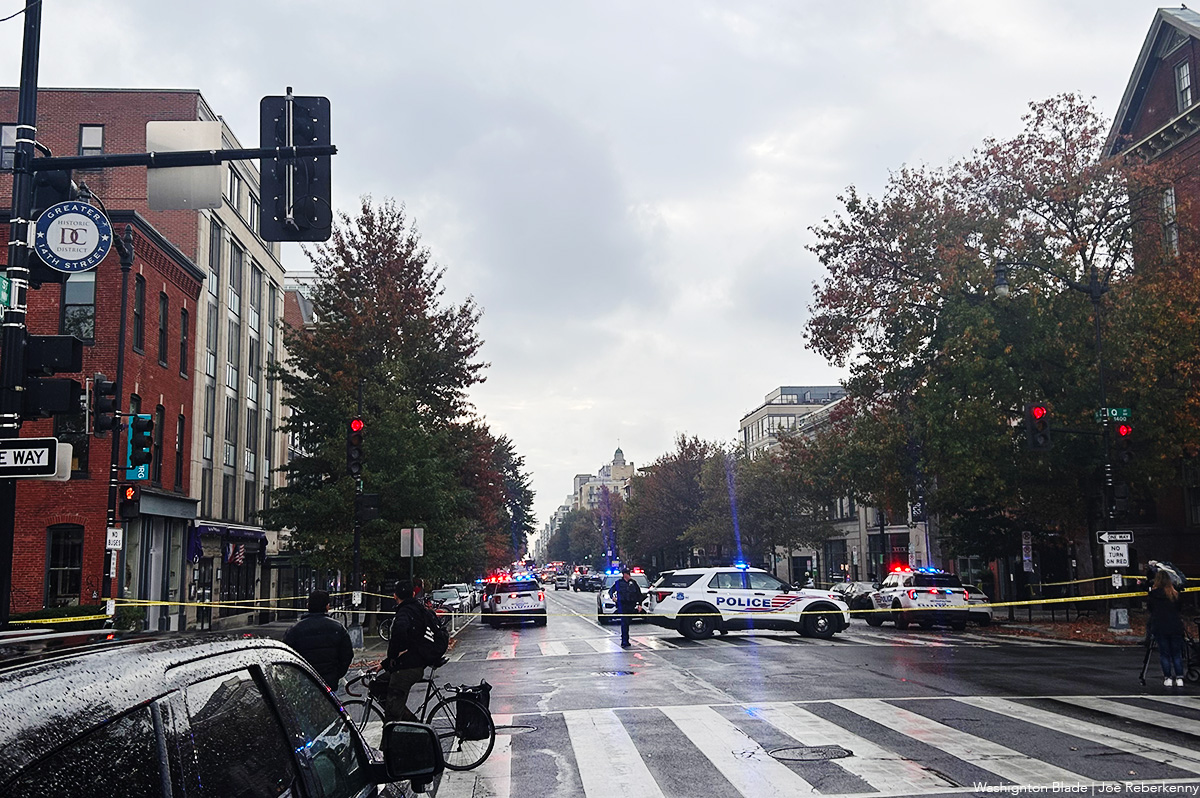
Interim D.C. Police Chief Jeffrey Carroll on Thursday confirmed a gunman killed one person inside the VIDA Fitness on 15th Street in Logan Circle.
Carroll told reporters the Metropolitan Police Department immediately responded to the scene shortly before 8 a.m. after it received reports that shots had been fired inside the gym.
Carroll said four people were also shot — one of them is in critical condition.
The suspected gunman later barricaded himself in a 7th floor apartment above the gym, and shot at responding officers. Carroll told reporters police found the suspected gunman, who was a gym member, with a self-inflicted gunshot wound.
“This lone gunman has been contained,” D.C. Mayor Muriel Bowser told reporters.
NBC Washington is reporting the suspected gunman is dead.
The MPD after the shooting issued a shelter-in-place order for “the immediate vicinity of the 1500 block of 15th Street, N.W.” that included 17th Street in Dupont Circle. The directive was lifted shortly after 11:30 a.m.
“Our thoughts are with everyone affected by this incident,” said VIDA President Aaron Moore in an email to gym members.
Joe Reberkenny contributed to this story.
Indonesia
US funding cuts leave LGBTQ Indonesians with HIV more vulnerable
Human Rights Watch report notes increased legal, societal pressures in country
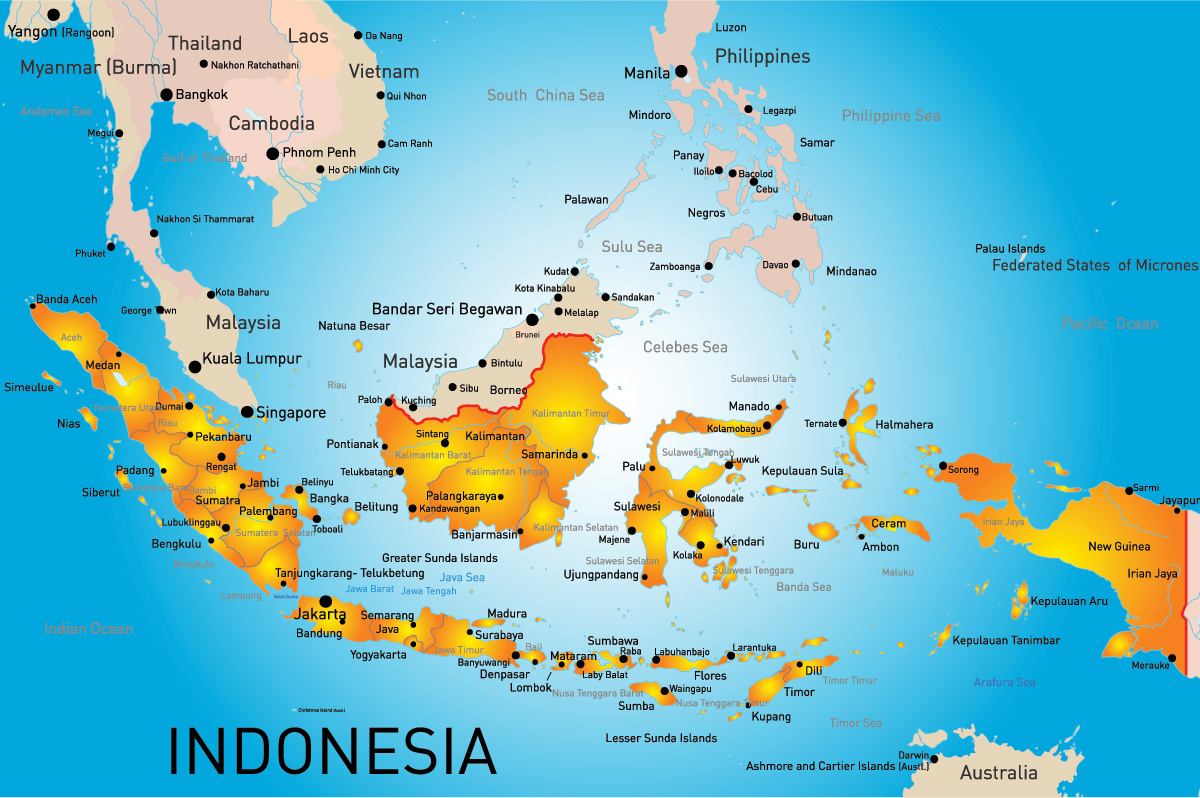
For many LGBTQ people in Indonesia, access to lifesaving HIV services depends on more than hospitals and clinics. It depends on community outreach workers who helped them get tested, obtain medication, and navigate a healthcare system often marked by stigma and discrimination.
When the U.S. cut foreign aid in 2025, many of those services disappeared, leaving vulnerable communities with fewer places to turn for care, according to a new Human Rights Watch investigation.
The 33-page investigation has documented how cuts to U.S. foreign aid disrupted HIV prevention and treatment services for LGBTQ communities in Indonesia.
The report, titled “We Want to Be Treated as Human: Impact of U.S. Foreign Aid Cuts on HIV/AIDS Prevention and Care in Indonesia,” traces the consequences of the Trump-Vance administration’s dismantling of the U.S. Agency for International Development, which ended funding for community-based programs serving people at greatest risk of HIV. Without those services, many face additional barriers to HIV testing, prevention, and lifesaving treatment. Human Rights Watch has urged Indonesia’s government and international donors to restore support for community-led HIV services.
Human Rights Watch based its findings on interviews with 35 people; including people living with HIV, outreach workers, activists, and academics. Researchers spoke to people in Jakarta, the country’s capital, and Depok and Serang during visits in November 2025 and June 2026, while also examining budget records and policy documents to understand how the funding cuts affected HIV services.
The U.S. and Indonesian governments were also given an opportunity to respond to the findings. Human Rights Watch said it had received no response from any of the three government departments it contacted.
The U.S. government’s foreign assistance records show that funding for HIV programs in Indonesia fell from $11.9 million in 2024 to $7.9 million in 2025. The reduction affected community-based prevention and care programs for LGBTQ people, including services previously supported by USAID.
The disparity is stark.
HIV affects about 0.4 percent of Indonesia’s general population, but the prevalence rises to 22 percent among men who have sex with men and 25 percent among transgender people, according to the report. Yet government spending has not reflected this divide.
In 2020, just 0.1 percent of Indonesia’s domestic HIV budget went towards programs for men who have sex with men, while none was allocated specifically for trans people. International donors funded 98 percent of HIV programs serving these communities, many of whom rely on community organizations and outreach workers to access healthcare because of stigma and discrimination in public health facilities.
The report describes how outreach workers served as a crucial link between LGBTQ people and HIV services. They distributed condoms and information about PrEP, helped people access confidential testing, accompanied them to clinics and supported adherence to antiretroviral treatment. Some also paid for clients’ transport and tests, advocated for them with clinic staff, and trained health workers to provide respectful care.
But after the funding cuts, outreach workers lost contact with some clients. The report says some people were collecting their medication late or missing doses, while local organisations no longer had the capacity to track new infections or identify interruptions in treatment.
“Just leaving the house as a trans person is scary,” said a trans outreach worker living with HIV, quoted in the Human Rights Watch report. “Without an outreach worker, the person will be alone and they won’t get care.”
The loss of those services came as LGBTQ people in Indonesia faced growing legal and social pressures.
The country’s new criminal code, which took effect on Jan. 2, 2026, makes sex outside marriage a criminal offense in certain circumstances, with cases subject to complaints by close family members. Human Rights Watch says the provisions effectively criminalize same-sex relations, adding another layer of risk for people already struggling to access healthcare.
The pressure extends beyond the new law.
Human Rights Watch says police have raided private gatherings and used condoms and suspected HIV medication as evidence in criminal cases. For people already wary of being identified or exposed, the consequences reach far beyond the threat of arrest. Carrying condoms, attending community outreach events, getting tested or seeking treatment can all become sources of fear.
For trans people, even a routine visit to a government office or health facility can bring the risk of humiliation. The report describes how those whose identity documents do not reflect their gender identity may be publicly addressed by a former name, exposing them to embarrassment and discrimination.
Outreach workers helped people navigate these barriers. They accompanied clients to clinics, intervened when they faced disrespectful treatment, helped them obtain identity documents and health insurance, and trained healthcare workers to treat them with dignity. With that support gone, many are left to negotiate a healthcare system that can be hostile to them on their own.
A gay activist living with HIV, quoted in the Human Rights Watch report, described the consequences in stark terms: “If you are LGBT and living with HIV, it’s the end of the story. You are doomed.”
The U.S. cuts were followed by reductions in HIV funding from other international donors, further shrinking the resources available to affected communities. The Human Rights Watch report notes that France, Japan, Germany, and other governments also withdrew funding for the HIV response.
The impact has been felt far beyond Indonesia.
In June, UNAIDS Executive Director Winnie Byanyima described the scale of the global disruption in stark terms.
“There’s no question that this is the most serious disruption in HIV response since the world came together to fight this disease,” she said.
Human Rights Watch says the Indonesian government must do more than simply fill the funding gap. It calls on the authorities to increase domestic funding for HIV prevention and treatment programs serving men who have sex with men and trans people, support community-led organizations, ensure a steady supply of antiretroviral medicines and train healthcare workers to provide care without discrimination.
The report also urges the government to repeal discriminatory laws, stop raids targeting LGBTQ people, and end the use of condoms and HIV medication as evidence of criminal activity. It calls for investigations into police abuses, accountability for those responsible and stronger protection for LGBTQ people facing vigilante violence.
The report also turns its attention to Washington, calling on the U.S. government to ensure that funding for PEPFAR, established in 2003, continues without interruption and is released on time. It urges the Trump-Vance administration to disclose the impact of programs it has terminated and withdraw its “Promoting Human Flourishing in Foreign Assistance Policy,” which restricts support for trans rights and related work.
Human Rights Watch also calls on international donors to increase their contributions to the Global Fund to Fight AIDS, Tuberculosis and Malaria, and to provide direct funding to LGBTQ-led community organisations working on HIV prevention and care in Indonesia.
Yudho Sudartio, an East Java representative of Jaringan Indonesia Positif, a national network and community-based organization of people living with HIV in Indonesia, told the Washington Blade the U.S. foreign aid cuts had not, so far, significantly affected access to antiretroviral therapy, HIV testing, or support services in the country.
“However, stakeholders and the government have already begun taking steps to ensure the sustainability to HIV programs through the mobilization of domestic resources,” said Sudartio. “One of the measures taken by the Indonesian government is the allocation of local funds and other domestic resources. Access to HIV treatment and testing continues to be supported through funding schemes provided by individual provinces and regencies.”

D.C. lesbian activist champions cause of common law marriage

BREAKING NEWS: One dead, four injured in shooting at VIDA Fitness in Logan Circle

US funding cuts leave LGBTQ Indonesians with HIV more vulnerable

Quinnie Pérez becomes first openly transgender person elected in Fla.

LGBTQ advocates look to new Congress for path forward on federal protections

Epic ‘La bola negra’ delivers powerful romance for the ages

Kim Kardashian gets the bio treatment in new book

Honoring LGBTQ+ veterans and advancing housing equality

Botswana’s marriage equality case and the politics of family values

New Orchestra of Washington to perform ‘Requiem for a People’
-

 Movies4 days ago
Epic ‘La bola negra’ delivers powerful romance for the ages
-
Books4 days ago
Kim Kardashian gets the bio treatment in new book
-
Real Estate4 days ago
Honoring LGBTQ+ veterans and advancing housing equality
-
Botswana3 days ago
Botswana’s marriage equality case and the politics of family values