News
Carney: ENDA would make executive order ‘redundant’
LGBT advocates pounce on notion that directive unnecessary if law enacted
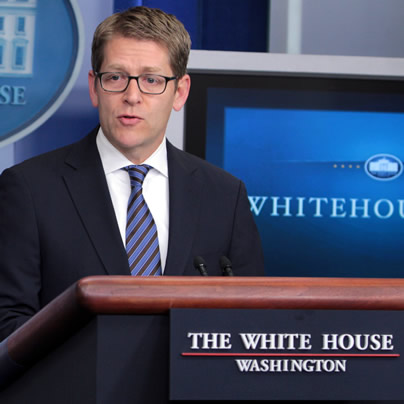
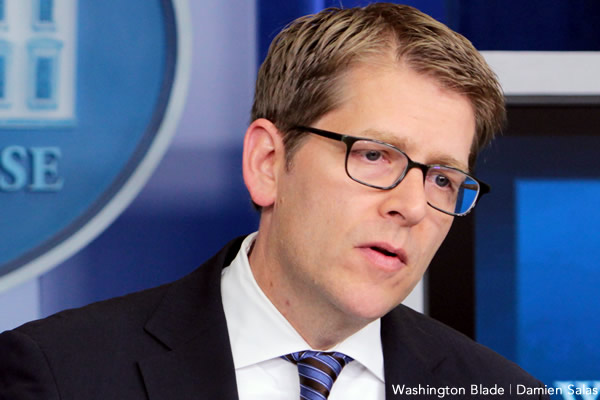
White House Press Secretary Jay Carney said he believes an executive order would be redundant with ENDA in place. (Washington Blade file photo by Damien Salas)
White House Press Secretary Jay Carney said Thursday he believes passage of the Employment Non-Discrimination Act would make “redundant” an executive order barring LGBT discrimination among federal contractors — an assertion that advocates say is untrue as they continue to press for both legislation and the directive.
Carney made the remarks in response to a question from the Washington Blade on whether passage of ENDA — which has already passed the Senate, but remains pending in the House — would change the thinking of President Obama on the executive order, which he continues to withhold despite continued pressure from LGBT rights supporters.
“I think if the law passed — and I’m not a lawyer — and I haven’t read every sentence of the law, but I think if a law passed that broadly banned this kind of employment discrimination, it would make redundant an executive order,” Carney said.
Carney articulated his belief that an executive order would be “redundant” in the event ENDA became law after emphasizing the broad-based protections under the bill, which applies not just to federal contractors, but to many public and private employers.
“I think the employment non-discrimination legislation, the Employment Non-Discrimination Act, would broadly apply, and that’s one of the reasons why we support it,” Carney said. “Because it’s a broad solution to the problem, and it ought to be passed by Congress.”
When the Blade pointed out there are possible instances of LGBT discrimination that ENDA wouldn’t cover, but may be covered under the executive order, Carney called such potential acts of anti-LGBT job bias “hypothetical.”
“Well, that could be, hypothetically, but I think we’d like to see the legislation passed,” Carney said. “That would be a good thing.”
LGBT advocates disputed the notion that an executive order barring LGBT discrimination would be redundant if ENDA were law, saying both are necessary to enable greater legal protections for LGBT workers.
Fred Sainz, vice president of communications for the Human Rights Campaign, said his organization is directly at odds with Carney’s assertion and blasted the White House spokesperson for being “completely out of step.”
“We couldn’t disagree more,” Sainz said. “Even if ENDA passed tomorrow, we’d still want the EO. His assertion is completely out of step with over 60 years of social change strategy related to enduring legal protections for race and gender and more recently for hate crimes and non-discrimination protections on the basis of sexual orientation and gender identity. What he’s asserting is the equivalent of saying that if ENDA passed tomorrow, we wouldn’t need non-discrimination laws in the majority of states that still don’t have them. That’s absolutely not the case.”
Other categories for individuals — race, color, religion, sex or national origin — are protected under current law by Title VII of Civil Rights Act of 1964, which is enforced by the U.S. Equal Employment Opportunity Commission, and by Executive Order 11246, which is enforced by the Labor Department’s Office of Federal Contract Compliance. Both were put in place under former President Lyndon Johnson.
Ian Thompson, legislative representative of the American Civil Liberties Union, said both ENDA and an executive order are needed to provide “parallel protections” for LGBT people enjoyed by other categories of workers.
“Race discrimination, for example, is prohibited under both Title VII of the 1964 Civil Rights Act and Executive Order 11246,” Thompson said. “It’s certainly our opinion and our view that the same should apply to LGBT workplace discrimination as well. Even if ENDA were to be passed and signed into law tomorrow, we would still advocate for and want the executive order, and absolutely, definitely do not see it as redundant.”
Rea Carey, executive director of the National Gay & Lesbian Task Force, also insisted that legislation and an executive order are necessary to provide full protections to LGBT workers.
“We need both,” Carey said. “We urge the president to use his power and act immediately with an executive order that protects millions of LGBT employees who work for federal contractors and we urge Congress to follow the lead of the Senate and pass ENDA. Rights delayed are rights denied.”
One difference between the executive order and ENDA would be the enforcement mechanism. If ENDA were law, anti-LGBT discrimination would be still be allowed by small businesses, or companies with fewer than 15 employees, as well as by religious organizations in a broader way than other groups because of ENDA’s religious exemption. But if an executive order were in place — and modeled after the existing executive order barring discrimination among other groups — companies exempt under ENDA could face penalties as long as they do $10,000 a year in business with the U.S. government.
According to Freedom to Work, under ENDA, a victim must first file a complaint with the EEOC before an investigation into anti-LGBT workplace discrimination can take place. But under the executive order, the Labor Department could proactively investigate a company for such discrimination — even if no complaint were filed. In fact, the Labor Department regularly conducts audits of federal contractors to determine if they’ve engaged in discrimination under the current directive.
Tico Almeida, president of Freedom to Work, took Carney to task, saying he’s incorrect and apparently unfamiliar with the Obama administration’s work against employment discrimination.
“When he calls the executive order ‘redundant,’ Mr. Carney is wrong on the law, and surprisingly, he’s even wrong on the facts about the Obama administration’s own successful record enforcing the existing executive order banning racial and sex discrimination at federal contractors,” Almeida said. “In order to have full equality under the law, LGBT Americans need both the statute and the executive order because they have distinct enforcement procedures, and more discrimination can be prevented when both policies work in tandem.”
Almeida added that Carney should consult with “dedicated public servants” at the Labor Department, which, among other victories, under Executive Order 11246 recently won a $2.2 million settlement with federal contractor Cargill in a set of hiring discrimination cases on behalf of nearly 3,000 African-American, Latino and female job applicants — even with a law barring this discrimination in place.
“LGBT Americans deserve these same workplace protections that the Obama Labor Department has been enforcing for other hardworking Americans,” Almeida said. “There’s no good reason to leave only the LGBT community out of the workplace protections that have been applied by the Labor Department to everyone else.”
Also during the briefing, Carney responded to an email from Democratic National Committee Treasurer Andrew Tobias in which he told LGBT donors on an off-the-record listserv the executive order should be signed and its absence is “frustrating and perplexing.”
“I think that there are lot of strongly held views on these matters,” Carney replied. “The president believes very strongly in employment non-discrimination. That’s why he has urged Congress to act on the ENDA legislation. We’ve seen some progress on that. It needs to be completed. Those who oppose it are standing in the way of history and they’ll look foolish in the future as future generations look back at that stance and recognize it for what it is. I just don’t have any updates for you on the EO that you mentioned.”


Federal Government
Markwayne Mullin confirmed as next DHS secretary
Okla. senator to succeed Kristi Noem
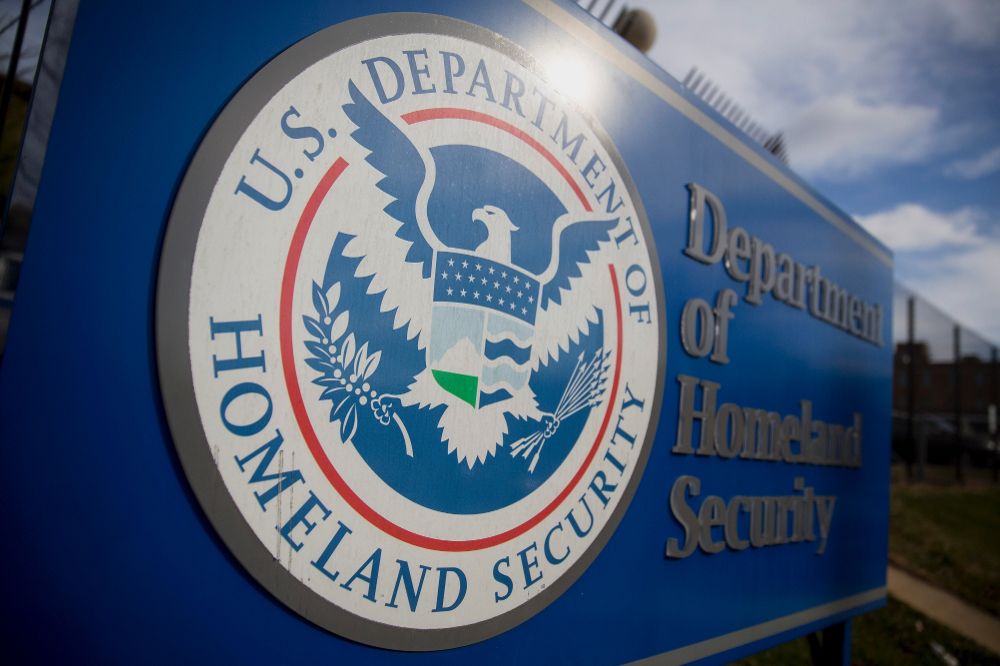
The U.S. Senate confirmed Markwayne Mullin as the next secretary of Homeland Security on Monday, as the agency continues to grapple with what lawmakers have described as a “never-ending” funding standoff, with Democrats attempting to withhold funding from one of the nation’s largest and most costly agencies.
Mullin — a Republican senator from Oklahoma, former mixed martial arts fighter, and plumbing business owner — was confirmed in a 54–45 vote. Two Democrats — U.S. Sens. John Fetterman (D-Pa.) and Martin Heinrich (D-N.M.) — sided with Republicans in supporting his confirmation.
The new agency head is expected to follow the policy direction set by President Donald Trump, emphasizing stricter immigration enforcement. This includes proposals to support immigration agents at polling sites and to cut funding to so-called “sanctuary cities.”
Mullin replaces Kristi Noem, who was fired earlier this month following a widely scrutinized 2-day congressional hearing on Capitol Hill.
During the hearing, Noem faced intense questioning over her response to several crises, including the fatal shooting of two American citizens in Minneapolis by U.S. Immigration and Customs Enforcement agents, a $220 million border security advertising campaign that featured her on horseback near Mount Rushmore amid one of the largest federal workforce reductions in U.S. history, and the federal response to major natural disasters such as the July 2025 Texas floods and Hurricane Helene in 2024.
Noem had previously drawn criticism for a series of policy decisions in South Dakota that broadly focused on restricting the rights of LGBTQ individuals. In 2023, she signed House Bill 1080, banning gender-affirming medical care for transgender minors. She also signed legislation and executive orders restricting trans athletes’ participation in women’s sports, as well as the state’s “Religious Freedom Restoration Act,” which critics argued enabled discrimination against LGBTQ individuals. Additionally, the state canceled contracts related to LGBTQ support services — including suicide prevention and health care navigation programs‚ and later agreed to a $300,000 settlement with trans advocacy group, The Transformation Project.
Despite her removal from DHS, Noem will remain in the Trump-Vance administration as a special envoy for the “Shield of the Americas,” an initiative aimed at promoting U.S. influence in the Western Hemisphere, including efforts to counter cartel networks, reduce Chinese influence, and manage migration.
The new head of DHS has served in Congress since 2013, in both houses of the federal legislature. While in the Senate and a member of the Health, Education, Labor, and Pensions (HELP) Committee, Mullin has been a vocal critic of policies aimed at expanding LGBTQ inclusion. He led a group of lawmakers in urging the Administration for Community Living to reverse a rule requiring states to prioritize Older Americans Act services based on sexual orientation and gender identity, arguing the policy could have unintended consequences.
Mullin also makes history as the first Native American — and a citizen of the Cherokee Nation — to lead the Department of Homeland Security. He was also among the 147 Republicans who voted to overturn the 2020 presidential election results despite no evidence of widespread fraud, and was present in the U.S. House of Representatives chamber on Jan. 6.
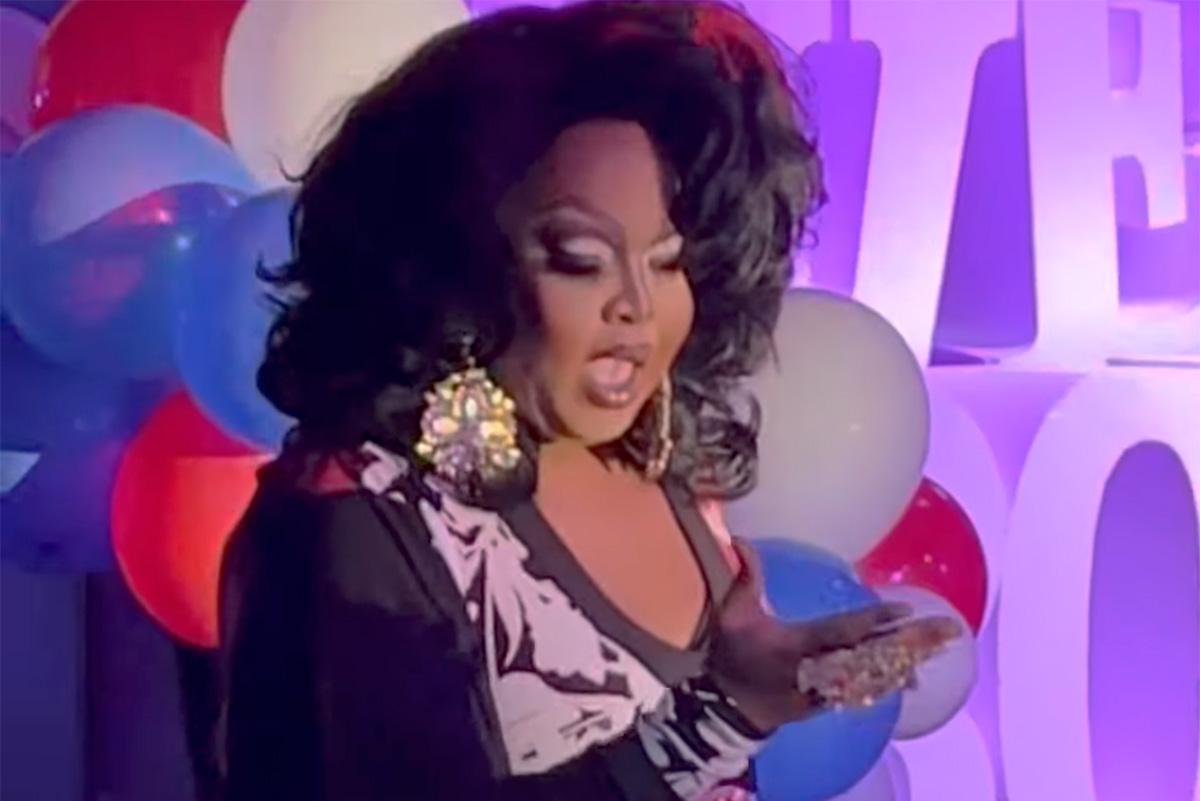
A gay man was murdered in Petersburg, Va., on March 13.
Shyyell Diamond Sanchez-McCray, who was also known as Saamel and Mable, was a drag queen who won the Miss Mayflower EOY pageant in 2015. Reports also indicate Sanchez-McCray, 42, was a well-known community activist in Virginia and in North Carolina.
Local media reports indicate police officers found Sanchez-McCray shot to death inside a home in Petersburg.
Sanchez-McCray’s brother, Jamal Mitchell Diamond, in a public statement the Washington Blade received from Equality Virginia and GLAAD, said Sanchez-McCray was not transgender as initial reports indicated.
“Our family has always embraced the fullness of who he was. He used the names Saamel, Shyyell, and Mable interchangeably, and we honor all of them. There is no division within our family regarding how he is being represented — only a shared commitment to preserving his truth with love and respect,” said Diamond.
“He was also deeply committed to community work through Nationz Foundation, where he worked and completed multiple state-certified programs to support marginalized communities,” added Diamond. “That work meant a great deal to him.”
Authorities have not made any arrests.
The Petersburg Bureau of Police has asked anyone with information about Sanchez-McCray’s murder to call Petersburg-Dinwiddie Crime Solvers at 804-861-1212.
District of Columbia
Trans Day of Visibility events planned
Rally on the National Mall scheduled for Saturday

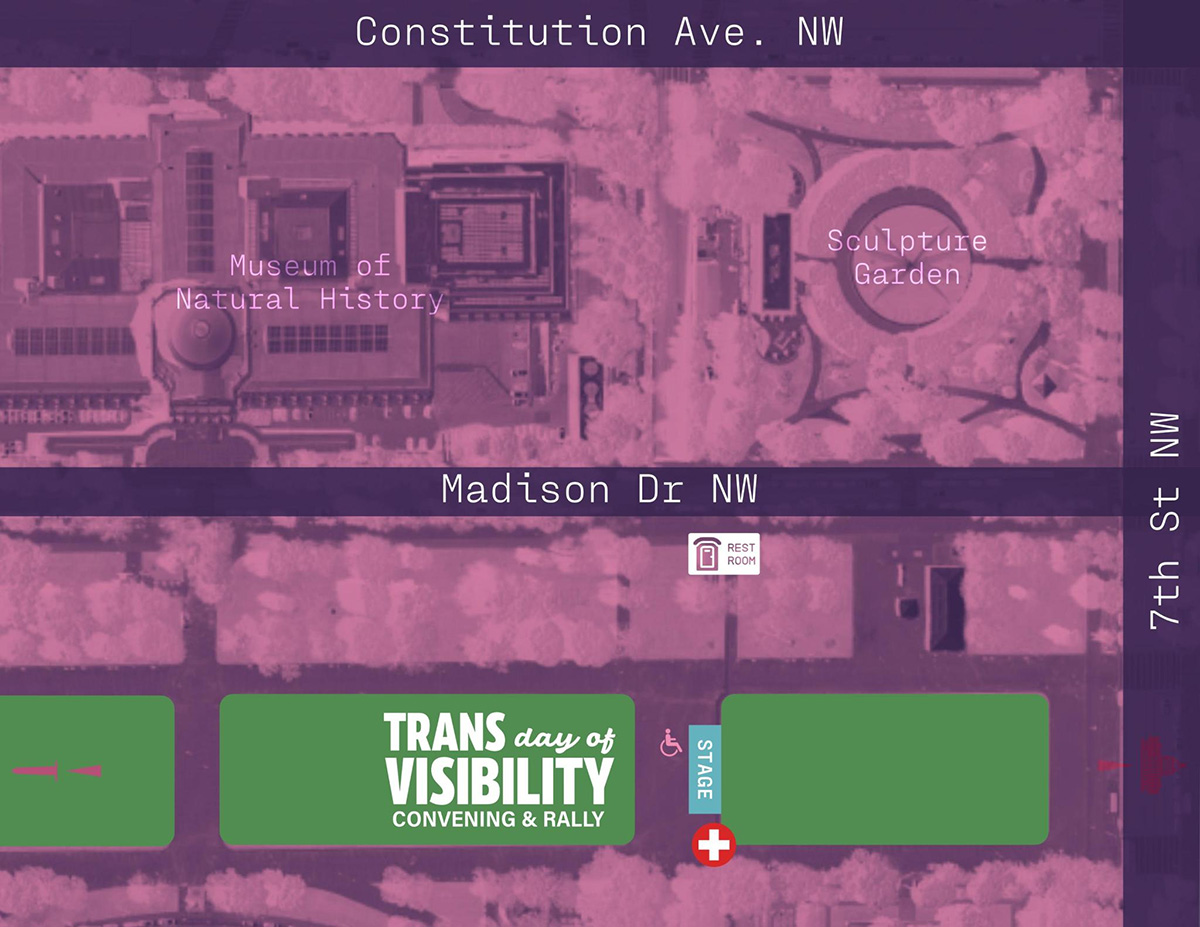
The Christopher Street Project has a number of events planned for the 2026 Trans Day of Visibility, including a rally on the Mall and an “Empowerment Ball” at the Eaton Hotel. Plenaries, panel discussions and meetings with members of Congress are scheduled in the three days of programming.
Announced speakers include N.H. state Rep. Alice Wade; Commissioner of the Metropolitan Water Reclamation District of Greater Chicago Precious Brady-Davis; activist and performer Miss Peppermint (“RuPaul’s Drag Race”); Lexington, Ky. Councilwoman Emma Curtis; Rabbi Abby Stein; D.C. activist and host Rayceen Pendarvis; Air Force Master Sgt. Logan Ireland; among other leaders, advocates and performers.
Conference programming on Thursday and Friday includes an educational forum and a Capitol Hill policy education day. Registration for the two-day conference has closed.
The “Trans Day of Visibility PAC Reception” is scheduled for Thursday, March 26 from 7:30-9 p.m. at As You Are (500 8th St., S.E.). Special guests include Rep. Dina Titus (D-Nevada) and Rep. Delia Ramirez (D-Ill.). Tickets are available at christopherstreetproject.org starting at $25.
The National Council of Jewish Women and the Christopher Street Project host a “Trans Day of Visibility Shabbat” on Friday, March 27 from 7-8 p.m. at Sixth & I (600 I St., N.W.). The service is to be led by Rabbi Jenna Shaw and Rabbi Abby Stein.
The “Now You See Me: Trans Empowerment Social & Ball” is scheduled for Friday, March 27 from 6-11 p.m. at the Eaton Hotel (1201 K. St., N.W.). The trans-themed drag ball is hosted by the Marsha P. Johnson Institute with support from the D.C. Mayor’s Office of LGBTQ+ Affairs, the Capital Ballroom Council, the Christopher Street Project, the Center for Black Equity, Generation for Common Good, and Parenting is Political. RSVP online at christopherstreetproject.org.
The National Transgender Day of Visibility Rally is scheduled for Saturday, March 28 on the National Mall at 11 a.m. The rally will include speakers and performances. Following the rally, attendees are encouraged to participate in the “No Kings” rally being held at Anacostia Park.

Markwayne Mullin confirmed as next DHS secretary

Gay man murdered in Va.

Trans Day of Visibility events planned

Virginia General Assembly’s 2026 legislative session ends

Polish court rules country must recognize same-sex marriages from EU states

Queer American in Israel discusses Iran war’s impact

Calendar: March 21-26

‘How We Survived’ panel set for March 25

Small is beautiful: subcompact SUVs