Congress
House ethics complaint filed over GOP staffer’s anti-trans email
Rep. Carol Miller’s chief of staff defended his actions
A federal government employee has filed a complaint to the U.S. House Ethics Committee over an email they received from Matthew Donnellan, chief of staff to Republican U.S. Rep. Carol Miller (W.Va.), which contained combative and anti-trans language.
The Washington Blade has seen the correspondence between the parties, in which the confrontation was apparently kicked off when the congresswoman’s top aide received an email that included the sender’s preferred pronouns in the signature box, triggering his reply.
Donnellan wrote, “As a father, it is disgusting that anyone would ever tell my son or daughter that something is wrong with them and they should take sterilizing hormones or have surgery to cut off their genitals.”
“The fact that you support that ideology by putting pronouns in your signature is awful,” he said, adding, “You’re disgusting and should be ashamed of yourself. Don’t email me or anyone from my office ever again.”
A senior government official told the Blade in a written statement that the email was not out of character for Donnellan:
“I’ve heard from two colleagues several months apart about two separate transphobic emails, using identical language, from Matthew. Unfortunately these emails—though inconsistent with the typical collegiality one would expect from a Chief of Staff on the Hill—is likely a reflection of both increased partisanship on the Hill and a rise in anti-LGBTQ rhetoric from the right.
“Not only is this virtual, hate-filled temper tantrum unbecoming of a Chief of Staff, inappropriate, and unprofessional, it also hurts his boss’s constituents. DC is built on congressional staff, members of Congress, and executive officials being able to put aside their differences to find unlikely areas of commonality where they can work together.
“Even some of the most progressive members, like [U.S. Reps. Alexandria Ocasio-Cortez (N.Y.) and Jerry Nadler (N.Y.)] have partnered with some of the most conservative members, like [U.S. Reps. Matt Gaetz (Fla.) and Jim Jordan (Ohio)], respectively, when they can find common ground.
“Matthew’s refusal to work with an agency department or office just because a staffer has pronouns in their signature isn’t just hateful—it means he’s cutting off opportunities to deliver results for his boss’s constituents, especially in a divided Washington.”
Donnellan told the Blade by email that his response to the government employee is “a reply I send to anyone who uses pronouns or pushes gender ideology in any way.”
“No one is ‘born in the wrong body’ and it’s horrific to tell anyone that they need genital mutilation surgery or sterilizing drugs,” he said. “People who push gender ideology, actively or passively, are awful and should be confronted every single time.”
“If the blunt reality of the terrible things that they are pushing is offensive to them then they should strongly reconsider what it this they believe and the harm that they are doing rather than simply trying to conform to liberal luxury beliefs,” Donnellan said.
Addressing the complaint filed against him, Donnellan said, “I haven’t heard anything from Ethics and doubt that I will, they generally don’t waste their time with sheltered progressives being forced into the real world for the first time.”
A House Ethics Committee spokesperson declined to comment when asked if they could confirm receipt of the complaint.
Asked whether Miller might object to the way that she and her Congressional office are represented with these confrontational email exchanges, Donnellan said his boss’s “motto is ‘cut the bull’, and gender ideology is some of the biggest bull there is.”
On Friday, the congresswoman’s son Chris Miller placed third in the Republican primary contest for West Virginia’s gubernatorial race, where the state’s Attorney General Patrick Morrissey secured his party’s nomination in a decisive victory with 33 percent of the vote.
Leading up to the election, trans issues had emerged as a dominant focal point as the GOP candidates squared off against each other, with Miller’s campaign attacking Morrissey with allegations that he had profited from “the trans agenda” and backed a drug company that “helps turn boys into girls” when working as a healthcare lobbyist in Washington.
In one ad that was paid for by a super PAC chaired by his father, Miller said the pronouns used by Morrissey are “money-grubbing liberal,” an interesting charge to level at the conservative Republican attorney general of West Virginia (even notwithstanding the fact that those three words are not pronouns but, rather, nouns and verbs.)
Declaring preferred pronouns in workplace email signatures has become commonplace in both the public and private sector, whether for purposes of sending an affirming message to transgender and gender expansive employees and officers or to mitigate the chances that either they or their cisgender counterparts might be unintentionally misgendered.
The Biden-Harris administration has pushed for agencies to adopt the practice along with other measures and policies to advance the rights and wellbeing of trans and gender expansive employees across the federal government.
In a 2021 announcement of the U.S. Department of Agriculture’s issuance of updated guidance on the agency’s email signature block, Michael Watts, director of civil rights for the U.S. Forrest Service, noted that “There are plenty of gender-neutral names out there, or names from other cultures that might not give you enough information to know their gender.”
While the inclusion of pronouns was not made mandatory at USDA, he urged employees to “strongly consider taking this small but important step toward supporting inclusiveness in the workplace.”
“The use of pronouns in our email signatures and getting into the habit of including pronouns in our introductions doesn’t really cost us anything,” Watts added, arguing that the move constitutes “a meaningful exchange to others and makes it easier for people to be respectful in how they address each other.”
“I just think it’s the right thing to do,” he said.
Official guidance published by the U.S. Office of Personnel Management, which is responsible for administering policies across the U.S. federal civil service, stipulates that agencies should “take steps to provide the option for employees to include the pronouns they use in employee systems and profiles, including email signature blocks, employee directories and employee profiles.”
Some have gone further, such as by adding pronouns to email signatures for all employees, as the U.S. Department of State did in 2023, while others like USDA have established, as official policy, that “employees are encouraged to include their pronouns in the first line of their email signature block (e.g. he/him/his). Signature blocks are a simple and effective way for individuals to communicate their identified pronouns to colleagues, stakeholders, and customers.”
“For example,” the USDA writes, “adding pronouns to signature blocks also has the benefit of indicating to the recipient that you will respect their gender identity and choice of pronouns.”




Congress
HRC president campaigns for Chris Pappas in NH
Gay congressman running to succeed retiring U.S. Sen. Jeanne Shaheen

Human Rights Campaign President Kelley Robinson on Sunday campaigned for U.S. Rep. Chris Pappas (D-N.H.) in New Hampshire.
Robinson traveled to Manchester, the state’s largest city, nine days before the Sept. 8 primary that will determine who will vie for retiring U.S. Sen. Jeanne Shaheen (D-N.H.)’s seat.
We’re hitting the pavement across New Hampshire to fight for a freer, fairer future for everyone.
Glad to have Human Rights Campaign President @KelleyJRobinson join us for a canvass launch in Manchester today. pic.twitter.com/XWCEaQxy4o
— Chris Pappas (@ChrisPappasNH) August 30, 2026
Former U.S. Sen. John E. Sununu, who represented New Hampshire in the U.S. Senate from 2003-2009, will face off against former U.S. Sen. Scott Brown, who represented Massachusetts in the U.S. Senate from 2010-2013, in the Republican primary.
Karishma Manzur is among the Democrats challenging Pappas.
A poll the University of New Hampshire Survey Center released on Aug. 26 shows Sununu is ahead of Brown. The same survey shows Pappas ahead of Manzur and his other Democratic challengers.
The UNH Survey Center poll shows Sununu ahead of Pappas by a 45-43 percent margin if they were to face off in the general election. The margin of error is +/-2.1 percent.
Pappas would become the first openly gay man elected to the U.S. Senate if he were to win in November.
Congress
Chris Van Hollen says the Democratic Party needs change. Is he the one to lead it?
Senator is backing anti-establishment Democrats across the country
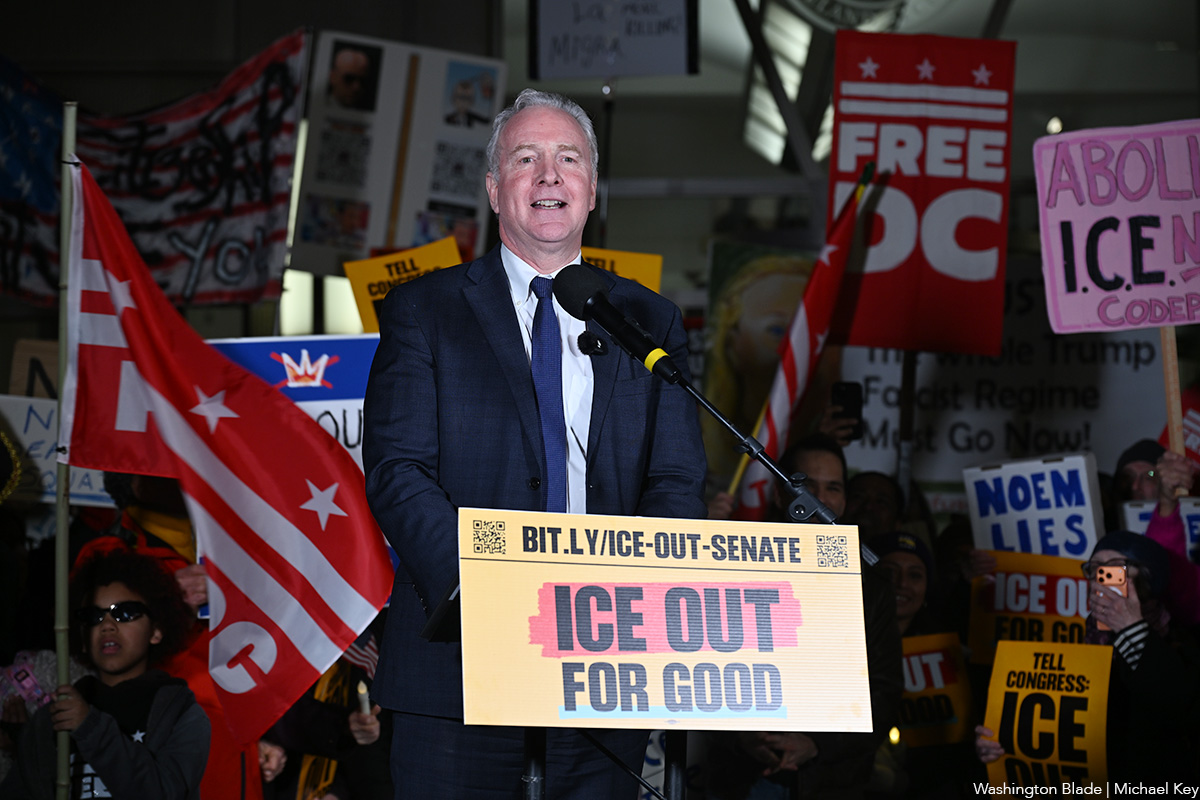
By LEE O. SANDERLIN | The Democratic Party is having something of an identity crisis — losing to President Donald Trump twice in three elections will do that.
Should the party embrace anti-establishment figures who espouse progressive policy ideas like Medicare for all and rhetoric about unrigging the economy for the 1 percent? Or should Democrats try to appeal to moderates who want to return to semi-normalcy in a time of political upheaval?
Although he’s been in Congress since 2002, with key leadership roles throughout his tenure, Maryland Sen. Chris Van Hollen, 67, counts himself firmly in the anti-establishment camp.
The rest of this article can be found on the Baltimore Banner’s website.
Congress
House blocks effort to codify transgender servicemember ban into law
Lawmakers approved two anti-trans NDAA amendments

The U.S. House of Representatives on Tuesday rejected an amendment to the National Defense Authorization Act that would have codified a ban transgender servicemembers in the military.
The bipartisan vote was 212-217.
The NDAA is for the 2027 fiscal year and sets policies for the Defense Department programs and activities and the national security programs of the Department of Energy.
U.S. Rep. Lauren Boebert (R-Colo.) proposed the amendment on July 21. It stated that all personnel are required to serve in accordance with their biological sex, citing military readiness and discipline.
Human Rights Campaign Senior Director of Government Affairs Jennifer Pike Bailey stated that she is grateful for the bipartisan vote that rejected President Donald Trump and Defense Secretary Pete Hegseth’s “dangerous and discriminatory policy that has kicked brave transgender servicemembers out of the military and weakened our national security.”
“Everyone who meets the same rigorous standards should be able to serve their country. We should honor that patriotism, particularly in this moment where we are witnessing brave servicemembers making the ultimate sacrifice for our country, instead of ending their careers and politicizing their existence. We’re grateful that a permanent extension of this ban failed, and we will keep fighting to reverse this senseless policy,” Bailey said.
Mark Takano, chair of the Congressional Equality Caucus, stated that he and his members put in countless hours of work to kill the amendment.
“When Americans know they or their families are going to be targeted by or not supported by the military, that leads them to avoid signing up to serve or staying in the service — making it harder to keep the ranks of the armed services full and our nation safe. My colleagues in the Equality Caucus and I will continue working to prevent these attacks on our servicemembers and their families from becoming law,” Takano said.
According to the Congressional Equality Caucus, two other bills could potentially be passed that would also target the transgender community, both of which were proposed by U.S. Rep. Nancy Mace (R-S.C.).
The first was a bill that would have prohibited gender-related medical care under TRICARE and to prevent TRICARE from covering certain gender-related medical procedures and treatments, which was approved in a vote of 219-208.
The second was a bill that would have prohibited male participation in female sports at DoDEA schools. DoDEA schools are Department of Defense Dependents Schools, which is a network of primary and secondary schools.
The amendment was approved in a vote of 221-203.

Everton Blair makes history as first openly gay congressman from Ga.

Mujer trans salvadoreña es encontrada sin vida

Iceland implements gender-neutral blood donor rules

Blade Foundation to host fundraiser in Rehoboth on Sept. 12

New book examines fashionista Audrey Smaltz’s fabulous life

Gloria Steinem dies at 92

Pentagon expands testosterone screening as trans troops face hormone therapy restrictions

Swiss government backs nationwide conversion therapy ban

Calendar: September 4-10