District of Columbia
D.C. Drag Awards roar with queer power, politics, and panther prints
The annual drag celebration spotlights LGBTQ activism, community, and fierce performances
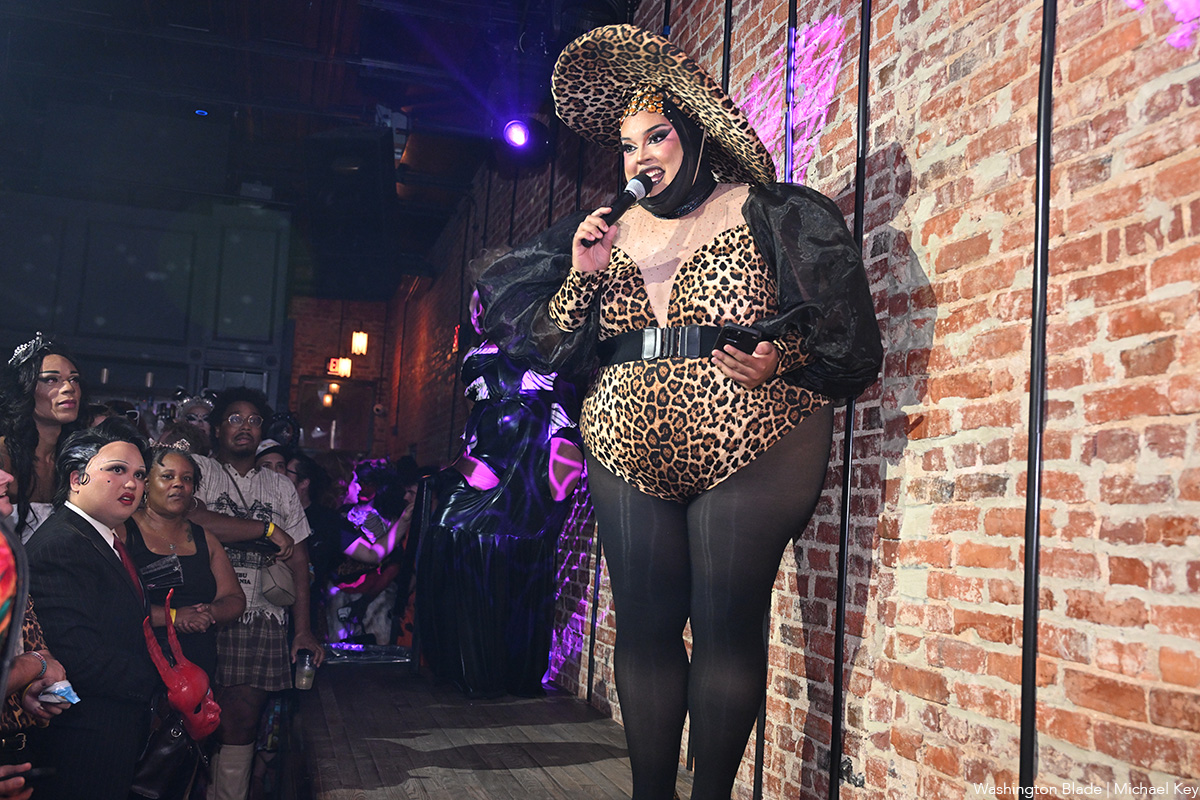
The third annual D.C. Drag Awards were held Sunday at Trade Bar in Washington’s Logan Circle neighborhood. The night was full of lewks, performances, and unapologetic queer existence.
This year’s hosts — Cake Pop!, Crystal Edge, and Evry Pleasure — all wore animal-themed outfits to match this year’s theme, “Welcome To The Jungle; Show Us Your Wild Side.” LGBTQ people from all over the DMV showed up in their beastly best attire, with animal prints being the most consistent motif.
This year, there were 26 categories ranging from best hair, DJ, party — if it had anything to do with D.C.’s drag culture and queer nightlife, there seemed to be an award for it.
The vibe for the night was mostly lighthearted, with lots of love for the whole LGBTQ community being shared loud and proud.
“I feel amazing,” Frieda Poussáy told the Blade before winning Comedy Performer of the Year. “I feel like I look phenomenal tonight… a cheetah print gown with roses on it, which I got and I stoned the absolute shit out of. It took me about seven and a half days to do and we finally got her looking right.”
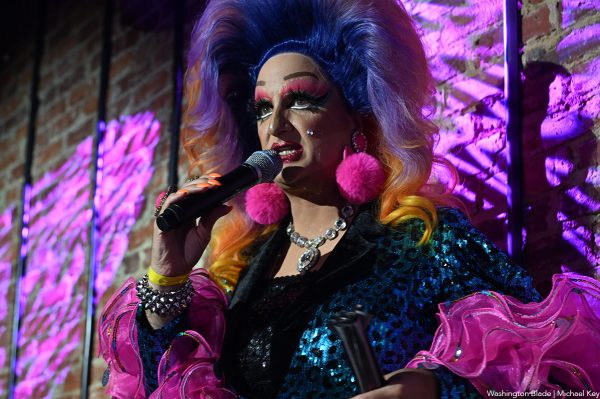
Tara Hoot, who has recently made national headlines for attending the opening night of ‘Les Misérables’ at the Kennedy Center in full drag while Trump was in the audience and led protests against Trump’s continued crusade on marginalized communities, won two awards: Community Changemaker and Social Media Star.
“Thanks for watching a 50-year-old man in a wig who started doing drag during the pandemic,” Tara Hoot said while accepting her award. “I know it’s not everybody’s cup of tea, but listen — you do what you can to make a little mark on the social media world. So thanks for following me. You’re all gorgeous. I love you.”
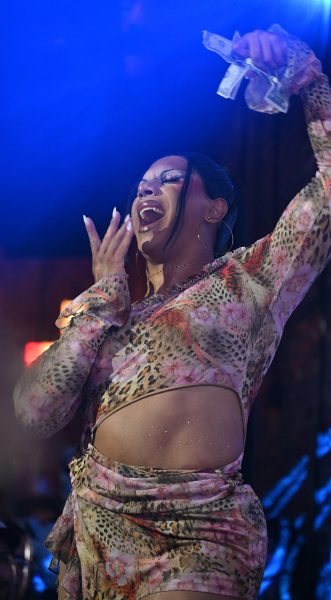
Drag queen Citrine spoke to the Blade after the show, saying that for her, drag is a strong instrument in being authentically herself.
“Drag is a powerful tool, because it allows you to express yourself in a way that you wouldn’t otherwise allow yourself to be,” she said. “It gives you the courage to say, ‘I’m here, I’m me, and I’m going to do whatever the fuck I want to do unapologetically.’ So use that tool to be yourself, even if you’re not going to put the makeup on. Just do it. If you love something, if you want to be something, do it. Be that person.”
The full list of nominees and winners is below:
Breakthrough Artist:
Danika Volkova
Grey Glowing
Makayla Starr
Manny Quinn
Sapphica Star- Winner
DJ of the Year:
Alex Love- Winner
Cake Pop!
DJ Drom
Samson
Wess the DJ
Scene Queen:
Bombshell Monroe
Delight
Girliepop
Rigatoni
Venetian- Winner
Best Comedy Performer:
Ani So Exotic
Dabatha Christie
Frieda Poussáy- Winner
Jaxknife Complex
Olive Ghardon
Community Changemaker:
Blaq Dinamyte
Brooke N. Hymen
Destiny B. Childs
Lord Henry
Tara Hoot- Winner
Best Dancing Performer:
Druex Sidora- Winner
Shelita Ramen
Sirene Nior Sidora-Jackson
Tiara Missou-Sidora
Venetian
Best Show Host:
Citrine- Winner
Desiree Dik
Destiny B. Childs
Druex Sidora
Tara Hoot
Best Party:
Church @ Trade
Deep Underground @ Bunker
Flower Factory @ Zebbie’s Garden- Winner
House Down Boots @ Flash
Sweet Spot @ Trade
Best Drag Brunch:
City Tap Drag Brunch Dupont- Winner
DC Drag Brunch
Perry’s Drag Brunch
Reggaeton Brunch
Tara Hoot’s Campy Bingo Brunch at Whitlow’s
Best Hair:
Anamosity
Crimsyn
Jasmine Blue
Labianna- Winner
Seneca Gemini
Social Media Star:
Aave Blue
Bombshell Monroe
King Molasses
Silver Ware Sidora
Tara Hoot- Winner
Best Makeup:
Andromeda
Baphomette
Crimsyn- Winner
Sapphica Star
Silver Ware Sidora
Best Duo/Group:
Cake Pop! & Venus Valhalla- Winner
Evry Pleasure & Jaxknife Complex
Jane Saw & King Molasses
Kora Edge & Nubia Love-Jackson
Tiara Missou-Sidora & TrevHER
Best At-Large Performer:
Bombshell Monroe
Evry Pleasure- Winner
Laylah Alexander
Mama Naytch
Queenie Iman Glamazon
Mx. Congeniality:
Anamosity
India Larelle Houston
Labianna
Sarah Tonin
Whitney Gucci Goo- Winner
Most Creative Performer:
De’ior Kouture
Desiree Dik- Winner
Johnny Alucard
Silver Ware Sidora
TrevHER
Gender Non-conforming Performer:
Andromeda
Brooke N. Hymen- Winner
Hennessey
Silver Ware Sidora
Sirene Nior Sidora-Jackson
Best LGBTQ Venue:
JR’s
Kiki
Shakers
Spark Social House
Trade- Winner
Best Drag Show:
Banshees @ JR’s
Brown Sugar @ Shakers
Freddie’s Follies @ Freddie’s Beach Bar
Shook @ Shakers- Winner
Vitamin C @ JR’s
Best Non-D.C. Performer:
Aave Blue
Daya B. Tease- Winner
Jasmen Clitopatra
Shenandoah
Stefon Royce
Best Dressed:
Citrine
Daya B. Tease
Hennessey
Jasmine Blue
Labella Mafia- Winner
Best Bartender:
Aaron @ Trade- Winner
Brendan @ Kiki
Levi @ JR’s
Martin @ Pitchers
Nate @ Kiki
Best Legacy Performer:
India Larelle Houston
Monet Dupree
Natalie Cole
Pussy Noir- Winner
Shiqueeta Lee
Trans Performer:
Baphomette
Brooke N. Hymen
Indiana Bones
Labella Mafia- Winner
Queenie Iman Glamazon
Drag King Of The Year:
Blaq Dinamyte
Johnny Alucard
King Flirty Xperince
King Molasses- Winner
Ricky Rosé
Drag Queen of the Year:
Citrine
Mari Con Carne- Winner
Sasha Adams Sanchez
Tara Hoot
Venetian
*Winners were decided through public voting via the D.C. Drag Awards Instagram page*



District of Columbia
D.C. police arrest man for burglary at gay bar Spark Social House
Suspect ID’d from images captured by Spark Social House security cameras
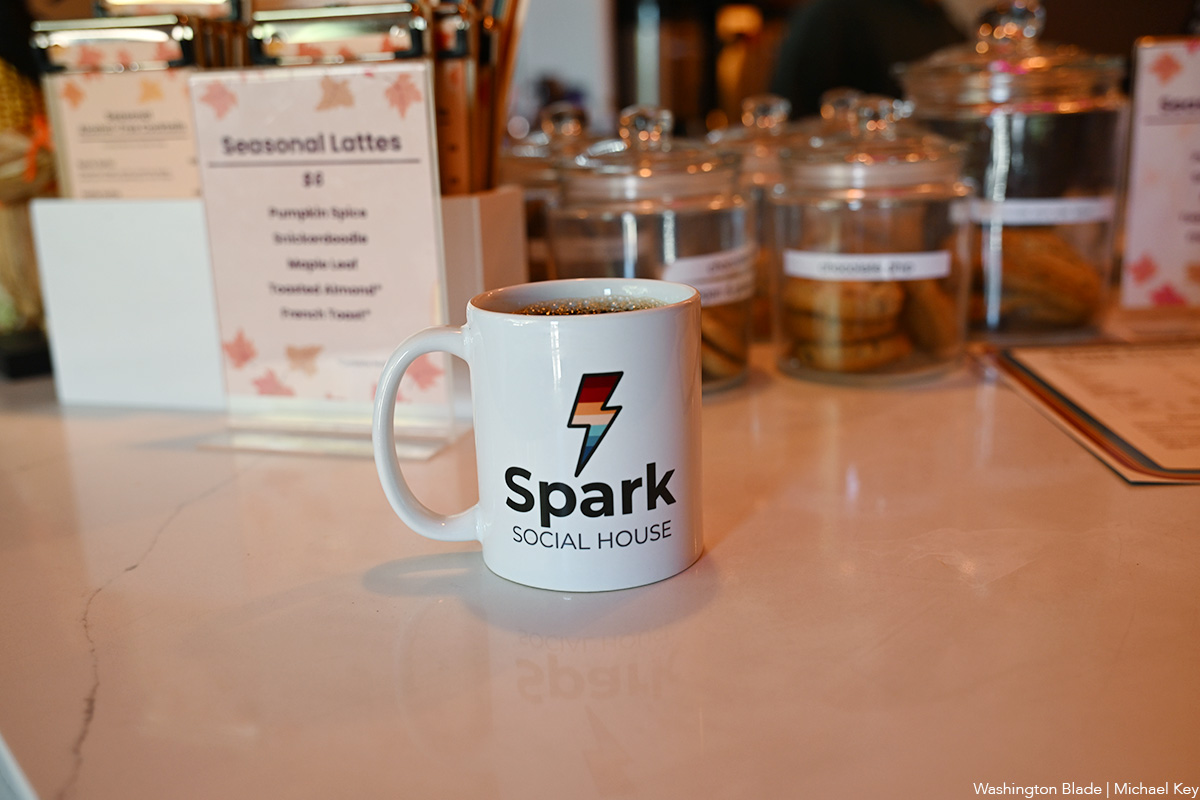
D.C. police on Feb. 18 arrested a 63-year-old man “of no fixed address” for allegedly stealing cash from the registers at the gay bar Spark Social House after unlawfully entering the bar at 2009 14th St., N.W., around 12:04 a.m. after it had closed for business, according to a police incident report.
“Later that day officers canvassing for the suspect located him nearby,” a separate police statement says. “63-year-old Tony Jones of no fixed address was arrested and charged with Burglary II,” the statement says.
The police incident report states that the bar’s owner, Nick Tsusaki, told police investigators that the bar’s security cameras captured the image of a man who has frequently visited the bar and was believed to be homeless.
“Once inside, the defendant was observed via the establishment’s security cameras opening the cash register, removing U.S. currency, and placing the currency into the left front pocket of his jacket,” the report says.
Tsusaki told the Washington Blade that he and Spark’s employees have allowed Jones to enter the bar many times since it opened last year to use the bathroom in a gesture of compassion knowing he was homeless. Tsusaki said he is not aware of Jones ever having purchased anything during his visits.
According to Tsusaki, Spark closed for business at around 10:30 p.m. on the night of the incident at which time an employee did not properly lock the front entrance door. He said no employees or customers were present when the security cameras show Jones entering Spark through the front door around 12:04 a.m.
Tsusaki said the security camera images show Jones had been inside Spark for about three hours on the night of the burglary and show him taking cash out of two cash registers. He took a total of $300, Tsusaki said.
When Tsusaki and Spark employees arrived at the bar later in the day and discovered the cash was missing from the registers they immediately called police, Tsusaki told the Blade. Knowing that Jones often hung out along the 2000 block of 14th Street where Spark is located, Tsusaki said he went outside to look for him and saw him across the street and pointed Jones out to police, who then placed him under arrest.
A police arrest affidavit filed in court states that at the time they arrested him police found the stolen cash inside the pocket of the jacket Jones was wearing. It says after taking him into police custody officers found a powdered substance in a Ziploc bag also in Jones’s possession that tested positive for cocaine, resulting in him being charged with cocaine possession in addition to the burglary charge.
D.C. Superior Court records show a judge ordered Jones held in preventive detention at a Feb. 19 presentment hearing. The judge then scheduled a preliminary hearing for the case on Feb. 20, the outcome of which couldn’t immediately be obtained.
District of Columbia
Judge rescinds order against activist in Capital Pride lawsuit
Darren Pasha accused of stalking organization staff, board members, volunteers
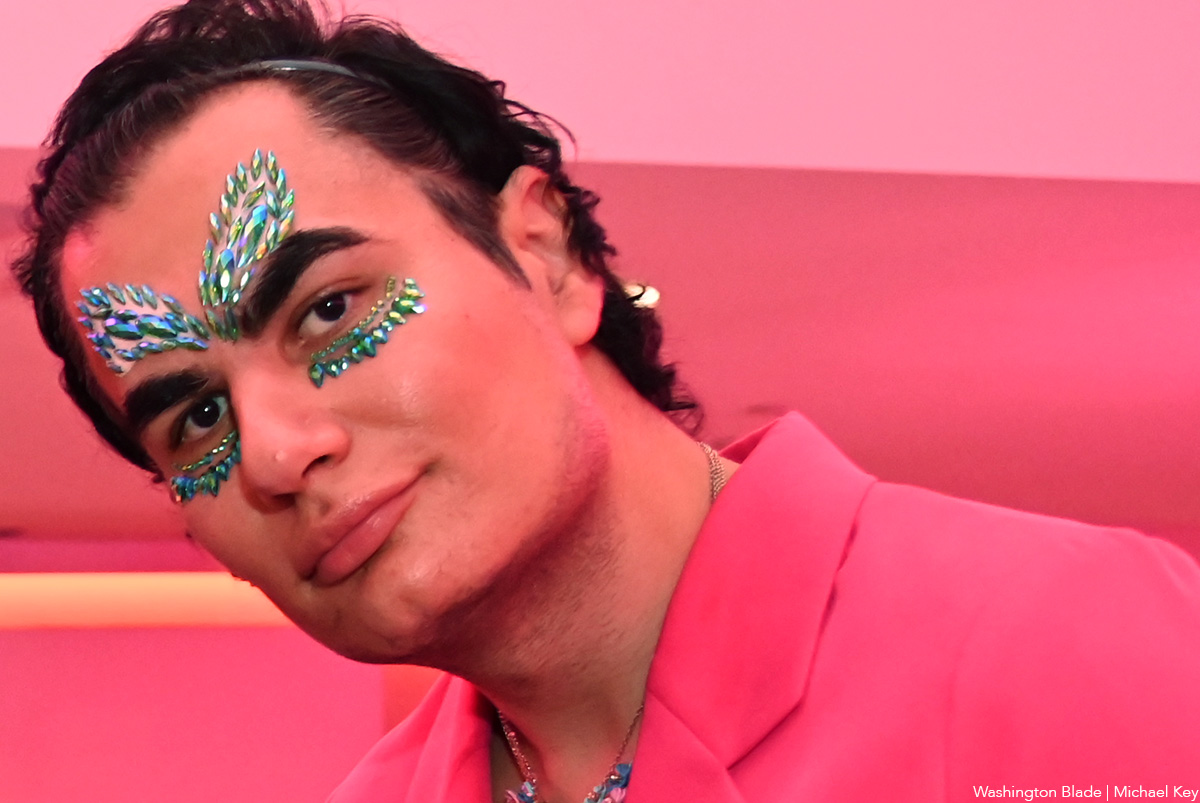
A D.C. Superior Court judge on Feb.18 agreed to rescind his earlier ruling declaring local gay activist Darren Pasha in default for failing to attend a virtual court hearing regarding an anti-stalking lawsuit brought against him by the Capital Pride Alliance, the group that organizes D.C.’s annual Pride events.
The Capital Pride lawsuit, initially filed on Oct. 27, 2025, accuses Pasha of engaging in a year-long “course of conduct” of “harassment, intimidation, threats, manipulation, and coercive behavior” targeting Capital Pride staff, board members, and volunteers.
In his own court filings without retaining an attorney, Pasha has strongly denied the stalking related allegations against him, saying “no credible or admissible evidence has been provided” to show he engaged in any wrongdoing.
Judge Robert D. Okum nevertheless on Feb. 6 approved a temporary stay-away order requiring Pasha to stay at least 100 feet away from Capital Pride’s staff, volunteers, and board members until the time of a follow-up court hearing scheduled for April 17. He reduced the stay-away distance from 200 yards as requested by Capital Pride.
In his two-page order issued on Feb. 18, Okun stated that Pasha explained that he was involved in a scooter accident in which he was injured and his phone was damaged, preventing him from joining the Feb. 6 court hearing.
“Therefore, the court finds there is a good cause for vacating the default,” Okun states in his order.
At the time he initially approved the default order at the Feb. 6 hearing that Pasha didn’t attend, Okun scheduled an April 17 ex parte proof hearing in which Capital Pride could have requested a ruling in its favor seeking a permanent anti-stalking order against Pasha.
In his Feb. 18 ruling rescinding the default order Okun changed the April 17 ex parte proof hearing to an initial scheduling conference hearing in which a decision on the outcome of the case is not likely to happen.
In addition, he agreed to consider Pasha’s call for a jury trial and gave Capital Pride 14 days to contest that request. The Capital Pride lawsuit initially called for a non-jury trial by judge.
One request by Pasha that Okum denied was a call for him to order Capital Pride to stop its staff or volunteers from posting information about the lawsuit on social media. Pasha has said the D.C.-based online blog called DC Homos, which Pasha claims is operated by someone associated with Capital Pride, has been posting articles portraying him in a negative light and subjecting him to highly negative publicity.
“The defendant has not set forth a sufficient basis for the court to restrict the plaintiff’s social media postings, and the court therefore will deny the defendant’s request in his social media praecipe,” Okun states in his order.
A praecipe is a formal written document requesting action by a court.
Pasha called the order a positive development in his favor. He said he plans to file another motion with more information about what he calls the unfair and defamatory reports about him related to the lawsuit by DC Homos, with a call for the judge to reverse his decision not to order Capital Pride to stop social media postings about the lawsuit.
Pasha points to a video interview on the LGBTQ Team Rayceen broadcast, a link to which he sent to the Washington Blade, in which DC Homos operator Jose Romero acknowledged his association with Capital Pride Alliance.
Capital Pride Executive Director Ryan Bos didn’t immediately respond to a message from the Blade asking whether Romero was a volunteer or employee with Capital Pride.
Pasha also said he believes the latest order has the effect of rescinding the temporary stay away order against him approved by Okun in his earlier ruling, even though Okun makes no mention of the stay away order in his latest ruling. Capital Pride attorney Nick Harrison told the Blade the stay away order “remains in full force and effect.”
Harrison said Capital Pride has no further comment on the lawsuit.
District of Columbia
Trans activists arrested outside HHS headquarters in D.C.
Protesters demonstrated directive against gender-affirming care
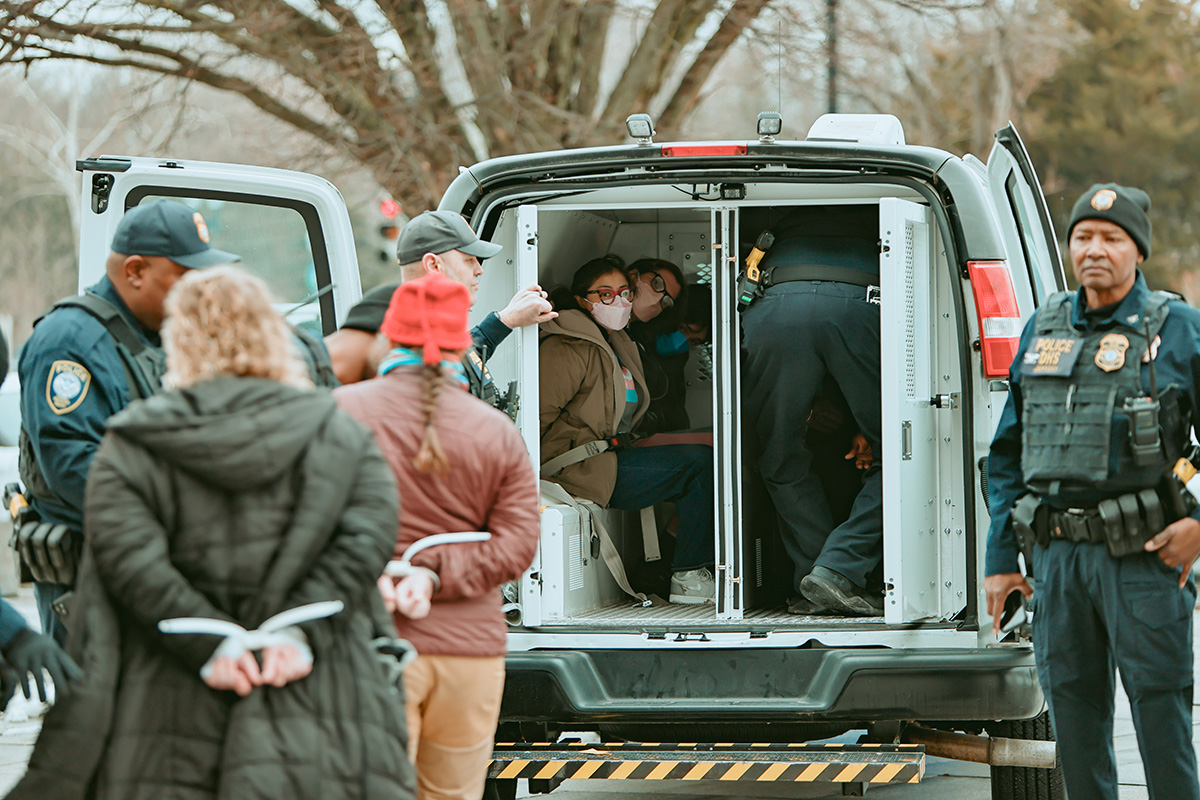
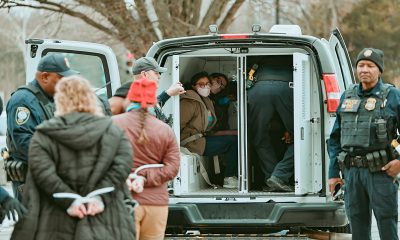
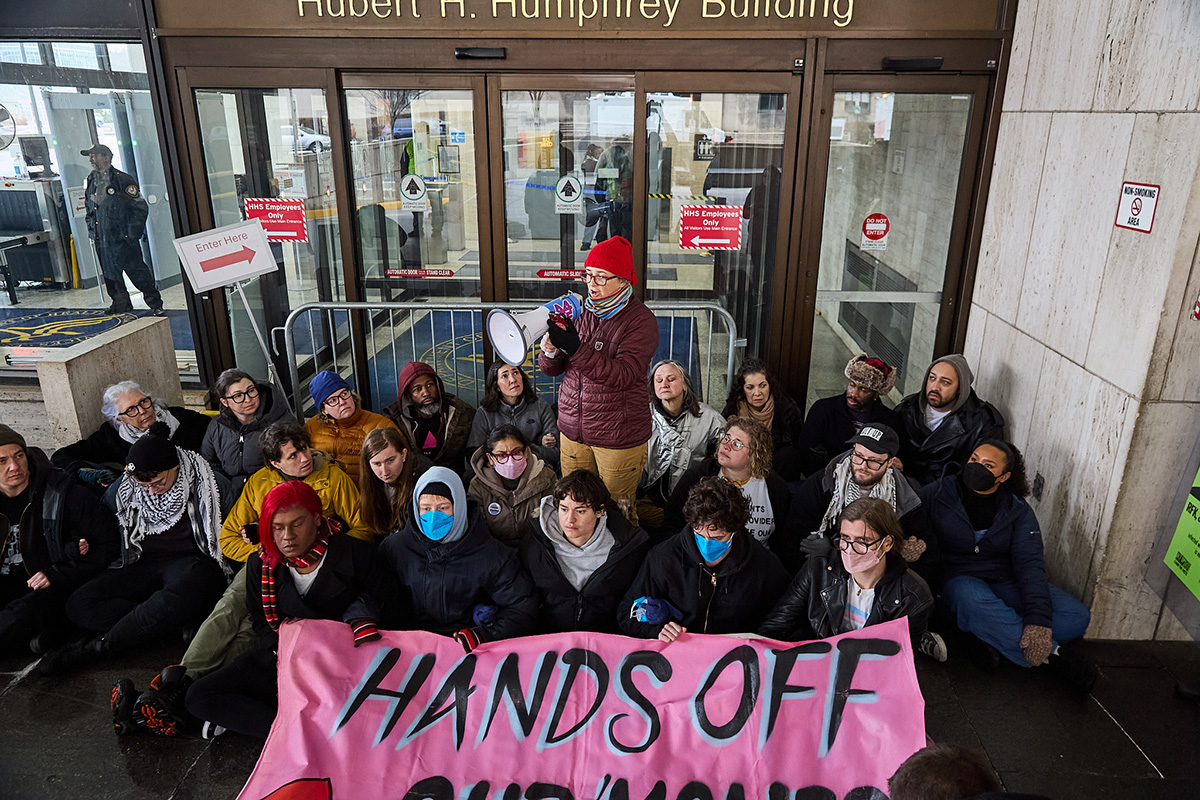
Authorities on Tuesday arrested 24 activists outside the U.S. Department of Health and Human Services headquarters in D.C.
The Gender Liberation Movement, a national organization that uses direct action, media engagement, and policy advocacy to defend bodily autonomy and self-determination, organized the protest in which more than 50 activists participated. Organizers said the action was a response to changes in federal policy mandated by Executive Order 14187, titled “Protecting Children from Chemical and Surgical Mutilation.”
The order directs federal agencies and programs to work toward “significantly limiting youth access to gender-affirming care nationwide,” according to KFF, a nonpartisan, nonprofit organization that provides independent, fact-based information on national health issues. The executive order also includes claims about gender-affirming care and transgender youth that critics have described as misinformation.
Members of ACT UP NY and ACT UP Pittsburgh also participated in the demonstration, which took place on the final day of the public comment period for proposed federal rules that would restrict access to gender-affirming care.
Demonstrators blocked the building’s main entrance, holding a banner reading “HANDS OFF OUR ‘MONES,” while chanting, “HHS—RFK—TRANS YOUTH ARE NO DEBATE” and “NO HATE—NO FEAR—TRANS YOUTH ARE WELCOME HERE.”
“We want trans youth and their loving families to know that we see them, we cherish them, and we won’t let these attacks go on without a fight,” said GLM co-founder Raquel Willis. “We also want all Americans to understand that Trump, RFK, and their HHS won’t stop at trying to block care for trans youth — they’re coming for trans adults, for those who need treatment from insulin to SSRIs, and all those already failed by a broken health insurance system.”
“It is shameful and intentional that this administration is pitting communities against one another by weaponizing Medicaid funding to strip care from trans youth. This has nothing to do with protecting health and everything to do with political distraction,” added GLM co-founder Eliel Cruz. “They are targeting young people to deflect from their failure to deliver for working families across the country. Instead of restricting care, we should be expanding it. Healthcare is a human right, and it must be accessible to every person — without cost or exception.”
Despite HHS’s efforts to restrict gender-affirming care for trans youth, major medical associations — including the American Medical Association, the American Academy of Pediatrics, and the Endocrine Society — continue to regard such care as evidence-based treatment. Gender-affirming care can include psychotherapy, social support, and, when clinically appropriate, puberty blockers and hormone therapy.
The protest comes amid broader shifts in access to care nationwide.
NYU Langone Health recently announced it will stop providing transition-related medical care to minors and will no longer accept new patients into its Transgender Youth Health Program following President Donald Trump’s January 2025 executive order targeting trans healthcare.

D.C. police arrest man for burglary at gay bar Spark Social House

Going for gold: Ford Bronco Sport vs. Toyota RAV4

How do we honor Renee Good, Alex Pretti?

Judge rescinds order against activist in Capital Pride lawsuit

Calendar: February 20-26

LGBTQ groups question US health agreements with African countries

Trump falsely links trans people to terrorism

Fellow lawmakers praise Adam Ebbin after Va. Senate farewell address

LGBTQ activists mourn the Rev. Jesse Jackson