District of Columbia
Protesters rally in D.C. one week after federal takeover
Hundreds of residents and community leaders gathered on U Street to condemn the Trump administration’s deployment of out-of-state National Guard troops and federal agents in D.C.
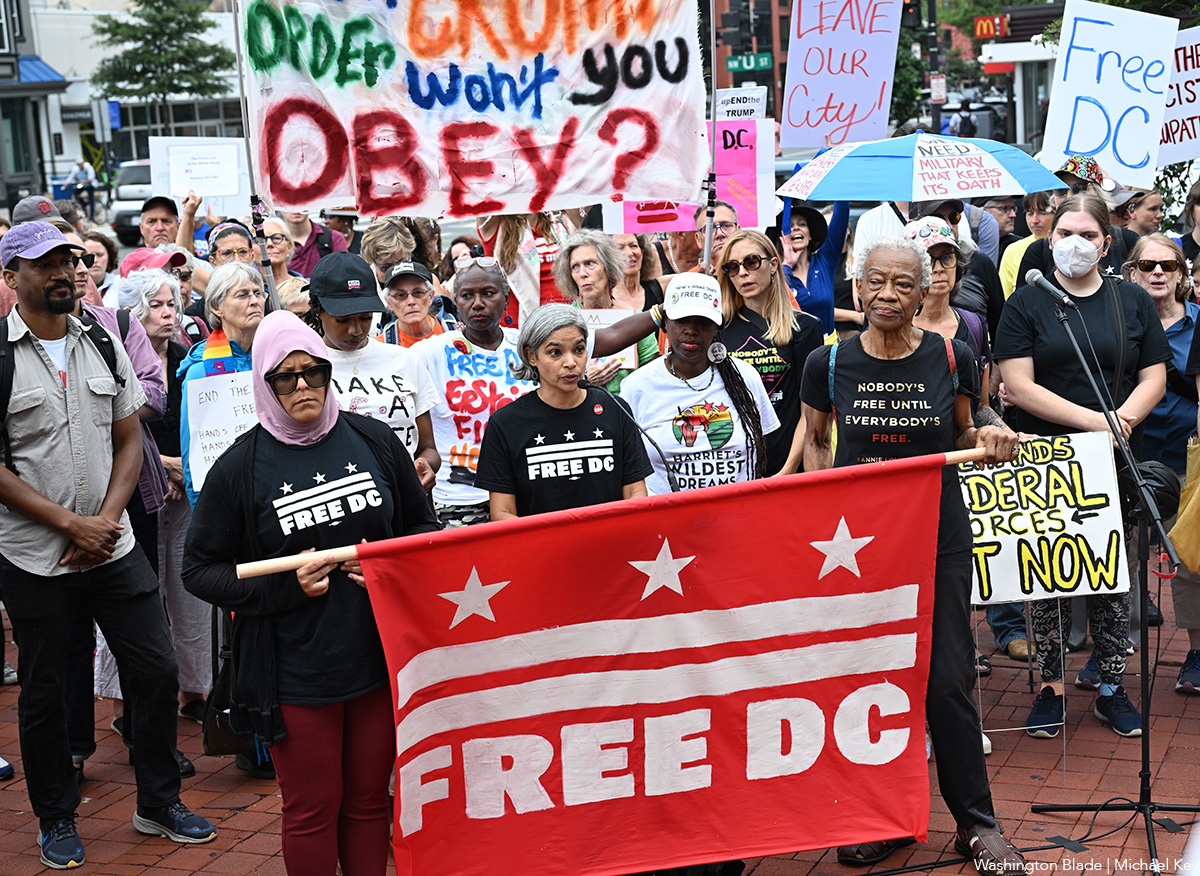
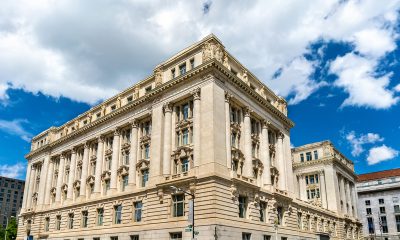
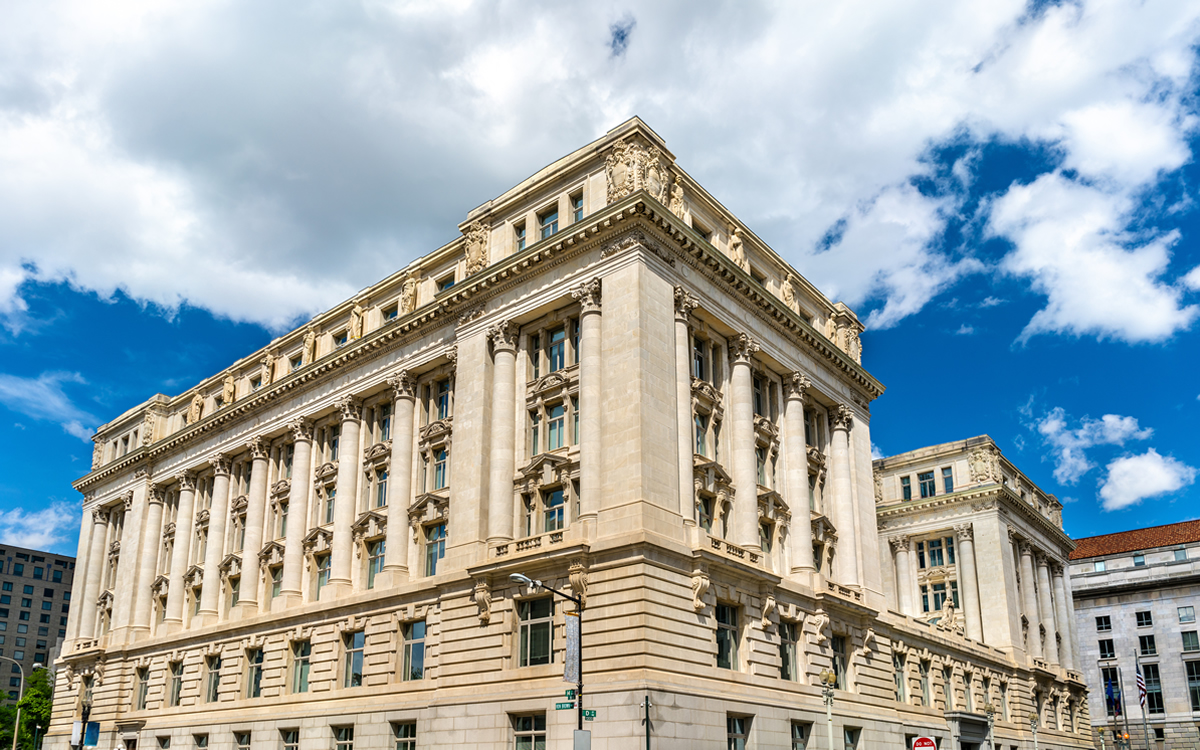
More than 200 people gathered in front of the old Frank Reeves Municipal Center on Monday to protest the Trump administration’s federal takeover of the District of Columbia and MPD.
Free D.C. — a nonprofit whose mission is securing self-determination for the District — hosted the event at 14th and U streets, N.W. Speakers from several community organizations addressed the crowd, arguing that the takeover harms the city more than it helps.
Keya Chatterjee, executive director of Free D.C., was among the first to speak. She said the administration’s actions represent a blatant overreach of federal power, motivated by partisanship rather than public safety.
“Since last week, Trump has sent federal law enforcement agents into our neighborhoods, made our police start turning people over to ICE, sent in our local National Guard and attempted to put our local police department under federal control,” Chatterjee told reporters and protesters. “Today, he has sent in armed National Guard from three additional states.”
By Tuesday morning, six states had pledged to send troops. All are governed by Republicans, contributing anywhere from 150 to 400 National Guard members each. Together, more than 1,000 out-of-state troops are now expected to patrol the District.
Louisiana Gov. Jeff Landry pledged 150 troops; West Virginia Gov. Patrick Morrisey said he would send between 300 and 400; South Carolina Gov. Henry Dargan McMaster pledged 200; Ohio Gov. Mike DeWine said his state would send 150; Tennessee Gov. Bill Lee committed about 160; and Mississippi Gov. Tate Reeves pledged 200.
Chatterjee was not alone in criticizing the presence of non-D.C. officers. Jesse Rabinowitz of the National Homelessness Law Center said the money spent deploying troops could instead be used to house people experiencing homelessness — many of whom, he argued, the administration is targeting for removal.
“According to estimates, it costs over $420,000 a day to deploy the D.C. Guard,” Rabinowitz said. “That number does not factor in the Guard troops now invading from West Virginia, Ohio and South Carolina. But just using this D.C. cost — $420,000 a day — tells an important story. It costs $47,000 a year to get somebody off the street and into housing for one year. For one day of D.C. Guard activation, we could solve homelessness for nine people.”
He added that the clearances are designed for optics, not solutions.
“On Thursday night, over 30 federal police officers from the FBI, Secret Service and Homeland Security gathered near a few tents in Foggy Bottom. They didn’t come offering housing or support. They came with their guns and lights flashing.”
“The solution to homelessness is housing,” he continued. “The solution to authoritarianism is solidarity.”
Kelsye Adams, director of D.C. Vote and Long Live Go-Go, also condemned the use of the U Street corridor as a staging ground for federal forces.
“For the first time in history, a president seized control of our local government,” Adams told the crowd, which booed loudly in response. “He stripped away local authority unlawfully as our AG got out there and filled our streets with over 800 National Guard troops from other states, federal agents, including ICE, FBI … And where did they land? Right here on U Street, on Black Broadway in the middle of our door.”
“They call it public safety, but here’s the truth: crime is down in D.C.,” she continued, citing Department of Justice data ignored by the administration. “This is the lowest that violent crime has been in D.C. in the past 30 years … If crime is down, why all the troops? Why ICE? Why remove the unhoused? Why checkpoints and why say this is about safety? Let’s be real. This is a fascist takeover.”
Adams stressed that Black and brown children living around U Street are bearing the brunt of the militarization.
“Children should not feel like suspects for simply living; our young people deserve joy, safety and dignity, not militarization.”
Nee Nee Taylor, organizing director of Free D.C., echoed that message, pointing to the long history of police targeting youth of color.
“Black and brown people, we are not safe,” Taylor said. “We are in a state of emergency right now. We are being watched. We are being targeted, and it’s not safe to walk alone.”
“They want to drag us back to the days of Emmett Till and Jim Crow, but hear me clearly — we’re going to resist. We’re going to show up. We’re going to take up space, we’re not going to comply, and we’re going to send joy while we’re doing it.”
“Safety cannot be manufactured through fear. Let me say that again: safety cannot be manufactured.”
A representative from Colectivo Familias Migrantes, a civil society group focused on human rights and democratic rule of law in the Americas, told the crowd that incidents of undocumented people being scooped up in unmarked cars by masked agents are part of a broader plan to continue policing Black and brown people in D.C. — regardless of their immigration status.
“These are not coincidences. These are strategically placed and targeted to bring fear and panic, all while building a disgusting narrative that continues to criminalize our bodies every single day.”
“We demand that all federal forces leave now,” she added.
Rach “Coach” Pike, co-owner of the queer bar As You Are in Southeast D.C., told the Blade they attended the event to show solidarity and to stress the importance of LGBTQ awareness.
“I think it has more to do with location and who they’re targeting, which are Black and brown communities, communities that are unhoused. So I think it’s more about that than queer people — at least for now. Queers aren’t the focus yet.”
As a business owner, Pike said their priority is supporting those being directly targeted by the administration — and encouraging other businesses to do the same.
“I just encourage business owners, mostly to be on the street, help with the resources they can communicate and get information out to people, and push people toward our amazing D.C. organizers, because they’re the ones we need to follow right now.”
“Being out here with our people and amongst like-mindedness is really important to kind of get your energy up,” Pike added. “I wouldn’t say I feel any better — it’s all bullshit — but I feel surrounded, wrapped up, covered. Like I’m getting more information to help cover other people. You know, we got to keep us safe.”


District of Columbia
Bowser appoints first nonbinary person to Cabinet-level position
Peter Stephan named Office of Disability Rights interim director
D.C. Mayor Muriel Bower has named longtime disability rights advocate Peter L. Stephan, who identifies as nonbinary, as interim director of the D.C. Office of Disability Rights.
The local transgender and nonbinary advocacy group Our Trans Capital and the LGBTQ group Capital Stonewall Democrats issued a joint statement calling Stephan’s appointment an historic development as the first-ever appointment of a nonbinary person to a Cabinet-level D.C. government position.
“This milestone appointment recognizes Stephan’s extensive expertise in disability rights advocacy and marks a historic advancement for transgender and nonbinary representation in District government leadership,” the statement says.
The statement notes that Stephan, an attorney, held the position of general counsel at the Office of Disability Rights immediately prior to the mayor’s decision to name him interim director.
The mayor’s office didn’t immediately respond to a question from the Washington Blade asking if Bowser plans to name Stephan as the permanent director of the Office of Disability Rights. John Fanning, a spokesperson for D.C. Council member Anita Bonds (D-At-Large), said the office’s director position requires confirmation by the Council.
Stephan couldn’t immediately be reached for comment.
“At a time when trans and nonbinary people ae under attack across the country, D.C. continues to lead by example,” said Stevie McCarty, president of Capital Stonewall Democrats. “This appointment reflects what we have always believed that our community is always strongest when every voice is represented in government,” he said.
“This is a historic step forward,” said Vida Rengel, founder of Our Trans Capital. “Interim Director Stephan’s career and accomplishments are a shining example of the positive impact that trans and nonbinary public servants can have on our communities,” according to Rangel.
District of Columbia
Capital Stonewall Democrats set to celebrate 50th anniversary
Mayor Bowser expected to attend March 20 event

D.C. Mayor Muriel Bowser, members of the D.C. Council, and local and national Democratic Party officials are expected to join more than 150 LGBTQ advocates and supporters on March 20 for the 50th anniversary celebration of the city’s Capital Stonewall Democrats.
A statement released by the organization says the event is scheduled to be held at the Pepco Edison Place Gallery building at 702 8th St., N.W. in D.C.
“The evening will honor the people who built Capital Stonewall Democrats across five decades – activists who fought for rights when the odds were against them, public servants who opened doors and refused to let them close, and a new generation of leaders ready to carry the work forward,” the statement says.
Founded in 1976 as the Gertrude Stein Democratic Club, the organization’s members voted in 2021 to change its name to the Capital Stonewall Democrats.
Among those planning to attend the anniversary event is longtime D.C. gay Democratic activist Paul Kuntzler, 84, who is one of the two co-founders of the then-Gertrude Stein Democratic Club. Kuntzler told the Washington Blade that he and co-founder Richard Maulsby were joined by about a dozen others in the living room of his Southwest D.C. home at the group’s founding meeting in January 1976.
He said that among the reasons for forming a local LGBTQ Democratic group at the time was to arrange for a then “gay” presence at the 1976 Democratic National Convention, at which Jimmy Carter won the Democratic nomination for U.S. president and later won election as president.
Maulsby, who served as the Stein Club president for its first three years and who now lives in Sarasota, Fla., said he would not be attending the March 20 anniversary event, but he fully supports the organization’s continuing work as an LGBTQ organization associated with the Democratic Party.
Steven McCarty, Capital Stonewall Democrats’ current president, said in the statement that the anniversary celebration will highlight the organization’s work since the time of its founding.
“Capital Stonewall Democrats has been fighting for LGBTQ+ political power in this city for 50 years, electing people, training organizers, holding this community together through some really hard moments,” he said. “And right now, with everything going on, that work has never mattered more. This gala is the first moment of our next chapter, and I want the community to be a part of it.”
The statement says among the special guests attending the event will be Democratic National Committee Vice Chair Malcolm Kenyatta, who became the first openly gay LGBTQ person of color to win election to the Pennsylvania General Assembly in 2018.
Other guests of honor, according to the statement, include Mayor Bowser; D.C. Council member Zachary Parker (D-Ward 5, the Council’s only gay member; D.C. Council member Anita Bonds (D-At-Large); Earl Fowlkes, founder of the International Federation of Black Prides; Vita Rangel, a transgender woman who serves as Deputy Director of the D.C. Mayor’s Office of Talent and Appointments; Heidi Ellis, director of the D.C. LGBTQ Budget Coalition; Rayceen Pendarvis, longtime D.C. LGBTQ civic activist; and Phillip Pannell, longtime D.C. LGBTQ Democratic activist and Ward 8 civic activist.
Information about ticket availability for the Capital Stonewall Democrats anniversary gala can be accessed here: capitalstonewalldemocrats.com/50th
District of Columbia
Owner of D.C. gay bar Green Lantern John Colameco dies at 79
Beloved businessman preferred to stay ‘behind the scenes’
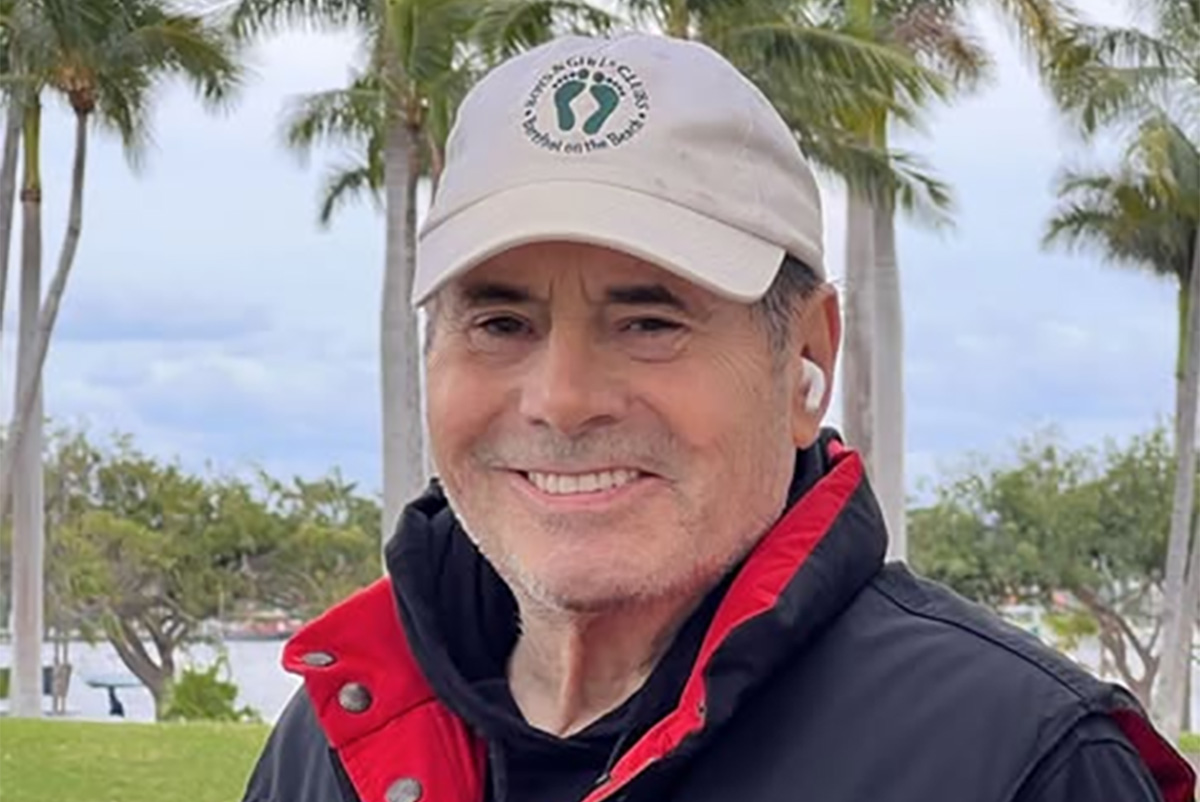
John Colameco, owner of the popular D.C. gay bar Green Lantern, has died, according to a March 7 announcement posted on the bar’s website and Instagram account. The announcement didn’t provide a date of his passing or a cause of death.
Green Lantern manager Howard Hicks said Colameco was 79 at the time of his passing.
“It is with great sadness that Green Lantern announces the death of our beloved owner, John Colameco,” the announcement says. “Most of our patrons might have heard John’s name, but might not have known his face,” it says.
“He was a ‘behind-the-scenes’ kind of guy who avoided the limelight,” the announcement continues. “He preferred to stay in the back of the house with staff and team ensuring everything was running smoothly so that everyone out front was having a good time.”
The announcement adds, “As a veteran and businessman, John wasn’t a member of the LGBTQ + community, but he was one of the best damn allies our community has ever had.”
It says he “long provided spaces for the queer community to come together” since the 1990s when he owned and operated a popular restaurant on 17th Street, N.W. called Peppers.
According to the announcement, Colameco and his then business partner Greg Zehnacker opened the Green Lantern in 2001 in an alley off of 14th Street, N.W., between Thomas Circle and L Street, N.W.
The announcement points out that the Green Lantern first opened in the same location in the early 1990s before it later closed when the original owners decided to purchase and open other bars, one of which was the gay bar Fireplace near Dupont Circle. Colameco and Zehnacker were able to reopen the bar with the Green Lantern name.
“When Greg died unexpectedly in February 2014, John remained steadfastly committed to carrying on their vision and ensuring that Green Lantern remained part of the fabric of D.C.’s queer community,” the announcement says.
“Over the years, through Green Lantern, John has provided support to many community organizations, most notably Stonewall Sports, the Gay Men’s chorus of Washington, and ONYX Mid-Atlantic with Green Lantern serving as a gathering hub for their activities,” it states.
The announcement adds that Colameco’s family was planning a memorial for him in his hometown of Philadelphia.
“His Green Lantern family will celebrate his life by operating the bar as usual and we encourage you to stop by and join us,” it says. “Community coming together and having a good time – it’s exactly what John would want.”

Gay Venezuelan man ‘forcibly disappeared’ to El Salvador files claim against White House

Trump proclamation targets trans rights as State Dept. shifts visa policy

Adolescentes trans en Ecuador podrán cambiar datos en su cédula, pero con condicionamientos

Gay Cameroonian immigrant will be freed from ICE detention — for now

Laverne Cox, Liza Minnelli among authors with new books

Claudia López wins primary in Colombian presidential race

Too afraid to leave home: ICE’s toll on Latino HIV care

Trump will refuse to sign voting bill without anti-trans provisions

Man stuck in Lebanon as Iran war escalates

CAMP Rehoboth hires new executive director
-

 Colombia5 days ago
Claudia López wins primary in Colombian presidential race
-
Health5 days ago
Too afraid to leave home: ICE’s toll on Latino HIV care
-
The White House4 days ago
Trump will refuse to sign voting bill without anti-trans provisions
-
Iran4 days ago
Man stuck in Lebanon as Iran war escalates