The White House
‘Lavender Scare 2.0’: inside the White House’s campaign against LGBTQ federal employees
LGBTQ federal workers organization sounding the alarm
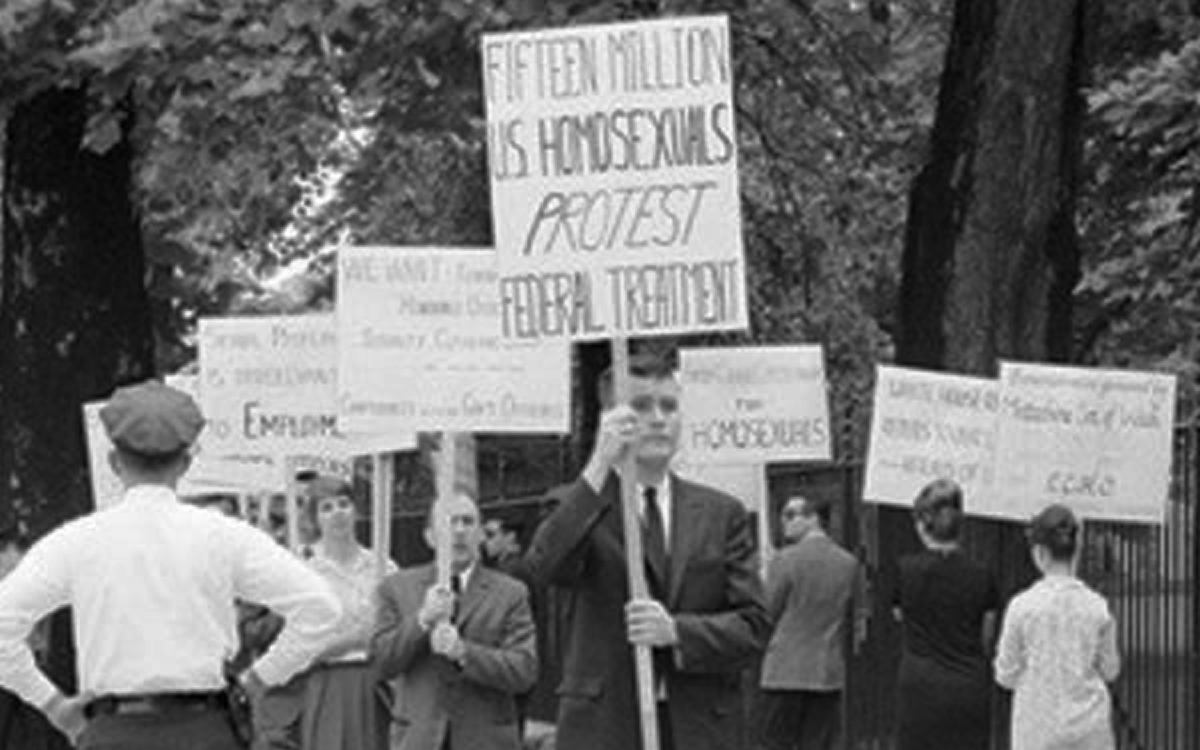
Since the beginning of the modern LGBTQ civil rights movement, there have been small but meaningful shifts in policy and public attitudes over the past 55 years that have allowed many within the LGBTQ community to feel safe in their right to love. The Trump-Vance administration is dramatically eroding that sense of security by enacting policies that directly harm LGBTQ people.
The Lavender Scare 2.0 is here, LGBTQ advocates warn, with stark decisions regarding LGBTQ federal employees that harken back to a time when you could be arrested — or worse— for not being a straight, cis citizen.
The Washington Blade spoke with Lucas F. Schleusener, the co-founder and CEO of Out in National Security, a nonprofit and nonpartisan organization that works to “empower queer national security professionals,” about the change in tone coming from the White House on LGBTQ government employees in national security and other federal circles.
There are almost 2.3 million federal government employees — not including uniformed military personnel, U.S. Postal Services employees, employees of federal contractors, and employees of federal grants — but only 7.3 percent of federal employees identified as LGBQ, and less than one percent identified as transgender, according to the 2023 Federal Employee Viewpoint Survey. Despite these numbers showing that this population is a minority within federal government employees, the steps the Trump-Vance administration is taking to erode LGBTQ federal workers’ protections seem to be of grave importance — especially within the military.
There are many things that caused shifts in public opinion of LGBTQ people (and their rights). Small victories over time build up and can change how the public views a particular issue — from the beginning legal fights for LGBTQ rights, which started nearly a decade before Stonewall by Frank Kameny, to the assassination attempt of the first openly gay public official Harvey Milk, to even the widespread humanizing impact of the HIV/AIDS epidemic on LGBTQ people who have suffered the most from the disease. All help make up the concept of American LGBTQ rights. Trump — laid out by Project 2025 and aided by other conservative politicians — is beginning to erode these rights.
One of the clearest ways the slow erosion of this protective space for LGBTQ federal employees can be seen, Schleusener explained, is through destabilization efforts within the bureaucratic system coming from the Oval Office — and with that is the return of 1980s–90s–style harassment.
“There’s an overwhelming bureaucratic trauma happening — a destabilization that feels intentional,” Schleusener said. “And underneath that, we’re seeing a return of different flavors of workplace harassment across national security agencies, from the CIA to the Import-Export Bank.”
gliffa, an employee resource group founded in 1992 that advocates for LGBTQ inclusion, equality, and workplace protections within U.S. foreign affairs agencies, was forced to have its entire board resign to comply with Trump’s “Defending Women from Gender Ideology Extremism and Restoring Biological Truth to the Federal Government” executive order the Blade covered in January, ultimately removing an important social and professional group that supported public servants. Since the executive order, the gliffa website has removed most of it’s content and contacts.
Schleusener continued, explaining that this policy will hurt LGBTQ federal workers.
“The administration has dissolved all minority employee resource groups, destroying networks of belonging and leaving queer federal employees in a state of psychological precarity,” he said.
Other organizations that have had to change their approach to supporting LGBTQ federal employee worker rights include the American Federation of Government Employees’ PRIDE program, a subsection of the largest federal employee union representing 820,000 federal and D.C. government workers. AFGE PRIDE was founded in 2015 to get more LGBTQ-inclusive contracts for federal workers and educate all members on LGBTQIA+ workplace and safety issues. AFGE has had numerous public disagreements with both Trump administrations’ anti-LGBTQ policy, notably when the federal employee union criticized the government’s multiple implementations of transgender military bans, and when it called out questionable budget-cutting techniques within the Centers for Disease Control and Prevention and multiple LGBTQ specific organizations by flagging — and subsequently removing — funding for anything with “transgender” in it.
Beyond minimizing the power of official structures created to specifically protect workers’ rights, the current administration and some members of the Republican Party have started to use “digital witch-hunts,” using social media to harass, dox, and lie about LGBTQ federal employees. While not as bad as denying a job to a deserving candidate for past homosexual “proclivities” like what happened with Frank Kameny, there are consequences to this shift in what is deemed acceptable for the online appearances of LGBTQ federal workers inside and outside of federal buildings.
“It’s not clearances being denied so much as it is targeted harassment. Laura Loomer has essentially declared herself the new Joe McCarthy, going through the Plum Book to identify anyone with ‘LGBT,’ ‘DEI,’ ‘equity,’ or ‘trans’ in their job titles and doxxing them.”
This intolerance promoted by the Trump-Vance administration and his party is not like whistleblowing on a State Department official for selling secrets to foreign governments, Schleusener explained, but rather attacking a part of LGBTQ federal workers’ human identity.
“These are ordinary federal workers — not public figures — whose home addresses end up on the internet simply for doing their jobs.”
Recently Laura Loomer, the far-right political activist, conspiracy theorist, internet personality, and Trump confidante, accused the trans community of playing some role in the assassination of right-wing political pundit Charlie Kirk, even going as far as to say that transgender people are “a national security threat” and constitute a terrorist movement, despite the shooter not being trans.
Trans federal employees have been facing a particularly difficult time under Trump’s second presidency. From bathroom bans restricting what gender bathrooms people can use to harassment on behalf of the federal government to remove them from military positions, there is a hyper-critical lens being placed on trans federal workers.
“There’s an organization called STARRS that combs through Instagram and LinkedIn looking for minority service members who show any pride in their identity. If you’re LGBTQ, a person of color, or even an ally who took your kids to Pride, they will tag and harass you — and they have a direct line into the Pentagon,” Schleusener pointed out. “People have been removed from their posts because of this, including the Navy’s top West Coast endocrinologist, whose only ‘offense’ was having a rainbow banner and pronouns on LinkedIn.”
Commander Janelle Marra was the medical director of Expeditionary Medical Facility 150 Bravo in San Diego until the TikTok account “Libs of TikTok” posted about her role as the Navy deputy medical director for trans healthcare, which was listed on her LinkedIn page, leading Defense Secretary Pete Hegseth to publicly order her removal from the role.
In addition to formally using the government to be hostile — if not outright discriminatory — against LGBTQ federal employees, the Trump-Vance administration has also fostered more informal harassment directed toward LGBTQ federal employees.
“It’s a climate of fear without any logical pattern — people doing important, everyday work suddenly find themselves targeted. These are not public political actors; they’re regular federal employees who now have to manage LinkedIn as if they were cabinet officials,” the former Pentagon employee and Obama national security associate shared.
“Between the administration’s formal hostility and these informal digital witch-hunts, queer employees are being squeezed from every direction.”
While there are some very clear discriminatory policies being put out by the White House, there is clear pushback from LGBTQ, human rights, and democracy advocates to stop them within the courts. With such a high amount of discriminatory action being taken by the Trump-Vance administration, it leaves the possibility for “legal chaos” within an already unhelpful system and the risk of a bad U.S. Supreme Court precedent.
“A lot of what we’re dealing with legally is documenting enough harassment to file viable claims, but the system is stacked against us. Even when we find a legal path — like restoring pensions for trans service members whose retirement benefits were revoked — everything is designed to be slow, difficult, and demoralizing,” Schleusener said. “And the frightening question is always whether fighting back could result in a bad Supreme Court precedent that hurts queer workers nationally.”
These pointed actions taken to harm LGBTQ federal worker protections by Trump and his followers in the federal system warrant a declaration of a second Lavender Scare, Schleusener told the Blade.
“Yes — this absolutely constitutes a second Lavender Scare. The federal government is saying trans people don’t belong in the military, even after spending billions training them for an all-volunteer force, which is both dangerous and absurd. Combined with attacks on ERGs, human rights reporting, and attempts to purge queer employees, it mirrors the patterns of the Cold War era.”
But this isn’t your grandparents’ Lavender Scare with vice squad cops trying to catch federal employees cruising like in the 60s. This is a whole other beast, Schleusener said.
The escalation of offenses, particularly for trans women within the government, is a major concern. The distaste for the trans community within the White House and among the president’s supporters on Capitol Hill makes this worse than a fine or a night in jail. The attempts to expand laws and policy regarding gender identity — particularly related to the National Defense Authorization Act and passport approvals — could have lasting impacts on LGBTQ federal workers’ ability to live in the U.S.
“This Lavender Scare is escalating: the NDAA moving through Congress includes a ban on trans women at service academies, and the administration is using Cold War statutes like the Walter McCarran Act to bar trans foreign nationals from entering the country.
Every opportunity they’ve had to go further, they have taken — and there’s no indication they plan to stop at trans people.”
Schleusener explained that although they are different in implementation, this new Lavender Scare is taking just as much of a toll on LGBTQ federal workers as it did the first time around — most of whom just want to help make the U.S. a better place.
“Like the original Lavender Scare, this is a manufactured moral panic weaponized through bureaucracy. Back then, the State Department bragged about driving queer employees to suicide; now we’re seeing trans service members taking their lives under the pressure of these policies. The difference today is that social media makes the harassment instantaneous and far-reaching, even as queer visibility also makes it harder to shove an entire community back into the closet.”
He also pointed out the growing purges of women and people of color from federal roles alongside the targeting of queer federal employees. This is a time to be aware of how federal work policies could shift the culture — and the safety of some of the most disenfranchised citizens.
“This isn’t only about LGBTQ people — there’s a broader purge underway targeting women and people of color in the senior ranks of the military. The first woman to take command of the SEALs was pushed out purely because she was a woman.
It’s a coordinated effort to turn back the clock across multiple identities simultaneously,” Schleusener said.
This manufactured climate of fear for LGBTQ federal employees is causing some to hide, delete, or exit the federal workforce altogether.
“We’ve seen a huge uptick in people trying to scrub their names from websites, delete their public bios, or step back from leadership programs out of fear of being hunted by Laura Loomer or similar groups. Even something as basic as using the bathroom has become a fraught question because the Pentagon now requires people to use facilities based on sex assigned at birth,” Schleusener added. “It’s driving people out of public service early, especially those with skills that are highly valued in the private sector.”
The Blade attempted to speak to multiple LGBTQ federal workers on record about their experience in seeing an overall shift in policy and tone directed toward the LGBTQ community — either anonymously or with their name attached — but no one wanted to speak for fear of losing their job. The Blade also reached out to the White House Press Office but has not received a response to the request for a statement on these allegations.

The White House
Trump budget would codify expanded global gag rule
Funding for LGBTQ health programs around the world would also be cut

The Trump-Vance administration’s fiscal year 2027 budget would codify the expanded global gag rule and eliminate funding for LGBTQ-specific programs in global health initiatives.
“The budget would ensure no funding supports abortion, unfettered access to birth control, and also eliminates funding for circumcision and lesbian, gay, bisexual, transgender, and queer services to better focus funds on life-saving assistance,” reads the proposed budget the White House released on April 3. “The United States should not pay for the world’s birth control and therapy.”
The proposed budget includes four examples of “eliminated activities.”
- In the last administration, PEPFAR funded health workers who performed over 21 abortions in Mozambique
- Promoting reproductive health education and access to birth control and other harmful programs couched under ‘family planning’ in Ghana
- A supply chain “control tower” to provide a “holistic commercial of the shelf solution” on the Office of Population and Reproductive Health (PRH)
- Promoting health equity and providing condoms and contraception in Kenya.
President Ronald Reagan in 1985 implemented the global gag rule, also known as the “Mexico City” policy, which bans U.S. foreign aid for groups that support abortion and/or offer abortion-related services.
Trump reinstated the rule during his first administration. The Biden-Harris administration shortly after it took office in January 2021 rescinded it.
The Trump-Vance White House earlier this year expanded the global gag rule to ban U.S. foreign aid for groups that promote “gender ideology.” The expansion took effect on Feb. 26.
US funding cuts have devastated global LGBTQ rights movement
The Trump-Vance administration after it took office in January 2025 moved to dismantle the U.S. Agency for International Development, which funded LGBTQ and intersex rights groups around the world. USAID officially shut down on July 1, 2025.
Secretary of State Marco Rubio in March 2025 announced the State Department would administer the 17 percent of USAID contracts that had not been cancelled. Rubio issued a waiver that allowed PEPFAR and other “life-saving humanitarian assistance” programs to continue to operate during the U.S. foreign aid freeze the White House announced shortly after it took office.
The global LGBTQ and intersex rights movement has lost more than an estimated $50 million in funding because of these cuts. The Washington Blade has previously reported PEPFAR-funded programs in Kenya and other African countries have been forced to suspend services and even shut down.
The Trump-Vance administration has signed healthcare-specific agreements with Kenya, Uganda, and other African countries through its American First Global Health Strategy. Advocacy groups with whom the Blade has spoken have expressed concern these partnerships will result in further exclusion and government-sanctioned discrimination based on sexual orientation or gender identity.
The proposed fiscal year 2027 budget includes $5.1 billion for “global health to end the previous administration’s abuse of these programs and to execute (the State Department’s) newly released America First Global Health Strategy.” This figure represents a $4.3 billion cut from the previous year.
“The president’s new vision of bilateral health assistance eliminates bloated Beltway Bandit contracts, does more with fewer dollars, and transitions recipient countries to self-reliance,” reads the proposed budget. “The budget would also eliminate disease-specific accounts and provide the department crucial agility to address the actual needs of each recipient country — across HIV/AIDS and other infectious diseases such as malaria, tuberculosis, and polio — to strengthen global health security and protect Americans from disease.”
“The budget would focus on new compacts that unify funding, achieving economies of scale in both implementation and oversight,” it adds. “Under the prior administration, only about 40 percent of PEPFAR funds supported actual service delivery, including medications, testing, commodities, and health workers, with the remaining 60 percent wasted on duplicative administrative costs, unwieldy supply chains, and layers of endless bureaucracy. The new AFGHS (America First Global Health Strategy) compacts would improve efficiency, cut red tape, and dismantle the bloated ecosystem of foreign assistance profiteers.”
The Council for Global Equality on April 3 reiterated its criticism of the expanded global gag rule, and urged Congress to reject the proposed budget.
“We won’t mince words: people are dying because of this policy,” said the Council for Global Equality in a statement. “Making this policy permanent will only ensure that U.S. foreign assistance discriminates against those who need services the most, all while forcing people around the world to adhere to the Trump administration’s extremist, ideological agenda that denies the very existence of transgender, nonbinary, and intersex persons.”
“We will not be silent as Trump threatens to upend decades of bipartisan foreign assistance programs to appease his extremist base,” added the group. “We call on Congress to immediately reject this budget and block implementation of the expanded global gag rules.”
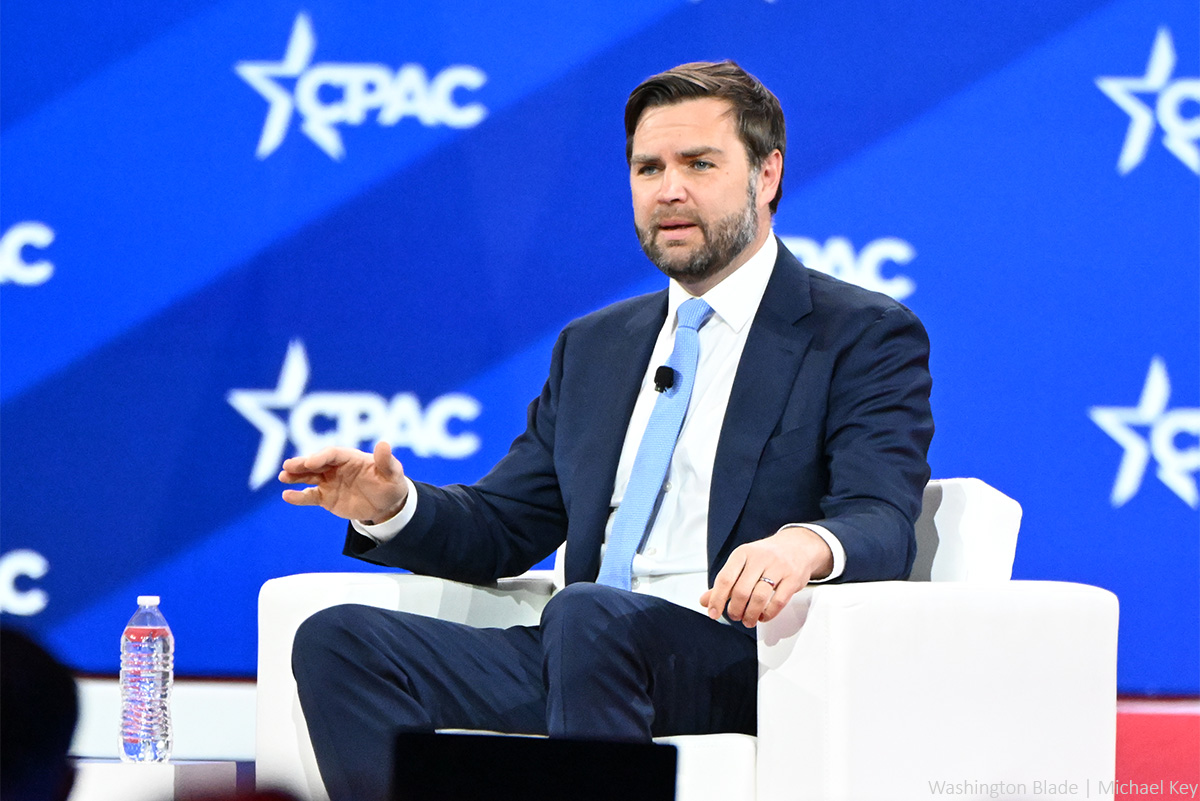
Vice President JD Vance and his wife, second lady Usha Vance, will visit Hungary next week.
An announcement the White House released on Thursday said the Vances will be in Budapest, the Hungarian capital, from April 7-8.
JD Vance “will hold bilateral meetings with” Hungarian Prime Minister Viktor Orbán. The announcement further indicates the vice president “will also deliver remarks on the rich partnership between the United States and Hungary.”
The Vances will travel to Hungary less than a week before the country’s parliamentary elections take place on April 12.
Orbán, who has been in office since 2010, and his Fidesz-KDNP coalition government have faced widespread criticism over its anti-LGBTQ crackdown.
The Associated Press notes polls indicate Orbán is trailing Péter Magyar and his center-right Tisza party.

President Donald Trump removed Attorney General Pam Bondi from her post Thursday, following growing criticism over how she and the Department of Justice handled a range of issues, including matters related to sex offender and Trump ally Jeffrey Epstein.
Trump announced Bondi’s removal on Truth Social, where he also said Todd Blanche will serve as acting head of the Justice Department.
“Pam Bondi is a great American patriot and a loyal friend, who faithfully served as my attorney general over the past year,” Trump wrote on the platform. “Pam did a tremendous job overseeing a massive crackdown on crime across our country, with murders plummeting to their lowest level since 1900.”
Trump was seen as recently as Wednesday with the now-former attorney general at a Supreme Court hearing on citizenship.
The decision contrasts with Trump’s previous public praise of Bondi, the 87th U.S. attorney general and former 37th attorney general of Florida, who served in that role from 2011-2019 before joining the Trump-Vance administration. He has frequently lauded her loyalty and said he speaks with her often. Bondi was also one of president’s defense lawyers during his first impeachment trial.
Privately, however, Trump had grown frustrated that Bondi was not “moving quickly enough” to prosecute critics and political adversaries he wanted to face criminal charges, according to multiple sources. The New York Times reported that her inability to charge former FBI Director James B. Comey and New York Attorney General Letitia James with any crimes is a large factor in the president’s choice to fire her from the government’s primary law enforcement agency.
The move comes as Trump has sought to minimize public turmoil within his administration, avoiding the perception of a revolving-door Cabinet that defined his first term.
Lee Zeldin, a former Republican congressman from New York who unsuccessfully ran for governor, has emerged as a leading contender to lead the Justice Department. He has been one of Trump’s most reliable allies.
“He’s our secret weapon,” Trump said of Zeldin in February during a White House event promoting the coal industry, adding, “He’s getting those approvals done in record-setting time.”
Bondi has also growing faced scrutiny from Congress.
The House Oversight Committee recently subpoenaed her to testify about the department’s handling of certain files, where she declined to answer key questions during a contentious House Judiciary Committee hearing in February.
The Tampa native has a long history of opposing LGBTQ rights through her roles in government. As Florida attorney general, she fought against the legalization of same-sex marriage, arguing it would cause “serious public harm,” pushing forward a legal battle that cost taxpayers nearly half a million dollars. She also asked the Florida Supreme Court to overturn a lower court ruling that found the state’s same-sex marriage ban unconstitutional.
More recently, Bondi established a “Title IX Special Investigations Team” within the Justice Department focused on restricting transgender women and girls from participating in women’s and girls’ sports teams and accessing facilities aligned with their gender identity. She also told Children’s Hospital of Philadelphia to turn over the medical records of anyone under 19 who received gender-affirming care.
Her removal follows Trump’s decision last month to oust another controversial female Cabinet figure, Kristi Noem.

Police mental health struggles gain growing attention
Man faces first S.C. ‘hate intimidation’ charge

Trump budget would codify expanded global gag rule

D.C. is the place for the Democratic Socialists of America

Key lifestyle changes can help patients cope with diabetes

VIDEO: Gay journalist detained for booing Trumps at ‘Chicago’ opening night

Trans-driven ‘Serpent’s Skin’ delivers campy sapphic horror

D.C. not the place for antisemitic Democratic Socialists of America

Pam Bondi ousted as attorney general

Award-winning D.C. chef reaching new culinary heights
-

 The White House4 days ago
VIDEO: Gay journalist detained for booing Trumps at ‘Chicago’ opening night
-
Movies5 days ago
Trans-driven ‘Serpent’s Skin’ delivers campy sapphic horror
-
Opinions5 days ago
D.C. not the place for antisemitic Democratic Socialists of America
-
The White House4 days ago
Pam Bondi ousted as attorney general