Local
Md. lieutenant guv backs marriage bill
Anthony Brown believes bill would survive voter referendum
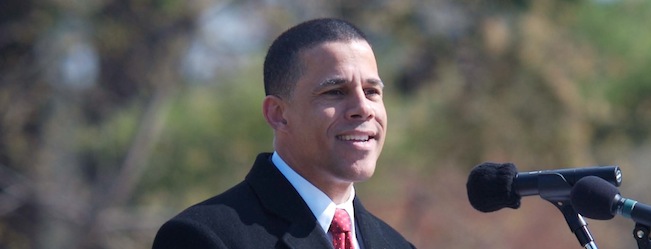
In his first public remarks on same-sex marriage, Maryland Lt. Gov. Anthony Brown told the Washington Blade Wednesday that he supports marriage equality for lesbians and gays and favors the approval of a same-sex marriage bill pending in the Maryland Legislature.
LGBT activists believe Brown, a Prince George’s County Democrat who is considered a potential candidate for governor in 2014, could play a key role in defending the marriage bill against a voter referendum in 2012 if the legislature passes it this year, as most political observers expect.
“I have always believed that all Marylanders should have an equality of rights and responsibilities and that includes marriage equality,” he said in an exclusive interview.
“So regardless of gender, we should be able to choose who it is that we are going to marry and hopefully spend the rest of our lives with. And so I’m supportive of that,” he said.
Brown said he has friends and acquaintances who are in same-sex relationships and he has seen first-hand how they are “successfully raising children,” a development that has helped shape his views on the marriage issue.
Brown’s expression of support for the marriage bill came on the same day that Republican State Sen. Allan Kittleman announced he was dropping plans to introduce a civil unions bill and would vote instead for the marriage bill.
Some LGBT activists viewed a civil unions bill as a possible competing measure that might have derailed the marriage bill.
The decision by Kittleman, the former Senate minority leader, to abandon plans to introduce a civil unions bill and to back the marriage measure, and Brown’s firm statement backing same-sex marriage, are likely to be viewed by LGBT activists as a major boost for the marriage measure.
Up until now, Brown had not taken a public stand on the marriage bill, although his press secretary, Mike Raia, said Brown had informed colleagues and friends of his support for the measure.
“The lieutenant governor’s statement comes as a surprise, but certainly a welcome surprise,” said Lisa Polyak, a board member and spokesperson for Equality Maryland, the statewide LGBT group leading efforts to pass the bill.
“We’re grateful for all elected officials, especially those in leadership roles, who understand that our families seek equal treatment under the law,” she said. “And we welcome the lieutenant governor’s joining the coalition to achieve civil marriage for same-sex couples.”
Gov. Martin O’Malley has said he would sign a same-sex marriage measure approved by the legislature. And most political observers in the state say supporters of the bill have the votes to get it through the legislature.
Before being named by O’Malley as his running mate in the 2006 gubernatorial race, Brown had served two terms in the Maryland House of Delegates from P.G. County. During his second term, Brown was named the House of Delegates’ majority whip, a leadership post that enabled him to build a good working relationship with his fellow lawmakers.
Noting that his job as whip involved “counting heads” to determine the support of various bills, Brown said he believes the marriage measure has solid support in the House of Delegates and appears to enjoy a “slim majority” in the Senate.
Asked what he thinks the chances are for opponents to place the marriage bill before the voters in a referendum, Brown said he believes a referendum on the issue will make it to the ballot, but he thinks voters will uphold the law rather than overturn it.
“It’s not a high hurdle in Maryland to get an issue on the ballot,” he said. “So it would be on the ballot for 2012 during the presidential campaign. There’s going to be a lot of voter turnout as we typically see in presidential campaigns. No doubt, like other referenda, it’s going to be hotly contested and debated.”
Brown added, “As I said today, my position is in support [of the marriage bill]. As we approach 2012 I’ll certainly evaluate what role I’m going to play on that issue.”
As a prominent black elected official, LGBT advocates for the marriage bill would likely seek Brown’s help in campaigning for the bill in a referendum fight in his home turf of majority black P.G. County. In California in 2008, exit polls showed that a majority of black voters supported overturning that state’s same-sex marriage law in the bitterly fought ballot measure known as Proposition 8.
“I think Prince George’s County, which is predominantly African American, should not be viewed as a monolithic entity or county or community,” Brown said. “I think we’re going to get varying degrees of support and varying degrees of opposition. We know from public comments that many of the traditional civil rights organizations have come out in support of it,” he said, referring to the same-sex marriage bill.
“We also know that a number of members of the clergy from the African-American churches have come out or spoke against it,” he said. “So there’s not a clear or I should say single voice in Prince George’s County on this issue as I suspect is true in most all of the large counties in Maryland.”
Brown was asked what he thought of assertions by Bishop Harry Jackson, a Maryland minister who led efforts to oppose D.C.’s same-sex marriage law. Jackson and his supporters, among other things, argued that same-sex unions endanger black families because they undermine traditional marriage.
“Well, my only response, and this is not a response to the impact on black families, white families, or any other families,” he said. “My response to that is I have had experience through friendships and acquaintances with couples – same-sex couples – who are successfully raising children. And that’s in a number or variety of racial or ethnic backgrounds. So I have difficulty understanding that comment.”
Brown’s official biography on the Maryland State website shows that he has served in the Army since 1984 both on active duty and currently in the reserves. He served a 10-month tour in Iraq as part of a Multi-National Force in 2004 that provided humanitarian assistance to the Iraqi people. In 2007 he was promoted to the rank of colonel and, as an attorney with a degree from Harvard Law School, he currently commands a Pennsylvania-based Army Legal Support unit.
With that as a backdrop, Brown was asked what he thought of the successful effort to repeal “Don’t Ask, Don’t Tell,” the law that barred gays and lesbians from serving openly in the military.
“Well, first I’ll say I couldn’t be more proud of our president for moving forward on the elimination of the “Don’t Ask, Don’t Tell” policy and recognizing full membership, if you will, in uniform services of men and women regardless of who they choose to be in a relationship with,” he said. “So I’m proud of that and I think it’s a big step forward for the armed forces and it’s a big step forward for our country.”
Added Brown, “And I will also say that after 26 years of active and reserve duty, I’d be kidding people if I told them that I never encountered a soldier who didn’t tell me that they were gay. And yet I have observed these soldiers performing their duty patriotically with the same level of diligence and commitment and that their preference had no relevance to their performance of their military duties.”
When asked about a transgender non-discrimination bill that was introduced last week into the House of Delegates with 55 co-sponsors, Brown didn’t disclose whether he has a position on the measure.
“I’m not familiar with that one,” he said. “I know I’ve dealt with some transgender bills when I was on the House Judiciary Committee, but this one in particular I’m not familiar with.”



Maryland
Md. groups receive state grants to fight hate crimes
Pride Center of Maryland among recipients
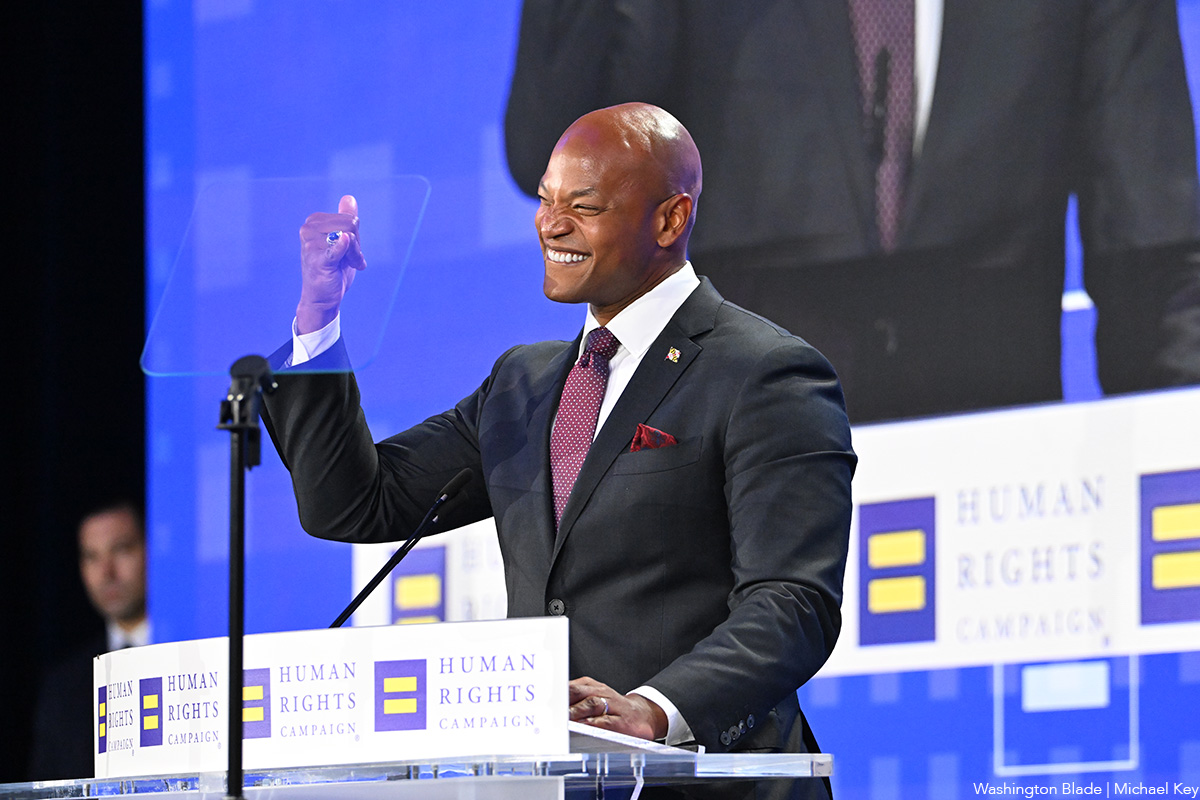
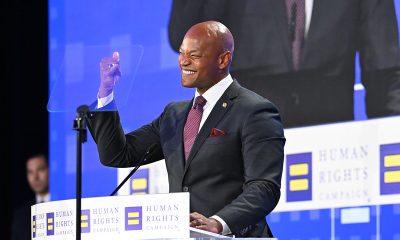
Maryland Gov. Wes Moore and the Governor’s Office of Crime Prevention and Policy are awarding a total of $10 million in grants in the 2027 fiscal year to nonprofit organizations that work to prevent hate crimes in the state.
The funds will be used to support those who feel targeted or discriminated against because of their race, religion, sexual orientation, gender identity, or disability status.
The Pride Center of Maryland is among the recipients. Churches, synagogues, mosques, and LGBTQ organizations are all eligible to receive grants
“The safety and security of all Marylanders is my top priority, so we are drawing a hard line because we have no tolerance for hate,” said Moore, according to media reports. “We are committed to protecting and ensuring safe and sacred spaces stay that way by investing in non-profit organizations, houses of worship, and community centers to protect and honor every community that makes our state so diverse and special.”
“Protection Against Hate Crime funding has strengthened the Pride Center of Maryland’s ability to protect, educate, and support the communities we serve … at a time of heightened concern associated with the Trump administration’s anti-LGBTQ/SGL (same-gender-loving) policies and pressures,” Pride Center of Maryland CEO Cleo Manago said. “PAHC funding helps us do more than improve physical security — it strengthens our community’s knowledge, preparedness, connection to resources, and ability to respond to hate with greater awareness and support.”
Maryland’s hate crimes law includes both sexual orientation and gender identity. The state’s nondiscrimination statute is also LGBTQ-inclusive.
District of Columbia
Blade welcomes fall intern
Alexis McLean is student at University of North Florida
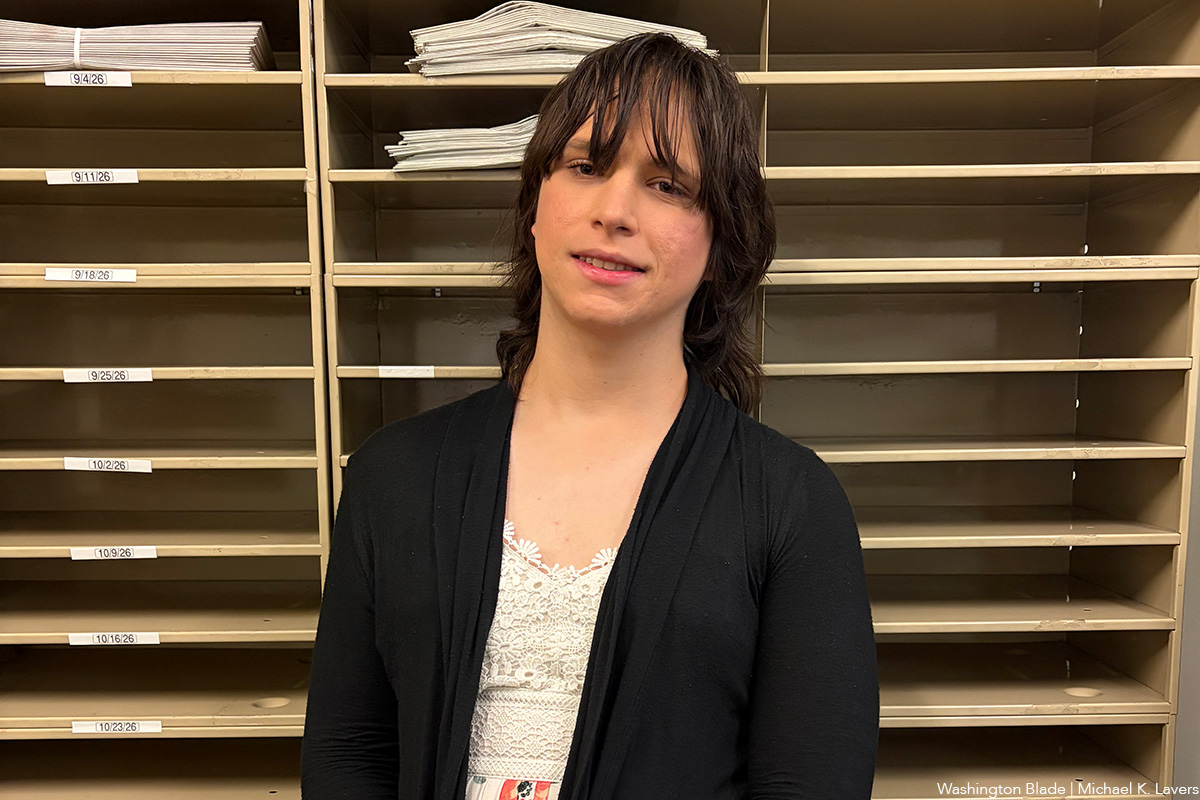
The Washington Blade this week welcomed Alexis McLean as its fall intern.
Alexis is studying political science at the University of North Florida in Jacksonville, Fla. She is interning with the Blade as part of a continued partnership with the Washington Center.
“I am looking forward to spending my time in the fall with the Washington Blade, as this is a new experience for me,” said Alexis. “I have not experienced any journalist jobs in the past so this would be my first time, and I am excited to better my writing and communications skills with this internship.”
Alexis’s internship with the Blade ends in early December.
Rehoboth Beach
SUNFESTIVAL takes center stage as Rehoboth Beach closes out summer
Labor Day Weekend bustling with events, including David Archuleta performance

Labor Day Weekend marks the unofficial end of summer in Rehoboth Beach, but there will be no shortage of LGBTQ events, with CAMP Rehoboth’s annual SUNFESTIVAL taking over town this weekend.
Thursday (9/3)
Get your Labor Day Weekend started early Thursday night with happy hour from 5-7 p.m. at Diego’s Bar & Nightclub, followed by Naughtee Bingo hosted by Magnolia Applebottom at 8:30 p.m.
After bingo, the party continues with Dancing at Diego’s from 9 p.m. to 1:30 a.m.
Aqua Bar & Grill will also kick off its Labor Day Weekend festivities Thursday with a DJ spinning from 9 p.m.-1 a.m.
Friday (9/4)
The weekend ramps up Friday night at Aqua, where DJ Matt Bailer will keep the dance floor moving from 9 p.m.-1 a.m.
Over at Diego’s, DJ Steve Sidewalk will then take over Diego’s for Freedom Friday from 9 p.m.-1:30 a.m.
Saturday (9/5)
The main event of the weekend arrives Saturday with the opening night of CAMP Rehoboth’s SUNFESTIVAL.
Billed as the ultimate party to close out the summer, SUNFESTIVAL has become one of Rehoboth’s signature Labor Day Weekend events. The annual celebration sells out each year, with proceeds benefiting CAMP Rehoboth.
Doors open at 6:30 p.m. with refreshments available at the cash bar while attendees are invited to socialize and find their seats.
Saturday night will feature local singer Ashley Williams as the opening performer, followed by headliner David Archuleta. The event will also feature a live auction.
Back across town Saturday, Aqua will continue its Labor Day Weekend DJ lineup from 9 p.m. to 1 a.m.
Diego’s will also have plenty happening, with ‘Splash Party’ hosted by Magnolia Applebottom at 5 p.m., followed by a Saturday Dance Party with Brett Oosterhaus from 9 p.m.- 1:30 a.m.
The Blue Moon hosts its popular Legends Show at 9 p.m. It’s an all-live singing show by the Blue Moon cast of celebrity impersonators.
Etienne Pilon has taken Rehoboth by storm this summer. Check out the talented singer/pianist at The Pines from 7-10 p.m.
Sunday (9/6)
Sunday’s SUNFESTIVAL event will shift the focus to the dance floor, with globally renowned DJs Robbie Leslie and James Anthony scheduled to perform. Doors open at 7 p.m., with dancing continuing until 1 a.m.
On Sunday, Aqua will throw its annual White Party, with DJs spinning from 9 p.m.-1 a.m. Guests are encouraged to dress in white for the holiday weekend celebration.
Diego’s will host its Sunday High T-Dance with Pamala Stanley at 5 p.m. Later that evening, DJ Tannr will be spinning at 9 p.m.
John Flynn is on the piano from 6-8 p.m. at the Blue Moon.
Monday (9/7)
The final day of Labor Day Weekend brings one last chance to hit the dance floor before summer officially winds down.
Aqua will close out its five-day Labor Day Weekend celebration with DJ Biff from 3-7 p.m.

Grindr settles UK lawsuit over claims it shared users’ personal information

Md. groups receive state grants to fight hate crimes

Chris Pappas wins NH Democratic Senate primary

Anti-science, anti-LGBTQ movements go hand in hand

Everton Blair makes history as first openly gay congressman from Ga.

Pentagon expands testosterone screening as trans troops face hormone therapy restrictions

Calendar: September 4-10

‘Here the Whole Time’ delivers queer coming-of-age comedy

Blade Foundation to host fundraiser in Rehoboth on Sept. 12

New book examines fashionista Audrey Smaltz’s fabulous life
-

 U.S. Military/Pentagon5 days ago
Pentagon expands testosterone screening as trans troops face hormone therapy restrictions
-
Calendar5 days ago
Calendar: September 4-10
-
Movies3 days ago
‘Here the Whole Time’ delivers queer coming-of-age comedy
-
Out & About2 days ago
Blade Foundation to host fundraiser in Rehoboth on Sept. 12