National
HRC president responds to Choi protest
Solmonese notes ‘frustration at the pace of progress’

Human Rights Campaign President Joe Solmonese (DC Agenda photo by Michael Key)
Joe Solmonese, president of the Human Rights Campaign, jumped into the debate triggered this week by gay Army Lt. Dan Choi over whether LGBT leaders and organizations are doing enough to advance LGBT equality, saying there should be a place for different tactics and strategies, including civil disobedience.
In response to questions from DC Agenda, Solmonese disputed Choi’s assertion that a deep “schism” exists in the LGBT movement over tactics and strategy.
Here are Solmonese’s responses to our questions:
DC Agenda: Dan Choi told Newsweek that groups like HRC “do not represent us if all you are looking for is a ladder to elite society.” He also said there’s a “deep schism” in the gay movement over strategy and tactics. What’s HRC’s response to this?
Joe Solmonese: Any healthy and diverse social movement will have a diversity of voices and opinions. Individuals and groups will take different approaches based on their ideology, life experience and other sincerely and deeply held beliefs about the political process. This is not indicative of a schism, but rather a sign of vibrant engagement.
Differences over tactics are nothing new; they have been a part of the LGBT rights movement since its inception. While there are some differences over strategy and tactics, there is a wide and deep consensus about movement priorities — LGBT non-discrimination laws (ENDA, DADT repeal, education, housing, credit, etc…), hate crimes protections and relationship recognition (marriage, DOMA repeal, domestic partnership benefits, adoption). Again, some in the community dissent from one or more of these goals, but these objectives enjoy significant support across the LGBT community.
Quick facts on our work:
• Our recent efforts across the country, with particular emphasis on 103 priority congressional districts, have resulted in over 190,000 phone calls and e-mails to members of Congress.
• 2,500 veterans recently said in a survey they’re willing to take action to repeal “Don’t Ask, Don’t Tell.”
• Our members submitted over 1,300 letters to editors in papers in priority media markets.
• Earlier this month, HRC sent 275 of our members to lobby on the Hill in support of ENDA, DADT and other key legislation.
• Beyond the Beltway, our members conducted over 250 in-district lobby visits.
• In 41 cities, we held events that highlighted veterans who are opposed to “Don’t Ask, Don’t Tell.” Over the next several months, we will conduct at least 20 more of these events.
• In May, we will send an even larger number of veterans to the Hill to lobby for repeal of the “Don’t Ask, Don’t Tell” law.
DC Agenda: What’s HRC’s view on how, or whether, non-violent civil disobedience action — as Dan Choi and Robin McGehee of the new national group GetEqual.org are now calling for — fits into the overall efforts to advance LGBT rights that HRC is working for?
Solmonese: The beauty of our movement is that we have a dedicated community that is constantly searching for new and innovative ways to effect change in Washington and at home. Whether it be the actions last week or meeting with a senator in a district office, these are ways that our community continues to advocate for LGBT equality. Activism by Dan Choi and others has one common intent in mind that we also share: to advance equality in the fastest way possible. As we said last week, this is the nature of social change and everyone has a role to play.
DC Agenda: Members of GetEqual.org, as you know, were arrested in the Washington and San Francisco offices of House Speaker Nancy Pelosi in a protest over what they say is Pelosi and Congress’s failure to hold a vote this year on ENDA. HRC has not included ENDA on its list of LGBT-related bills it expects Congress to vote on this year. What is HRC’s understanding of why ENDA hasn’t been scheduled for a mark up in the House and Senate and may not be voted on in the Senate this year?
Solmonese: The Human Rights Campaign and the entire LGBT community have worked hard over the last two years to build support in Congress to pass a fully inclusive Employment Non-Discrimination Act (ENDA). In recent weeks, Rep. Barney Frank (D-Mass.), the lead sponsor of ENDA, has publicly stated on a number of occasions that he believes that the House should move ENDA in the coming weeks and that we can pass an inclusive bill. We agree. We also agree with Speaker Pelosi that ensuring we will win that vote and protect the bill from harmful amendments is a critical factor in timing of floor action.
DC Agenda: Dan Choi and others have suggested that mainstream LGBT groups like HRC are too accommodating to the White House and congressional Democratic leaders on issues like ENDA and DADT. What is HRC’s current count of U.S. senators on an up or down vote on ENDA right now? Can you release a list of which of the 17 Democratic senators who are not ENDA co-sponsors will vote for or against ENDA?
Solmonese: There has been understandable frustration in the community at the pace of progress at advancing some of the pieces of key legislation that are important to the lesbian, gay, bisexual and transgender community. We continue to press the president and Congress to live up to the promises they made to advance real, substantive equality for LGBT Americans. It is critical that everyone in the LGBT community and our allies engage in this effort.
All senators (or House members) who are not co-sponsors of ENDA, DADT or other LGBT bills are pursued as key votes needed in order to pass pro-equality legislation.
DC Agenda: If you choose not to release this list, please explain why you feel it should not be released at this time. Many activists feel they could better direct their lobbying or ‘direct action’ if they know which way their senators stand on ENDA. As far as I can see, HRC’s lengthy and detailed web site page on ENDA makes no mention at all of which lawmakers are for or against ENDA.
Solmonese: Members’ positions on ENDA are determined by their co-sponsorship of the legislation, a clear public statement or their vote. Ensuring we will win that vote and protect the bill from harmful amendments is a critical factor for determining floor action and timing. There are 17 Democratic senators and 39 Republican senators who are not cosponsors of ENDA. We must win 14 of these votes to get to 60 votes to overcome a potential filibuster. Unless a member of Congress makes a clear public statement, we do not assume we have their vote.
Direct action toward a member of Congress should be done after a careful analysis of that member’s position on the issue and, if they are not publicly supportive, after determining why are they not publicly supportive. This involves significantly more research than checking a web site. HRC works every day with individual activists and organizations in those states and districts that require the most intensive grassroots work. Every LGBT person who cares about these issues should lobby their House member and two senators. Even cosponsors must be asked to do more to bring these bills to successful votes.
DC Agenda: Robin McGehee of GetEqual.org says her group wants a vote on ENDA, even if there aren’t enough votes to pass it. What is HRC’s view on this? What are the pros and cons of having a vote on an important bill if you know in advance there aren’t enough votes to pass it?
Solmonese: An unsuccessful vote can be very harmful to an issue and prevent successful action for many years. In some cases, having the vote can be a useful marker. Particularly in regard to ENDA, bringing the bill to the Senate floor without very careful consideration could result in some incredibly harmful amendments, some related to ENDA and other anti-LGBT-related amendments. Harmful congressional votes can spill over into fights over state legislation and into state and federal court cases. In addition, it is unusual for congressional leaders to schedule votes that are expected to fail.
U.S. Military/Pentagon
Pentagon expands testosterone screening as trans troops face hormone therapy restrictions
Defense Department says updated guidelines to be issued shortly

The Pentagon has announced that new clinical guidance will be released establishing mandatory testosterone deficiency screening for active-duty and reserve cisgender male service members ages 30 and older, advancing a policy that expands hormone-related care for cisgender troops.
The Defense Department said the existing clinical guidelines, which are not currently available on the Defense Health Agency’s website, are being updated and that the final guidance will be issued shortly.
The announcement comes amid a wave of anti-transgender policies from both the DoD and the Trump-Vance administration, which continue to prohibit trans men from receiving the same treatment.
Under the forthcoming guidance, men ages 30 and older will be forced to undergo testosterone blood tests as part of their medical care. Younger male service members will be tested if they request screening or if clinicians identify warning signs of low testosterone.
The new guidelines formalize a screening program Defense Secretary Pete Hegseth announced in July, when he said the Pentagon would begin testing service members to ensure that “you have the right testosterone levels to operate at your absolute best.”
“Taking care of your long-term health means ensuring you remain strong, resilient, and capable — not just for your next deployment, but for the rest of your life, so you can thrive long after you take off the uniform,” Hegseth said at the time.
The Defense Health Agency’s clinical guidance says the program is intended to address “hormonal and energy-availability issues.” Hegseth said in July that testosterone replacement therapy would remain voluntary for service members if treatment is recommended.
The Food and Drug Administration is also scheduled to hold a meeting later this month with experts to discuss the medical use of testosterone.
The Pentagon’s push to routinely test testosterone levels runs counter to current medical guidance, which generally recommends considering testosterone therapy only for men who have symptoms consistent with low testosterone and have documented low hormone levels on two separate blood tests.
Testosterone is a sex hormone naturally produced by people of all sexes. It plays a role in regulating muscle mass, bone density, and sex drive. Testosterone levels in men naturally decline with age and have been associated with symptoms including erectile dysfunction, low libido, mood changes and weight gain, although experts continue to debate when testosterone therapy is medically appropriate.
The policy has drawn scrutiny from LGBTQ advocates because the Pentagon and Hegseth have simultaneously cited hormone therapy as part of the rationale for removing trans service members from the military.
Under President Donald Trump’s 2025 executive order, “Prioritizing Military Excellence and Readiness,” the military has moved to bar trans people diagnosed with gender dysphoria from serving and has begun formal administrative separation proceedings against trans personnel.
The Pentagon continues to pursue implementation of the trans military ban as litigation over the policy proceeds. As a result, some trans service members have had their gender-affirming hormone therapy halted even as the Pentagon expands testosterone screening and potential treatment for cisgender service members.
SPARTA Pride, a nonpartisan nonprofit organization made up of trans service members, veterans and their allies, criticized the disparity to the Washington Blade when Hegseth first announced the screening program.
“If hormone therapy helps warfighters perform at their best, then it cannot simultaneously be used as evidence that transgender service members are unfit to serve,” said Kara Corcoran, executive director of SPARTA Pride. “The same class of evidence-based medical treatment cannot be characterized as readiness-enhancing for one group and readiness-destroying for another.”
On June 1, the U.S. Court of Appeals for the D.C. Circuit ruled that trans service members already serving in the military could continue to do so while allowing the armed services to continue refusing to enlist new trans recruits.
The Blade reached out to the Pentagon when the testosterone screening program was first announced in July, asking why cisgender service members could receive testosterone therapy while transgender service members could not. The Pentagon did not respond.
National
Lou Chibbaro Jr. documentary wins award from NLGJA
‘Lou’s Legacy’ produced by D.C.’s Mattachine Society

“Lou’s Legacy: a Reporter’s Life at the Washington Blade,” a documentary produced by The Mattachine Society of Washington, D.C., will receive an Excellence in Journalism Award from NLGJA, the Association of LGBTQ+ Journalists.
The film premiered on WETA PBS in D.C. and Maryland Public Television (MPT) in June of 2025. The documentary’s Emmy-nominated director and producer Patrick Sammon will accept the award for Excellence in Local Television on Sept. 11 at NLGJA’s National Convention in San Francisco.
“Lou’s Legacy” was produced in association with the Mattachine Society of Washington, D.C., a non-profit LGBTQ history society dedicated to conducting original archival research. Aside from Sammon, the NLGJA is recognizing other members of the film’s production team including Producer Julianne Donofrio, Editor Amir Jaffer, Executive Producer Charles Francis, and Executive Producer Pate Felts.
“Lou’s Legacy” tells the story of two D.C. icons — legendary Washington Blade reporter Lou Chibbaro Jr. and beloved drag performer Donnell Robinson, known to generations of Washington audiences as “Ella Fitzgerald.” Through Lou’s nearly five-decade career at the Blade and Ella’s return to the stage after a three-year hiatus following COVID, the 29-minute documentary explores the history of Washington’s LGBTQ community and today’s rising backlash against LGBTQ rights, including laws targeting drag performers.
“All students of journalism can learn a lot from the story of Lou Chibbaro, Jr. Lou has chronicled nearly five decades of LGBTQ+ life and the community’s struggle for equality in Washington, D.C. Lou’s work and the role of the queer press has been essential in covering stories the mainstream media would often ignore or erase,” said Ryan Levi, president of the D.C. chapter of the NLGJA.
“We are thrilled to receive this award from the NLGJA,” said the film’s director Patrick Sammon. “Lou Chibbaro’s nearly five decade career at the Washington Blade demonstrates the essential role LGBTQ journalism plays in telling our community’s stories and documenting its history. This recognition from journalists who follow in Lou’s footsteps is particularly meaningful to me and the rest of our production team.”
Arizona
Shooting outside gay bar in Ariz. leaves three dead
Tucson police investigating double murder-suicide as a hate crime
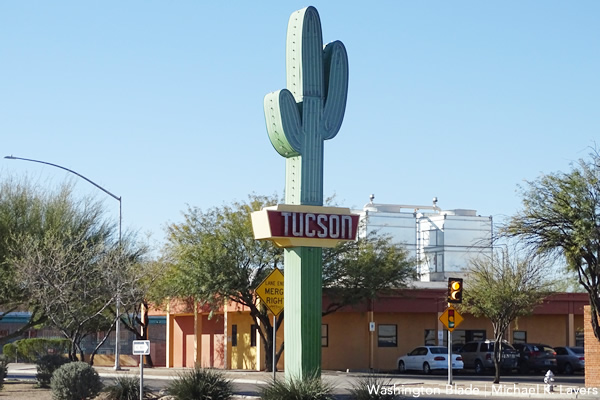
Three people were fatally shot outside a gay bar in Tucson, Ariz., early Monday morning, about a mile from the city’s nightlife district.
Police have said the shooting, which took place in the parking lot of Venture-N bar at 1239 N. 6th Ave., was likely a hate crime and a double murder-suicide following a verbal altercation.
The suspect, Ousman Ceesay, allegedly shot Vincent Anthony Siqueiros and Cameron Davis Capara while they were outside the club around 12:30 a.m. Monday.
Reports show Capara and Siqueiros were pronounced dead at the scene. Ceesay died after being taken to a local hospital with gunshot wounds.
Police have also said that Ceesay was carrying a list of LGBTQ businesses at the time of the shooting.
Arizona Public Media has said police are investigating the case as a hate crime because the suspect was carrying a note containing the names of multiple LGBTQ-associated businesses.
“I am deeply saddened that another senseless loss of life has happened in our community,” Tucson Police Chief Monica Prieto said in a statement. “Bias-based crimes are especially heinous and have no place in our community.”
According to Prieto, there is no imminent threat to the community, and the Tucson Police Department is working to provide extra protection to various LGBTQ businesses across town.
Congresswoman Adelita Grijalva, who represents the area, issued a statement condemning the act of violence, which appears to have been at least in part motivated by homophobia.
“I am disgusted and deeply saddened to learn of a targeted act of hate and the cold-blooded murder of two members of our LGBTQIA+ community, Vincent Siqueiros and Cameron Capara, at the Venture-N bar in Tucson last night. This horrific attack is a painful reminder that even in welcoming communities like Tucson, hate and violence against the LGBTQIA+ community still exist.”
“When that hate is combined with easy access to firearms, the consequences can be deadly. I am sick and tired of Congress refusing to lift a finger to protect our communities while, every day, dozens of people are shot and killed across the country. It does not have to be this way. The House of Representatives is returning to session this week, and our first action should be passing common-sense gun safety reforms that we know can save lives.”
Other federal lawmakers also condemned the shooting.
The Congressional Equality Caucus, which is made up of federal legislators advancing LGBTQ interests, issued a statement after news broke.
“Our hearts are with the friends and loved ones of the victims of this devastating attack outside a Tucson gay bar and with the Tucson LGBTQI+ community,” it said on X. “No one should fear violence because of who they are — and we’re going to continue fighting to build a world where no one does.”
The Human Rights Campaign, the largest LGBTQ organization in the country, released a statement following the shooting.
“We are heartbroken by the loss of Vincent Anthony Siqueiros and Cameron Davis Capara and our hearts are with their families, loved ones, and the entire Tucson LGBTQ+ community. Once again, we are reminded that gun violence robs people of their lives, destroys families, and devastates communities.”
A candlelight vigil honoring the victims is planned for Sept. 2 at 6:30 p.m. at Catalina Park in North Tucson.

Pentagon expands testosterone screening as trans troops face hormone therapy restrictions

Calendar: September 4-10

Swiss government backs nationwide conversion therapy ban

Gloria Steinem dies at 92

The mastery of love

Prominent French activist attacked outside Paris bar

Whitman-Walker’s 40th Walk & 5k Run to End HIV set for Sept. 19
Shooting outside gay bar in Ariz. leaves three dead

PHOTOS: Miss Gay Old Bay