Politics
Corporate allies increasingly challenged over LGBTQ support
State Farm, Disney punished for speaking out

After years of leveraging their familiar brand names to denounce anti-LGBTQ measures in state legislatures, large corporations are facing increasing challenges to their free speech amid newfound pressure from conservative forces, raising questions about whether they will continue to remain as vocal as they have in the recent past.
From retaliation against State Farm for pledging to donate LGBTQ-themed books to children’s schools, to Florida revoking Disney’s special districting status after speaking out against the “Don’t Say Gay” law recently signed by Gov. Ron DeSantis, businesses are encountering significant resistance after pledging support for the LGBTQ community — and the blowback is having an impact that may silence the relatively newfound ally for LGBTQ causes.
Nadine Smith, at the forefront of the fight as executive director of Equality Florida, said businesses “are receiving clear messages from the DeSantis bully pulpit not to interfere with the agenda of censorship and discrimination.”
“Speaking out on behalf of your employees’ children and the respect of your employees’ families is in keeping with the values of diversity and inclusion companies have touted for years to attract and retain top talent,” Smith added. “Failing to walk the walk because the governor and his fellow extremists have threatened you is the political choice.”
One recent case of a business reversing course was State Farm backing down after pledging to donate LGBTQ-themed books in coordination with GenderCool, a youth organization highlighting LGBTQ-themed voices, to schools and libraries. Among the titles of the books to be donated were “A Kids Book About Being Transgender,” “A Kids Book About Being Inclusive,” and “A Kids Book About Being Non-Binary,” which portrayed the experience of different gender identities. The anti-LGBTQ group Consumers’ Research launched a campaign consisting of online blasts, which were boosted by The Daily Wire and Breitbart, with the slogan “Like a Creepy Neighbor…State Farm is There.”
The campaign appeared to have the desired impact. On May 23, State Farm announced it would pull back, declaring “conversations about gender should happen at home with parents” as opposed from GenderCool it “will no longer support that program.” Although State Farm in a later statement insisted it would continue to support the LGBTQ community and inclusivity, the victory for conservative forces was evident.
Another high-profile example of a business speaking out on policy against LGBTQ people and facing blowback was Disney when it spoke out against the Florida “Don’t Say Gay” law, which prohibits discussion in schools on LGBTQ matters in grades K-3 . Although Disney initially was reluctant to speak out, it reversed course in response to public pressure and CEO Bob Chapek contacted DeSantis to denounce the measure days before he would sign it.
DeSantis, who’s widely considered a leading contender for the Republican presidential nomination in 2024, publicly denounced the company for embracing “woke” ideology. The Florida Legislature followed up by revoking Disney’s tax status, which had enabled it to operate its own security forces in Disney World in Orlando.
The conservative media also played a role. Skewering Disney for taking a stance against the “Don’t Say Gay” measure, The Daily Wire decried the media conglomerate for its all around approach to LGBTQ visibility, declaring a $100 million investment in the launch of a “DW Kids,” which aims to be a competitor to Disney in youth media. Conservatives also crowed when polling found Disney has suffered a loss in public approval; one poll from the conservative Trafalgar Group found 68 percent of respondents were less likely to do business with Disney as a result of the company “focusing on creating content to expose young children to sexual ideas.”
Disney ended up making neither side happy. The Human Rights Campaign announced it wouldn’t accept a donation of up to $500,000 pledged by Disney at the time it came out against the “Don’t Say Gay” law. Media reports also highlighted stories about LGBTQ employees and allies at Disney storming out in protest over the media company’s delayed action on the Florida measure.
Fabrice Houdart, managing director of the LGBTQ group Out Leadership, acknowledged the “Disney debacle hurt our community,” but said he thinks the overall impact of the incident was no indication of a decrease in strength among LGBTQ people.
“If Bob Chapek was testing the resolve and clout of our community and its allies to ensure corporations take a stance when our human rights are under attack, he got a very clear response,” Houdart said. “The community’s reaction, protests, and media coverage highlighted that the time for companies to play both sides on human rights is over. Corporate power is immense and we will continue to engage corporations to ensure they put their money and lobbying efforts where their mouth is.”
But the growing tension among business leaders is palpable. The Wall Street Journal, in an article titled “Disney’s clash with Florida has CEOs on alert” dated May 2, details the impact retaliation is having on businesses and whether or not they will take a stance on LGBTQ issues or other matters deemed socially divisive, revealing a new trepidation not seen in recent years.
“The fallout from the recent political spat between Disney and Florida Gov. Ron DeSantis has alarmed leaders across the corporate sphere, according to executives and their advisers, and heightened the challenges for chief executive officers navigating charged topics,” the Journal reported.
The current situation stands in stark contrast to years past when businesses were falling over themselves to denounce measures and policies against LGBTQ people. The most recent case was House Bill 2 in North Carolina, which barred citywide LGBTQ non-discrimination ordinances and transgender people from using restrooms on public property consistent with their gender identity. The business outcry and cancellations cost the state an estimated $39.7 million in revenue and is credited for being the reason Gov. Pat McCrory lost re-election in 2016.
The outcry over House Bill 2 echoed a similar situation. In Arizona, the business outcry in 2013 over religious freedom legislation seen to enable discrimination against LGBTQ people led conservative Gov. Jan Brewer to veto the measure. In 2015, Then-Indiana Gov. Mike Pence defied opposition to similar religious freedom legislation and signed the measure into law, but after outcry continued to escalate, he signed into a law a “fix” to the legislation that dramatically limited its discriminatory scope.
In each of these cases, businesses were seen as the key ally in pushing back against measures against LGBTQ people because their brands were well known, seen as neutral in outlook and influential with lawmakers counting on political donations to win re-election. As a result, corporate involvement may well have turned the tide in conservative states like Arizona, Indiana, and North Carolina.
Regional differences may account for the different outcomes as LGBTQ advocates in certain states continue to boast strong business support that continues to thwart legislation seen to enable discrimination.
Angela Hale, managing director of the LGBTQ group Texas Competes, made a distinction between Florida, where she said the environment is “toxic” after retaliation against Disney and may lead businesses to “think twice” on LGBTQ issues, and Texas, where she said the business community continues to support LGBTQ people, pointing out more than 1,500 businesses back her organization.
“What I’ve been watching is Ron DeSantis punish Disney, try to punish the Special Olympics, punish the baseball team in his state, for speaking out on issues that are important to those corporate values,” Hale said. “And that’s unfortunate that he is taking such tactics because businesses employ millions of people across the country and have employees in every state, and these employees care about the positions that the company they work at take.”
Asked whether she thinks the retaliation against companies like Disney would have an impact, Hale said it’s “too soon to tell,” but in the meantime businesses are continuing to speak out on a range of issues, including gun control after the recent shooting at a grade school in Uvalde, Texas.
“When we have these horrible anti-LGBT bills, and we’re particularly targeting trans children, and we’re targeting teachers, businesses are going to speak out,” Hale said. “I have found at least what’s going on, even in this climate and in Texas, that because of the seriousness of the situation right now that we are having people brave enough to speak out, and it does take bravery to speak out because there can be consequences to those actions if you’re a regulated industry.”
The new influence of conservative media, which in years past didn’t have the impact or organization to take on LGBTQ rights, also cannot be understated. The Daily Wire, for example, proudly brags about its influence on Facebook and has produced some of the most widely circulated pieces on LGBTQ issues. Ben Shapiro, founder and contributor to The Daily Wire, did not immediately respond to the Blade’s request Wednesday to comment for this article.
Houdart, at the end of the day, said he’s is “not concerned” about businesses withdrawing because they know supporting LGBTQ people is good business, and the LGBTQ movement would continue to harness that power to “engage corporations to ensure they put their money and lobbying efforts where their mouth is.”
“Companies were never supportive out of the goodness of their heart but because it is good business,” Houdart said. “And it remains good business. Employees, consumers, and investors are very clearly demanding that the private sector acquires a social license to operate and LGBTQ+ issues are one of the most straightforward avenues for companies to do so.”


Congress
HRC president campaigns for Chris Pappas in NH
Gay congressman running to succeed retiring U.S. Sen. Jeanne Shaheen
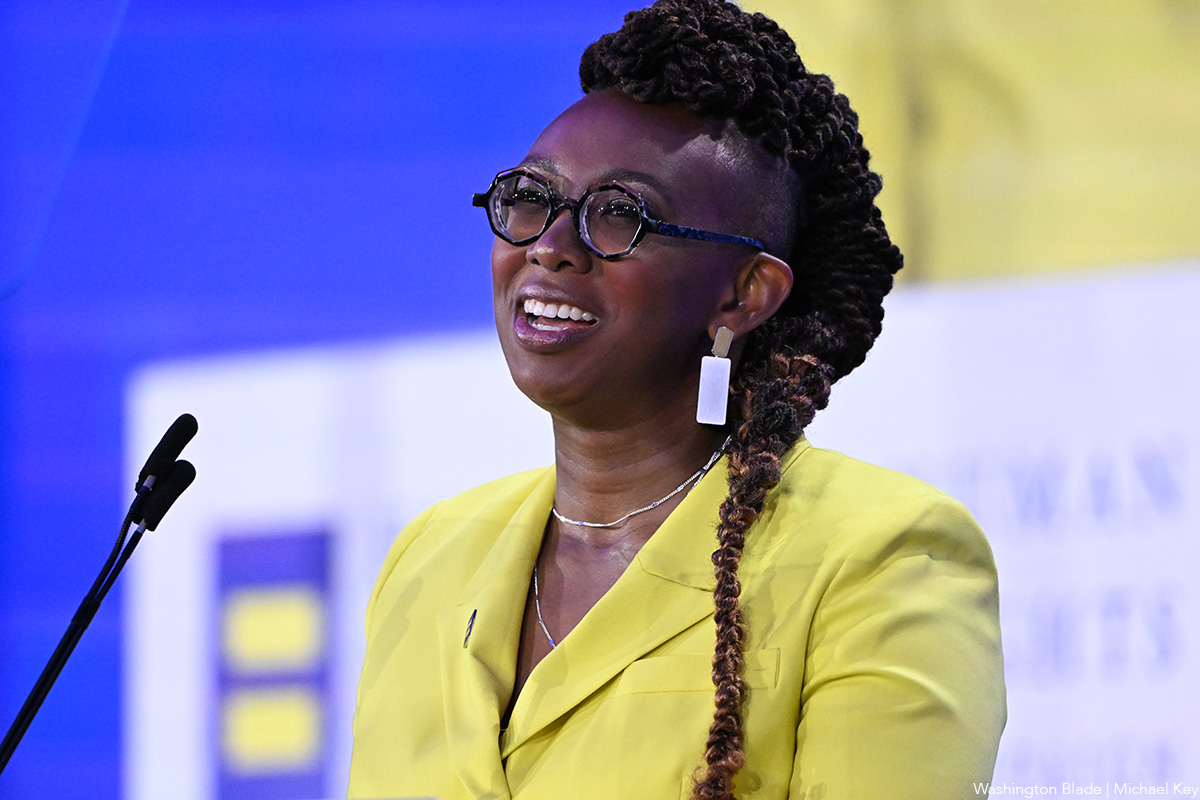
Human Rights Campaign President Kelley Robinson on Sunday campaigned for U.S. Rep. Chris Pappas (D-N.H.) in New Hampshire.
Robinson traveled to Manchester, the state’s largest city, nine days before the Sept. 8 primary that will determine who will vie for retiring U.S. Sen. Jeanne Shaheen (D-N.H.)’s seat.
We’re hitting the pavement across New Hampshire to fight for a freer, fairer future for everyone.
Glad to have Human Rights Campaign President @KelleyJRobinson join us for a canvass launch in Manchester today. pic.twitter.com/XWCEaQxy4o
— Chris Pappas (@ChrisPappasNH) August 30, 2026
Former U.S. Sen. John E. Sununu, who represented New Hampshire in the U.S. Senate from 2003-2009, will face off against former U.S. Sen. Scott Brown, who represented Massachusetts in the U.S. Senate from 2010-2013, in the Republican primary.
Karishma Manzur is among the Democrats challenging Pappas.
A poll the University of New Hampshire Survey Center released on Aug. 26 shows Sununu is ahead of Brown. The same survey shows Pappas ahead of Manzur and his other Democratic challengers.
The UNH Survey Center poll shows Sununu ahead of Pappas by a 45-43 percent margin if they were to face off in the general election. The margin of error is +/-2.1 percent.
Pappas would become the first openly gay man elected to the U.S. Senate if he were to win in November.
Congress
Chris Van Hollen says the Democratic Party needs change. Is he the one to lead it?
Senator is backing anti-establishment Democrats across the country
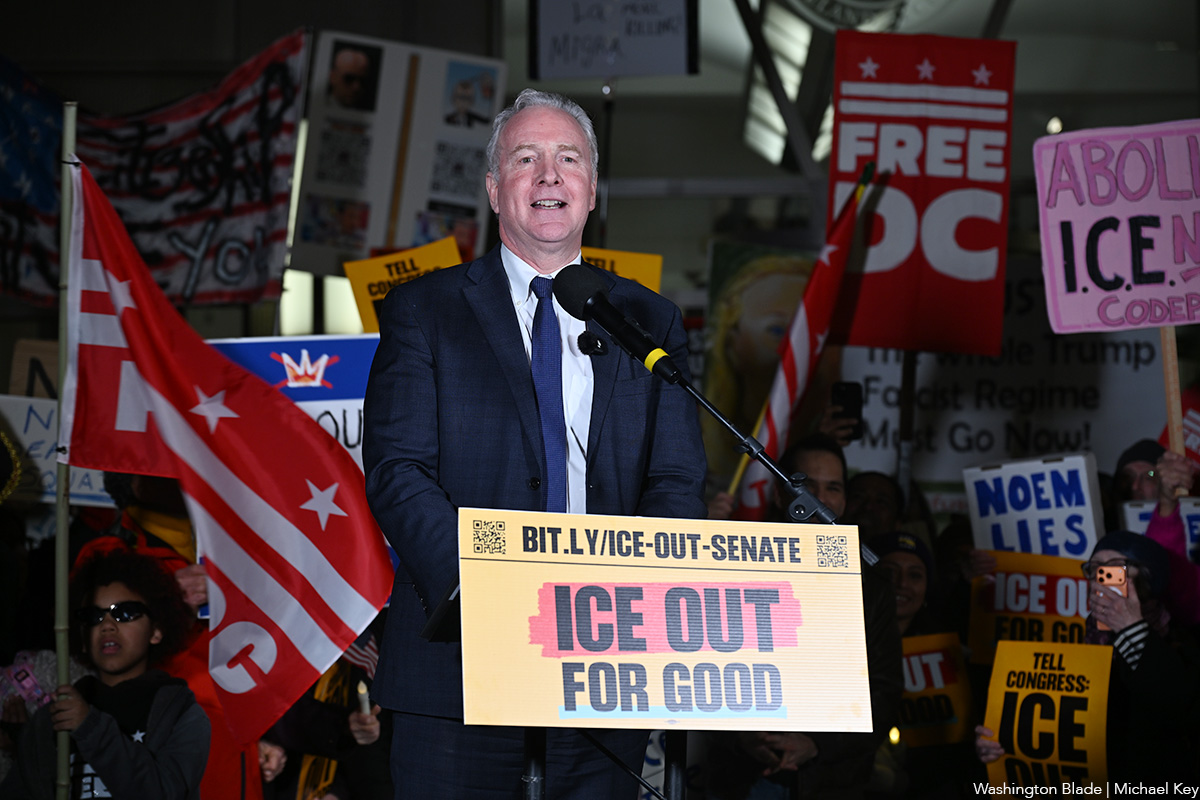
By LEE O. SANDERLIN | The Democratic Party is having something of an identity crisis — losing to President Donald Trump twice in three elections will do that.
Should the party embrace anti-establishment figures who espouse progressive policy ideas like Medicare for all and rhetoric about unrigging the economy for the 1 percent? Or should Democrats try to appeal to moderates who want to return to semi-normalcy in a time of political upheaval?
Although he’s been in Congress since 2002, with key leadership roles throughout his tenure, Maryland Sen. Chris Van Hollen, 67, counts himself firmly in the anti-establishment camp.
The rest of this article can be found on the Baltimore Banner’s website.
Politics
Log Cabin Republicans remove transgender rights from mission
Decision made after ‘significant discussion’ with members, board

Log Cabin Republicans, an organization that formerly represented LGBTQ conservatives, has removed advocating for transgender and queer rights from its “renewed” national advocacy focus.
In an opinion piece written by Log Cabin Republicans President Ross Hemminger for the conservative media outlet Town Hall, he announced that trans rights would no longer be part of what the organization advocates for through conservative leadership and candidates.
In his piece, Hemminger wrote that after “significant discussion” with members and Log Cabin Republicans’ board of directors, the organization’s leadership voted to “refine Log Cabin Republicans’ national advocacy focus to concentrate specifically on issues of sexual orientation and conservative values,” a focus that does not include trans people.
“We have fought for the right to legally marry who we love, serve our country and our communities openly and proudly, and to enjoy the same inalienable rights afforded to all law-abiding Americans — and we succeeded,” Hemminger wrote. “However, the new era of gender identity politics is not the movement we supported and fought for. Gay men and women are losing public support across the country, and support for gay marriage and other once-widely accepted rights is eroding. Why? Because many voters today weren’t alive or cognizant of the politics of gay marriage winding its way through the courts and gaining ground in public opinion. Their view of the gay community is based on today’s radical transgender activists with their unnecessary and discomfiting focus on America’s youth.”
Hemminger then went on to argue that trans advocacy has shifted to focusing primarily on minors — a characterization that does not reflect the breadth of issues trans advocates address.
“They push schools to teach radical gender ideology; they want biological men in women’s sports regardless of the consequences; perhaps most offensively, they support gender reassignment treatments for minors, often without the knowledge or consent of the parents, knowing full well these treatments are mostly irreversible,” he wrote.
Hemminger and many right-wing political leaders have continued to assert this false reality as fact.
A Harvard-affiliated study found approximately 2.1 gender-affirming surgeries occur per 100,000 trans and gender-diverse minors diagnosed with gender dysphoria, underscoring how uncommon these procedures are among minors. In addition to the option of surgery for those who think it’s right for them, there is an array of other medically sound options to treat gender dysphoria, which according to KFF, an independent source for health policy research and polling, includes “medical, surgical, mental health, and non-medical services for transgender and nonbinary people.”
Additionally trans advocacy is not as narrow as Hemminger makes it seem in his opinion piece.
There are a slew of issues the trans community faces — and fights for — on a daily basis that have nothing to do with healthcare. Those include obtaining government documents that accurately reflect one’s gender identity, multiple elements of family law that include the right to marry and adopt children as straight couples can, protections from violence, hate crime protections, the right to serve in the military, access to bathrooms corresponding with their gender, and the right to education.
Despite the overwhelming number of issues trans people — regardless of political affiliation — have to struggle with as a result of systemic gaps in protections that are supposed to be afforded to everyone under the law, they remain vulnerable to unequal treatment.
Despite this shift, Log Cabin Republicans has committed to standing with the Republican Party rather than LGBTQ people as a whole. The organization was initially founded as a loosely connected network of local California social clubs made up of LGBTQ conservatives in the late 1970s before eventually emerging as a national political organization in the early 1990s under its founding executive director, Rich Tafel.
As the organization continued to gain momentum, it endorsed a handful of Republicans who voted against the Respect for Marriage Act, the 2022 law that federally recognized marriage equality for same-sex couples.
The Washington Blade reached out to Log Cabin Republicans for comment but did not hear back by the time of publication.

HRC president campaigns for Chris Pappas in NH

We’re getting married but our parents object

Michael Smith could make history as Delaware’s first LGBTQ treasurer

Poland begins to legally recognize same-sex marriages from other countries

Immersive ‘Nation-State’ imagines a society free of authoritarianism

Please join me in supporting the Washington Blade Foundation

American democracy on the brink

Girlfriends charged with Silver Spring murder to go on trial in 2027

Rehoboth mayor calls for commissioner’s resignation after investigation into improper behavior

San Francisco, long a queer safe haven, remains competitive for homebuyers
-

 Commentary5 days ago
Please join me in supporting the Washington Blade Foundation
-
Opinions5 days ago
American democracy on the brink
-
Maryland5 days ago
Girlfriends charged with Silver Spring murder to go on trial in 2027
-
Rehoboth Beach5 days ago
Rehoboth mayor calls for commissioner’s resignation after investigation into improper behavior