District of Columbia
Protesters rally in D.C. one week after federal takeover
Hundreds of residents and community leaders gathered on U Street to condemn the Trump administration’s deployment of out-of-state National Guard troops and federal agents in D.C.
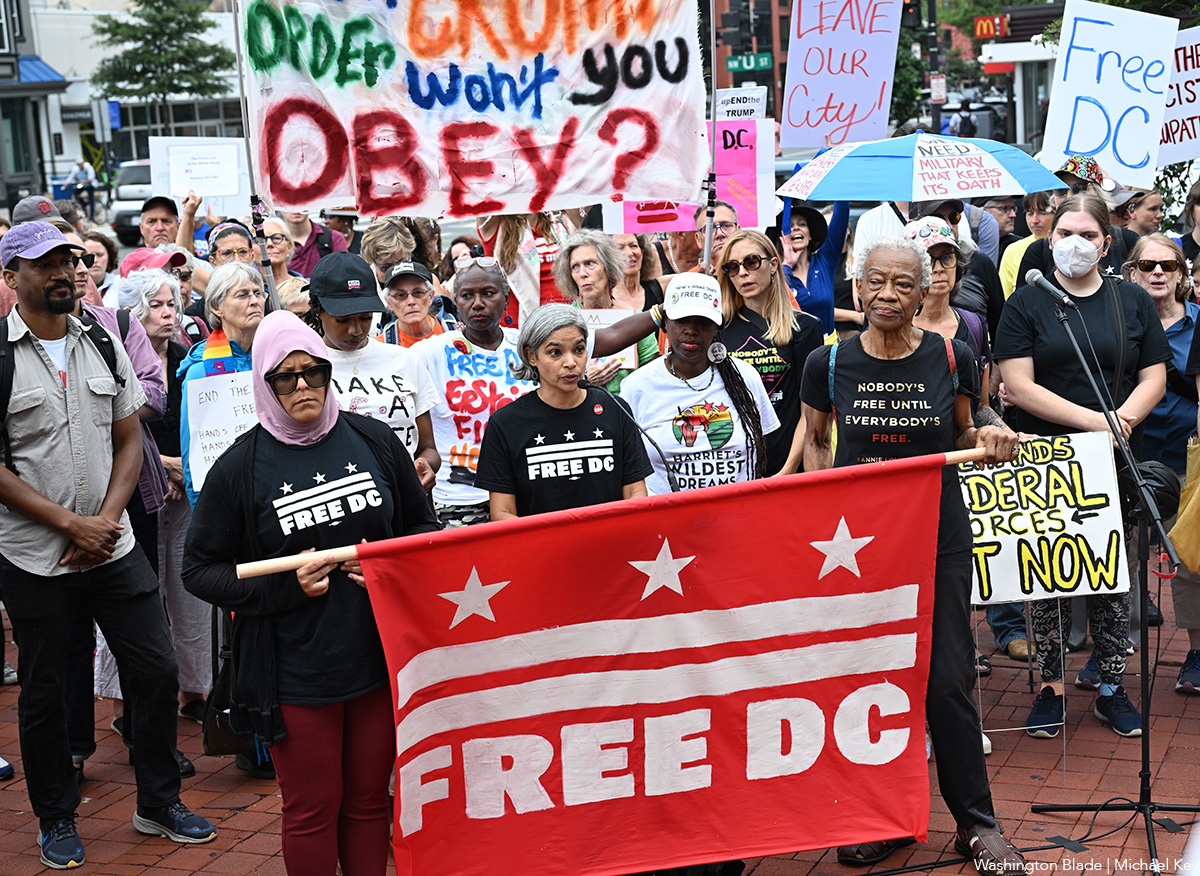
More than 200 people gathered in front of the old Frank Reeves Municipal Center on Monday to protest the Trump administration’s federal takeover of the District of Columbia and MPD.
Free D.C. — a nonprofit whose mission is securing self-determination for the District — hosted the event at 14th and U streets, N.W. Speakers from several community organizations addressed the crowd, arguing that the takeover harms the city more than it helps.
Keya Chatterjee, executive director of Free D.C., was among the first to speak. She said the administration’s actions represent a blatant overreach of federal power, motivated by partisanship rather than public safety.
“Since last week, Trump has sent federal law enforcement agents into our neighborhoods, made our police start turning people over to ICE, sent in our local National Guard and attempted to put our local police department under federal control,” Chatterjee told reporters and protesters. “Today, he has sent in armed National Guard from three additional states.”
By Tuesday morning, six states had pledged to send troops. All are governed by Republicans, contributing anywhere from 150 to 400 National Guard members each. Together, more than 1,000 out-of-state troops are now expected to patrol the District.
Louisiana Gov. Jeff Landry pledged 150 troops; West Virginia Gov. Patrick Morrisey said he would send between 300 and 400; South Carolina Gov. Henry Dargan McMaster pledged 200; Ohio Gov. Mike DeWine said his state would send 150; Tennessee Gov. Bill Lee committed about 160; and Mississippi Gov. Tate Reeves pledged 200.
Chatterjee was not alone in criticizing the presence of non-D.C. officers. Jesse Rabinowitz of the National Homelessness Law Center said the money spent deploying troops could instead be used to house people experiencing homelessness — many of whom, he argued, the administration is targeting for removal.
“According to estimates, it costs over $420,000 a day to deploy the D.C. Guard,” Rabinowitz said. “That number does not factor in the Guard troops now invading from West Virginia, Ohio and South Carolina. But just using this D.C. cost — $420,000 a day — tells an important story. It costs $47,000 a year to get somebody off the street and into housing for one year. For one day of D.C. Guard activation, we could solve homelessness for nine people.”
He added that the clearances are designed for optics, not solutions.
“On Thursday night, over 30 federal police officers from the FBI, Secret Service and Homeland Security gathered near a few tents in Foggy Bottom. They didn’t come offering housing or support. They came with their guns and lights flashing.”
“The solution to homelessness is housing,” he continued. “The solution to authoritarianism is solidarity.”
Kelsye Adams, director of D.C. Vote and Long Live Go-Go, also condemned the use of the U Street corridor as a staging ground for federal forces.
“For the first time in history, a president seized control of our local government,” Adams told the crowd, which booed loudly in response. “He stripped away local authority unlawfully as our AG got out there and filled our streets with over 800 National Guard troops from other states, federal agents, including ICE, FBI … And where did they land? Right here on U Street, on Black Broadway in the middle of our door.”
“They call it public safety, but here’s the truth: crime is down in D.C.,” she continued, citing Department of Justice data ignored by the administration. “This is the lowest that violent crime has been in D.C. in the past 30 years … If crime is down, why all the troops? Why ICE? Why remove the unhoused? Why checkpoints and why say this is about safety? Let’s be real. This is a fascist takeover.”
Adams stressed that Black and brown children living around U Street are bearing the brunt of the militarization.
“Children should not feel like suspects for simply living; our young people deserve joy, safety and dignity, not militarization.”
Nee Nee Taylor, organizing director of Free D.C., echoed that message, pointing to the long history of police targeting youth of color.
“Black and brown people, we are not safe,” Taylor said. “We are in a state of emergency right now. We are being watched. We are being targeted, and it’s not safe to walk alone.”
“They want to drag us back to the days of Emmett Till and Jim Crow, but hear me clearly — we’re going to resist. We’re going to show up. We’re going to take up space, we’re not going to comply, and we’re going to send joy while we’re doing it.”
“Safety cannot be manufactured through fear. Let me say that again: safety cannot be manufactured.”
A representative from Colectivo Familias Migrantes, a civil society group focused on human rights and democratic rule of law in the Americas, told the crowd that incidents of undocumented people being scooped up in unmarked cars by masked agents are part of a broader plan to continue policing Black and brown people in D.C. — regardless of their immigration status.
“These are not coincidences. These are strategically placed and targeted to bring fear and panic, all while building a disgusting narrative that continues to criminalize our bodies every single day.”
“We demand that all federal forces leave now,” she added.
Rach “Coach” Pike, co-owner of the queer bar As You Are in Southeast D.C., told the Blade they attended the event to show solidarity and to stress the importance of LGBTQ awareness.
“I think it has more to do with location and who they’re targeting, which are Black and brown communities, communities that are unhoused. So I think it’s more about that than queer people — at least for now. Queers aren’t the focus yet.”
As a business owner, Pike said their priority is supporting those being directly targeted by the administration — and encouraging other businesses to do the same.
“I just encourage business owners, mostly to be on the street, help with the resources they can communicate and get information out to people, and push people toward our amazing D.C. organizers, because they’re the ones we need to follow right now.”
“Being out here with our people and amongst like-mindedness is really important to kind of get your energy up,” Pike added. “I wouldn’t say I feel any better — it’s all bullshit — but I feel surrounded, wrapped up, covered. Like I’m getting more information to help cover other people. You know, we got to keep us safe.”




The Comings & Goings column is about sharing the professional successes of our community. We want to recognize those landing new jobs, new clients for their business, joining boards of organizations and other achievements. Please share your successes with us at [email protected].
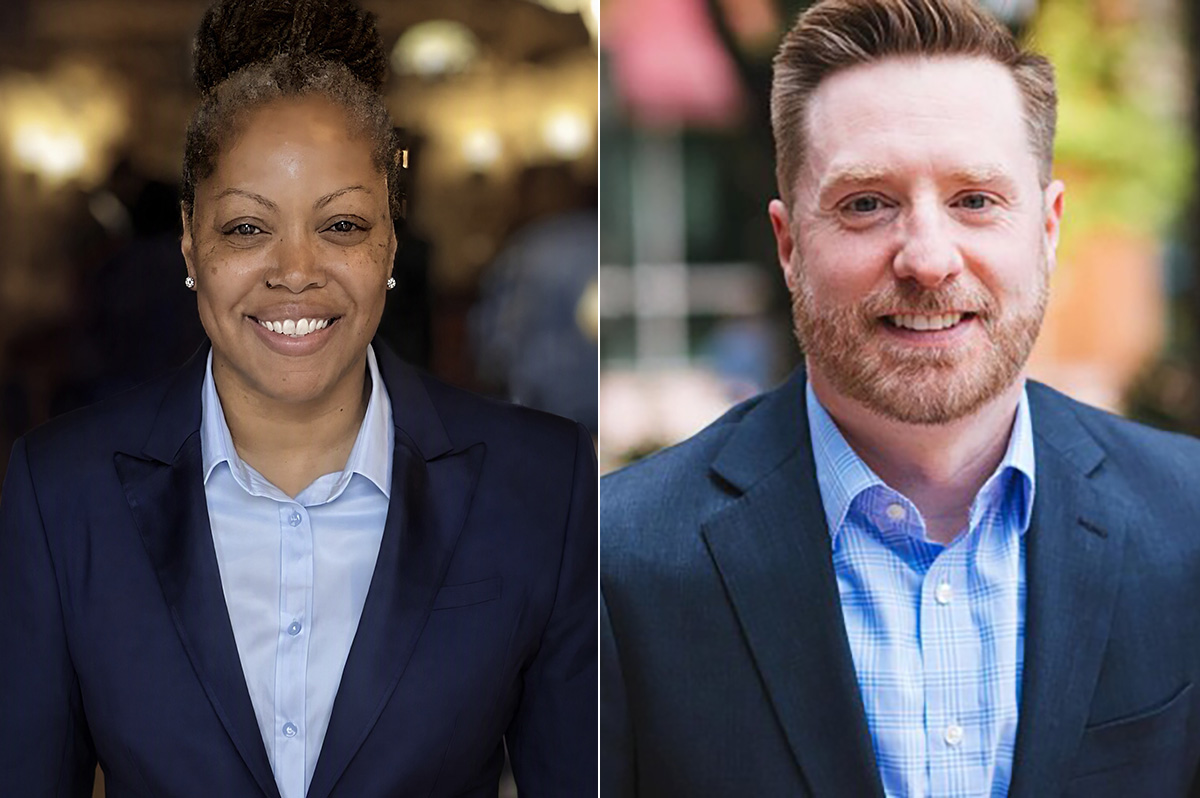
Congratulations to Carla Lester, LICSW on her new position as Chief Program Officer with SMYAL. Upon accepting the position she said, “SMYAL deeply aligns with my passion for honoring, protecting, and upholding the rights of all individuals, particularly LGBTQ+ youth and others who have been historically underserved, to belong to communities that affirm their identities, treat them with dignity and respect, and support their well-being. At this point in my career, I was ready to transition to an organization whose mission more closely reflected my values and was rooted in the community. SMYAL offered the opportunity to serve both an organization and a population whose mission not only resonates deeply with me but also intersects with my own multiple identities.”
Lester is a healthcare and human services executive with more than 20 years of experience in behavioral health, federal and state health insurance programs, housing, health care, education, and community-based services. She has held senior roles at Carelon Behavioral Health, Pathways to Housing and N Street Village, leading clinical programs, Housing First initiatives, homeless outreach, trauma-informed services, and integrated case management.
She earned master’s degrees in Social Work and Divinity, and maintains active clinical social work licenses in D.C. and Maryland.
Congratulations also to Tad Czyzewski on his new position as Chief Development Officer at SMYAL. On accepting the position, he said, “While I’ve spent much of my nonprofit career in the arts, the current social and political environments made me want to apply my skills and passion more directly toward supporting and strengthening our community. SMYAL and this role felt like the right place to do that.”
Czyzewski brings more than two decades of experience in nonprofit leadership and strategy, fundraising, and business development. Prior to joining SMYAL, he served for eight years as executive director of The Choral Arts Society of Washington, where he led fundraising, financial management, and community engagement. During his tenure, he helped raise more than $15 million in contributed revenue. He guided the organization through a major rebrand and the COVID-19 pandemic.
Prior to that Czyzewski served as Business and Development Director for Washington Revels, and held leadership and advisory roles with Chorus America, the DC Commission on the Arts and Humanities, and the National Endowment for the Arts. He began his career in the corporate sector, including at Capital One, where his work in product development and marketing contributed to new financial products and more than $2 billion in deposits.
Czyzewski is a lifelong musician, has performed professionally as a classical singer, including with the Washington National Opera and the National Symphony Orchestra.
District of Columbia
Gay ANC commissioner sues D.C. over police ‘failure’ to pay reward money
Lawsuit says information led to conviction in murder, armed robbery cases

Gay D.C. Advisory Neighborhood Commissioner Tom Donohue on Aug. 11 filed a lawsuit in D.C. Superior Court charging that D.C. police acted improperly and violated a local law by not paying him $30,000 in reward money for his role in helping police identify and arrest — and obtain the subsequent conviction — of one man charged with murder and another man charged with armed robbery in separate cases.
Although the lawsuit alleges improper action by D.C. police in carrying out the city’s Crime Solvers reward program, it names as defendants the District of Columbia and the Office of the Attorney General for D.C., which, among other things, defends the city against lawsuits.
Donohue, who is a member of the city’s ANC Rainbow Caucus consisting of LGBTQ elected ANC members, held a news conference outside the D.C. Superior Court building on Aug. 11 to talk about the lawsuit before entering the courthouse to officially file it.
The lawsuit states that Donohue “provided key video evidence that led to the arrest and conviction” of a man initially charged with first degree murder for allegedly running over a bicyclist with his car after the two got into an argument.
The lawsuit states that police had offered a $25,000 reward for information leading to the arrest and conviction of the defendant in that case, but police “arbitrarily slashed the payment to $5,000 without prior notice or policy justification.”
Court records show that D.C. resident Eric Beasley was charged with first degree murder for killing David Farewell, 45, by hitting him with his car on Sept. 4, 2020, on the 2100 block of Young Street, S.E. The records show the evidence for the case was based in large part on video camera footage of the incident obtained by police. Donohoe has said he provided that video camera evidence.
The records show that during Beasley’s October 2023 trial a jury was unable to reach the required unanimous verdict, and the judge declared a mistrial.
According to the records, Beasley later agreed to an offer by prosecutors to plead guilty to a lesser charge of involuntary manslaughter and was sentenced in September 2024 to eight years in prison, a development that angered the victim’s family members who called it a “slap on the wrist,” according to a Fox 5 News report.
Donohue’s lawsuit says the second case in which he provided police with pivotal information involved a series of armed robberies known as the Fairlawn Serial Armed Robbery Spree that occurred in the Fairlawn neighborhood in Southeast D.C. in 2023 near where Donohue lives.
The lawsuit says evidence consisting of video surveillance footage provided by Donohue to police enabled police to determine they initially wrongfully arrested an 18-year-old male for the robberies. “Using Plaintiff’s security video, MPD identified, arrested, and convicted the actual robber, David Crocker, who was sentenced to 18 years in federal prison,” the lawsuit states.
It says one of the detectives investigating the case recommended a $10,000 reward for Donohue’s help in the case based on the police Crime Solvers reward program. The detective’s recommendation was approved by then-Assistant D.C. Police Chief Kyle Ramey on Aug. 4, 2025, according to the lawsuit.
But it adds, “Nevertheless, MPD improperly withheld payment.”
When contacted by the Washington Blade for comment on Donohue’s lawsuit allegations, a D.C. police spokesperson said “MPD does not comment on pending or ongoing litigation.”
Gabriel Shoglow-Rubenstein, who serves as press secretary for the D.C. Office of the Attorney General, which will be defending the city against the Donohue lawsuit, said he would look into obtaining a possible comment but said the office has a similar longstanding policy of not commenting on pending litigation.
“This action arises from the District of Columbia Metropolitan Police Department’s arbitrary, bad-faith, and legally unsupportable failure to honor its public reward promises and administrative obligations to Plaintiff,” the lawsuit states.
It says the MPD violated the city’s Freedom of Information Act or FOIA law by not responding to Donohue’s request for information and documents related to the decision not to pay him the full reward money.
“MPD’s reduction of Plaintiff’s homicide reward from $25,000 to $5,000, and its withholding of his approved $10,00 robbery reward, were undertaken completely devoid of written standards, making such decisions inherently arbitrary, capricious, and an abuse of administrative discretion,” it says.
It calls for Donohue to be awarded $30,000 in compensatory damages consisting of the $20,000 “unpaid balance” for the homicide case reward and $10,000 for the robbery case reward. It also calls for reimbursement for “reasonable” litigation costs and attorney’s fees. Donohue told the Washington Blade that at this time he is representing himself without an attorney.
Donohue told the Blade that the refusal by D.C. police to pay him the full reward money also limited his plans to donate some of that money to the family of murder victim David Farewell to help pay for a burial stone. He said that due to the family’s limited resources Farewell is buried in an unmarked grave
District of Columbia
D.C.’s Mary’s House For Older Adults names new executive director
Charlene Leach to succeed Imani Woody as leader of LGBTQ-supportive seniors home
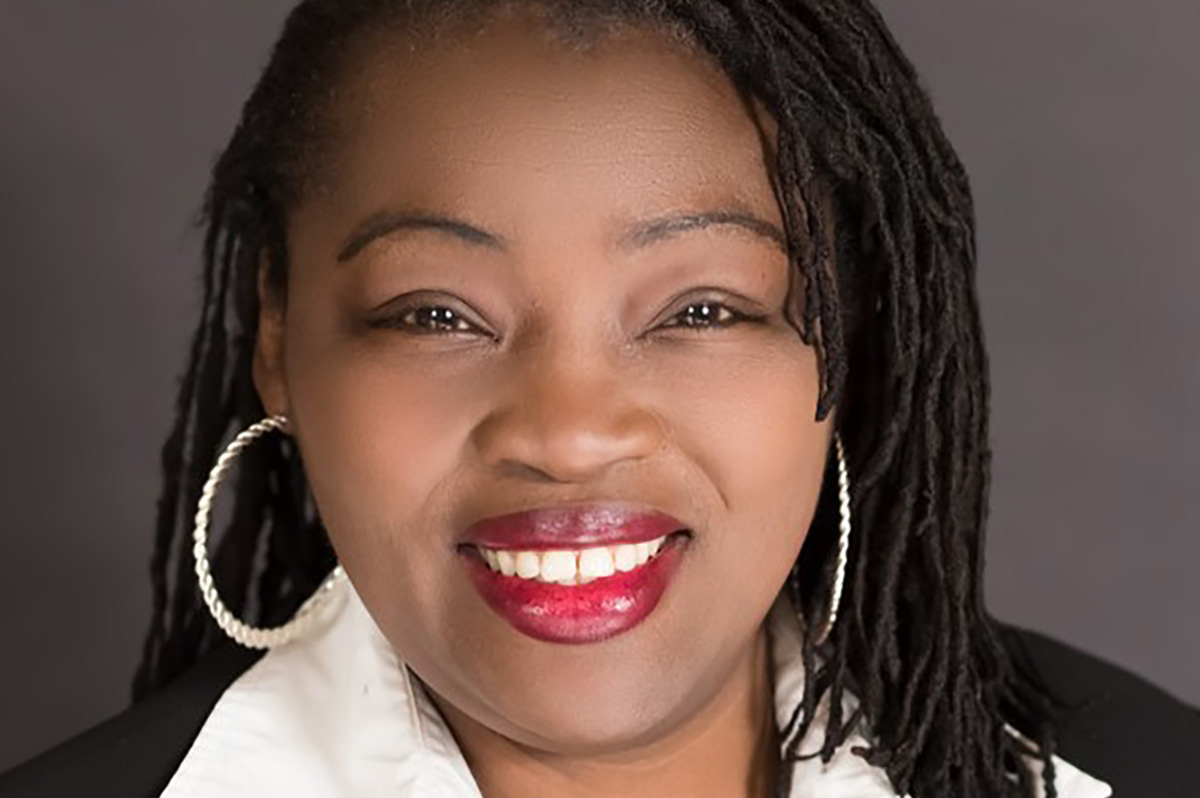
The board of directors of Mary’s House for Older Adults, the D.C.-based home dedicated to providing affordable housing for LGBTQ seniors, has announced it has named longtime nonprofit organization leader A. Charlene Leach as its new executive director.
Leach, who is now serving in the executive director’s position, is succeeding Dr. Imani Woody, the Mary’s House founding president and CEO, who announced her retirement from her official leadership role at Mary’s House on July 7.
Woody, who holds a PhD in Human Services, is credited with playing the lead role over many years in arranging both city and private funding needed to construct and operate the Mary’s House three-story building located at 401 Anacostia Road, S.E., in the city’s Fort DuPont neighborhood.
“With over three decades of nonprofit experience and 15 years serving as an executive director, Charlene brings a wealth of knowledge in organizational leadership, program development, and community engagement,” the Mary’s House board says in a statement.
“Her proven track record of building impactful programs and leading mission-driven organizations makes her uniquely suited to guide Mary’s House into its next phase of growth,” the statement continues. “Charlene is deeply aligned with the mission of Mary’s House and is committed to advancing its work to provide safe, inclusive housing and supportive services for LGBTQ+ older adults,” it says. “Under her leadership, the organization will continue to expand its impact while remaining grounded in the values that define our community.”
Leach’s LinkedIn page shows she has most recently served since 2022 as executive director of the African American AIDS Task Force in Minneapolis. Prior to that, it shows she served as executive director of the Fredericksburg Area Health and Support Services organization in Fredericksburg, Va., and before that as director of development for the D.C.-Baltimore area Women’s Collective.
Her LinkedIn page says she has been involved with Mary’s House as a volunteer and grant writer since 2016.
The newly built and enlarged Mary’s House, which opened in March 2025, with a grand opening ceremony held in May 2025 attended by D.C. Mayor Muriel Bowser, includes 15 single-occupancy residential apartments and more than 5,000 square feet of shared communal living space.
An earlier statement released by the Mary’s House board announcing Woody’s retirement said Woody would continue to be involved with the organization as a member of the board. The earlier statement and board’s more recent statement on July 29 announcing Leach’s appointment as executive director did not say whether the board plans to name someone else as president and CEO, the title that Woody held before her retirement. But the latest statement says Leach will be running Mary’s House’s day-to-day operations as Woody did.

PHOTOS: Nellie’s Drag Brunch

Remembering Barbara ‘Boo’ Price, a pioneering force in women’s music

‘Maddie’s Secret’ defies campy expectations

Bros + romance + fantasy = ‘Bromantasy.’

National tour of ‘The Notebook’ retains its tearjerking power

Will Michigan save the GOP?

Treat our political opponents as neighbors not enemies

Supreme Court ruled Boy Scouts could exclude James Dale. Now he says that same rule protects LGBTQ scouts from Trump

Beloved pastor, AIDS activist Rainey Cheeks dies at 74

Live music drag cabaret set for Shaw’s Tavern
-

 Opinions5 days ago
Will Michigan save the GOP?
-
Opinions5 days ago
Treat our political opponents as neighbors not enemies
-

 Pentagon4 days ago
Supreme Court ruled Boy Scouts could exclude James Dale. Now he says that same rule protects LGBTQ scouts from Trump
-
Obituary4 days ago
Beloved pastor, AIDS activist Rainey Cheeks dies at 74