Local
Kameny’s ashes remain in storage
Cemetery president proposes end to burial impasse
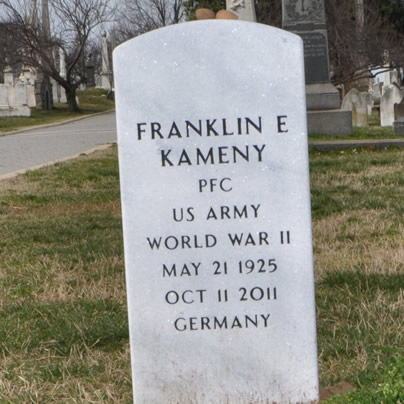
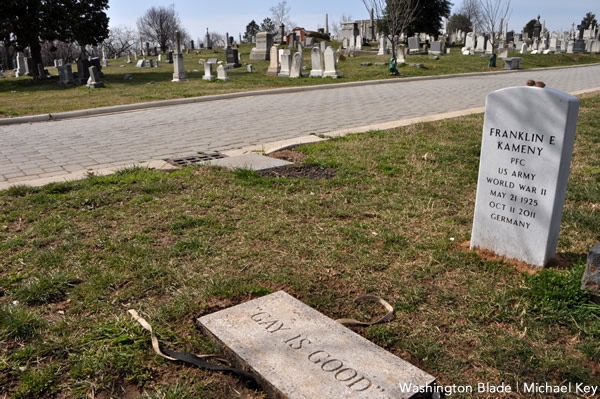
A headstone and a separate marker inscribed with Frank Kameny’s famous slogan ‘Gay is Good’ have been removed from his gravesite in Congressional Cemetery. (Blade photo by Michael Key)
Nearly 10 months after nationally acclaimed gay rights leader Frank Kameny died in his Washington home at the age of 86, an urn bearing his ashes continues to sit on a shelf in a storage vault in the headquarters building of D.C.’s historic Congressional Cemetery.
Cemetery officials said a dispute between Kameny’s estate and the D.C. gay charitable group Helping Our Brothers and Sisters (HOBS) over ownership rights to the plot where Kameny’s ashes were scheduled to be interred on March 2 forced the cancellation of the interment. HOBS purchased the plot earlier this year without consulting the estate, a development that the estate’s attorney says triggered the dispute.
The ashes, along with a headstone provided by the U.S. Veterans Administration recognizing Kameny’s military service during World War II and a separate marker inscribed with Kameny’s famous slogan “Gay is Good” have languished in storage at the cemetery since shortly after the interment was cancelled.
But in a surprise development on Wednesday, Congressional Cemetery’s new president, Paul Williams, disclosed in an email to the estate and HOBS that HOBS never had legal ownership rights to the Kameny plot because it failed to pay the balance on the purchase price.
“Because it had a balance, no deed was issued for the site to HOBS,” Williams said in his email.
“I propose we issue the deed directly to the estate (copy to HOBS) showing proof of ownership,” he wrote. “The estate would also need to sign an authorization of interment, which can be done at the same time. Then, we can replace the two stones in storage that we also have onsite and proceed with a private interment,” Williams wrote.
Glen Ackerman, an attorney representing the estate on behalf of Timothy Clark, whom Kameny named in his will as the main beneficiary of the estate, said the estate has accepted Williams’ proposal.
He said Williams’ disclosure that HOBS never had a deed to the cemetery plot and that the cemetery would issue the deed to the estate effectively ends the dispute by turning over the plot to Clark and the estate.
HOBS President Marvin Carter couldn’t immediately be reached Wednesday afternoon to comment on Williams’ disclosure that the cemetery planned to issue to the Kameny estate the deed to the cemetery plot.
Ackerman has said all along that the dispute centered on the estate’s desire to own the cemetery plot to ensure, among other things, that no one else would be buried or interred in the plot.
Under cemetery rules, two coffins and three urns may be buried or interred in Congressional Cemetery plots.
HOBS, which purchased the cemetery plot earlier this year from money donated by Kameny’s friends and admirers, has said it had no intention of burying others at the site.
Carter has said he and HOBS were always willing to transfer ownership of the plot to the estate. But people familiar with the dispute have said the point of contention was whether the estate should reimburse HOBS for the purchase price of the plot.
Ackerman has said Clark’s position was that donors from the LGBT community put up the money to buy the plot by giving it to HOBS, a non-profit group with tax-exempt status, so the donors could receive a tax deduction on their contribution. HOBS, in turn, made the purchase on behalf of the donors, the estate has maintained.
Meanwhile, the cemetery’s former interim director, Patrick Crowley, said he had the headstone and marker removed from the gravesite earlier this year until the estate and HOBS reached an agreement over final ownership of the plot.
Ackerman has said Clark and the estate became alarmed in February when a small group of Kameny friends announced in a press release that an interment ceremony for Kameny’s ashes would take place at the cemetery on March 3. Ackerman said organizers of the interment never consulted Clark or the estate, even though the estate had legal rights to the ashes.
Organizers of the interment ceremony abruptly cancelled the ceremony and burial the day before it was scheduled to take place on March 3, saying they did so out of “respect” for the Kameny estate. The urn bearing Kameny’s ashes has been in storage in the cemetery’s offices at 1801 E St., S.E. ever since that time.
The burial ceremony organizers, led by gay rights advocates and longtime Kameny friends Charles Francis and Bob Witeck, have said through intermediaries at the time that they invited Clark to participate in the ceremony and attempted to keep him informed of their plans. They said Ackerman refused to allow them to speak directly to Clark.
Gay activist and longtime Kameny friend Rick Rosendall, who was scheduled to speak at the Kameny interment ceremony, said it was his understanding that it was the estate’s “demand that no interment could be held until the deed to the burial plot was turned over to the estate that led to the event’s cancellation.”
Rosendall said he expressed his hope at the time that the dispute could be resolved. “That is still my hope,” he said.
Ackerman said the estate didn’t learn of the burial service until it obtained a copy of the organizers’ Feb. 13 press release announcing the ceremony.
He said the Kameny friends’ decision to organize the burial without initially consulting Clark or the estate created an atmosphere of mistrust between the two parties. Because of that, he said, Clark has insisted that ownership of the cemetery plot be transferred from HOBS to the estate without charge before the estate would consent to allowing the ashes to be buried.
Clark told the Blade in an interview earlier this year that he planned to keep half of the ashes and would donate the remaining half to be interred at Congressional Cemetery.
Francis and Witeck took initial possession of the ashes following Kameny’s death after Kameny’s sister, Edna Kameny, Kameny’s surviving next of kin, signed over power of attorney for Kameny’s remains to Witeck. Edna Kameny, who lives in New York and is in frail health, told the Blade she was pleased to entrust to Witeck and other Kameny friends the task of carrying out her brother’s stated wish to be cremated and to make funeral and memorial arrangements.
Once the details of Kameny’s will became known, including Clark’s role as personal representative or executor of the estate, Ackerman said it became clear that Clark and the estate should take possession of the ashes.
But when Clark sought to obtain possession of the ashes he said Francis told him the ashes had already been buried, a development that contributed to the mistrust between the estate and the Kameny friends organizing the burial.
Ackerman said it wasn’t until the estate saw the Feb. 13 press release announcing the interment ceremony at Congressional Cemetery that he and Clark learned the ashes had not, in fact, been buried.
When contacted on Wednesday, Francis said he had no comment on the matter, saying the dispute over the ashes is between the estate and HOBS and he has nothing to do with it.
Last week, Congressional Cemetery President Williams said he was hopeful that the dispute between the two parties would be resolved soon but said he couldn’t predict when that would happen.
“We have a little movement,” he told the Blade on July 27, saying negotiations were taking place between the estate and HOBS.
“It’s all confidential so far until everything’s signed. But I can tell you that the two parties have come to an agreement, that being the estate and Helping Our Brothers and Sisters.”
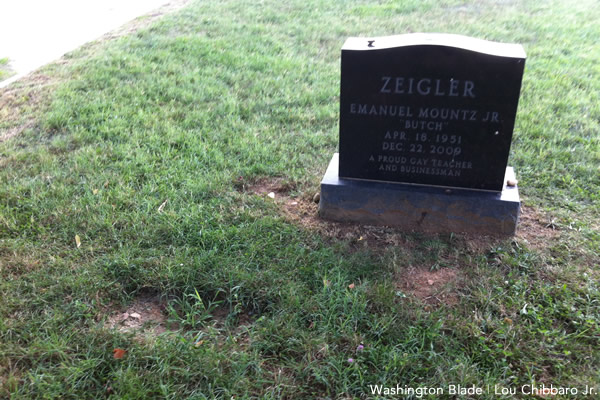
Before being removed earlier this year from this gravesite, the head and foot stones for Frank Kameny were located to the left and in front of head stone shown here, which marks the grave of another person. (Blade photo by Lou Chibbaro Jr.)
However, when reached two days later by phone, Carter told the Blade Williams had just informed him he had a proposal to resolve the dispute but that Williams did not provide any details about the proposal. Carter said Williams told him he would take steps to provide those details soon.
“HOBS has always been willing to work things out,” Carter said. “We’re not interested in continuing to own the gravesite.”
Carter told the Blade in a phone interview on July 29 that he had been out of town for the past few weeks and didn’t have a chance to check mail that may have been sent to HOBS.
“But no one from the estate has called me or emailed me about this recently,” he said. “They have my number and email address.”
Ackerman disputes this assertion, saying he and his law firm repeatedly sent written material to Carter by certified mail. He said the mail was returned to the law firm marked “refused” by recipient.




District of Columbia
Three women elected leaders of Capital Pride Alliance board
Restructured body includes chair rather than president as top leader
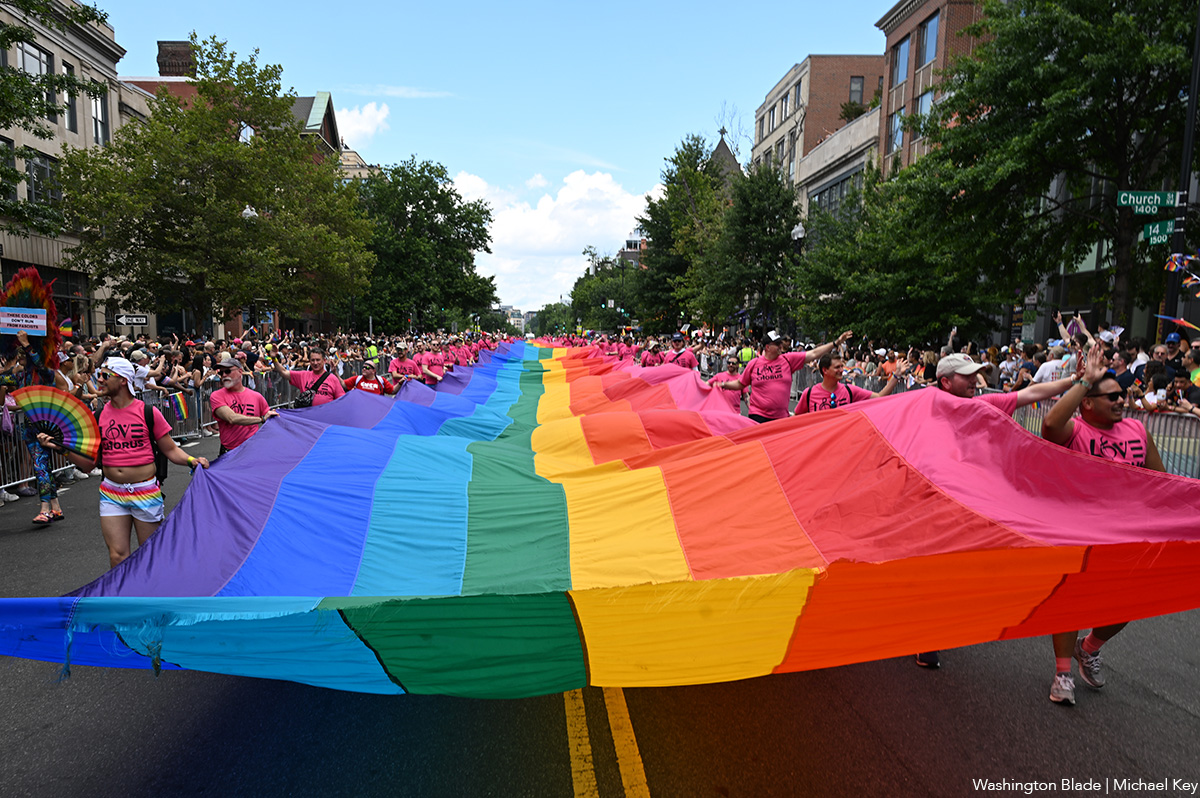
The Capital Pride Alliance, the D.C.-based group that organizes the city’s annual LGBTQ Pride events, announced it has restructured its board of directors and elected for the first time three women to serve as leaders of the board’s Executive Committee.
“Congratulations to our newly elected Executive Officers, making history as Capital Pride Alliance’s first all-women Board leadership,” the group said in a statement.
“As we head into 2026 with a bold new leadership structure, we’re proud to welcome Anna Jinkerson as Board Chair, Kim Baker as Board Treasurer, and Taylor Lianne Chandler as Board Secretary,” the statement says.
In a separate statement released on Nov. 20, Capital Pride Alliance says the restructured Board now includes the top leadership posts of Chair, Treasurer, and Secretary, replacing the previous structure of President and Vice President as the top board leaders.
It says an additional update to the leadership structure includes a change in title for longtime Capital Pride official Ryan Bos from executive director to chief executive officer and president.
According to the statement, June Crenshaw, who served as acting deputy director during the time the group organized WorldPride 2025 in D.C., will now continue in that role as permanent deputy director.
The statement provides background information on the three newly elected women Board leaders.
• Anna Jinkerson (chair), who joined the Capital Pride Alliance board in 2022, previously served as the group’s vice president for operations and acting president. “A seasoned non-profit executive, she currently serves as Assistant to the President and CEO and Chief of Staff at Living Cities, a national member collaborative of leading philanthropic foundations and financial institutions committed to closing income and wealth gaps in the United States and building an economy that works for everyone.”
• Kim Baker (treasurer) is a “biracial Filipino American and queer leader,” a “retired, disabled U.S. Army veteran with more than 20 years of service and extensive experience in finance, security, and risk management.” She has served on the Capital Pride Board since 2018, “bringing a proven track record of steady, principled leadership and unwavering dedication to the LGBTQ+ community.”
• Taylor Lianne Chandler (Secretary) is a former sign language interpreter and crisis management consultant. She “takes office as the first intersex and trans-identifying member of the Executive Committee.” She joined the Capital Pride Board in 2019 and previously served as executive producer from 2016 to 2018.
Bos told the Washington Blade in a Dec. 2 interview that the Capital Pride board currently has 12 members, and is in the process of interviewing additional potential board members.
“In January we will be announcing in another likely press release the full board,” Bos said. “We are finishing the interview process of new board members this month,” he said. “And they will take office to join the board in January.”
Bos said the organization’s rules set a cap of 25 total board members, but the board, which elects its members, has not yet decided how many additional members it will select and a full 25-member board is not required.
The Nov. 20 Capital Pride statement says the new board executive members will succeed the organization’s previous leadership team, which included Ashley Smith, who served as president for eight years before he resigned earlier this year; Anthony Musa, who served for seven years as vice president of board engagement; Natalie Thompson, who served eight years on the executive committee; and Vince Micone, who served for eight years as vice president of operations.
“I am grateful for the leadership, dedication, and commitment shown by our former executive officers — Ashley, Natalie, Anthony, and Vince — who have been instrumental in CPA’s growth and the exceptional success of WorldPride 2025,” Bos said in the statement.
“I look forward to collaborating with Anna in her new role, as well as Kim and Taylor in theirs, as we take on the important work ahead, prepare for Capital Pride 2026, and expand our platform and voice through Pride365,” Bos said.
District of Columbia
D.C. Police Chief Pamela Smith to step down Dec. 31
Cites plans to spend more time with family after 28 years in law enforcement
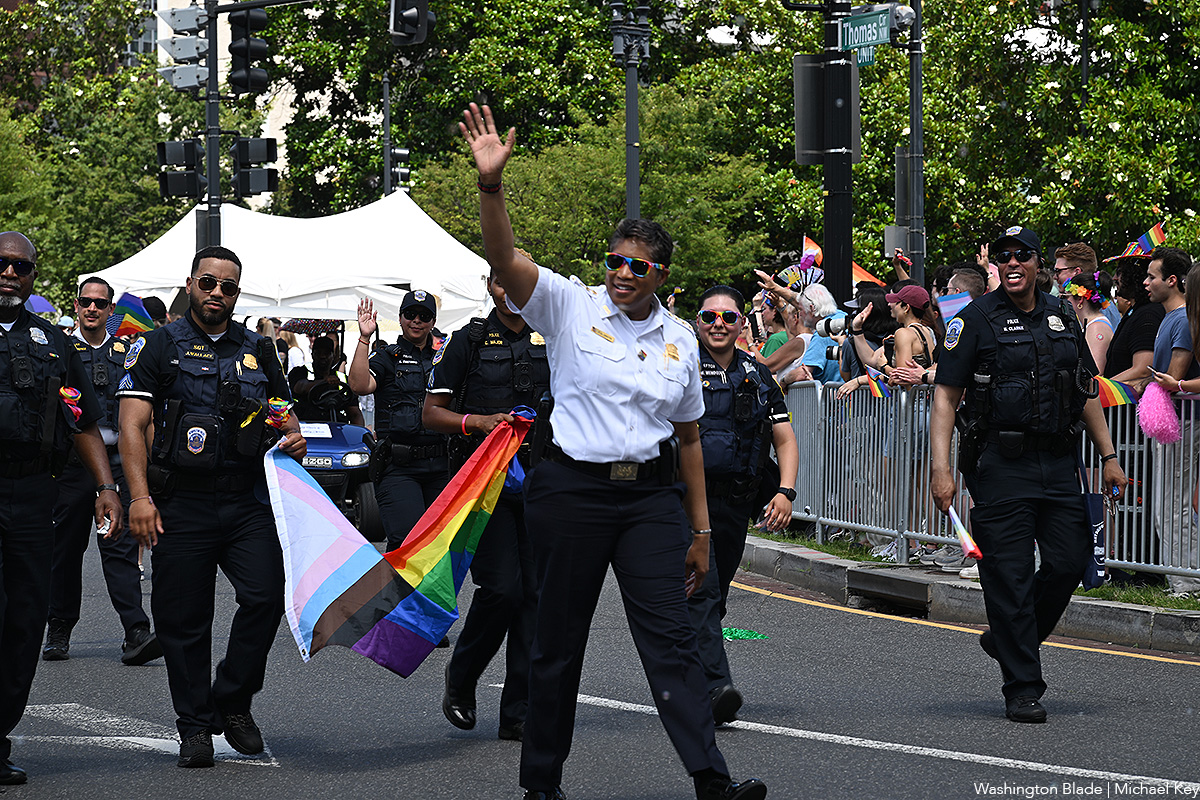
In a surprise statement on Dec. 8, Mayor Muriel Bowser announced that D.C. Police Chief Pamela Smith will step down from her job on Dec. 31 after a little over two years as the city’s police chief.
In August of 2023, after Bowser named Smith as Acting Chief shortly before the D.C. Council approved her nomination as permanent chief, she told the Washington Blade in an interview she was committed to providing “fair and equal treatment” for all of the city’s diverse communities, especially the LGBTQ community.
She pointed out that in her role as the department’s Chief Equity Officer before she was appointed chief, she worked in support of what she said was the significant number of LGBTQ police officers serving in the department and also worked closely with the department’s LGBTQ Liaison Unit.
“We also have LGBTQ members serving in the reserve and volunteer corps supporting many functions in the department, including support for the LGBTQ Liaison Unit,” she told the Blade. “We have a nationally recognized LGBTQ Liaison Unit.”
Bowser’s statement announcing Smith’s resignation praised Smith for playing a lead role in significantly lowering the city’s crime rate.
“Chief Smith dramatically drove down violent crime, drove down the homicide rate to its lowest levels in eight years, and helped us restore a sense of safety and accountability in our neighborhoods,” the mayor said in her statement. “We are grateful for her service to Washington, D.C.”
Bowser’s statement did not provide a reason for Smith’s decision to step down at this time. But in a Monday morning interview with D.C.’s Fox 5 TV, Smith said she was stepping down to spend more time with her family based in Arkansas.
“After 28 years in law enforcement I have been going nonstop,” she told Fox 5. “I have missed many amazing celebrations, birthdays, marriages, you name it, within our family,” she said. “Being able to come home for Thanksgiving two years after my mom passed really resonated with me,” she added in referring to her family visit in Arkansas for Thanksgiving last month.
Smith said she plans to remain a D.C.-area resident following her departure as police chief. Bowser said later in the day on Dec. 8 that she needs some time to decide who she will name as the next D.C. police chief and that she would begin her search within the MPD.
Smith served for 24 years in high-level positions with the U.S. Park Police, including as Park Police Chief in the D.C. area, before joining D.C. police as Chief Equity Officer in 2021. A short time later she was named an assistant chief for homeland security before Bowser nominated her as Police Chief in 2023 and installed her as acting chief before the D.C. Council confirmed her as chief.
She became D.C. police chief at a time when homicides and violent crime in general were at a record high in the years following the pandemic. Although Bowser and Smith have pointed to the significant drop in homicides through 2024 and 2025, Smith was hit with President Donald Trump’s decision in August of this year to order a temporary federal takeover of the D.C. Police Department and to send National Guard Troops to patrol D.C. streets on grounds, according to Trump, that the D.C. crime rate was “out of control.”
Both Bowser and Smith have come under criticism from some local activists and members of the D.C. Council for not speaking out more forcefully against the Trump intervention into D.C. law enforcement, especially over what critics have said appeared to be D.C. police cooperation with federal immigration agents sent in by the Trump administration.
During a mayoral End of Year Situational Update event called by Bowser on Dec. 8, shortly after announcing Smith’s resignation, both Bowser and Smith said they cooperated with federal law enforcement officials to a certain degree as part of the city’s longstanding practice of cooperating with federal law enforcement agencies since long before Trump became president.
“We are currently on pace to be at the lowest number of homicides in over eight years,” Smith told those attending the event held at the D.C. Department of Health’s offices. “To date, homicides are down 51 percent compared to 2023, and we are down 30 percent compared to the same time last year,” she said.
She also noted that homicide detectives have been closing murder cases by arranging for arrests at a significantly higher rate in the past two years.
In her 2023 interview with the Blade, Smith said she would continue what she called the department’s aggressive effort to address hate crimes at a time when the largest number of reported hate crimes in the city were targeting LGBTQ people.
“What I can say is in this department we certainly have strong policies and training to make sure members can recognize hate crimes,” Smith said. “And officers have to report whether there are any indications of a possible hate crime whenever they’re investigating or engaged in a case,” she added. “We have a multidisciplinary team that works together on reported hate crimes.”
District of Columbia
Third LGBTQ candidate running for Ward 1 D.C. Council seat
Community organizer Aparna Raj a ‘proud daughter of immigrants’
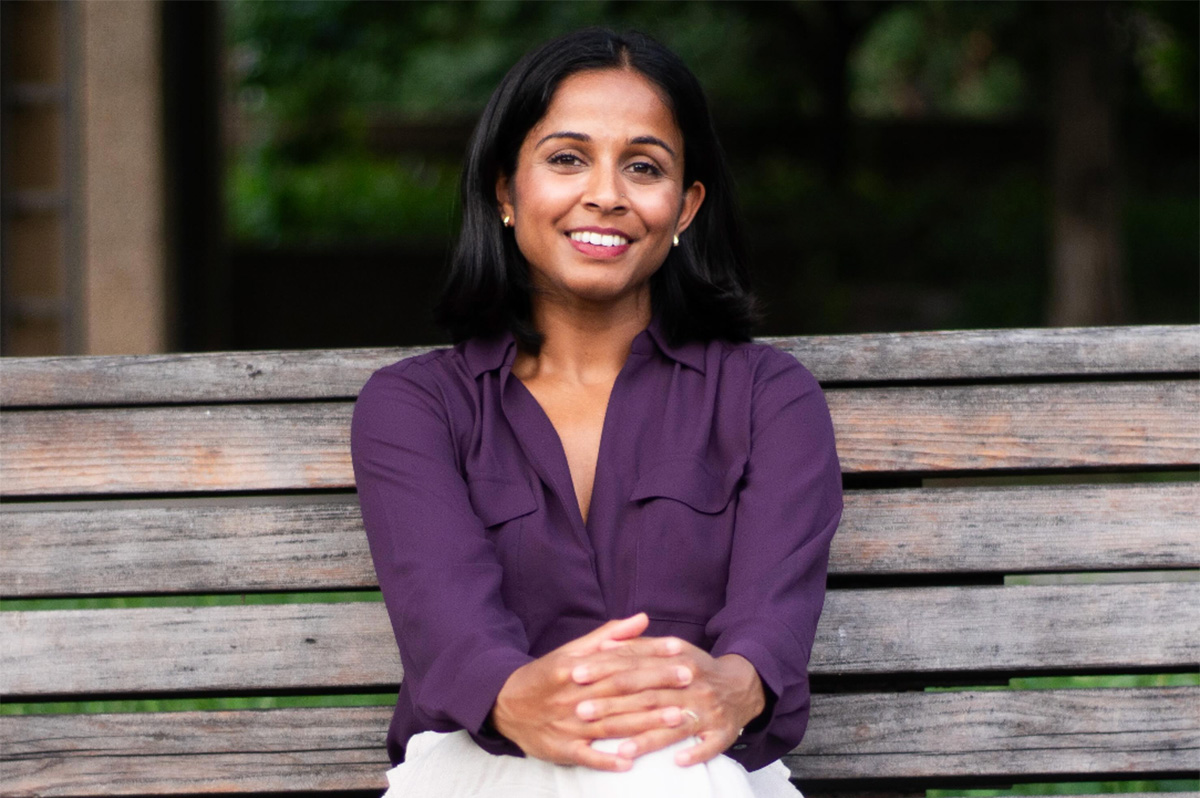
In what appears to be an unprecedented development in local D.C. elections, three known LGBTQ candidates are now running for the open Ward 1 D.C. Council seat in the city’s June 16, 2026, Democratic primary.
Longtime Ward 1 community organizer Aparna Raj, a bisexual woman who identifies herself on her campaign website as a “queer woman of color,” announced her candidacy for the Ward 1 Council seat on Aug. 12 of this year.
The Washington Blade didn’t learn of her status as an out-LGBTQ candidate until late last month when one of her supporters contacted the Blade after publication of the Blade’s story about the second of two gay male candidates running for the Ward 1 Council seat – Ward 1 Advisory Neighborhood Commissioner Miguel Trindade Deramo.
Trindade Deramo’s candidacy announcement on Nov. 18 followed the announcement in July by fellow gay Ward 1 ANC commissioner Brian Footer that Footer is running for the Ward 1 Council seat in the upcoming Democratic primary.
If any of the three Ward 1 LGBTQ candidates were to win the primary and win in the November general election, they would likely become the second LGBTQ member of the D.C. Council. Then gay D.C. Board of Education member Zachary Parker, a Democrat, won election to the Ward 5 Council seat in 2022. Parker, who is up for re-election in 2026, is considered by political observers to have a strong chance of winning the upcoming election.
“Aparna Raj is a community organizer, union member and proud daughter of immigrants,” her campaign website states. “She is running for D.C. Council in Ward 1 because she believes everyone – from Adams Morgan to Park View, from Spring Road to U Street – can and should have what they need to survive and thrive,” the statement on her website continues.
It adds, “Aparna is a renter, a queer woman of color, and a democratic socialist fighting for a better world … She lives in Columbia Heights with her husband, Stuart, and their little dog, Frank.”
In a Dec. 5 interview with the Blade, Raj said she identifies as a bisexual woman and has been a longtime supporter of D.C.’s “queer and trans communities” on a wide range of issues that she says she will continue to address if elected to the Council.
She said she currently works as a communications manager for a nonprofit organization that supports local elected officials across the country on issues related to economic justice.
As the daughter of parents who immigrated to the U.S. from India, Raj said she will continue her work as an advocate for D.C.’s immigrant communities, especially those who live in Ward 1.
“And I feel very strongly that we need someone who will organize and fight for the working class, who will fight for renters and workers and immigrants and families, to not just be able to get by but to be able to live a full life here,” she told the Blade. “Making sure that we’re providing enough for renters and for workers means that is an LGBTQ+ issue,” she said. “That is an issue that benefits the LGBTQ+ community.”
Among the things she will also address as a Council member, Raj said, will be to push for the city to do all it can to counter the policies of the administration of President Donald Trump.
“When the LGBTQ community is so under attack right now and when queer and trans folks are facing homelessness, are making less money on the job than their cis counterparts – when folks are scared about whether they will be able to continue healthcare or be able to hold on to their job through this period, having someone that takes on their landlord, that will stand on picket lines with workers and will certainly fight the Trump administration – all that is an LGBTQ justice issue,” she told the Blade.
Raj, Trindade Deramo, and Footer are among a total of six known candidates so far who are competing in the June 16 Democratic primary for the Ward 1 Council seat.
The other three, who are not LGBTQ, are Ward 1 ANC member Rashida Brown, longtime Ward 1 community activist Terry Lynch, and Jackie Reyes-Yanes, the former director of the Mayor’s Office of Community Affairs.
Similar to Raj, Trindade Deramo and Footer have been involved as community activists in a wide range of local LGBTQ and non-LGBTQ issues as described on their respective campaign websites.
And like all candidates on the ballot for the city’s 2026 primary, the three LGBTQ Ward 1 candidates will be competing for voters under the city’s newly implemented rank choice voting system. Under that system, voters will have the option of designating one of the LGBTQ candidates as their first, second, or third choice for the Council seat,
“I’m really excited about ranked choice voting,” Raj said. “And I think it’s great that there’s so many incredible candidates who are dropping into the Ward 1 race,” she said. “We’ll also be including a lot of voter education into our campaign materials as well since this will be the first year that D.C. is doing ranked choice voting.”
The three LGBTQ Ward 1 candidates are running at a time when local political observers are predicting the largest change in local D.C. elected officials, including the office of mayor and D.C. Council, in decades following the 2026 election. Longtime D.C. Council member Anita Bonds (D-At-Large), announced on Dec. 5 that she will not run for re-election in 2026.
Her announcement came shortly after Mayor Muriel Bowser announced she too is not running for a fourth term in office as mayor and about a month after incumbent Ward 1 Council member Brienne Nadeau (D) announced she is not running for re-election.
Bowser’s announcement prompted speculation that more Council members will run for mayor, some of whom will give up their Council seats if they either win or lose the mayoral race because their respective Council seats are also up for election in 2026.
Thus the 2026 D.C. election shakeup, in addition to bringing about a new mayor, could result in five or six new Council members on the 13-member Council.
Aparna Raj’s campaign website can be accessed here:
Brian Footer’s campaign website can be accessed here:
Miguel Trindade Deramo’s campaign website can be accessed here:

Iran, Egypt object to playing in Seattle World Cup ‘Pride Match’

‘Heated Rivalry’ is the gay hockey romance you didn’t know you needed

PHOTOS: Team DC holiday party

The beginning of the fall of Trump

Have yourself a merry John Waters Christmas
Trump’s shocking East Wing amputation—and the painful fallout Americans won’t ignore

Third LGBTQ candidate running for Ward 1 D.C. Council seat

Cynthia Erivo, Eva Victor, and ‘Blue Moon’ bring queer representation to Golden Globe film nominations

The harsh truth about HIV phobia in gay dating

‘90s club kids will love Mark Ronson’s new book
-

 The White House3 days ago
Trump’s shocking East Wing amputation—and the painful fallout Americans won’t ignore
-

 District of Columbia3 days ago
Third LGBTQ candidate running for Ward 1 D.C. Council seat
-
Arts & Entertainment3 days ago
Cynthia Erivo, Eva Victor, and ‘Blue Moon’ bring queer representation to Golden Globe film nominations
-
Health2 days ago
The harsh truth about HIV phobia in gay dating