Politics
3 key Democrats still undecided on ENDA
Republicans say House vote on measure unlikely
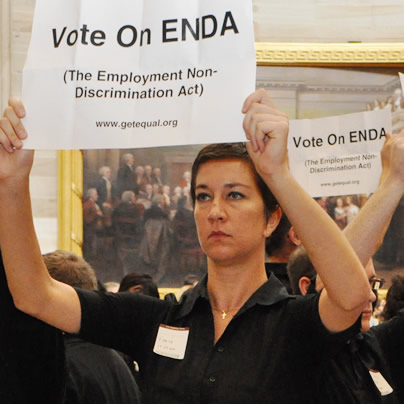
Sens. Joe Manchin (D-W.Va.), Mark Pryor (D-Ark.) and Bill Nelson (D-Fla.) are three Senate Democrats who haven’t said how they’ll vote on ENDA. (Photos public domain).
As LGBT advocates ramp up efforts to pass the Employment Non-Discrimination Act, some key U.S. senators this week said they’re still undecided on how they’ll vote on the bill.
Most notable among these holdouts are three Senate Democrats who are not co-sponsors of ENDA — Sens. Bill Nelson (D-Fla.), Joe Manchin (D-W.Va.) and Mark Pryor (D-Ark.) — even in the aftermath of a 15-7 Senate committee vote weeks ago reporting out ENDA to the floor.
Manchin ignored questions from the Blade on how he’ll vote on the bill. His response to the final question: “It’s very nice to meet you.”
Pryor was similarly non-committal. Asked whether he was familiar with the legislation, the senator replied, “I am in concept, but I haven’t seen it or read it yet.”
Asked for a sense of how he’ll vote on ENDA, Pryor said he needed time to review the bill, adding, “I’ll just have to look at it.”
Nelson couldn’t be reached on Capitol Hill for a comment on how he’ll vote on ENDA. In a recent interview with the Tampa Bay Times, the Florida senator reportedly cited the transgender protections in the legislation as an issue of concern.
“There are so many ramifications,” Nelson was quoted as saying. “What is the responsibility of an employer to provide facilities, for example, for someone who dresses, thinks, acts, has had hormone treatments as a woman, but who has not had the operations? Is that person allowed to go into the women’s restroom? There are just a whole host of issues that I haven’t worked through.”
It’s not unusual for senators to refrain from saying how they’ll vote on legislation that isn’t imminently before them. Still, Senate Health, Education, Labor & Pensions Committee Chair Tom Harkin (D-Iowa) said that he’s expecting a floor vote this fall after August recess.
Tico Almeida, president of Freedom to Work, said the time has come for the holdout Democrats to co-sponsor ENDA because the more time that passes without their support makes them “look sillier and weaker the longer they drag this out.”
“The three holdout Senate Democrats are alienating themselves further from the Democratic Party and ignoring American values of hard work and success with every passing day that they stubbornly refuse to cosponsor the bipartisan ENDA,” Almeida said.
Although the lack of commitment from Pryor and Manchin may not be surprising because they’re among the Democrats who don’t support marriage equality, Nelson’s silence is striking because he supports same-sex marriage. In May 2010, the senator also voted for “Don’t Ask, Don’t Tell” repeal as a member of the Senate Armed Services Committee even before the Pentagon report on open service came out later that fall.
Almeida called on Obama and senior White House officials to take additional action to win ENDA support from Nelson as well as Pryor and Manchin.
“There’s a difference between providing strong leadership and issuing press statements, and LGBT Americans who fear getting fired from their jobs have been waiting for President Obama’s leadership for a long time,” Almeida said. “President Obama, Vice President Biden, Valerie Jarrett, Cecilia Munoz and especially the LGBT staff at the White House should start lobbying Congress to bring home these three holdout Democratic senators.”
Shin Inouye, a White House spokesperson, insisted that White House officials are reaching out to the Senate to ensure a successful floor vote.
“The president is pleased that the Senate HELP Committee, on a bipartisan basis, approved ENDA in July, and we look forward to the Senate’s consideration of the Employment Non-Discrimination Act,” Inouye said. “The White House will continue to reach out to lawmakers on this legislation which would enshrine into law strong, lasting and comprehensive protections against employment discrimination on the basis of sexual orientation or gender identity.”
LGBT groups launch campaigns to build ENDA support
(Washington Blade file photo by Michael Key)
Amid attention on these three Democratic senators, the Human Rights Campaign announced on Tuesday evening that it launched a $2 million campaign to work to pass ENDA called “Americans for Workplace Opportunity.”
The steering committee is being billed as a bipartisan group of organizations and consists of the American Civil Liberties Union, the American Federation of Teachers, the American Unity Fund, HRC, the Leadership Conference on Civil & Human Rights, the National Center for Transgender Equality, the National Gay & Lesbian Task Force and the Service Employees International Union.
Heading the campaign will be Matt McTighe, an LGBT activist who most recently was Marriage Project Director for Gill Action after leading the campaign to bring marriage equality to Maine last year.
In a statement, McTighe said the campaign plans to “mobilize the supermajority of diverse Americans” who believe LGBT people should be protected from workplace discrimination.
“With the tremendously successful mark-up of ENDA earlier this month, we have strong momentum as we build to reach 60 votes on the Senate floor,” McTighe said. “We will use all of our resources including grassroots action and strong corporate support to make it clear that the American people want action on this bill.”
In addition to states represented by Senate Democratic holdouts on ENDA — Arkansas, Florida and West Virginia — the campaign will be engaged in grassroots activities to encourage Republican votes for ENDA in Arizona, Idaho, Indiana, Nevada, New Hampshire, New Jersey, Ohio and Pennsylvania. According to HRC’s announcement, the eight steering committee members represent more than 5.6 million members and supporters.
It’s noteworthy that McTighe’s stated goal with the campaign is “to reach 60 votes” to pass ENDA on the Senate floor. Freedom to Work’s Almeida has been more bullish about ENDA and has projected between and 60 and 65 votes for the bill in the Senate.
At the same time, statewide LGBT advocacy groups in Florida and West Virginia say they’ve met with the respective senators from their states to encourage them to support ENDA.
Nadine Smith, executive director of Equality Florida, said she’s “optimistic” that Nelson will vote in favor of ENDA following a D.C. meeting that her organization — along with transgender activist and former Seal Team 6 member Kristin Beck — had in June with the Florida senator.
“Our team had a great conversation about the importance of protections for LGBT people, and were able to have an honest dialogue with the senator,” Smith said. “The meeting clearly had an impact and we are continuing to work with his staff to keep this on the front burner.”
Casey Willits, a spokesperson for Fairness West Virginia, said his organization has had conversations with Manchin and his staff on ENDA.
“When ENDA is voted on in the Senate, we trust that Sen. Manchin will act on the West Virginia values of hard work and fairness,” Willits said. “I’m sure when Sen. Manchin votes, he will have the story of Sam Hall, a gay West Virginian coal miner, on his mind. It’s our goal to have two senators in the ‘yes’ column for ENDA.”
Internal discussions within the Senate are also underway. A Senate aide familiar with ENDA, who spoke on condition of anonymity, said the five original co-sposors of the bill — Sen. Jeff Merkley (D-Ore.), Tammy Baldwin (D-Wis.), Mark Kirk (R-Ill.), Susan Collins (R-Maine) and Tom Harkin — met recently to discuss a whip strategy for ENDA.
Additional conversations will happen in the next few weeks, the Senate aide said, in anticipation of a Senate floor vote before the end of the year.
The aide also said Merkley met with Sen. Lisa Murkowski (R-Alaska) prior to her “yes” vote on ENDA during the committee vote and also met recently with Sen. Rob Portman (R-Ohio), who’s considered a swing vote on ENDA, to talk about the bill.
Jeffrey Sadoksy, a Portman spokesperson, confirmed that Merkley met with the Republican senator and said the meeting took place last week, but wasn’t able to provide any information on whether Portman would vote for ENDA in the wake of the meeting.
Conversations over scheduling a vote apparently haven’t taken place yet within the Senate Democratic leadership. Senate Majority Whip Richard Durbin (D-Ill.) said he’s unaware of those conversations happening at this time.
“I have not heard any, but there’s strong support for it,” Durbin said. “Sen. Merkley is, I believe, the lead sponsor — at least that was my understanding a few weeks ago. I hope we can schedule this quickly.”
Flake calls trans protections ‘problematic’
As groups push Senate Democrats to vote for ENDA, support from key Republicans is also necessary to surpass the 60-vote threshold needed to end a filibuster in the Senate. Most of the states targeted in the “Americans for Workplace Opportunity” campaign are represented in the Senate by Republicans.
One Republican who’s considered in play is Sen. Dean Heller (R-Nev.). Asked by the Blade about ENDA, Heller initially said he was unfamiliar with the bill.
When the Blade explained the legislation would prohibit job discrimination against LGBT people, Heller said, “I’m against discrimination.” Asked if that means he’ll vote for the bill, Heller repeated, “I’m against discrimination.”
Sen. Kelly Ayotte (R-N.H.) said on Capitol Hill in response to a question on ENDA, “I’m familiar with it, but I haven’t studied it,” and refused to comment on how she’d vote on the bill.
Another Senate Republican — Sen. Jeff Flake (R-Ariz.) — is considered in play because he voted “yes” in 2007 on a gay-only version of ENDA as a U.S. House member. Asked by the Blade about ENDA, Flake recalled that he voted for the measure while serving in the lower chamber of Congress.
But Flake refused to offer a commitment on ENDA this time around, saying the language has changed since 2007 and that he needs to revisit the bill.
“I don’t know if it’s going to go back to the original or not, and so, until I see the language, I can’t tell you,’ Flake said.
When the Blade pointed out that a major difference between the 2007 version of ENDA and the current one is the addition of protections for transgender workers, Flake suggested that could be a sticking point for him.
“I know there were some issues there that came up for employers, so that was problematic,” Flake said. “I’ll have to look at the language and see.”
Flake’s counterpart from Arizona — Sen. John McCain (R) — asserted he was completely oblivious to ENDA. Asked by the Blade if he was familiar with the legislation, McCain replied, “I”m not familiar with it.”
When the Blade explained the bill provides non-discrimination protections for LGBT workers, McCain said, “I have not looked at it. I’m engaged in a whole lot of issues and I haven’t been engaged in that.”
Asked if he could say how he intends to vote on the bill, McCain replied, “No, of course not, because I haven’t looked at it.”
Jeff Cook-McCormac, senior adviser to the newly formed Republican-affiliated American Unity Fund, said his organization is building off work advancing LGBT initiatives throughout the states and in the last few weeks has held conversations with a “wide berth” of Republicans to persuade them to vote for ENDA.
“One of things we’ve learned over the years is not to count people out,” Cook-McCormac said. “As I’m sure you’ve seen with the vote on ‘Don’t Ask, Don’t Tell’ repeal and many of the state legislatures both on marriage and non-discrimination, it’s really not fair to assume that any legislator is hostile to this legislation.”
Sen. Orrin Hatch (R-Utah), among the Republicans to vote in favor of ENDA in committee, said he doesn’t know if his vote would bring along other GOP senators to support the bill as he explained his support for ENDA.
“I don’t believe in discrimination against anybody,” Hatch said. “I do draw the line on marriage, the definition of marriage. I just think that would be a tragic shame to change that. But I don’t like the way some people are treated.”
Even if the Senate approves ENDA, questions remain over the strategy to pass the legislation in the House, where Republican control makes advancing the bill difficult to say the least.
For his part, Hatch was pessimistic about the prospects of the House taking up ENDA even after a successful Senate vote.
“I doubt the House is going to do that” Hatch said. “I really doubt that, but I can’t speak for them either. You never know.”
Cook-McCormac acknowledged that much of the attention that LGBT advocates put on ENDA is devoted at this time to moving the legislation in the Senate.
“Getting the House to move is going to require initial Senate action,” Cook-McCormac said. “I think that the real critical focus for this coalition of business and labor, of the gay community and employers, is building on the overwhelming vote in the Health, Education, Labor & Pensions Committee to get to floor consideration, to get the majority that we need and then to begin to work in a careful and thoughtful way with House Republicans to think through ways that this important measure can be realized.”
UPDATE: This article has been updated to include the quote from Nelson on ENDA in the Tampa Bay Times piece.


2026 Midterm Elections
Ken Paxton wins Texas Republican primary runoff
LGBTQ rights opponent will face Democrat James Talarico in November

Attorney General Ken Paxton won the Republican Senate primary in Texas on Tuesday, ousting incumbent U.S. Sen. John Cornyn.
Paxton won the primary against the four-term incumbent in large part due to President Donald Trump’s endorsement. Despite Cornyn voting with Trump more than 90 percent of the time, political insiders say being supportive isn’t enough to win Trump’s endorsement anymore — Republican candidates need to embrace the full MAGA image, something Paxton has done.
Paxton has served as Texas attorney general since 2015 and, before that, worked as a Texas state representative. He has approached both roles with what LGBTQ activists call a “consistently Anti-LGBTQ+ Record.” Following the landmark U.S. Supreme Court decision in Obergefell v. Hodges — the case that made same-sex marriage the law of the land — Paxton advised Texas county clerks they could refuse marriage licenses to same-sex couples on religious grounds.
His anti-LGBTQ crusade doesn’t stop at fighting against marriage equality.
Paxton has repeatedly demanded medical records for transgender youth in multiple states — including Texas, Georgia, and Washington — in hopes of making the practice illegal. His anti-trans actions go far past medical records. Paxton issued an opinion barring trans Texans from changing the sex on their driver’s licenses and birth certificates, claiming any changes made were “unlawfully altered,” and helped the DOJ reach an agreement with a Texas’s children’s hospital for providing minors gender-affirming care, eventually leading to a 10 million dollar settlement. He also authored a non-legally binding opinion equating gender-affirming healthcare for youth to child abuse.
In addition to his long history of anti-LGBTQ policy in the Lone Star State, Paxton is no stranger to controversy.
Multiple impeachment efforts brought against him in the state House of Representatives for “abuse of office” — with the state Senate later acquitting him — allegations that he used his office to assist large campaign donors, namely Nate Paul, and a widely publicized separation from his wife, state Sen. Angela Paxton, all impacted his run for the U.S. Senate seat — but not enough to keep him from the office.
Lynne Bowman, vice president of campaigns at the Human Rights Campaign, issued a statement following the announcement of Paxton’s primary win.
“Texans have a clear choice this fall, and an opportunity to reject failed policies that hurt all families,” Bowman sent to the Blade via email. “Ken Paxton is so out of step that he has fought to undercut marriage equality and spent time demanding personal medical records for young people who do not even live in Texas, all while becoming the most corrupt politician in America. The more than 2 million Equality Voters in Texas will send him packing.”
Paxton will face off against Democratic hopeful and vocal Trump critic James Talarico in the fall.
Talarico, who won the Democratic primary in April against Congresswoman Jasmine Crockett, has been a vocal supporter of LGBTQ rights, citing his ministry work as the source of his support for the community.
The race for Texas’s Senate seat will be decided on Nov. 3.
2026 Midterm Elections
Bree Fram’s congressional campaign ends but her fight continues
Former highest-ranking trans military member steps back from Va. congressional race
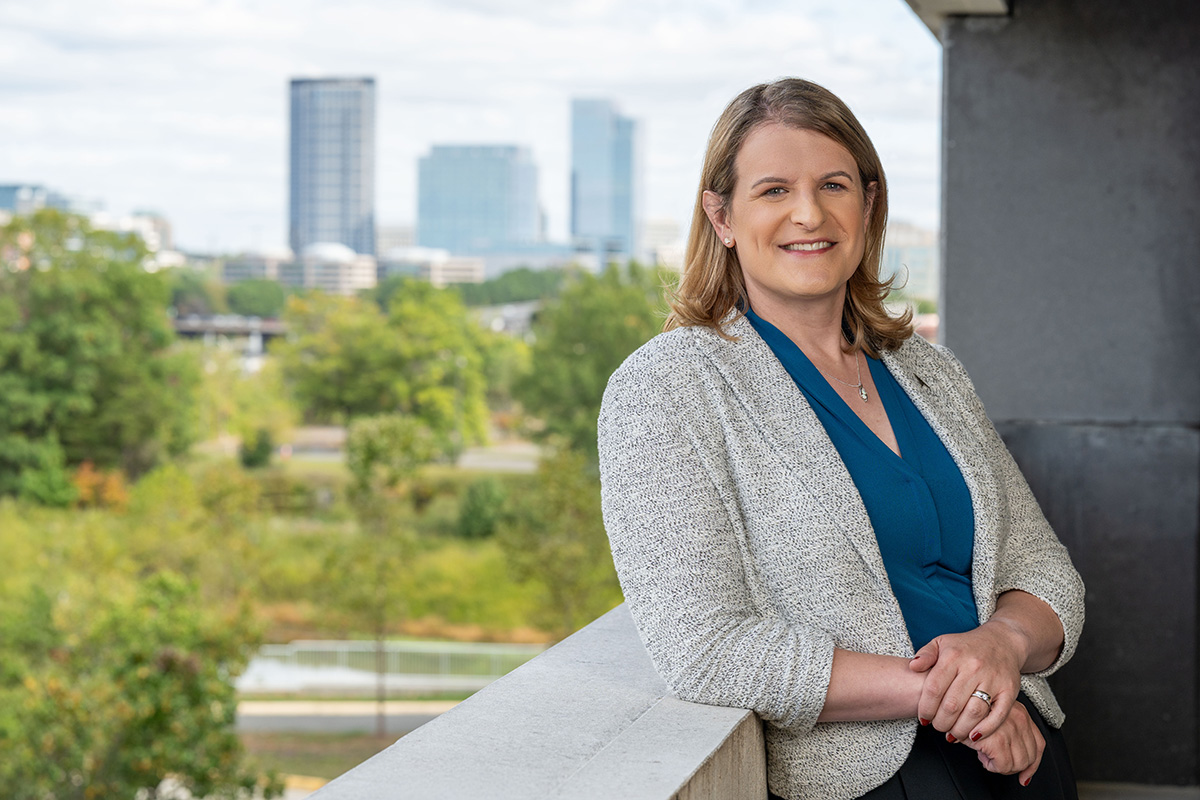
After being forced to retire, Bree Fram couldn’t stop. Restless even after giving everything she had to make the United States Air Force — and later the Space Force — better in every way she could, Fram quickly turned toward a new mission: public office.
The same tenacity that fueled her rise from Air Force researcher to the highest-ranking openly transgender officer in the United States Armed Forces would eventually carry her onto the campaign trail in Virginia.
Now, after months of campaigning, countless conversations with voters, and abrupt shifts in Virginia’s political landscape, Fram has stepped back from her congressional run.
Fram sat down with the Blade to discuss her decision to step away, what she learned on the campaign trail, and what comes next.
Earlier this month, the Virginia Supreme Court struck down a voter-approved Democratic congressional redistricting plan that likely would have created multiple additional Democratic-leaning seats in the U.S. House. The ruling dramatically altered the district Fram had built her campaign around and left little time for candidates to adjust before voting began.
“That decision really was the end of my campaign, that there was not the chance after that ruling, particularly so late in the game, for me to meaningfully pivot back to a different district and have a conversation with voters with just five weeks to go until early voting started,” Fram said. “I do feel that the will of the people has been ignored over a technicality regarding the date of Election Day.”
For Fram, the ruling was not only politically devastating, but personally frustrating after months spent building relationships with voters and shaping a campaign around the district’s needs.
“What was incredibly disappointing about it was that none of the facts about the case had changed from the beginning of the year until when they made the ruling,” she said.
Still, Fram entered the race with a platform centered on affordability, government accountability, and protecting fundamental rights, pledging “to protect our rights, make opportunity affordable, and build a government that works for the people.”
That message focused heavily on affordability — one of the defining political issues of 2026 — and lowering costs for Virginians across ideological, geographic, and generational divides. Fram said voters responded warmly to that vision, even if it ultimately did not lead to an office in the Rayburn House Office Building on Capitol Hill.
“The experience on the trail was fantastic. As a first-time candidate, you never know what you’re really getting yourself into, but any chance I had to get out there and talk with people was amazing,” Fram said. “I had the opportunity to change folks’ minds about trans people, about people from Northern Virginia.”
One conversation with a rural Virginia voter especially stayed with her.
“I called someone who runs a rural art shop… and he started talking about Democrats messaging on trans issues being such a problem,” Fram recalled. “And I’m like, do you know that you’re talking to one?”
Throughout the campaign, Fram said she often found herself breaking down preconceived notions about both transgender people and military service. The impact of that visibility became especially clear during another interaction on the trail that still stays with her.
“I had a young person, maybe 20 years old, come up to me. I could tell there was something on their mind,” Fram said. “I preempted them by saying ‘If you were about to ask if I’m trans, the answer is yes.’”
The young person, she said, appeared visibly relieved.
“As we made small talk I could tell there was something else he wanted to ask,” Fram continued. “Eventually they got it out– that they think they might be too.”
The moment quickly turned emotional.
“And then I asked, do you need a hug, they leaned in at first and then just hung on for dear life,” she said. “So what it means to our community to have that kind of representation out there, and to hopefully inspire others, was incredibly important.”
For Fram, those moments became some of the most meaningful parts of the campaign.
“My experience, I think, helped just shape what was our strategy,” she said.
The campaign also came at a uniquely difficult moment in Fram’s life. The Human Rights Campaign honored Fram alongside four other transgender military officials during a Jan. 8 event in Washington commemorating the forced retirement of transgender service members following President Donald Trump’s Executive Order 14183, “Prioritizing Military Excellence and Readiness,” which directed the Pentagon to prohibit transgender, nonbinary, and gender-nonconforming people from serving openly in the military.
Even while navigating the fallout from the discriminatory policy that forced her retirement, Fram launched a campaign rooted heavily in direct voter engagement and personal storytelling.
Her decades in the military, she said, fundamentally shaped how she approached campaigning and leadership.
“As an officer, particularly the more senior you become, you get more and more training on ‘what does it mean to match your ends’ ways and means,’” Fram said. “My end goal was get into office … and constantly reassess what it looks like.”
Fram also said her military background informed her progressive politics more than many voters expected.
“My military background was interesting, because I was running as the progressive candidate,” she said. “People think you were in the military, how can you possibly be the progressive person?”
Her answer, she said, often surprised people.
“Well, where did you think I learned this stuff?” Fram said. “No matter who we were at the same rank, no matter what our job was, we all got paid the same. We all had government-provided health care where we never needed to worry about a medical bill.”
For Fram, and those who talked with her on the trail, military service reinforced the idea that good governance allows people to thrive.
“You actually learn a lot about progressive policies and good governance that lets people be their best self in the military,” she said. “We understand that military officers’ oaths don’t expire when their time in uniform does, and I think that resonated with a lot of people, that veterans can be part of the solution in getting us out of the situation that we are in today.”
Before launching her campaign, Fram built one of the most extensive careers of any openly transgender military officer in U.S. history, serving in senior leadership roles across the Air Force, Space Force, and intelligence community.
Most recently, she served as chief of the Requirements Integration Division at Headquarters, Space Force, after previously leading acquisition policy for the Air Force’s space programs. Earlier in her career, she oversaw advanced weapons and cyberspace programs at the Air Force Research Laboratory, managed billions in foreign military sales and intelligence-related operations, worked on Capitol Hill as a legislative fellow, and directed major engineering and national security programs at the National Reconnaissance Office.
Fram also co-led the Department of the Air Force’s LGBTQ+ Initiatives Team and deployed in support of Operation Iraqi Freedom. She holds a master’s degree from the Air Force Institute of Technology and is a distinguished graduate of the Naval War College.
Despite stepping away from the race, Fram said she remains optimistic about the future.
“When I look at the big picture of what we did and how we ran a campaign, that is what I’m most proud of,” she said. “It really is the strategy that my team and I were able to craft, the messaging that we were able to share, that was all about connecting our personal story, the story of America to something that says we need a vision of what can be.”
Fram rejected the idea that ending her congressional campaign means ending her public life altogether.
“I can absolutely guarantee that I will not get off the stage. It is just a question of what stage or stages do I jump to,” she said.
She also encouraged LGBTQ people — especially transgender Americans — to stay politically engaged despite increasingly hostile rhetoric and legislation nationwide.
“Just do it,” Fram said. “It is incredibly important to show at every level that people can engage with the political process and make a meaningful difference.”
Congress
Eight Democrats break with party as House advances ‘Don’t Say Trans’ bill
Measure not expected to pass in Senate
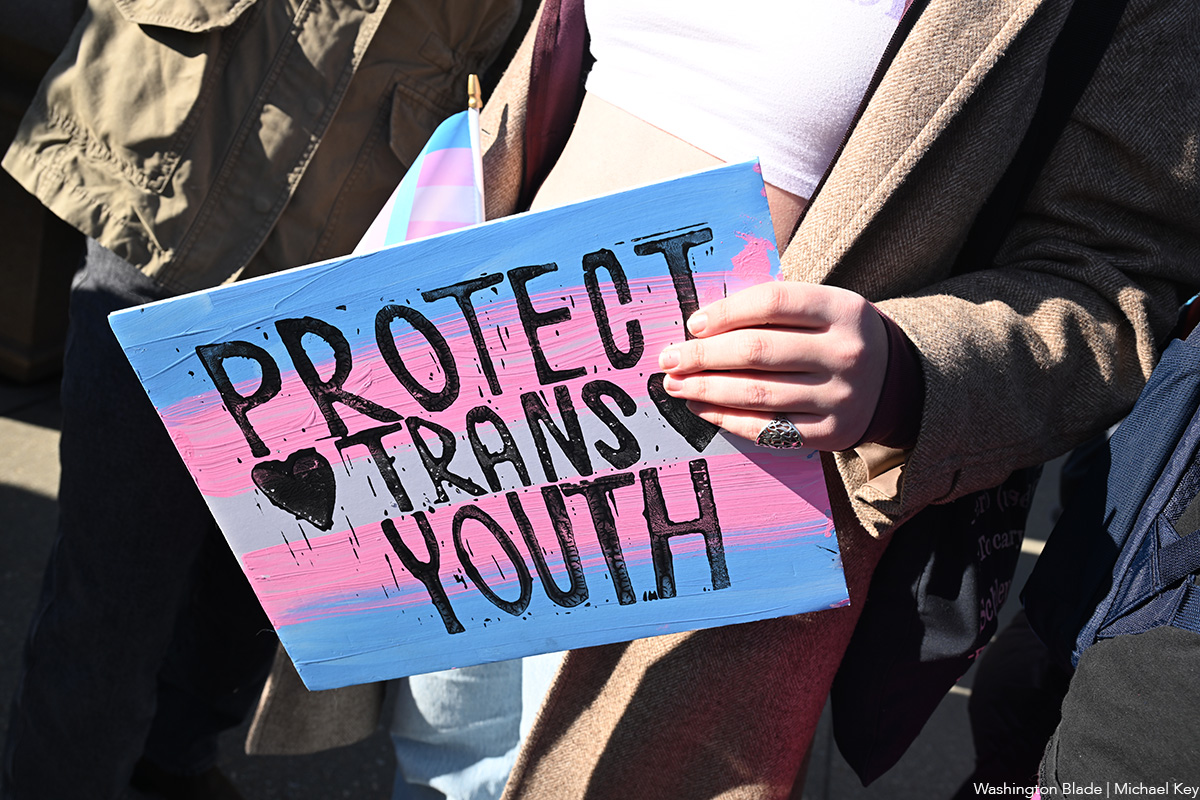
The U.S. House of Representatives passed a federal “Don’t Say Trans” bill on Wednesday, attempting to force teachers to out transgender students nationwide.
The bill, House Resolution 2616, also called the “Stopping Indoctrination and Protecting Kids Act,” would require schools to get parental consent before allowing students to use their preferred, rather than originally assigned, gender markers, pronouns, or preferred name on any school form, and to use any sex-based accommodations, including locker rooms or bathrooms.
The bill amends Section 8526 of the Elementary and Secondary Education Act of 1965, legislation that allows for federal aid to help elementary and secondary education programs — particularly those under its lowest-income Title I-A program — to stop allocating funds to any education that teaches concepts “related to gender ideology.”
This is directly related to Executive Order 14168, also known as the “Defending Women From Gender Ideology Extremism and Restoring Biological Truth to the Federal Government” order, one of President Donald Trump’s first executive orders of his second term. It requires the federal government to recognize only sex assigned at birth and dismiss gender identity rather than sex.
The bill was sponsored by U.S. Rep. Tim Walberg (R-Mich.) and passed by a 217-198 margin. The vote fell mostly along party lines; however, eight Democrats voted for its passage. They were U.S. Reps. Henry Cuellar (D-Texas), Donald Davis (D-N.C.), Cleo Fields (D-La.), Laura Gillen (D-N.Y.), Vicente Gonzalez (D-Texas), Marcy Kaptur (D-Ohio), Marie Gluesenkamp Perez (D-Wash.), and Eugene Vindman (D-Va.).
Proponents of the bill argue a child’s gender identity should be directed by parents at home rather than in public schools.
Critics say this is dangerous and will force students to be outed by their teachers to parents — some of whom may not be supportive of their gender identity — which could lead to violence or possibly conversion therapy.
California Congressman Mark Takano, chair of the Congressional Equality Caucus, spoke on the House floor while the bill was being debated.
“Republicans claim to be the party of small government, but they have no problem bringing the full force of the federal government down against children. The GOP thinks they can legislate transgender people out of existence with this inhumane Don’t Say Trans bill, but all they’re doing is making life worse for a small minority of already-vulnerable children,” Takano said. “I spent 24 years as an educator where I worked with hundreds of high school students and their parents. Most children go to their parents when they need help or are struggling — including transgender children — but not all parents are accepting. The forced outing provision of this bill puts teachers in an impossible situation by requiring them to out trans kids to their parents in certain situations — even if the teacher knows the student will likely face physical abuse. Students like these are who Republicans want to put in immediate physical danger with this bill.”
The Washington Blade talked to Tyler Heck, founder and executive director of the trans advocacy organization and Christopher Street Project PAC, following the bill’s passage.
“Most queer kids go to their families when they are figuring out who they are, and then not all queer kids have that option,” Heck told the Blade. “If this became law, it would harm those already vulnerable kids who rely on school as a safe place and might not have a safe place at home.”
They explained this is not about protecting parents’ rights to know what is going on with their children, but rather the weaponization of trans identity that has become a mainstream Republican ideal pushed by the Trump-Vance administration.
“Young people deserve the space to figure out who they are without the federal government interfering in their lives,” they said. “It is beyond the pale, or rather it should be beyond the pale, and has become a norm for Republicans in Congress to villainize kids, because I mean, this bill targets kids, it’s in the name of the bill, and it’s in the implications.”
Heck continued, saying that amid the rising cost of everyday necessities — from gas to groceries — and while the Trump-Vance administration continues to defund programs intended to help the most vulnerable Americans while creating slush funds for political allies, this is not what Congress should be focusing on.
“At a time when people are really struggling, and politicians need to be focused on lowering costs, they’re using queer and trans kids as political pawns,” Heck said. “They want to divide and conquer this country, and we need to stand up against them and unite behind values of inclusion and of trust in our teachers.”
David Stacy, the Human Rights Campaign’s vice president of government affairs, provided a statement to the Blade.
“Trans kids are not a political agenda — they are students who deserve safety and affirmation at school like anyone else,” Stacy said. “Despite the many pressing issues facing our nation, House Republicans continue their bizarre obsession with trans people. HR 2616 does not protect children. It targets them. This bill is cruel, and we’ll continue to fight to ensure it never becomes law.”
The bill will move to the U.S. Senate in the coming days and weeks, but it must first be reviewed by a Senate committee before leadership schedules it for a floor vote, where it will need 60 votes to pass.

‘The Stranger’ queers an existentialist classic

Nine Russian LGBTQ groups deemed ‘extremist’ banned

D.C. Pride flag raising ceremony set for June 1

Still marching: Rev. Troy Perry and the ongoing fight for liberation

Introducing Next-Generation Assisted Living & Memory Support.

Bree Fram’s congressional campaign ends but her fight continues

Peppermint made her mark on ‘Drag Race.’ Now, her advocacy is front and center

Why this Black Pride, I ranked Janeese Lewis George #1 for D.C. mayor

From Media Matters to massive queer ragers: the rise of Tara Dikhof

Man accused of threatening to shoot D.C. bar employee after making anti-gay slurs
-

 2026 Midterm Elections3 days ago
Bree Fram’s congressional campaign ends but her fight continues
-
Celebrity News3 days ago
Peppermint made her mark on ‘Drag Race.’ Now, her advocacy is front and center
-
Opinions3 days ago
Why this Black Pride, I ranked Janeese Lewis George #1 for D.C. mayor
-
a&e features3 days ago
From Media Matters to massive queer ragers: the rise of Tara Dikhof