Politics
Religious exemption inspires heated debate at ENDA panel
Wolfson challenges current language in LGBT anti-discrimation bill
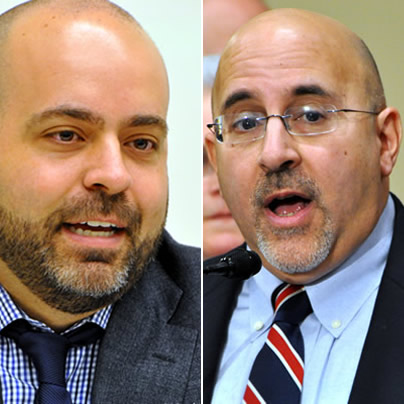
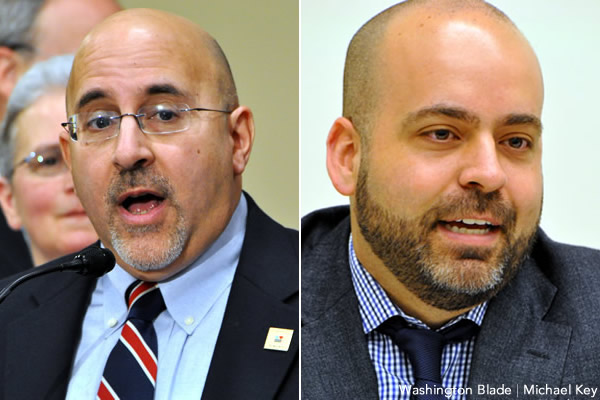
Freedom to Marry’s Evan Wolfson (left) and Freedom to Work’s Tico Almeida had heated exchange on ENDA’s religious exemption (Blade file photos by Michael Key).
NEW YORK — The appropriate scope of the religious exemption in the Employment Non-Discrimination Act continues to stir debate as a prominent marriage equality advocate on Thursday made a surprise endorsement of narrowing the broad provision in the bill.
Evan Wolfson, president of Freedom to Marry, said he shares the “grave concerns” expressed by the American Civil Liberties Union over the religious exemption — which he said would “carve coverage by certain kinds of entities for LGBT people” — during a panel as part of Freedom to Work’s premier “Situation Room” in New York City.
“I do have grave concerns about the specific language in the specific bill,” Wolfson said. “That’s one of the points of difference I have with Freedom to Work on this current bill.”
Currently, ENDA has a religious exemption that provides leeway for religious organizations, like churches or religious schools, to discriminate against LGBT employees. That same leeway isn’t found under Title VII, which prohibits religious organizations from discriminating on the basis of race, gender or national origin.
Wolfson and Tico Almeida, president of Freedom to Work and proponent of the religious exemption, were the lone speakers on the second panel of the day. Wolfson’s main purpose on the panel was to talk about the lessons the campaign to pass ENDA can learn from the marriage equality fight.
Almeida initially responded by saying the religious exemption has value in allaying concerns from Republican lawmakers who are undecided on ENDA.
“I would say that in a bunch of Republican meetings we spend a majority of the time talking about the religious exemption and exactly how it will apply, what the case law is,” Almeida said.
Almeida co-wrote the current version of the religious exemption when working as a staffer for Rep. George Miller (D-Calif.). It was passed as an amendment on the U.S. House floor in 2007 to a gay-only version of ENDA by a vote of 402-25.
But Almeida qualified his support for the religious exemption by saying he believes religious organizations shouldn’t be able to receive federal funds if they discriminate against LGBT people. But, Almeida continued, the mechanism to prohibit this discrimination isn’t ENDA; rather, it should be a workplace non-discrimination executive order signed by President Obama.
“I think there’s complete uniformity that we are all pushing for a federal policy that if you take and profit from federal dollars, you must follow American values, you must pledge not to discriminate against LGBT folks — and if you get caught, there should be consequences,” Almeida said.
But Wolfson quickly retorted as the panel developed into a heated debate between him and Almeida that seemed to become almost hostile as the session closed.
“We have a body of laws across the country that include sexual orientation and gender identity as prohibited discriminatory classifications alongside race, sex and others — and they have all followed generally a certain kind of exemption — as had Title VII and the Civil Rights Act, and so on,” Wolfson said. “The problem with this current draft of ENDA is that exemption goes far beyond what that body of experience has taught us is the right balance.”
Wolfson added the argument in favor of ENDA to undecided lawmakers should be to look at existing law throughout the states as opposed to enshrining “new and unnecessary and dangerous exemptions from non-discrimination law.”
“By the way, calling them religious exemptions implies that there’s some religious problem to be solved,” Wolfson said. “There is no religious problem to be solved: what these are are licenses to discriminate.”
Almeida, a Catholic, responded by saying he thinks attitudes should change within the church by action from members of that particular faith.
“I don’t believe civil rights statute in the form of Title VII and ENDA should be used to force the Catholic Church to make a change to its policies,” Almeida said. “I think we will push them, and it may take decades, and it may take more than my lifetime, but we will push them in other ways.”
Almeida added he doesn’t understand the argument the religious exemption in ENDA is a new approach because he said he “literally copied and pasted it from Title VII.”
Besides, Almeida also said groups that oppose ENDA’s religious exemption missed an opportunity to propose an amendment when the Senate Health, Education, Labor & Pensions Committee voted on the bill in July. Also, he challenged them to make public the language they would prefer instead.
“I would love for those organizations to publicly communicate to the LGBT community and to Congress what is their proposal,” Almeida said. “They made a big fuss …, and they didn’t seek an amendment at markup. They didn’t ask any of our progressive champions, and there are very progressive champions on that committee, or if they asked, then they got rejected.”
Wolfson countered by saying Almeida’s proposal to change the Catholic Church from within is “completely irrelevant” to the conversation of putting a “license to discriminate” in a statute.
“Nobody is saying that the Catholic Church should be sued or told what to do as a matter of law when it comes to doctrine or the church, or ministers,” Wolfson said. “That’s misleading language that might confuse people in a way that you didn’t intend.”
Additionally, Wolfson said Almeida was mischaracterizing the religious exemption in ENDA by saying it’s lifted from Title VII. Almeida conceded that point on the panel.
“To say that something has some degree of religion in it, but now that it’s in the marketplace, it can now fire not just the priest, but the janitor, that’s an exemption that doesn’t exist in Title VII or any other parts of law,” Wolfson said.
Concluding his argument, Wolfson said the religious exemption issue must be resolved because it’s giving fuel to the anti-LGBT forces seeking to thwart ENDA passage.
“The religious exemption language thing is mostly a distraction, it’s a non-and-wrong solution to a non-problem, but becomes important if it get put into law,” Wolfson said.
Ian Thompson, legislative representative for the ACLU, told the Blade after the panel he commends Wolfson for endorsing a narrower religious exemption for ENDA, calling the news “a great development.”
“As a leader of the freedom to marry movement, he knows as well as anyone the importance of rejecting overly broad religious exemptions,” Thompson said.
Further, Thompson responded to Almeida’s claims that narrower language on religious institutions hasn’t been proposed by pointing to existing law.
“The alternative to ENDA’s unprecedented religious exemption has been and remains crystal clear,” Thompson said. “Just as our civil rights laws have never permitted blank checks to discriminate based on race, sex, national origin, age, and disability, they must not now do so based on sexual orientation and gender identity.”
Discussion of the religious exemption also came up during the first panel of the day, which consisted of six speakers from a bipartisan group of LGBT organizations. Paul Schindler, editor-in-chief of Gay City News, asked the panel if they were comfortable with the language.
Gregory Angelo, executive director of the National Log Cabin Republicans, started off the discussion by saying he was “comfortable” with the current wording because it’s hard enough selling the bill as it is.
“Without naming names, there are meetings that I have had with Republicans — both in the House and the Senate — where there’s some Republicans who don’t feel those religious protections go far enough,” Angelo said. “We’re pushing back against that. I think the protections as they exist now are strong, they’re solid.”
Melissa Sklarz, a transgender Democratic activist from Stonewall Democrats of New York City, seemed to support the exemption on a temporary basis as a way to win support for the bill, saying it won’t hold up in court and is just “a barrier to try to win allies” on the Republican side.
“It’s a good idea,” Sklarz said. “We watched them fight LGBT equality in ‘Don’t Ask, Don’t Tell’ and we’ve watched it in marriage. As they keep throwing things at ideas that prevent equality, they will not stand up. If this is going to win allies among the moderate and right-wing so we can get it to the floor, then great.”
Asked by Schindler whether under the current religious exemption he could be fired at a Catholic hospital or a Mormon book store, Almeida replied, “It depends.”
“It depends on the facts,” Almeida said. “Law has very few bright line tests, and neither the Title VII religious exemption, nor the ENDA religious exemption, list types of organizations. So, courts have created factors that are considered.”
Almeida said courts have established that for-profit businesses are eligible for the religious exemption under existing law. But he acknowledged that organizations like the Catholic Church and Catholic Charities will be able to continue to discriminate against LGBT people in hiring and firing decisions.
“By tying the ENDA religious exemption explicitly to the Title VII religious exemption, that gives us the most clarity, and as a byproduct, and for me it’s just a byproduct, it’s going to be the one to help us win,” Almeida said.





2026 Midterm Elections
LGBTQ issues, attacks on Democrats dominate unusual RNC midterm convention
“Trumpapalooza” emphasized the gains Republicans need to maintain control of the federal government.

The Republican Party held an unusual midterm convention in Dallas last week, where President Donald Trump and other prominent GOP officials spoke in hopes of building enthusiasm and support ahead of the November elections.
The two-day gathering at the American Airlines Center was the first midterm convention of its kind for the Republican Party. Unlike a traditional presidential nominating convention, there was no official party business or nominations. Instead, the event was designed to energize Republican voters and unite the party behind its candidates and broader message heading into the midterm elections.
Trump, who spoke during both nights of the convention, repeatedly emphasized the importance of Republicans turning out to vote in the midterms — elections in which incumbent presidents and the parties in power have historically faced significant challenges.
“I’m asking you to pretend that I’m on the ballot,” the president implored attendees on the first day.
On the second night, Trump delivered another direct appeal to Republican voters.
“You know what happens if you don’t vote? You go to hell,” he said.
Trump also urged attendees at one point to “cheat like hell” to keep Republicans in control of Congress.
The president also used the event to promote Republican candidates, including Texas Attorney General Ken Paxton, the GOP nominee in the state’s closely watched Senate race against outspoken LGBTQ rights supporter James Talarico.
“He may not dress right, he may not talk exactly perfectly, and he may not be the best-looking guy I’ve ever seen, but he’s the greatest attorney general in America and he deserves to be your next senator,” Trump said when talking about Paxton.
Among those in attendance were gay Treasury Secretary Scott Bessent, Rep. Brandon Gill (R-Texas), North Carolina Senate nominee Michael Whatley, and Ohio Republican Sen. Jon Husted.
Both days, there were thousands of empty seats, including almost all of the upper level, despite Trump insisting the arena was “packed” with “thousands” more waiting outside.
The convention’s message frequently emphasized personal and political attacks on Democrats, often over detailed policy discussions. Speakers repeatedly targeted Democratic candidates and progressive figures, with Michigan Democratic Senate nominee Abdul El-Sayed among those mentioned throughout the event.
The first lady was notably absent from the event.
Five RNC officials described the scope of the party’s nationwide “election integrity” effort to Axios. They said strict enforcement of voting laws and preventing noncitizens from registering and voting are top priorities, even as analysts say voter fraud is rare and there is no evidence of any systemic or significant problem.
President Trump also proposed giving American adults $5,000 if Republicans retain control of the House and Senate, a proposal that immediately raised questions about its legality and implementation.
The Republican base has also fractured over several key issues during the last 18 months, including the war in Iran, the handling of the release of the Epstein files, surging gas prices, and rising costs driven by tariffs. The convention was organized as an effort to rally Republicans around the party and motivate turnout despite those divisions and broader concerns heading into the midterms.
A protester carrying a Mexican flag interrupted Vice President JD Vance’s speech on Sept. 10.
“It’s about sending a message to the Democratic Party that if you send your crazies, we’re going to send you packing,” Vance said of the stakes of November’s elections.
More than 100 protesters also marched through downtown Dallas during the RNC Midterm Convention, briefly blocking traffic near the American Airlines Center.
At the convention both nights, an image that can only be described as a thirst trap of Democratic socialist commentator and creator Hassan Piker was shown on the jumbotron, garnering attention on social media.
The social media star posted a video shortly after images of him, abs and all, appeared on the jumbotron, sitting at a desk and completely dumbfounded at the thought that “my meat pic was on the jumbotron at the republican midterm convention.”
Piker has been a frequent target of conservative and Republican figures because of his criticism of the Israel-Palestine war, the war in Iran, and his broader critiques of the establishment and political institutions of both parties. Piker and El-Sayed were two of the most targeted progressive figures during the convention.
Another figure from the other side of the aisle who made an appearance was Democratic Sen. John Fetterman, who in recent months has adopted more conservative positions on some issues and continued to voice strong support for Israel — an issue on which there are divisions within the Democratic Party.
“Yes, I’m a Democrat. Why am I here talking to you today? Because well, I’m a common sense Democrat,” Fetterman said in the prerecorded video that also aired on the American Airlines Center’s jumbotron. “I’m always going to stand with America. I’m always going to reject the extremes and socialism and that anti-American way of life.”
“We’ll work with President Trump to fight and defend the steel way of life right here in the steel valley,” he added.
Fetterman’s prerecorded appearance was a notable moment at an event otherwise dominated by Republican officials and speakers.
Also at the event, accusations began to spread online about alleged Grindr outages in the area of the convention — a juxtaposition with the anti-LGBTQ positions the Republican Party officially reflects and its emphasis on “family values.”
A spokesperson for Grindr told Snopes, “Grindr has not experienced recent outages. Third party sources that often make these claims rely on unreliable data such as self-reporting, while Grindr reports outages directly on its status page.” The status page showed no outages in August or September 2026.
Another person, who goes by the name of Nick Pringle online, garnered over eight million views on an Instagram video in which he claims he was about to start working “undercover as a male escort” at the convention.
In the video, he appears to be in a hotel bathroom and says he will post for the sake of exposing hypocritical Republican lawmakers who have used their power to champion what he described as hateful and divisively anti-LGBTQ legislation.
The Blade reached out to Pringle via Instagram to ask whether he ultimately carried out what he described in the video and whether he had any evidence or additional information to share about his experience at the convention, but did not hear back by the time of publication.
Politics
Ind. prosecutor declines to press charges over false Buttigieg child welfare complaint
Former Biden-Harris Cabinet member declined to comment on decision
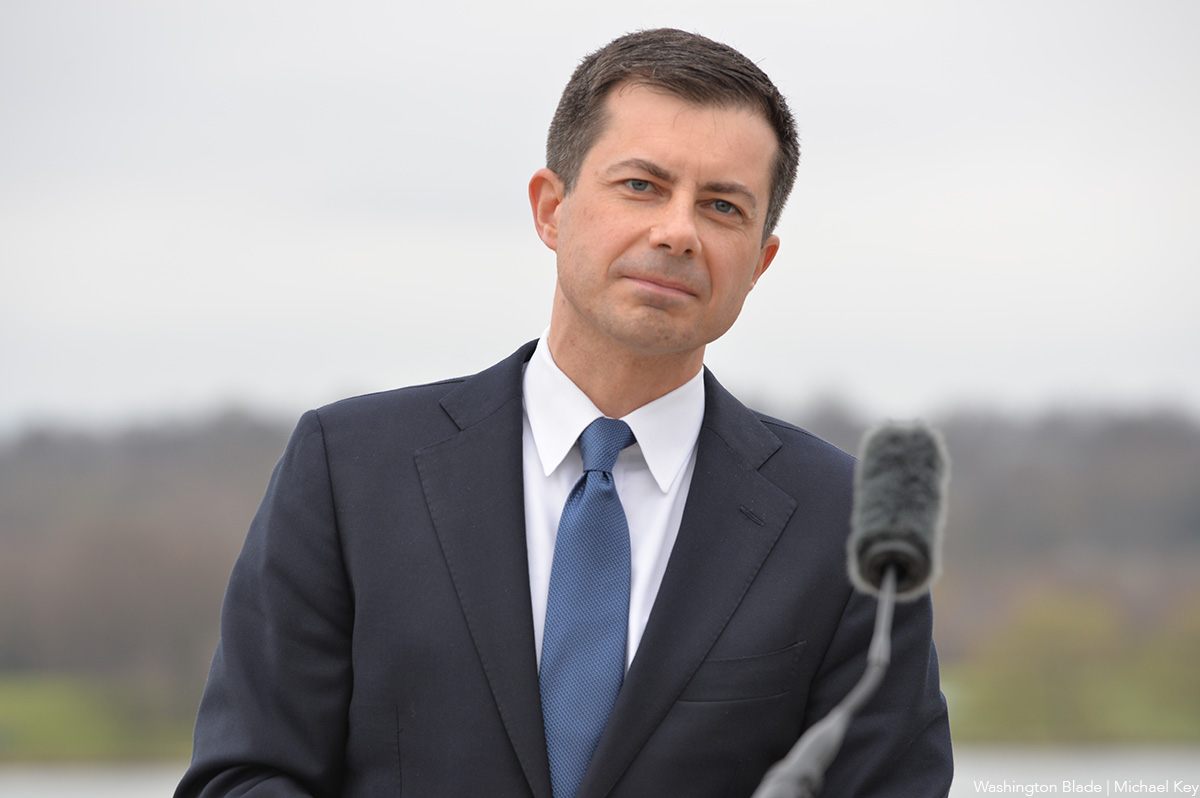
An Indiana prosecutor has declined to file criminal charges against a woman who made a false child welfare complaint against Pete Buttigieg.
Buttigieg, the former transportation secretary in the Biden-Harris administration, was accused in June of posing a threat to his children via an anonymous call to police that resulted in him being temporarily separated from his four-year-old twins.
Marshall County Prosecuting Attorney E. Nelson Chipman Jr. opted not to pursue charges against the Alabama woman who filed the false child welfare claim against the Democratic political figure while she was in Marshall County.
According to ABC 57, the television station in South Bend that published a letter from Michigan State Police to Indiana State Police, the 50-year-old woman, identified only as TJ of Alabama, was responsible for the “brief and intrusive investigation” into Buttigieg and his family.
In the letter to Indiana State Police, Michigan State Police described TJ’s documented alcoholism and other chemical dependencies, as well as hallucinations and delusional thinking. The prosecutor also noted that TJ has self-identified as God and claims to hear voices only she can hear.
The letter from Michigan State Police to Indiana State Police states:
“Your investigation reveals that TJ, 50 years old, has a documented history of alcohol abuse and has experienced numerous treatment facilities and programs for alcoholism and other chemical dependency over the years. Further, TJ has a long history of mental illness, manifested by hallucinations and delusional thinking which includes frequently responding to voices only she hears and grandiose ideation including self-identifying as God. She frequently reports she has enjoyed an evening meal with Barack and Michele Obama.
TJ is from Alabama. During her relatively short stay here, TJ was able to generate three separate police encounters that resulted in reports, one of which resulted in TJ’s arrest for domestic battery. I note her BAC in that case was reported at .323. I also note one of the three early reports was based upon TJ’s claim of herself being a victim of sexual abuse at the age of 3 by her mother some 47 years prior. Her explanation for such a delayed report was incoherent.
As you found out, TJ returned to Alabama and took up residence in a treatment facility only to be soon evicted for a rule violation. She currently resides in a half-way house near Alabama, with very limited mental health treatment options available. I note TJ’s abusive and harassing attitude has resulted in restricting only somewhat her access to a telephone, and that she continues to have access to computers at the facility. Obviously she may still have the ability to file additional complaints. No doubt a regrettable situation.
In light of the totality of circumstances, I am unable to conclude that TJ is capable of forming the requisite intent to support a criminal conviction for this offense. Accordingly, this office will not be filing a criminal case in this matter.
Thank you, as always, for a thorough investigation and cogent report.
Stay safe.
Best regards,
E. Nelson Chipman, Jr.
Marshall County Prosecuting Attorney”
When the situation first arose in June, Buttigieg opened up about the experience via his Substack, where he described the situation as one of the worst things that has ever happened to his family — one that resulted in him being separated from his twins, Joseph August “Gus” and Penelope Rose, for their safety.
“The caller said that he had spoken to a woman who claimed to have met me at a conference several years ago in Alabama, where she said I told her that I had committed unspeakable violent crimes, and the caller believed my children were still at risk,” Buttigieg wrote in a post he titled “A Terrible Thing Happened to My Family.” “I am a reasonable man. I try to keep as calm and low-key as possible. But I cannot describe the mix of rage and sadness that I feel at the idea that someone brought our children into this.”
A Buttigieg spokesman declined to comment on the prosecutor’s decision not to pursue charges, but did tell the Washington Post in a statement: “This has been a painful and infuriating situation for the family. They are in touch with Michigan authorities, seeking answers and accountability for what happened.”
In response to the story Buttigieg shared on his Substack, Kelley Robinson, president of the Human Rights Campaign, released the following statement:
“I know how I would feel if someone tried to come between me and my kids. This is truly bottom-of-the-barrel stuff. It takes an awful, hateful person to question someone’s fitness as a parent just because of who they are, who they love, or in Sec. Buttigieg’s case, perhaps even who he speaks out against politically. We’re thinking of Pete, Chasten, and their whole family in this moment — and we aren’t resting until all LGBTQ+ families have the kind of safety and justice every one of us deserves.”
The Washington Blade reached out to Michigan State Police after the story initially broke to ask if any disciplinary action would be imposed on the woman who made the false report, but was told to file a FOIA request to view the full report. After filing a FOIA request, the Blade was denied access to any additional information.
2026 Midterm Elections
Chris Pappas wins NH Democratic Senate primary
Gay congressman running to succeed retiring U.S. Sen. Jeanne Shaheen

New Hampshire Congressman Chris Pappas on Tuesday won the Democratic primary in the race to succeed retiring U.S. Sen. Jeanne Shaheen (D-N.H.) in the U.S. Senate.
Pappas defeated Karishma Manzur, who was his primary challenger, by a 61.8-36.1 percent margin.
The gay congressman will face off against former U.S. Sen. John E. Sununu, who defeated former U.S. Sen. Scott Brown in the Republican primary.
“Tonight’s victory sends a clear message that voters are looking for leaders who will fight for their rights, their freedoms, and to be treated with dignity and respect,” said Human Rights Campaign President Kelley Robinson in a statement.
She campaigned for Pappas in Manchester, New Hampshire’s largest city, on Aug. 30.
“Chris Pappas has delivered results, stood up for equality, and showed up for the people he serves,” said Robinson in her statement. “HRC was proud to mobilize Equality Voters across New Hampshire to help power this win. We don’t have a second to waste between now and November. We look forward to continuing our work with Rep. Pappas as he drives toward victory in November so he can help return a pro-equality majority to the United States Senate.”
A poll the University of New Hampshire Survey Center released on Aug. 26 showed Sununu ahead of Pappas by a 45-43 percent margin if they were to face off in the general election. The margin of error is +/-2.1 percent.
Pappas would become the first openly gay man elected to the U.S. Senate if he were to win in November.

Trump’s Cabinet: Dumb, dumber, dumbest, and evil

D.C.’s fall theater season is already well underway

More than 150 people detained outside Istanbul courthouse

Gay man sues Delaware AG for not prosecuting partner in domestic violence case

Virginia Anti-Violence Project struggles to fill federal funding gaps

‘Thelma and Louise’ remains landmark of unspoken queer rebellion

Dolly Parton biography puts her hardships into context

PHOTOS: SMYAL Fall Brunch

Fashion icon Bob Mackie dead at 87