Arts & Entertainment
Broadway at the beach
Clear Space provides theater fix for Rehoboth visitors all summer
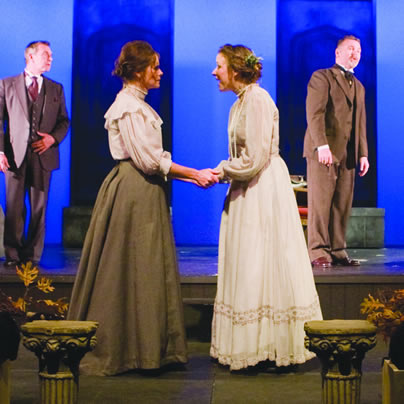
Rehoboth Clear Space Theatre
20 Baltimore Ave.
Rehoboth Beach, Del.
Show times depend on the week
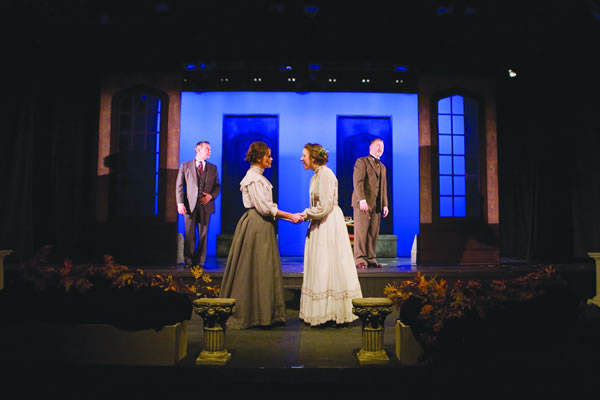
A scene from one of last year’s plays at Rehoboth Clear Space Theatre. (Photos courtesy the theater)
General admission is $30, senior citizens are $25 and students are $15
For many theaters, summer is the slowest time of year as families escape the city heat for the cooler shore. But for Clear Space Theatre in Rehoboth Beach, the influx of tourists keeps the theater teeming with people finding alternative ways to spend a summer night at the beach.
The theater gets so busy that this year its management is running three different shows at once in rotation. This year’s shows, which each cost between $8,000 and $25,000 to produce, include, “Cabaret,” “Broadway at the Beach” and “Annie.”
“Our seasons tend to appeal to a variety of tastes,” says Doug Yetter, founder and musical director. “For the summer season, we offer a family musical (“Annie”), a more adult-themed show (“Cabaret”) and a revue show that bridges the gap.”
“Annie,” opened June 30 and is the famous musical about a little orphan girl who goes on adventures in her orphanage and eventually around New York City, ingratiating herself with the president and finding a home in the Warbucks’ mansion.
“Cabaret” opened June 28 and is the more mature show being performed at Clear Space. Taking place in the Kit Kat Klub in Nazi Germany, American writer Cliff falls for a Klub performer named Sally Bowles. The play observes how they try to make their love survive in a changing world.
“Broadway at the Beach” opened this week and brings several Broadway hit songs to the shores of Delaware.
All shows run until September with “Broadway at the Beach” closing the season on Sept. 2.
Despite the schedule — each show is performed at least once a week — changing sets hasn’t been a problem.
“When my former partner and I were thinking to move down here, we thought we need to clear some space,” Yetter says. “We don’t need great sets for this; we let the audience bring their imagination.”
Yetter and his former partner co-founded Clear Space Theatre when they moved to Rehoboth Beach from New York City in 2004. Yetter says they thought the community would “benefit both culturally and economically from having a year-round theater.”
Yetter had about 40 years of musical theater experience, putting on productions all over the country. At Clear Space he works largely as artistic and musical director, overseeing all productions.
Since there’s not a strong emphasis on the sets for these shows, the costumes and characters have to carry the productions. Bill Clark, the full-time costume designer, immerses himself in the various stories to dress the cast appropriately.
“When we choose the shows we’re going to do three months out from our first creative meeting, I read the scripts three times,” he says. “Then I create a costume plot, detailed scenes that serve as a map, and from there I sketch individual costumes.”
For Clark’s favorite costumes in “Cabaret,” he began studying the culture in Berlin from 1925 onward. He also studied the works by Christopher Isherwood, a gay novelist from the 1930s, who wrote the original story upon which “Cabaret” is based, trying to reflect its dark tones in the clothes the Kit Kat Klub girls don.
“I’ve put the girls in some vintage lingerie from that era with a corset pattern,” he says.
Compared to other renditions of “Cabaret,” director Dorothy Neuman says her version may appear darker.
“It’s very topical,” she says. “A force in the government, the Nazis who are coming to power, have certain prejudices in society. They consider that they have the right answer. I feel this is a very parallel situation in America, a very strong conservative right in which they think they know what is morally right and if you don’t agree with them then you are not American.”
Neuman, who identifies as a “woman who happens to be gay,” has been directing theater since 1978, starting in various places in Arlington, Va., and Washington.
Michael Matthias, who is acting in all three productions, says that he’s looking forward to “Cabaret” mostly because of its darker overtones. He also says staging three shows is made easier because they are working with mostly the same company all year round.
“We are considered a professional theater because we have a year-round theater company,” he says. “The theater holds auditions for roles not filled by the company.”
As part of the company, he’s expected to continue his growth as an actor by attending classes. This season, he plays Rooster Hannigan in “Annie,” he’s part of the ensemble in “Broadway at the Beach” and also Cliff in “Cabaret.”
Chris Poeschl, an actor brought in for the summer, says Clear Space Theatre is different from most venues where he’s performed.
“It’s such an intimate experience, when we are out on the stage we are in the audience,” he says.
Poeschl is in the ensemble for “Broadway at the Beach,” but is excited for all three productions. None of the plays are LGBT-specific, though “Cabaret,” of course, has long been a gay favorite.
“‘Cabaret’ in our theater is handled very maturely, very real,” he says. “It’s a reliable description.”
Because of the large LGBT population in Rehoboth, Yetter says he makes it a point to include shows with gay appeal.
“We really serve the community,” he says. “It’s important that we have pieces that are inclusive.”
Bob Hoffer and Max Dick, who have been attending performances at Clear Space for the past five years, say the small, tight-knit community of the theater draws in many Rehoboth gay residents and visitors.
“There are a lot of gay and lesbian people involved in the theater,” Hoffer says. “Often you will run into a lot of cast members in the restaurants and bars around the theater. Going to the theater gives you a kind of perk in your day.”




Sports
Jason Collins dies at 47
First openly gay man to actively play for major sports team battled brain cancer
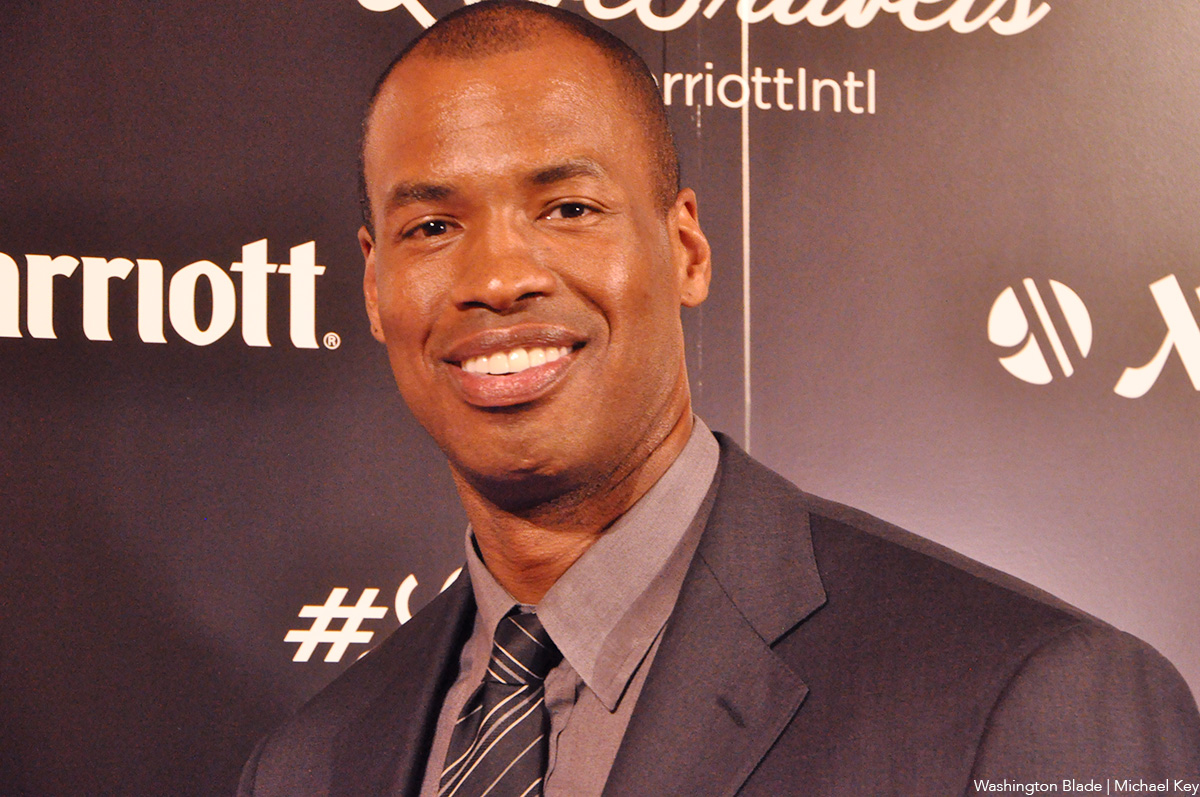
Jason Collins, the first openly gay man to actively play for a major professional sports team, died on Tuesday after a battle with brain cancer. He was 47.
The California native had briefly played for the Washington Wizards in 2013 before coming out in a Sports Illustrated op-ed.
Collins in 2014 became the first openly gay man to play in a game for a major American professional sports league when he played 11 minutes during a Brooklyn Nets game. He wore jersey number 98 in honor of Matthew Shepard, a gay college student murdered outside of Laramie, Wyo., in 1998.
Collins told the Washington Blade in 2014 that his life was “exponentially better” since he came out. Collins the same year retired from the National Basketball Association after 13 seasons.
Collins married his husband, Brunson Green, in May 2025.
The NBA last September announced Collins had begun treatment for a brain tumor. Collins on Dec. 11, 2025, announced he had Stage 4 glioblastoma.
“We are heartbroken to share that Jason Collins, our beloved husband, son, brother and uncle, has died after a valiant fight with glioblastoma,” said Collins’s family in a statement the NBA released. “Jason changed lives in unexpected ways and was an inspiration to all who knew him and to those who admired him from afar. We are grateful for the outpouring of love and prayers over the past eight months and for the exceptional medical care Jason received from his doctors and nurses. Our family will miss him dearly.”
NBA Commissioner Adam Silver said Collins’s “impact and influence extended far beyond basketball as he helped make the NBA, WNBA, and larger sports community more inclusive and welcoming for future generations.”
“He exemplified outstanding leadership and professionalism throughout his 13-year NBA career and in his dedicated work as an NBA Cares Ambassador,” said Silver. “Jason will be remembered not only for breaking barriers, but also for the kindness and humanity that defined his life and touched so many others.”
“To call Jason Collins a groundbreaking figure for our community is simply inadequate. We truly lost a giant today,” added Human Rights Campaign President Kelley Robinson in a statement. “He came out as gay — while still playing — at a time when men’s athletes simply did not do that. But as he powerfully demonstrated in his final years in the league and his post-NBA career, stepping forward as he did boldly changed the conversation.”
“He was and will always be a legend for the LGBTQ+ community, and we are heartbroken to hear of his passing at the young age of 47,” she said. “Our hearts go out to his family and loved ones. We will keep fighting on in his honor until the day everyone can be who they are on their terms.”
The Washington Blade will update this article with additional reaction when it becomes available.

Glitterati Productions held the “Studio 69” party at Bunker on Friday, May 8.
(Washington Blade photos by Michael Key)


Arts & Entertainment
Washington Blade’s Pride on the Pier returns June 13 to kick off D.C. Pride week
Pride on the Pier officially launches Pride Week in D.C.

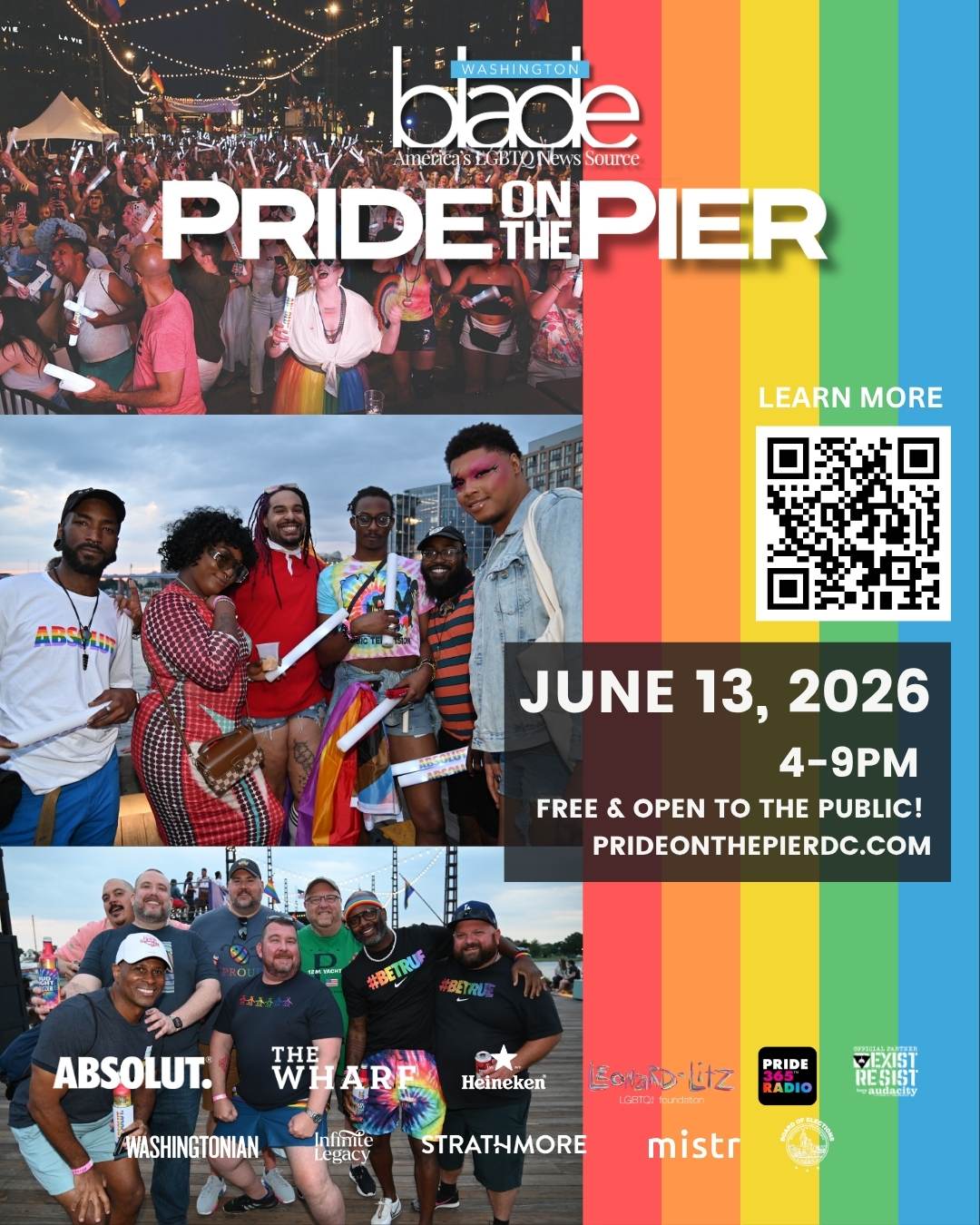
The Washington Blade’s annual Pride on the Pier celebration returns to The Wharf on Saturday, June 13, 2026 from 4-9 p.m., bringing thousands of LGBTQ community members and allies together for an unforgettable waterfront celebration to kick off Pride week in Washington, D.C.
Now in its eighth year, Washington Blade Pride on the Pier extends the city’s annual celebration of LGBTQ visibility to the bustling Wharf waterfront with an exciting array of activities and entertainment for all ages. The District Pier will offer DJs, dancing, drag, and other entertainment. Alcoholic beverages will be available for purchase for those 21 and older.
“Pride on the Pier has become one of the signature moments of Pride in D.C.,” said Lynne Brown, publisher of the Washington Blade. “There’s nothing like watching our community come together on the waterfront with live music and incredible energy as we kick off Pride week.”
Pride on the Pier is free and open to the public, with VIP tickets available for exclusive pier access to the Dockmaster Building. To purchase VIP tickets visit www.prideonthepierdc.com/vip.
Additional entertainment announcements, sponsor activations, and event details will be released in the coming weeks.
Event Details:
📍 Location: District Pier at The Wharf (101 District Sq SW, Washington, DC)
📅 Dates: Friday, 13, 2026
⏱️ 4-9PM
🎟️ VIP Tickets: www.PrideOnThePierDC.com/VIP

Jason Collins dies at 47

Polish government to recognize same-sex marriages from EU countries

America’s broken pipeline of mental healthcare for trans youth

GLAA releases ratings for 18 candidates running for D.C. mayor, Council, AG

Blade finalist for D.C. Society of Professional Journalists awards

Maren Morris to headline Capital Pride Concert

Va. Supreme Court invalidates Democrat-backed redistricting plan

Celebrate Pride in Lost River, a slice of rural heaven

Learn more about queer love